Abu Bashar
    It involves assignment of people to projects,
    jobs to machines, workers to jobs and teachers
    to classes etc., while minimizing the total
    assignment costs.
   One of the important characteristics of
    assignment problem is that only one job (or
    worker) is assigned to one machine (or project).
   An assignment problem is a special type of linear
    programming problem where the objective is to
    minimize the cost or time of completing a
    number of jobs by a number of persons.
   This method was developed by D. Konig, a
    Hungarian mathematician and is therefore
    known as the Hungarian method of
    assignment problem.
    In order to use this method, one needs to
    know only the cost of making all the possible
    assignments.
   Each assignment problem has a matrix (table)
    associated with it. Normally, the objects (or
    people) one wishes to assign are expressed in
    rows, whereas the columns represent the
    tasks (or things) assigned to them.
   The number in the table would then be the
    costs associated with each particular
    assignment.
   Though       assignment      problem     finds
    applicability in various diverse business
    situations, we discuss some of its main
    application areas:
   In assigning machines to factory orders.
   In assigning sales/marketing people to sales
    territories.
   In assigning contracts to bidders by
    systematic bid-evaluation.
   In assigning teachers to classes.
   In assigning accountants to accounts of the
    clients.
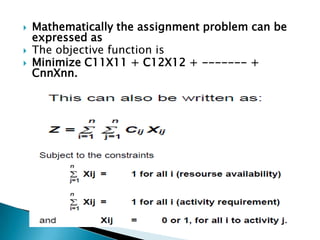
   Mathematically the assignment problem can be
    expressed as
   The objective function is
   Minimize C11X11 + C12X12 + ------- +
    CnnXnn.
   Step 1. Determine the cost table from the given
    problem.
   (i) If the no. of sources is equal to no. of
    destinations, go to step 3.
   (ii) If the no. of sources is not equal to the no.
    of destination, go to step2.
   Step 2. Add a dummy source or dummy
    destination, so that the cost table becomes a
    square matrix. The cost entries of the dummy
    source/destinations are always zero.
   Step 3. Locate the smallest element in each row
    of the given cost matrix and then subtract the
    same from each element of the row.
   Step 4. In the reduced matrix obtained in the step 3,
    locate the smallest element of each column and then
    subtract the same from each element of that column.
    Each column and row now have at least one zero.
   Step 5. In the modified matrix obtained in the step 4,
    search for the optimal assignment as follows:
   (a) Examine the rows successively until a row with a
    single zero is found. Enrectangle this row ( )and cross
    off (X) all other zeros in its column. Continue in this
    manner until all the rows have been taken care of.
   (b) Repeat the procedure for each column of the
    reduced matrix.
   (c) If a row and/or column has two or more zeros and
    one cannot be chosen by inspection then assign
    arbitrary any one of these zeros and cross off all other
    zeros of that row / column.
   (d) Repeat (a) through (c) above successively until the
    chain of assigning ( ) or cross (X) ends.
   Step 6. If the number of assignment (􀀀 ) is equal
    to n (the order of the cost matrix), an optimum
    solution is reached.
   If the number of assignment is less than n(the
    order of the matrix), go to the next step.
   Step7. Draw the minimum number of horizontal
    and/or vertical lines to cover all the zeros of the
    reduced matrix.
   Step 8. Develop the new revised cost matrix as
    follows:
   (a)Find the smallest element of the reduced matrix
    not covered by any of the lines.
   (b)Subtract this element from all uncovered
    elements and add the same to all the elements
    laying at the intersection of any two lines.
   Step 9. Go to step 6 and repeat the procedure until
    an optimum solution is attained.
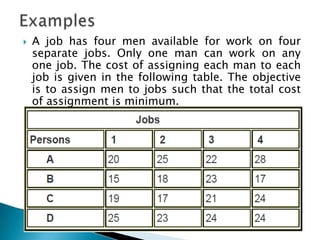
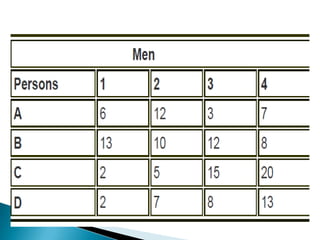
   A job has four men available for work on four
    separate jobs. Only one man can work on any
    one job. The cost of assigning each man to each
    job is given in the following table. The objective
    is to assign men to jobs such that the total cost
    of assignment is minimum.
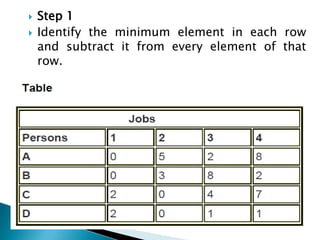
   Step 1
   Identify the minimum element in each row
    and subtract it from every element of that
    row.
   Step 2
   Identify the minimum element in each column
    and subtract it from every element of that
    column.
   Make the assignment for the reduced matrix
    obtain from steps 1 and 2 in the following
    way:
   Draw the minimum number of vertical and
    horizontal lines necessary to cover all the
    zeros in the reduced matrix obtained from
    last step
   Select the smallest element from all the
    uncovered elements. Subtract this smallest
    element from all the uncovered elements and
    add it to the elements, which lie at the
    intersection of two lines. Thus, we obtain
    another reduced matrix for fresh assignment.
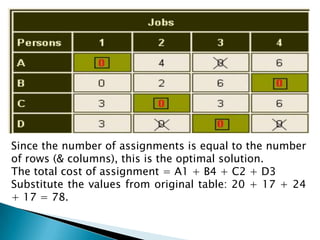
Since the number of assignments is equal to the number
of rows (& columns), this is the optimal solution.
The total cost of assignment = A1 + B4 + C2 + D3
Substitute the values from original table: 20 + 17 + 24
+ 17 = 78.
   Some       assignment     problems       entail
    maximizing the profit, effectiveness, or layoff
    of an assignment of persons to tasks or of
    jobs to machines.
   The     conversion   is    accomplished     by
    subtracting all the elements of the given
    effectiveness matrix from the highest
    element.
   It turns out that minimizing opportunity loss
    produces the same assignment solution as
    the original maximization problem.
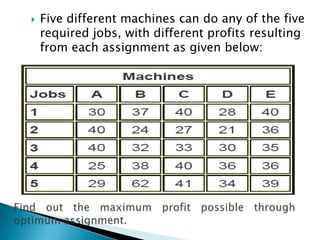
   Five different machines can do any of the five
    required jobs, with different profits resulting
    from each assignment as given below:
   Here, the highest element is 62. So we
    subtract each value from 62.


The maximum profit through this
assignment is 214.
   It is an assignment problem where the
    number of persons is not equal to the
    number of jobs.
   If the number of persons is less than the
    number of jobs then we introduce one or
    more dummy persons (rows) with zero values
    to make the assignment problem balanced.
   Likewise, if the number of jobs is less than
    the number of persons then we introduce one
    or more dummy jobs (columns) with zero
    values to make the assignment problem
    balanced
Assignment problem
Assignment problem
Assignment problem

Assignment problem

  • 1.
  • 2.
    It involves assignment of people to projects, jobs to machines, workers to jobs and teachers to classes etc., while minimizing the total assignment costs.  One of the important characteristics of assignment problem is that only one job (or worker) is assigned to one machine (or project).  An assignment problem is a special type of linear programming problem where the objective is to minimize the cost or time of completing a number of jobs by a number of persons.
  • 3.
    This method was developed by D. Konig, a Hungarian mathematician and is therefore known as the Hungarian method of assignment problem.  In order to use this method, one needs to know only the cost of making all the possible assignments.  Each assignment problem has a matrix (table) associated with it. Normally, the objects (or people) one wishes to assign are expressed in rows, whereas the columns represent the tasks (or things) assigned to them.  The number in the table would then be the costs associated with each particular assignment.
  • 4.
    Though assignment problem finds applicability in various diverse business situations, we discuss some of its main application areas:  In assigning machines to factory orders.  In assigning sales/marketing people to sales territories.  In assigning contracts to bidders by systematic bid-evaluation.  In assigning teachers to classes.  In assigning accountants to accounts of the clients.
  • 6.
    Mathematically the assignment problem can be expressed as  The objective function is  Minimize C11X11 + C12X12 + ------- + CnnXnn.
  • 7.
    Step 1. Determine the cost table from the given problem.  (i) If the no. of sources is equal to no. of destinations, go to step 3.  (ii) If the no. of sources is not equal to the no. of destination, go to step2.  Step 2. Add a dummy source or dummy destination, so that the cost table becomes a square matrix. The cost entries of the dummy source/destinations are always zero.  Step 3. Locate the smallest element in each row of the given cost matrix and then subtract the same from each element of the row.
  • 8.
    Step 4. In the reduced matrix obtained in the step 3, locate the smallest element of each column and then subtract the same from each element of that column. Each column and row now have at least one zero.  Step 5. In the modified matrix obtained in the step 4, search for the optimal assignment as follows:  (a) Examine the rows successively until a row with a single zero is found. Enrectangle this row ( )and cross off (X) all other zeros in its column. Continue in this manner until all the rows have been taken care of.  (b) Repeat the procedure for each column of the reduced matrix.  (c) If a row and/or column has two or more zeros and one cannot be chosen by inspection then assign arbitrary any one of these zeros and cross off all other zeros of that row / column.  (d) Repeat (a) through (c) above successively until the chain of assigning ( ) or cross (X) ends.
  • 9.
    Step 6. If the number of assignment (􀀀 ) is equal to n (the order of the cost matrix), an optimum solution is reached.  If the number of assignment is less than n(the order of the matrix), go to the next step.  Step7. Draw the minimum number of horizontal and/or vertical lines to cover all the zeros of the reduced matrix.  Step 8. Develop the new revised cost matrix as follows:  (a)Find the smallest element of the reduced matrix not covered by any of the lines.  (b)Subtract this element from all uncovered elements and add the same to all the elements laying at the intersection of any two lines.  Step 9. Go to step 6 and repeat the procedure until an optimum solution is attained.
  • 10.
    A job has four men available for work on four separate jobs. Only one man can work on any one job. The cost of assigning each man to each job is given in the following table. The objective is to assign men to jobs such that the total cost of assignment is minimum.
  • 11.
    Step 1  Identify the minimum element in each row and subtract it from every element of that row.
  • 12.
    Step 2  Identify the minimum element in each column and subtract it from every element of that column.
  • 13.
    Make the assignment for the reduced matrix obtain from steps 1 and 2 in the following way:
  • 14.
    Draw the minimum number of vertical and horizontal lines necessary to cover all the zeros in the reduced matrix obtained from last step
  • 15.
    Select the smallest element from all the uncovered elements. Subtract this smallest element from all the uncovered elements and add it to the elements, which lie at the intersection of two lines. Thus, we obtain another reduced matrix for fresh assignment.
  • 16.
    Since the numberof assignments is equal to the number of rows (& columns), this is the optimal solution. The total cost of assignment = A1 + B4 + C2 + D3 Substitute the values from original table: 20 + 17 + 24 + 17 = 78.
  • 19.
    Some assignment problems entail maximizing the profit, effectiveness, or layoff of an assignment of persons to tasks or of jobs to machines.  The conversion is accomplished by subtracting all the elements of the given effectiveness matrix from the highest element.  It turns out that minimizing opportunity loss produces the same assignment solution as the original maximization problem.
  • 20.
    Five different machines can do any of the five required jobs, with different profits resulting from each assignment as given below:
  • 21.
    Here, the highest element is 62. So we subtract each value from 62. The maximum profit through this assignment is 214.
  • 23.
    It is an assignment problem where the number of persons is not equal to the number of jobs.  If the number of persons is less than the number of jobs then we introduce one or more dummy persons (rows) with zero values to make the assignment problem balanced.  Likewise, if the number of jobs is less than the number of persons then we introduce one or more dummy jobs (columns) with zero values to make the assignment problem balanced