INTRODUCTION TO
OPERATIONS RESEARCH
D Victorseelan,. MSc.,Mphil.,
Nehru College of Management
INTRODUCTION
Operational Research is a systematic and analytical
approach to decision making and problem solving.
O.R. is an Branch of applied mathematics that uses
techniques and statistics to arrive at Optimal solutions to

solve complex problems.
It is typically concerned with determining the
maximum profit, sale, output, crops yield and efficiency
And minimum losses, risks, cost, and time of some objective
function.
Some of the PRIMARY TOOLS used by operation
researchers are-
STATISTICS
GAME THEORY
PROBABILITY THEORY, etc.
Define OR ?
Operations Research is the application of
analytical methods designed to help the
decision makers choose between
various courses of action available to
accomplish specified objectives
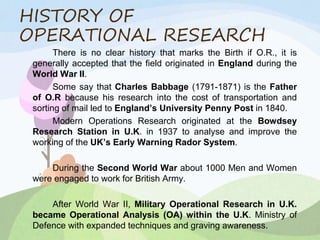
HISTORY OF
OPERATIONAL RESEARCH
There is no clear history that marks the Birth if O.R., it is
generally accepted that the field originated in England during the
World War II.
Some say that Charles Babbage (1791-1871) is the Father
of O.R because his research into the cost of transportation and
sorting of mail led to England’s University Penny Post in 1840.
Modern Operations Research originated at the Bowdsey
Research Station in U.K. in 1937 to analyse and improve the
working of the UK’s Early Warning Rador System.
During the Second World War about 1000 Men and Women
were engaged to work for British Army.
After World War II, Military Operational Research in U.K.
became Operational Analysis (OA) within the U.K. Ministry of
Defence with expanded techniques and graving awareness.
OPERATIONAL RESEARCH
IN INDIA
The Operational Research Society of India was
founded in 1957 to provide a forum for the
Operational Research Scientists as well as an avenue to
widen their horizon by exchange of knowledge and
application of techniques from outside the country. The
Society is affiliated to the International Federation of
Operational Research Societies (IFORS).
The Headquarters of the Society is located
in Kolkata at 39, Mahanirvan Road, Kolkata 700029,
India. At present the Society has 12 Operating
Chapters located in Agra, Ahmedabad, Ajmer,
Bangalore, Chennai, Delhi, Durgapur,
Jamshedpur, Kolkata, Madurai, Mumbai and Tirupati.
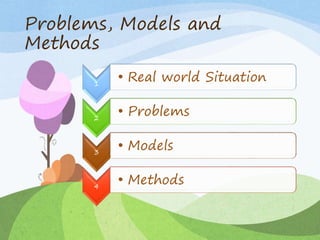
Problems, Models and
Methods
1
• Real world Situation
2
• Problems
3
• Models
4
• Methods
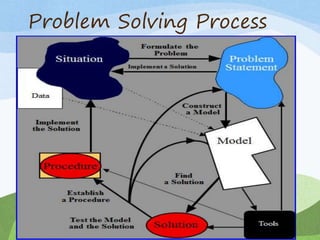
Problem Solving Process
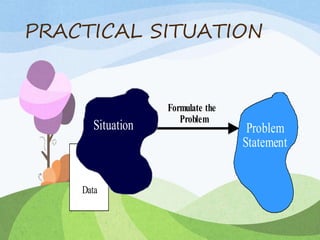
PRACTICAL SITUATION
Formulate the
Problem
Problem
Statement
Data
Situation
Constructing a Model
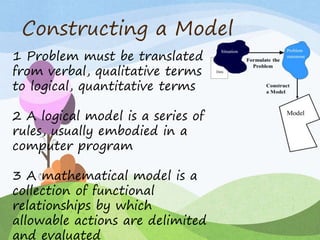
1 Problem must be translated
from verbal, qualitative terms
to logical, quantitative terms
2 A logical model is a series of
rules, usually embodied in a
computer program
3 A mathematical model is a
collection of functional
relationships by which
allowable actions are delimited
and evaluated
Solving the Mathematical Model
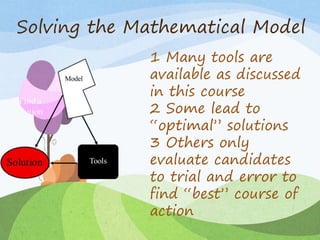
1 Many tools are
available as discussed
in this course
2 Some lead to
“optimal” solutions
3 Others only
evaluate candidates
to trial and error to
find “best” course of
action
Implementation
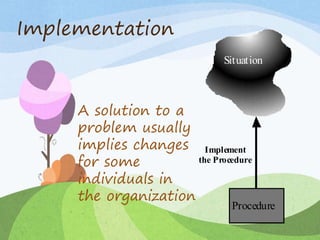
Situation
Procedure
Implement
the Procedure
A solution to a
problem usually
implies changes
for some
individuals in
the organization
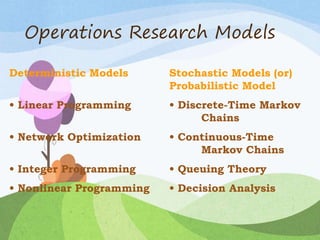
Operations Research Models
Deterministic Models Stochastic Models (or)
Probabilistic Model
• Linear Programming • Discrete-Time Markov
Chains
• Network Optimization • Continuous-Time
Markov Chains
• Integer Programming • Queuing Theory
• Nonlinear Programming • Decision Analysis
SCOPE
Different fields
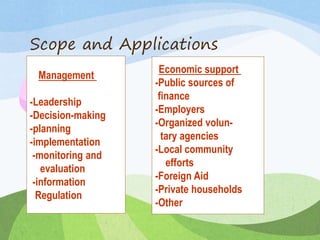
Scope and Applications
Management
-Leadership
-Decision-making
-planning
-implementation
-monitoring and
evaluation
-information
Regulation
Economic support
-Public sources of
finance
-Employers
-Organized volun-
tary agencies
-Local community
efforts
-Foreign Aid
-Private households
-Other
Introduction
to
Linear Programming
Problem
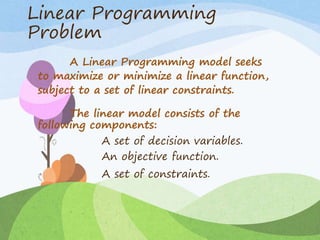
Linear Programming
Problem
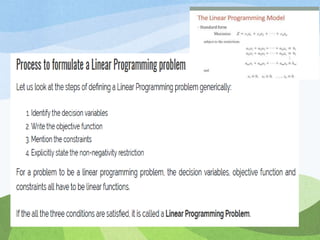
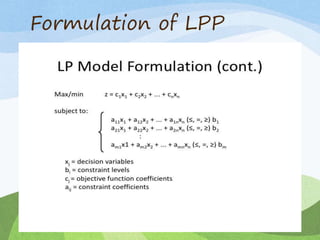
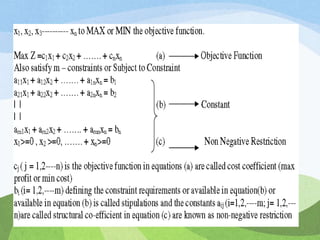
A Linear Programming model seeks
to maximize or minimize a linear function,
subject to a set of linear constraints.
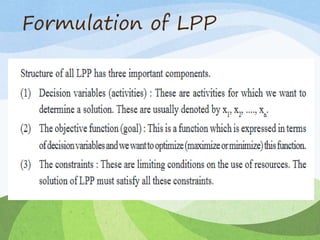
The linear model consists of the
following components:
A set of decision variables.
An objective function.
A set of constraints.
Formulation of LPP
Formulation of LPP
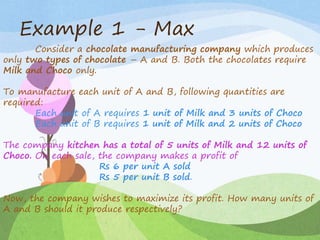
Example 1 - Max
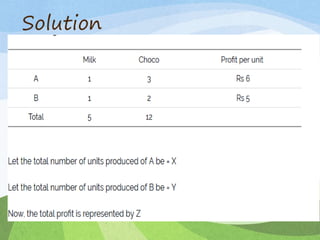
Consider a chocolate manufacturing company which produces
only two types of chocolate – A and B. Both the chocolates require
Milk and Choco only.
To manufacture each unit of A and B, following quantities are
required:
Each unit of A requires 1 unit of Milk and 3 units of Choco
Each unit of B requires 1 unit of Milk and 2 units of Choco
The company kitchen has a total of 5 units of Milk and 12 units of
Choco. On each sale, the company makes a profit of
Rs 6 per unit A sold
Rs 5 per unit B sold.
Now, the company wishes to maximize its profit. How many units of
A and B should it produce respectively?
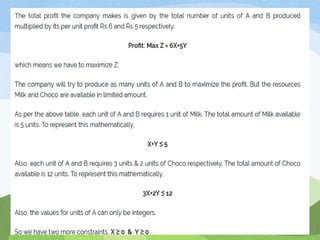
Solution
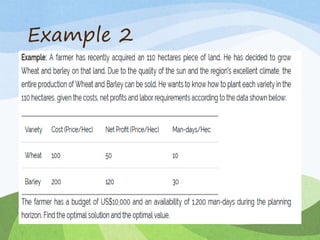
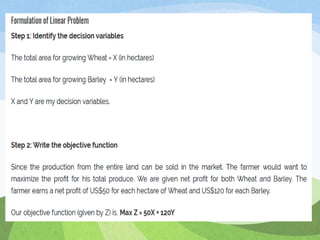
Example 2
Example
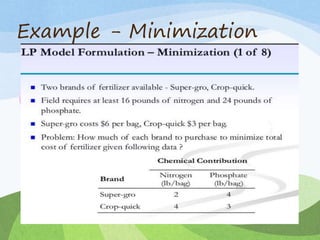
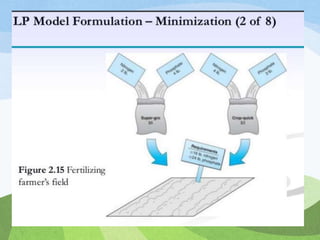
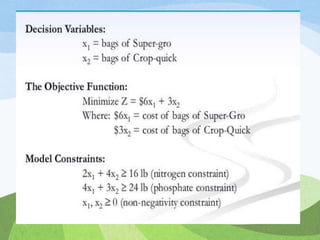
Example - Minimization
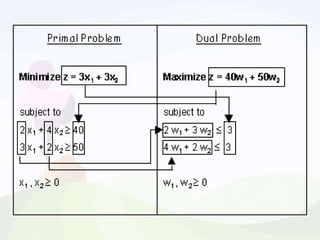
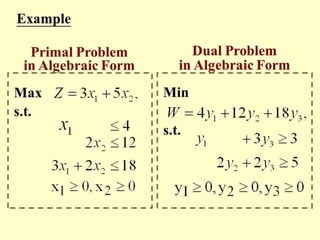
Primal and Dual
conversion
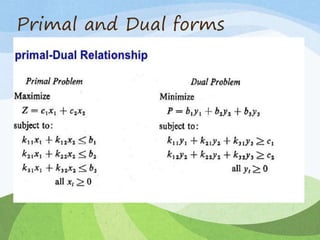
Primal and Dual forms
Introduction to Operations Research

Introduction to Operations Research

  • 1.
    INTRODUCTION TO OPERATIONS RESEARCH DVictorseelan,. MSc.,Mphil., Nehru College of Management
  • 2.
    INTRODUCTION Operational Research isa systematic and analytical approach to decision making and problem solving. O.R. is an Branch of applied mathematics that uses techniques and statistics to arrive at Optimal solutions to solve complex problems. It is typically concerned with determining the maximum profit, sale, output, crops yield and efficiency And minimum losses, risks, cost, and time of some objective function. Some of the PRIMARY TOOLS used by operation researchers are- STATISTICS GAME THEORY PROBABILITY THEORY, etc.
  • 3.
    Define OR ? OperationsResearch is the application of analytical methods designed to help the decision makers choose between various courses of action available to accomplish specified objectives
  • 4.
    HISTORY OF OPERATIONAL RESEARCH Thereis no clear history that marks the Birth if O.R., it is generally accepted that the field originated in England during the World War II. Some say that Charles Babbage (1791-1871) is the Father of O.R because his research into the cost of transportation and sorting of mail led to England’s University Penny Post in 1840. Modern Operations Research originated at the Bowdsey Research Station in U.K. in 1937 to analyse and improve the working of the UK’s Early Warning Rador System. During the Second World War about 1000 Men and Women were engaged to work for British Army. After World War II, Military Operational Research in U.K. became Operational Analysis (OA) within the U.K. Ministry of Defence with expanded techniques and graving awareness.
  • 5.
    OPERATIONAL RESEARCH IN INDIA TheOperational Research Society of India was founded in 1957 to provide a forum for the Operational Research Scientists as well as an avenue to widen their horizon by exchange of knowledge and application of techniques from outside the country. The Society is affiliated to the International Federation of Operational Research Societies (IFORS). The Headquarters of the Society is located in Kolkata at 39, Mahanirvan Road, Kolkata 700029, India. At present the Society has 12 Operating Chapters located in Agra, Ahmedabad, Ajmer, Bangalore, Chennai, Delhi, Durgapur, Jamshedpur, Kolkata, Madurai, Mumbai and Tirupati.
  • 6.
    Problems, Models and Methods 1 •Real world Situation 2 • Problems 3 • Models 4 • Methods
  • 7.
  • 8.
  • 9.
    Constructing a Model 1Problem must be translated from verbal, qualitative terms to logical, quantitative terms 2 A logical model is a series of rules, usually embodied in a computer program 3 A mathematical model is a collection of functional relationships by which allowable actions are delimited and evaluated
  • 10.
    Solving the MathematicalModel 1 Many tools are available as discussed in this course 2 Some lead to “optimal” solutions 3 Others only evaluate candidates to trial and error to find “best” course of action
  • 11.
    Implementation Situation Procedure Implement the Procedure A solutionto a problem usually implies changes for some individuals in the organization
  • 12.
    Operations Research Models DeterministicModels Stochastic Models (or) Probabilistic Model • Linear Programming • Discrete-Time Markov Chains • Network Optimization • Continuous-Time Markov Chains • Integer Programming • Queuing Theory • Nonlinear Programming • Decision Analysis
  • 13.
  • 14.
  • 15.
    Scope and Applications Management -Leadership -Decision-making -planning -implementation -monitoringand evaluation -information Regulation Economic support -Public sources of finance -Employers -Organized volun- tary agencies -Local community efforts -Foreign Aid -Private households -Other
  • 16.
  • 17.
    Linear Programming Problem A LinearProgramming model seeks to maximize or minimize a linear function, subject to a set of linear constraints. The linear model consists of the following components: A set of decision variables. An objective function. A set of constraints.
  • 19.
  • 20.
  • 22.
    Example 1 -Max Consider a chocolate manufacturing company which produces only two types of chocolate – A and B. Both the chocolates require Milk and Choco only. To manufacture each unit of A and B, following quantities are required: Each unit of A requires 1 unit of Milk and 3 units of Choco Each unit of B requires 1 unit of Milk and 2 units of Choco The company kitchen has a total of 5 units of Milk and 12 units of Choco. On each sale, the company makes a profit of Rs 6 per unit A sold Rs 5 per unit B sold. Now, the company wishes to maximize its profit. How many units of A and B should it produce respectively?
  • 23.
  • 25.
  • 29.
  • 35.
  • 38.
  • 40.