Evaluating Business Ethics 
Normative, Traditional and 
Contemporary Ethical Theories
What are normative ethical theories? 
• Ethical theories are the rules and principles 
that determine right and wrong for any given 
situation Crane and Matten (2010) 
• Normative ethical theories are those that 
propose to prescribe the morally correct way of 
acting
The role of ethical theory 
• Two extreme positions (De George 1999) 
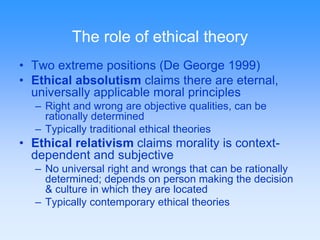
• Ethical absolutism claims there are eternal, 
universally applicable moral principles 
– Right and wrong are objective qualities, can be 
rationally determined 
– Typically traditional ethical theories 
• Ethical relativism claims morality is context-dependent 
and subjective 
– No universal right and wrongs that can be rationally 
determined; depends on person making the decision 
& culture in which they are located 
– Typically contemporary ethical theories
North American and European 
origins and differences 
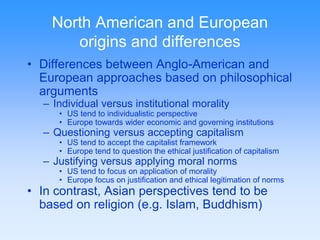
• Differences between Anglo-American and 
European approaches based on philosophical 
arguments 
– Individual versus institutional morality 
• US tend to individualistic perspective 
• Europe towards wider economic and governing institutions 
– Questioning versus accepting capitalism 
• US tend to accept the capitalist framework 
• Europe tend to question the ethical justification of capitalism 
– Justifying versus applying moral norms 
• US tend to focus on application of morality 
• Europe focus on justification and ethical legitimation of norms 
• In contrast, Asian perspectives tend to be 
based on religion (e.g. Islam, Buddhism)
Traditional ethical theories 
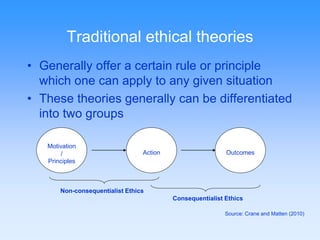
• Generally offer a certain rule or principle 
which one can apply to any given situation 
• These theories generally can be differentiated 
into two groups 
Source: Crane and Matten (2010) 
Motivation 
/ 
Principles 
Action Outcomes 
Consequentialist Ethics 
Non-consequentialist Ethics
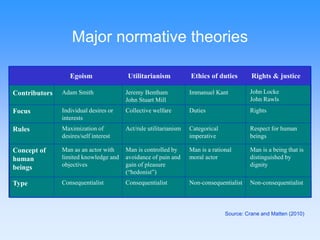
Major normative theories 
Egoism Utilitarianism Ethics of duties Rights & justice 
Man is a being that is 
distinguished by 
dignity 
Man is a rational 
moral actor 
Type Consequentialist Consequentialist Non-consequentialist Non-consequentialist 
Source: Crane and Matten (2010) 
Man is controlled by 
avoidance of pain and 
gain of pleasure 
(“hedonist”) 
Man as an actor with 
limited knowledge and 
objectives 
Concept of 
human 
beings 
Respect for human 
beings 
Categorical 
imperative 
Maximization of Act/rule utilitarianism 
desires/self interest 
Rules 
Individual desires or Collective welfare Duties Rights 
interests 
Focus 
John Locke 
John Rawls 
Jeremy Bentham Immanuel Kant 
John Stuart Mill 
Contributors Adam Smith
Egoism 
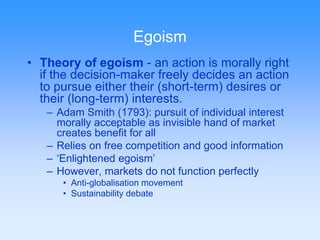
• Theory of egoism - an action is morally right 
if the decision-maker freely decides an action 
to pursue either their (short-term) desires or 
their (long-term) interests. 
– Adam Smith (1793): pursuit of individual interest 
morally acceptable as invisible hand of market 
creates benefit for all 
– Relies on free competition and good information 
– ‘Enlightened egoism’ 
– However, markets do not function perfectly 
• Anti-globalisation movement 
• Sustainability debate
Utilitarianism 
• According to utilitarianism, an action is 
morally right if it results in the greatest 
amount of good for the greatest number of 
people affected by the action 
– Also called the ‘greatest happiness principle’ 
– Based on cost-benefit analysis
Problems with Utilitarianism 
• Subjectivity 
– This has led to refinement of theory 
• Act utilitarianism 
• Rule utilitarianism 
• Issues around quantification and distribution 
of utility
Act- and Rule-Utilitarianism 
Act utilitarianism 
– Looks to single actions and bases the moral 
judgement on the amount of pleasure and the 
amount of pain this single action causes. 
Rule utilitarianism 
– looks at classes of action and ask whether the 
underlying principles of an action produce more 
pleasure than pain for society in the long run.
Ethics of duties 
‘Categorical Imperative’ (Kant) 
• Maxim 1: Consistency 
– Act only according to that maxim by which you can at the same 
time will that it should become a universal law. 
Maxim 2: Human Dignity 
– Act so that you treat humanity, whether in your own person or in 
that of another, always as an end and never as a means only. 
• Maxim 3: Universality 
– Act only so that the will through its maxims could regard itself at 
the same time as universally lawgiving (would others agree? 
Would you be happy to see your decision reported in the press?)
Problems with ethics of duties 
• Undervaluing outcomes 
• Complexity 
• Misplaced optimism?
Ethics of rights and justice 
Natural rights 
• Certain basic, important, unalienable entitlements 
that should be respected and protected in every 
single action. 
– Based on consensus about nature of human dignity 
– Strongly based in western view of morality 
Justice 
• The simultaneously fair treatment of individuals in a 
given situation with the result that everybody gets 
what they deserve 
– Fair procedures (procedural justice) 
– Fair outcomes (distributive justice)
John Rawls’s 
‘Theory of Justice’ 
1. Each person is to have an equal right to the 
most extensive total system of basic 
liberties compatible with a similar system of 
liberty for all. 
2. Social and economic inequalities are to be 
arranged so that they are both: 
a. to the greatest benefit of the least advantaged; 
b. attached to offices and positions open to all under 
conditions of fair equality of opportunity.
Limits of traditional theories 
• Too abstract 
• Too reductionist 
• Too objective and elitist 
• Too impersonal 
• Too rational and codified 
• Too imperialist
Alternative perspectives on ethical 
theory
Approaches based on character and 
integrity 
Virtue ethics 
• Contends that morally correct actions are those 
undertaken by actors with virtuous characters. 
Therefore, the formation of a virtuous character is the 
first step towards morally correct behaviour 
Acquired traits 
• Intellectual virtues 
• Moral virtues
Approaches based on ethics and 
responsibility 
Feminist ethics 
• An approach that prioritizes empathy, harmonious 
and healthy social relationships, care for one another, 
and avoidance of harm above abstract principles 
Key elements 
• Relationships 
– Decisions taken in context of personal human interrelations 
• Responsibility 
– Active ‘taking’ of responsibility, rather than merely ‘having’ it 
• Experience 
– Learn and develop from experience
Approaches based on procedures of 
norm generation 
Discourse ethics 
• Aims to solve ethical conflicts by providing a process 
of norm generation through rational reflection on the 
real-life experiences of all relevant participants 
Key elements 
• Ultimate goal of ethical issues in business should be 
the peaceful settlement of conflicts 
• Different parties in a conflict should sit together and 
engage in a discourse about the settlement of the 
conflict, and ultimately provide a situation that is 
acceptable to all 
• ‘ideal discourse’ criteria
Approaches based on empathy and 
moral impulse 
Postmodern ethics 
• An approach that locates morality beyond the sphere 
of rationality in an emotional ‘moral impulse’ towards 
others. It encourages individual actors to question 
everyday practices and rules, and to listen to and 
follow their emotions, inner convictions and ‘gut 
feelings’ about what they think is right and wrong in a 
particular incident of decision-making.
Postmodern business ethics 
• Postmodern business ethics emphasises 
(Gustafson, 2000:21) 
– Holistic approach 
– Examples rather than principles 
– ‘Think local, act local’ 
– Preliminary character
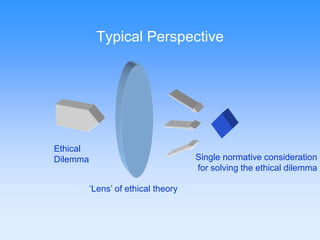
Typical Perspective 
Single normative consideration 
for solving the ethical dilemma 
Ethical 
Dilemma 
‘Lens’ of ethical theory
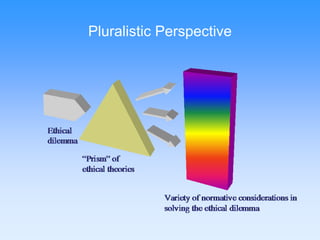
Pluralistic Perspective
Pluralism? 
Crane and Matten (2010) argue that for the 
practical purpose of making effective 
decisions in business: 
• Not suggest one theory or one approach as the best 
or true view of a moral dilemma 
• Suggest that all these theoretical approaches throw 
light from different angles on one and same problem 
• Complementary rather than mutually exclusive 
Advocate position of pluralism 
• Middle ground between absolutism and relativism
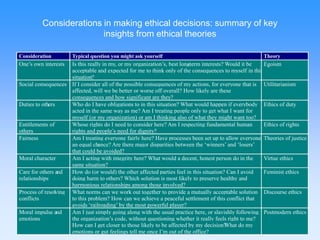
Considerations in making ethical decisions: summary of key 
insights from ethical theories 
Consideration Typical question you might ask yourself Theory 
One’s own interests Is this really in my, or my organization’s, best long-term interests? Would it be 
acceptable and expected for me to think only of the consequences to myself in this 
situation? 
Egoism 
Social consequences If I consider all of the possible consequences of my actions, for everyone that is 
affected, will we be better or worse off overall? How likely are these 
consequences and how significant are they? 
Utilitarianism 
Duties to others Who do I have obligations to in this situation? What would happen if everybody 
acted in the same way as me? Am I treating people only to get what I want for 
myself (or my organization) or am I thinking also of what they might want too? 
Ethics of duty 
Entitlements of 
others 
Whose rights do I need to consider here? Am I respecting fundamental human 
rights and people’s need for dignity? 
Ethics of rights 
Fairness Am I treating everyone fairly here? Have processes been set up to allow everyone 
an equal chance? Are there major disparities between the ‘winners’ and ‘losers’ 
that could be avoided? 
Theories of justice 
Moral character Am I acting with integrity here? What would a decent, honest person do in the 
same situation? 
Virtue ethics 
Care for others and 
relationships 
How do (or would) the other affected parties feel in this situation? Can I avoid 
doing harm to others? Which solution is most likely to preserve healthy and 
harmonious relationships among those involved? 
Feminist ethics 
Process of resolving 
conflicts 
What norms can we work out together to provide a mutually acceptable solution 
to this problem? How can we achieve a peaceful settlement of this conflict that 
avoids ‘railroading’ by the most powerful player? 
Discourse ethics 
Moral impulse and 
emotions 
Am I just simply going along with the usual practice here, or slavishly following 
the organization’s code, without questioning whether it really feels right to me? 
How can I get closer to those likely to be affected by my decision?W hat do my 
emotions or gut feelings tell me once I’m out of the office? 
Postmodern ethics

Ethics unit 3 pgdm 1st trisemester

  • 1.
    Evaluating Business Ethics Normative, Traditional and Contemporary Ethical Theories
  • 2.
    What are normativeethical theories? • Ethical theories are the rules and principles that determine right and wrong for any given situation Crane and Matten (2010) • Normative ethical theories are those that propose to prescribe the morally correct way of acting
  • 3.
    The role ofethical theory • Two extreme positions (De George 1999) • Ethical absolutism claims there are eternal, universally applicable moral principles – Right and wrong are objective qualities, can be rationally determined – Typically traditional ethical theories • Ethical relativism claims morality is context-dependent and subjective – No universal right and wrongs that can be rationally determined; depends on person making the decision & culture in which they are located – Typically contemporary ethical theories
  • 4.
    North American andEuropean origins and differences • Differences between Anglo-American and European approaches based on philosophical arguments – Individual versus institutional morality • US tend to individualistic perspective • Europe towards wider economic and governing institutions – Questioning versus accepting capitalism • US tend to accept the capitalist framework • Europe tend to question the ethical justification of capitalism – Justifying versus applying moral norms • US tend to focus on application of morality • Europe focus on justification and ethical legitimation of norms • In contrast, Asian perspectives tend to be based on religion (e.g. Islam, Buddhism)
  • 5.
    Traditional ethical theories • Generally offer a certain rule or principle which one can apply to any given situation • These theories generally can be differentiated into two groups Source: Crane and Matten (2010) Motivation / Principles Action Outcomes Consequentialist Ethics Non-consequentialist Ethics
  • 6.
    Major normative theories Egoism Utilitarianism Ethics of duties Rights & justice Man is a being that is distinguished by dignity Man is a rational moral actor Type Consequentialist Consequentialist Non-consequentialist Non-consequentialist Source: Crane and Matten (2010) Man is controlled by avoidance of pain and gain of pleasure (“hedonist”) Man as an actor with limited knowledge and objectives Concept of human beings Respect for human beings Categorical imperative Maximization of Act/rule utilitarianism desires/self interest Rules Individual desires or Collective welfare Duties Rights interests Focus John Locke John Rawls Jeremy Bentham Immanuel Kant John Stuart Mill Contributors Adam Smith
  • 7.
    Egoism • Theoryof egoism - an action is morally right if the decision-maker freely decides an action to pursue either their (short-term) desires or their (long-term) interests. – Adam Smith (1793): pursuit of individual interest morally acceptable as invisible hand of market creates benefit for all – Relies on free competition and good information – ‘Enlightened egoism’ – However, markets do not function perfectly • Anti-globalisation movement • Sustainability debate
  • 8.
    Utilitarianism • Accordingto utilitarianism, an action is morally right if it results in the greatest amount of good for the greatest number of people affected by the action – Also called the ‘greatest happiness principle’ – Based on cost-benefit analysis
  • 9.
    Problems with Utilitarianism • Subjectivity – This has led to refinement of theory • Act utilitarianism • Rule utilitarianism • Issues around quantification and distribution of utility
  • 10.
    Act- and Rule-Utilitarianism Act utilitarianism – Looks to single actions and bases the moral judgement on the amount of pleasure and the amount of pain this single action causes. Rule utilitarianism – looks at classes of action and ask whether the underlying principles of an action produce more pleasure than pain for society in the long run.
  • 11.
    Ethics of duties ‘Categorical Imperative’ (Kant) • Maxim 1: Consistency – Act only according to that maxim by which you can at the same time will that it should become a universal law. Maxim 2: Human Dignity – Act so that you treat humanity, whether in your own person or in that of another, always as an end and never as a means only. • Maxim 3: Universality – Act only so that the will through its maxims could regard itself at the same time as universally lawgiving (would others agree? Would you be happy to see your decision reported in the press?)
  • 12.
    Problems with ethicsof duties • Undervaluing outcomes • Complexity • Misplaced optimism?
  • 13.
    Ethics of rightsand justice Natural rights • Certain basic, important, unalienable entitlements that should be respected and protected in every single action. – Based on consensus about nature of human dignity – Strongly based in western view of morality Justice • The simultaneously fair treatment of individuals in a given situation with the result that everybody gets what they deserve – Fair procedures (procedural justice) – Fair outcomes (distributive justice)
  • 14.
    John Rawls’s ‘Theoryof Justice’ 1. Each person is to have an equal right to the most extensive total system of basic liberties compatible with a similar system of liberty for all. 2. Social and economic inequalities are to be arranged so that they are both: a. to the greatest benefit of the least advantaged; b. attached to offices and positions open to all under conditions of fair equality of opportunity.
  • 15.
    Limits of traditionaltheories • Too abstract • Too reductionist • Too objective and elitist • Too impersonal • Too rational and codified • Too imperialist
  • 16.
  • 17.
    Approaches based oncharacter and integrity Virtue ethics • Contends that morally correct actions are those undertaken by actors with virtuous characters. Therefore, the formation of a virtuous character is the first step towards morally correct behaviour Acquired traits • Intellectual virtues • Moral virtues
  • 18.
    Approaches based onethics and responsibility Feminist ethics • An approach that prioritizes empathy, harmonious and healthy social relationships, care for one another, and avoidance of harm above abstract principles Key elements • Relationships – Decisions taken in context of personal human interrelations • Responsibility – Active ‘taking’ of responsibility, rather than merely ‘having’ it • Experience – Learn and develop from experience
  • 19.
    Approaches based onprocedures of norm generation Discourse ethics • Aims to solve ethical conflicts by providing a process of norm generation through rational reflection on the real-life experiences of all relevant participants Key elements • Ultimate goal of ethical issues in business should be the peaceful settlement of conflicts • Different parties in a conflict should sit together and engage in a discourse about the settlement of the conflict, and ultimately provide a situation that is acceptable to all • ‘ideal discourse’ criteria
  • 20.
    Approaches based onempathy and moral impulse Postmodern ethics • An approach that locates morality beyond the sphere of rationality in an emotional ‘moral impulse’ towards others. It encourages individual actors to question everyday practices and rules, and to listen to and follow their emotions, inner convictions and ‘gut feelings’ about what they think is right and wrong in a particular incident of decision-making.
  • 21.
    Postmodern business ethics • Postmodern business ethics emphasises (Gustafson, 2000:21) – Holistic approach – Examples rather than principles – ‘Think local, act local’ – Preliminary character
  • 22.
    Typical Perspective Singlenormative consideration for solving the ethical dilemma Ethical Dilemma ‘Lens’ of ethical theory
  • 23.
  • 24.
    Pluralism? Crane andMatten (2010) argue that for the practical purpose of making effective decisions in business: • Not suggest one theory or one approach as the best or true view of a moral dilemma • Suggest that all these theoretical approaches throw light from different angles on one and same problem • Complementary rather than mutually exclusive Advocate position of pluralism • Middle ground between absolutism and relativism
  • 25.
    Considerations in makingethical decisions: summary of key insights from ethical theories Consideration Typical question you might ask yourself Theory One’s own interests Is this really in my, or my organization’s, best long-term interests? Would it be acceptable and expected for me to think only of the consequences to myself in this situation? Egoism Social consequences If I consider all of the possible consequences of my actions, for everyone that is affected, will we be better or worse off overall? How likely are these consequences and how significant are they? Utilitarianism Duties to others Who do I have obligations to in this situation? What would happen if everybody acted in the same way as me? Am I treating people only to get what I want for myself (or my organization) or am I thinking also of what they might want too? Ethics of duty Entitlements of others Whose rights do I need to consider here? Am I respecting fundamental human rights and people’s need for dignity? Ethics of rights Fairness Am I treating everyone fairly here? Have processes been set up to allow everyone an equal chance? Are there major disparities between the ‘winners’ and ‘losers’ that could be avoided? Theories of justice Moral character Am I acting with integrity here? What would a decent, honest person do in the same situation? Virtue ethics Care for others and relationships How do (or would) the other affected parties feel in this situation? Can I avoid doing harm to others? Which solution is most likely to preserve healthy and harmonious relationships among those involved? Feminist ethics Process of resolving conflicts What norms can we work out together to provide a mutually acceptable solution to this problem? How can we achieve a peaceful settlement of this conflict that avoids ‘railroading’ by the most powerful player? Discourse ethics Moral impulse and emotions Am I just simply going along with the usual practice here, or slavishly following the organization’s code, without questioning whether it really feels right to me? How can I get closer to those likely to be affected by my decision?W hat do my emotions or gut feelings tell me once I’m out of the office? Postmodern ethics