3.3.1   Chem. Properties of groups
        Chem. Properties of groups
 •Discuss the similarities and differences
 in the chemical properties of elements
 in the same group
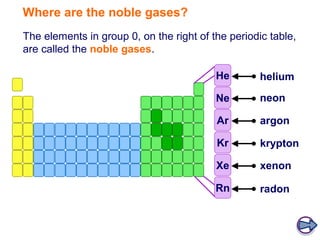
Where are the noble gases?
The elements in group 0, on the right of the periodic table,
are called the noble gases.

                                          He        helium

                                          Ne        neon

                                          Ar        argon

                                          Kr        krypton

                                          Xe        xenon

                                          Rn        radon
Discovery of argon
Because the noble gases are so unreactive, they were very
difficult to identify.
The first noble gas, helium, was discovered on the Sun in
1868 by William Ramsay and Morris Travers. It was not
known to exist on Earth until 1895.
In the early 1890s, a British physicist Lord Rayleigh found
that nitrogen obtained from the air was very slightly denser
than nitrogen obtained from decomposing ammonia.
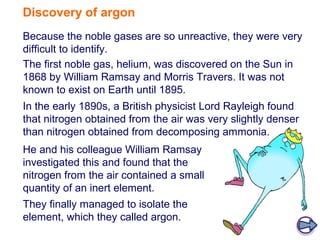
He and his colleague William Ramsay
investigated this and found that the
nitrogen from the air contained a small
quantity of an inert element.
They finally managed to isolate the
element, which they called argon.
Discovery of argon
Ramsay realised that there was no place for this new gas in
the periodic table, and he predicted that it belonged to a
whole new group of elements.
He experimented on the argon with his colleague Morris
Travers, and in 1898, they discovered that the argon actually
contained tiny quantities of the three other noble gases,
neon, krypton and xenon.


Radon was discovered in 1900.
Why are they called the ‘noble gases’?
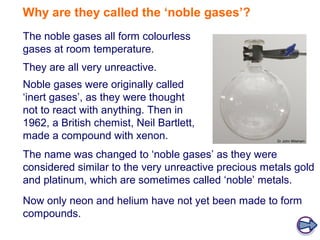
The noble gases all form colourless
gases at room temperature.
They are all very unreactive.
Noble gases were originally called
‘inert gases’, as they were thought
not to react with anything. Then in
1962, a British chemist, Neil Bartlett,
made a compound with xenon.
The name was changed to ‘noble gases’ as they were
considered similar to the very unreactive precious metals gold
and platinum, which are sometimes called ‘noble’ metals.
Now only neon and helium have not yet been made to form
compounds.
The noble gases
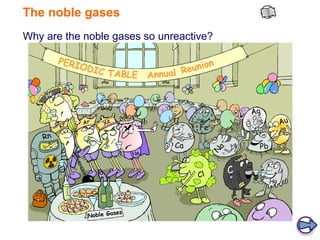
Why are the noble gases so unreactive?
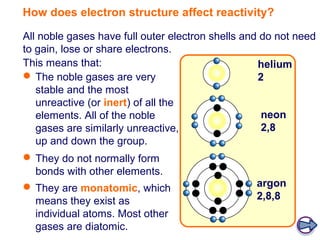
How does electron structure affect reactivity?

All noble gases have full outer electron shells and do not need
to gain, lose or share electrons.
This means that:                                   helium
 The noble gases are very                         2
   stable and the most
   unreactive (or inert) of all the
   elements. All of the noble                       neon
   gases are similarly unreactive,                  2,8
   up and down the group.
 They do not normally form
  bonds with other elements.
 They are monatomic, which                       argon
  means they exist as                             2,8,8
  individual atoms. Most other
  gases are diatomic.
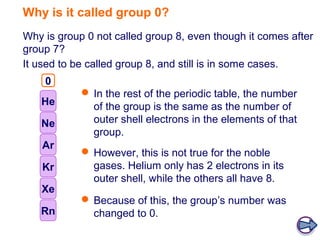
Why is it called group 0?
Why is group 0 not called group 8, even though it comes after
group 7?
It used to be called group 8, and still is in some cases.
    0
    8
             In the rest of the periodic table, the number
   He         of the group is the same as the number of
   Ne         outer shell electrons in the elements of that
              group.
    Ar
             However, this is not true for the noble
    Kr        gases. Helium only has 2 electrons in its
              outer shell, while the others all have 8.
   Xe
             Because of this, the group’s number was
   Rn         changed to 0.

1. group 0

  • 1.
    3.3.1 Chem. Properties of groups Chem. Properties of groups •Discuss the similarities and differences in the chemical properties of elements in the same group
  • 2.
    Where are thenoble gases? The elements in group 0, on the right of the periodic table, are called the noble gases. He helium Ne neon Ar argon Kr krypton Xe xenon Rn radon
  • 3.
    Discovery of argon Becausethe noble gases are so unreactive, they were very difficult to identify. The first noble gas, helium, was discovered on the Sun in 1868 by William Ramsay and Morris Travers. It was not known to exist on Earth until 1895. In the early 1890s, a British physicist Lord Rayleigh found that nitrogen obtained from the air was very slightly denser than nitrogen obtained from decomposing ammonia. He and his colleague William Ramsay investigated this and found that the nitrogen from the air contained a small quantity of an inert element. They finally managed to isolate the element, which they called argon.
  • 4.
    Discovery of argon Ramsayrealised that there was no place for this new gas in the periodic table, and he predicted that it belonged to a whole new group of elements. He experimented on the argon with his colleague Morris Travers, and in 1898, they discovered that the argon actually contained tiny quantities of the three other noble gases, neon, krypton and xenon. Radon was discovered in 1900.
  • 5.
    Why are theycalled the ‘noble gases’? The noble gases all form colourless gases at room temperature. They are all very unreactive. Noble gases were originally called ‘inert gases’, as they were thought not to react with anything. Then in 1962, a British chemist, Neil Bartlett, made a compound with xenon. The name was changed to ‘noble gases’ as they were considered similar to the very unreactive precious metals gold and platinum, which are sometimes called ‘noble’ metals. Now only neon and helium have not yet been made to form compounds.
  • 6.
    The noble gases Whyare the noble gases so unreactive?
  • 7.
    How does electronstructure affect reactivity? All noble gases have full outer electron shells and do not need to gain, lose or share electrons. This means that: helium  The noble gases are very 2 stable and the most unreactive (or inert) of all the elements. All of the noble neon gases are similarly unreactive, 2,8 up and down the group.  They do not normally form bonds with other elements.  They are monatomic, which argon means they exist as 2,8,8 individual atoms. Most other gases are diatomic.
  • 8.
    Why is itcalled group 0? Why is group 0 not called group 8, even though it comes after group 7? It used to be called group 8, and still is in some cases. 0 8  In the rest of the periodic table, the number He of the group is the same as the number of Ne outer shell electrons in the elements of that group. Ar  However, this is not true for the noble Kr gases. Helium only has 2 electrons in its outer shell, while the others all have 8. Xe  Because of this, the group’s number was Rn changed to 0.

Editor's Notes

  • #3 Boardworks GCSE Additional Science: Chemistry The Noble Gases
  • #4 Boardworks GCSE Additional Science: Chemistry The Noble Gases
  • #5 Boardworks GCSE Additional Science: Chemistry The Noble Gases
  • #6 Boardworks GCSE Additional Science: Chemistry The Noble Gases Photo credit: Dr John Mileham Image is of xenon gas in a flask.
  • #7 Boardworks GCSE Additional Science: Chemistry The Noble Gases Teacher notes This illustration contains representations of how the noble gases are unreactive compared to the other elements in the periodic table. It can be used as plenary or revision exercise to the topic or as an introduction.
  • #8 Boardworks GCSE Additional Science: Chemistry The Noble Gases
  • #9 Boardworks GCSE Additional Science: Chemistry The Noble Gases