By Alex && Mel Noble Gases
 
 
Atomic Number:  2  Melting Point:  -272.0 °C (1.15 K, -457.6 °F)  Boiling Point:  -268.6 °C (4.549994 K, -451.48 °F)  Number of Protons/Electrons:  2  Number of Neutrons:  2  Density @ 293 K:  0.1785 g/cm 3   Date of Discovery:  1895  Discoverer:  Sir William Ramsay  Name Origin:  From the Greek word  hêlios  (sun)  Uses:  balloons, deep sea diving  Obtained From:  natural gas deposit, air  The dangers of inahing helium are rare, but if you don't breathe for 5 seconds in between, you could get a soar throat or maybe pass out.  Can't be made into compounds
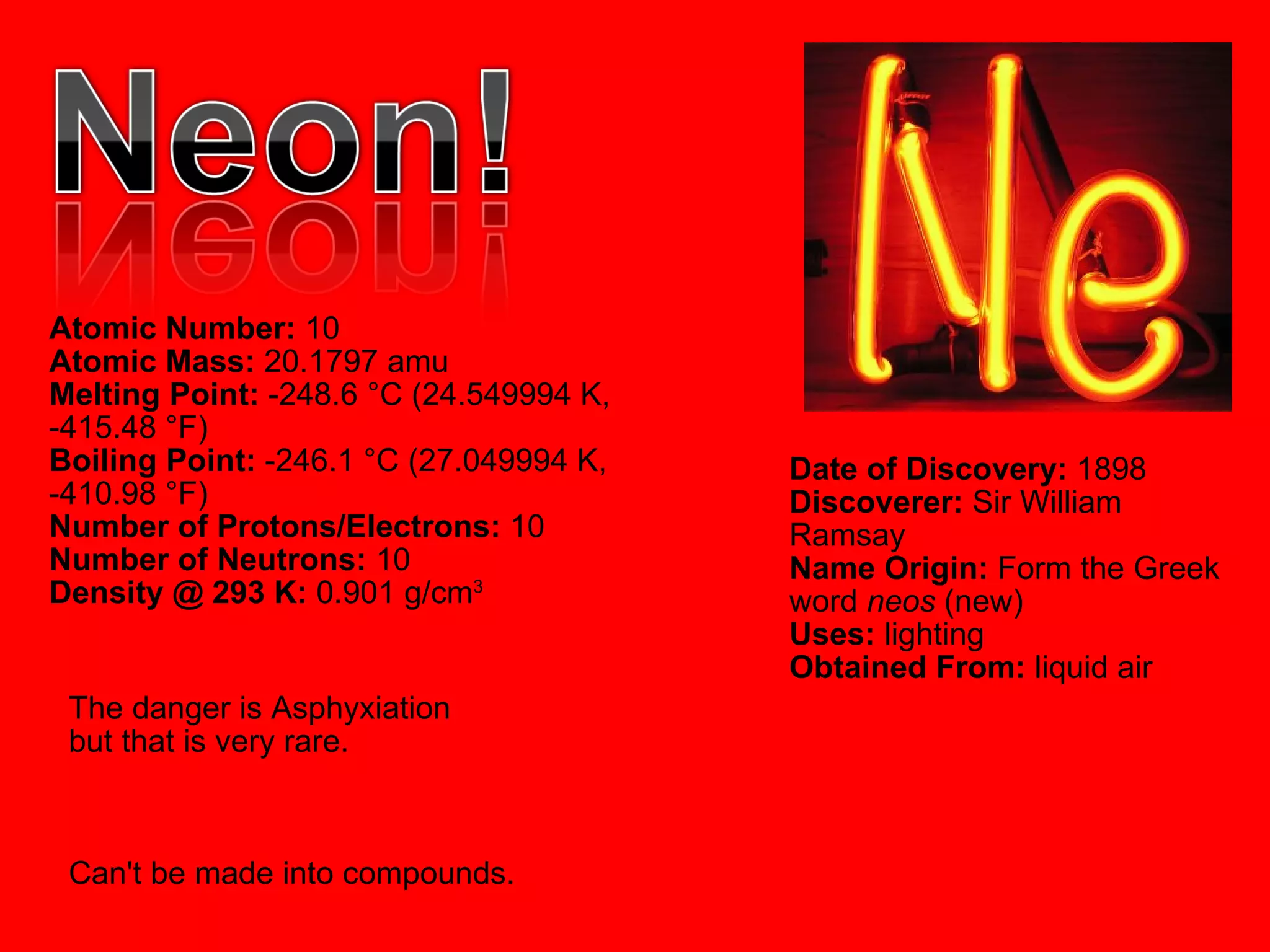
Atomic Number:  10  Atomic Mass:  20.1797 amu  Melting Point:  -248.6 °C (24.549994 K, -415.48 °F)  Boiling Point:  -246.1 °C (27.049994 K, -410.98 °F)  Number of Protons/Electrons:  10  Number of Neutrons:  10  Density @ 293 K:  0.901 g/cm 3   Date of Discovery:  1898  Discoverer:  Sir William Ramsay  Name Origin:  Form the Greek word  neos  (new)  Uses:  lighting  Obtained From:  liquid air  The danger is Asphyxiation  but that is very rare. Can't be made into compounds.
Atomic Number:  18  Atomic Mass:  39.948 amu  Melting Point:  -189.3 °C (83.85 K, -308.74 °F)  Boiling Point:  -186.0 °C (87.15 K, -302.8 °F)  Number of Protons/Electrons:  18  Number of Neutrons:  22  Density @ 293 K:  1.784 g/cm 3   Date of Discovery:  1894  Discoverer:  Sir William Ramsay  Name Origin:  From the Greek word  argon  (inactive)  Uses:  Lighting  Obtained From:  air Argon has the opposite effect as helium on your voice. Because it is so dense - it makes your voice lower. Which means it has the same dangers as helium. Can't be made into compounds.
Krypton is not toxic, but in an enclosed environment, it can displace air and cause asphyxiation. Can't be made into compounds. Atomic Number:  36  Atomic Mass:  83.8 amu  Melting Point:  -157.2 °C (115.950005 K, -250.95999 °F)  Boiling Point:  -153.4 °C (119.75001 K, -244.12 °F)  Number of Protons/Electrons:  36  Number of Neutrons:  48  Density @ 293 K:  3.74 g/cm 3   Date of Discovery:  1898  Discoverer:  Sir William Ramsay  Name Origin:  From the Greek word  kryptos  (hidden)  Uses:  Lighting  Obtained From:  production of liquid air
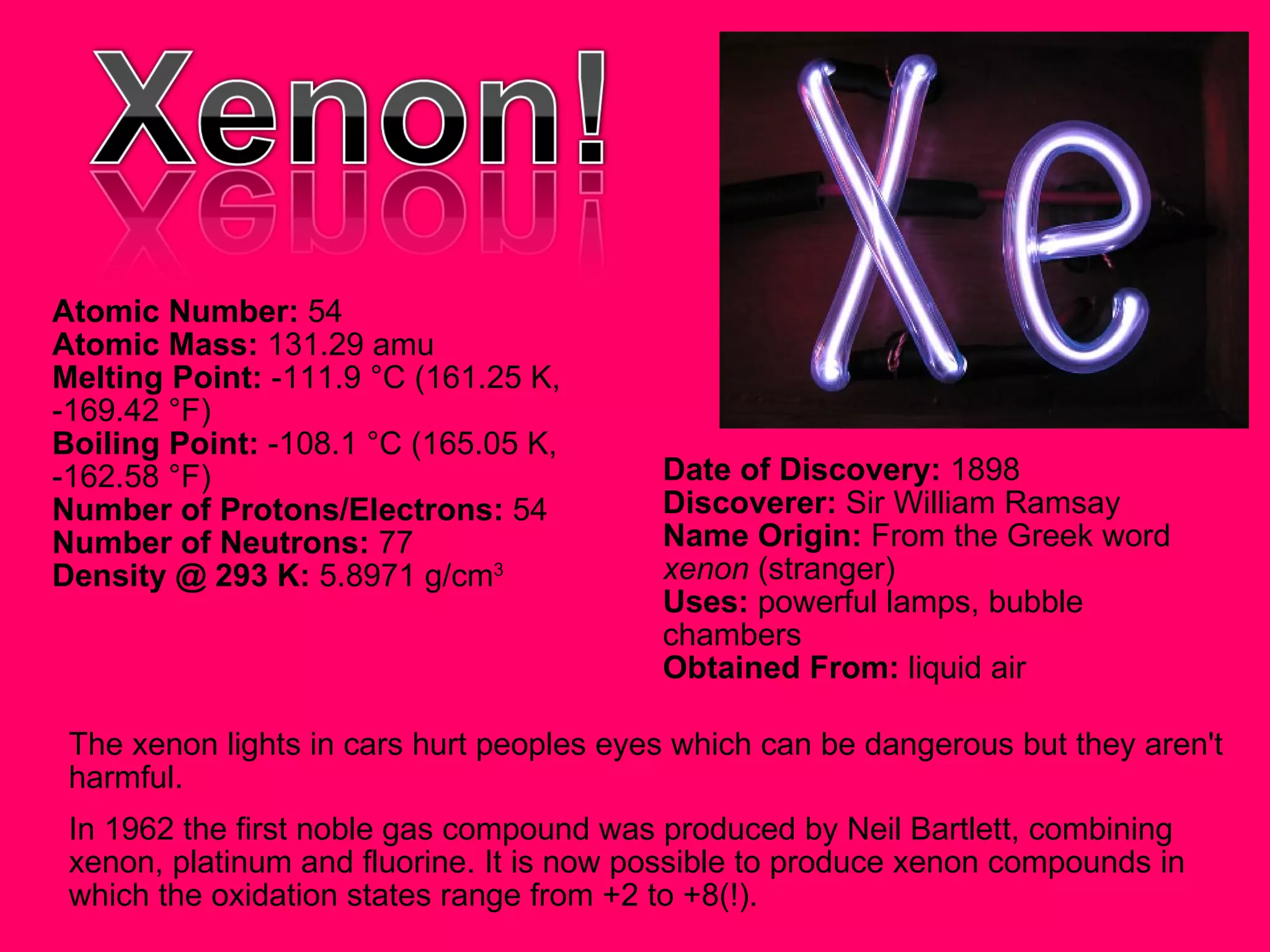
The xenon lights in cars hurt peoples eyes which can be dangerous but they aren't harmful. In 1962 the first noble gas compound was produced by Neil Bartlett, combining xenon, platinum and fluorine. It is now possible to produce xenon compounds in which the oxidation states range from +2 to +8(!).  Atomic Number:  54  Atomic Mass:  131.29 amu  Melting Point:  -111.9 °C (161.25 K, -169.42 °F)  Boiling Point:  -108.1 °C (165.05 K, -162.58 °F)  Number of Protons/Electrons:  54  Number of Neutrons:  77  Density @ 293 K:  5.8971 g/cm 3   Date of Discovery:  1898  Discoverer:  Sir William Ramsay  Name Origin:  From the Greek word  xenon  (stranger)  Uses:  powerful lamps, bubble chambers  Obtained From:  liquid air
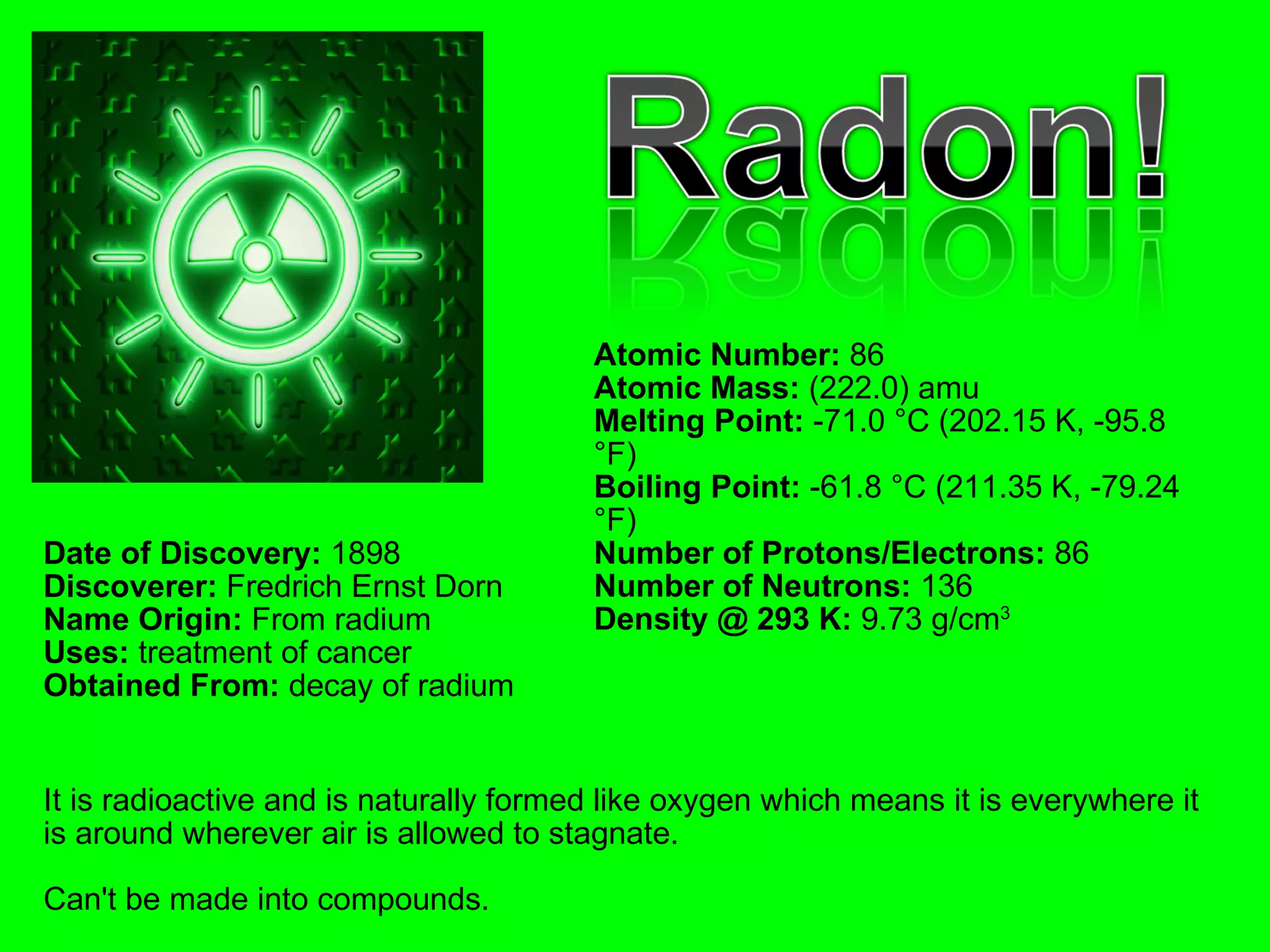
Atomic Number:  86  Atomic Mass:  (222.0) amu  Melting Point:  -71.0 °C (202.15 K, -95.8 °F)  Boiling Point:  -61.8 °C (211.35 K, -79.24 °F)  Number of Protons/Electrons:  86  Number of Neutrons:  136  Density @ 293 K:  9.73 g/cm 3 It is radioactive and is naturally formed like oxygen which means it is everywhere it is around wherever air is allowed to stagnate. Can't be made into compounds. Date of Discovery:  1898  Discoverer:  Fredrich Ernst Dorn  Name Origin:  From radium  Uses:  treatment of cancer  Obtained From:  decay of radium
By Mel & Alex :]  :]

Noble Gases

  • 1.
    By Alex &&Mel Noble Gases
  • 2.
  • 3.
  • 4.
    Atomic Number: 2 Melting Point: -272.0 °C (1.15 K, -457.6 °F) Boiling Point: -268.6 °C (4.549994 K, -451.48 °F) Number of Protons/Electrons: 2 Number of Neutrons: 2 Density @ 293 K: 0.1785 g/cm 3 Date of Discovery: 1895 Discoverer: Sir William Ramsay Name Origin: From the Greek word hêlios (sun) Uses: balloons, deep sea diving Obtained From: natural gas deposit, air The dangers of inahing helium are rare, but if you don't breathe for 5 seconds in between, you could get a soar throat or maybe pass out. Can't be made into compounds
  • 5.
    Atomic Number: 10 Atomic Mass: 20.1797 amu Melting Point: -248.6 °C (24.549994 K, -415.48 °F) Boiling Point: -246.1 °C (27.049994 K, -410.98 °F) Number of Protons/Electrons: 10 Number of Neutrons: 10 Density @ 293 K: 0.901 g/cm 3 Date of Discovery: 1898 Discoverer: Sir William Ramsay Name Origin: Form the Greek word neos (new) Uses: lighting Obtained From: liquid air The danger is Asphyxiation but that is very rare. Can't be made into compounds.
  • 6.
    Atomic Number: 18 Atomic Mass: 39.948 amu Melting Point: -189.3 °C (83.85 K, -308.74 °F) Boiling Point: -186.0 °C (87.15 K, -302.8 °F) Number of Protons/Electrons: 18 Number of Neutrons: 22 Density @ 293 K: 1.784 g/cm 3 Date of Discovery: 1894 Discoverer: Sir William Ramsay Name Origin: From the Greek word argon (inactive) Uses: Lighting Obtained From: air Argon has the opposite effect as helium on your voice. Because it is so dense - it makes your voice lower. Which means it has the same dangers as helium. Can't be made into compounds.
  • 7.
    Krypton is nottoxic, but in an enclosed environment, it can displace air and cause asphyxiation. Can't be made into compounds. Atomic Number: 36 Atomic Mass: 83.8 amu Melting Point: -157.2 °C (115.950005 K, -250.95999 °F) Boiling Point: -153.4 °C (119.75001 K, -244.12 °F) Number of Protons/Electrons: 36 Number of Neutrons: 48 Density @ 293 K: 3.74 g/cm 3 Date of Discovery: 1898 Discoverer: Sir William Ramsay Name Origin: From the Greek word kryptos (hidden) Uses: Lighting Obtained From: production of liquid air
  • 8.
    The xenon lightsin cars hurt peoples eyes which can be dangerous but they aren't harmful. In 1962 the first noble gas compound was produced by Neil Bartlett, combining xenon, platinum and fluorine. It is now possible to produce xenon compounds in which the oxidation states range from +2 to +8(!). Atomic Number: 54 Atomic Mass: 131.29 amu Melting Point: -111.9 °C (161.25 K, -169.42 °F) Boiling Point: -108.1 °C (165.05 K, -162.58 °F) Number of Protons/Electrons: 54 Number of Neutrons: 77 Density @ 293 K: 5.8971 g/cm 3 Date of Discovery: 1898 Discoverer: Sir William Ramsay Name Origin: From the Greek word xenon (stranger) Uses: powerful lamps, bubble chambers Obtained From: liquid air
  • 9.
    Atomic Number: 86 Atomic Mass: (222.0) amu Melting Point: -71.0 °C (202.15 K, -95.8 °F) Boiling Point: -61.8 °C (211.35 K, -79.24 °F) Number of Protons/Electrons: 86 Number of Neutrons: 136 Density @ 293 K: 9.73 g/cm 3 It is radioactive and is naturally formed like oxygen which means it is everywhere it is around wherever air is allowed to stagnate. Can't be made into compounds. Date of Discovery: 1898 Discoverer: Fredrich Ernst Dorn Name Origin: From radium Uses: treatment of cancer Obtained From: decay of radium
  • 10.
    By Mel &Alex :] :]