Pressure and equilibrium
Changing the pressure has an effect on the equilibrium of
reversible reactions involving gases.
Pressure and equilibrium
Changing the pressure has an effect on the equilibrium of
reversible reactions involving gases.

     If the pressure is increased:
      equilibrium shifts to decrease the pressure
      equilibrium shifts in the direction of fewest
       molecules
Pressure and equilibrium
Changing the pressure has an effect on the equilibrium of
reversible reactions involving gases.

     If the pressure is increased:
      equilibrium shifts to decrease the pressure
      equilibrium shifts in the direction of fewest
       molecules


     If the pressure is decreased:
      equilibrium shifts to increase the pressure
      equilibrium shifts in the direction of most
       molecules
Opposing changes in pressure
Nitrogen dioxide is in constant equilibrium with dinitrogen
tetroxide. Two molecules of nitrogen dioxide react to form
one molecule of dinitrogen tetroxide.
Opposing changes in pressure
Nitrogen dioxide is in constant equilibrium with dinitrogen
tetroxide. Two molecules of nitrogen dioxide react to form
one molecule of dinitrogen tetroxide.

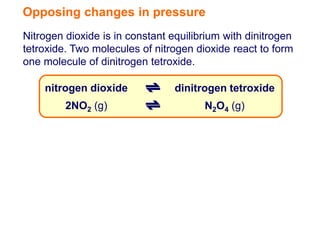
    nitrogen dioxide             dinitrogen tetroxide
         2NO2 (g)                      N2O4 (g)
Opposing changes in pressure
Nitrogen dioxide is in constant equilibrium with dinitrogen
tetroxide. Two molecules of nitrogen dioxide react to form
one molecule of dinitrogen tetroxide.

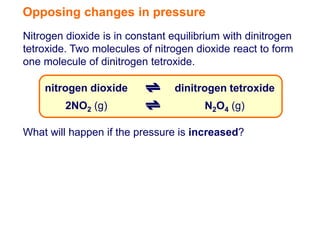
    nitrogen dioxide             dinitrogen tetroxide
         2NO2 (g)                      N2O4 (g)

What will happen if the pressure is increased?
Opposing changes in pressure
Nitrogen dioxide is in constant equilibrium with dinitrogen
tetroxide. Two molecules of nitrogen dioxide react to form
one molecule of dinitrogen tetroxide.

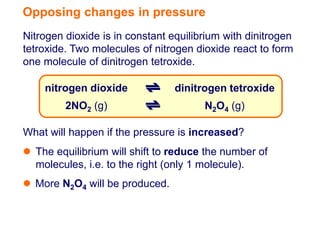
    nitrogen dioxide             dinitrogen tetroxide
         2NO2 (g)                      N2O4 (g)

What will happen if the pressure is increased?
 The equilibrium will shift to reduce the number of
  molecules, i.e. to the right (only 1 molecule).
 More N2O4 will be produced.
Opposing changes in pressure
Nitrogen dioxide is in constant equilibrium with dinitrogen
tetroxide. Two molecules of nitrogen dioxide react to form
one molecule of dinitrogen tetroxide.

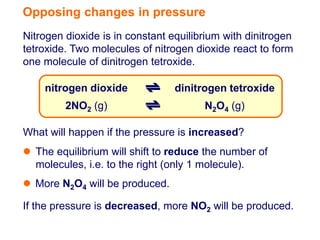
    nitrogen dioxide             dinitrogen tetroxide
         2NO2 (g)                      N2O4 (g)

What will happen if the pressure is increased?
 The equilibrium will shift to reduce the number of
  molecules, i.e. to the right (only 1 molecule).
 More N2O4 will be produced.

If the pressure is decreased, more NO2 will be produced.

4

  • 1.
    Pressure and equilibrium Changingthe pressure has an effect on the equilibrium of reversible reactions involving gases.
  • 2.
    Pressure and equilibrium Changingthe pressure has an effect on the equilibrium of reversible reactions involving gases. If the pressure is increased:  equilibrium shifts to decrease the pressure  equilibrium shifts in the direction of fewest molecules
  • 3.
    Pressure and equilibrium Changingthe pressure has an effect on the equilibrium of reversible reactions involving gases. If the pressure is increased:  equilibrium shifts to decrease the pressure  equilibrium shifts in the direction of fewest molecules If the pressure is decreased:  equilibrium shifts to increase the pressure  equilibrium shifts in the direction of most molecules
  • 4.
  • 5.
    Opposing changes inpressure Nitrogen dioxide is in constant equilibrium with dinitrogen tetroxide. Two molecules of nitrogen dioxide react to form one molecule of dinitrogen tetroxide.
  • 6.
    Opposing changes inpressure Nitrogen dioxide is in constant equilibrium with dinitrogen tetroxide. Two molecules of nitrogen dioxide react to form one molecule of dinitrogen tetroxide. nitrogen dioxide dinitrogen tetroxide 2NO2 (g) N2O4 (g)
  • 7.
    Opposing changes inpressure Nitrogen dioxide is in constant equilibrium with dinitrogen tetroxide. Two molecules of nitrogen dioxide react to form one molecule of dinitrogen tetroxide. nitrogen dioxide dinitrogen tetroxide 2NO2 (g) N2O4 (g) What will happen if the pressure is increased?
  • 8.
    Opposing changes inpressure Nitrogen dioxide is in constant equilibrium with dinitrogen tetroxide. Two molecules of nitrogen dioxide react to form one molecule of dinitrogen tetroxide. nitrogen dioxide dinitrogen tetroxide 2NO2 (g) N2O4 (g) What will happen if the pressure is increased?  The equilibrium will shift to reduce the number of molecules, i.e. to the right (only 1 molecule).  More N2O4 will be produced.
  • 9.
    Opposing changes inpressure Nitrogen dioxide is in constant equilibrium with dinitrogen tetroxide. Two molecules of nitrogen dioxide react to form one molecule of dinitrogen tetroxide. nitrogen dioxide dinitrogen tetroxide 2NO2 (g) N2O4 (g) What will happen if the pressure is increased?  The equilibrium will shift to reduce the number of molecules, i.e. to the right (only 1 molecule).  More N2O4 will be produced. If the pressure is decreased, more NO2 will be produced.