GROUP VII ELEMENTS
BY THUGIANG
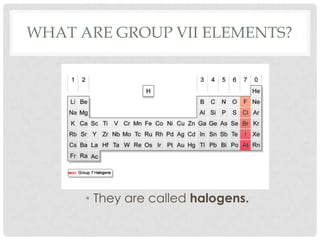
WHAT ARE GROUP VII ELEMENTS?

• They are called halogens.
PHYSICAL PROPERTIES
• These elements are non-metals.
• At room temperature (25°C), they exist as diatomic
molecules: F2, Cl2, Br2, and I2.
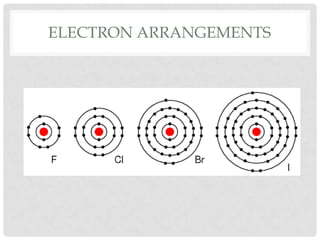
• Their atoms have seven electrons in the outer
principal quantum shell.
ELECTRON ARRANGEMENTS
ATOMIC RADIUS
Atomic Radius
0.14

0.12
0.1
0.08
Atomic Radius

0.06
0.04
0.02
0
Fluorine

Chlorine

Bromine

Iodine
WHY?
• Causeeee…
• The number of layers of electrons around the
nucleus.
• The more layers, the bigger the atomic radius.
MELTING AND BOILING POINTS
250
200
150
100
50

Melting point

0
-50
-100
-150

-200
-250

Fluorine

Chlorine

Bromine

Iodine

Boiling point
MELTING AND BOILING POINTS
• The boiling points show us the volatility (how easy
can they evaporate) of the halogens.
• They are relatively low cause they have simple
molecular structure and weak van der Waals’
forces between their diatomic molecules.
• These forces increase as the no. of electrons
increase with increasing atomic number (the
greater number no. of electrons, the greater the
opportunities for dipoles arising within molecules).
• => the larger the molecules, the stronger the van
der Waals’ forces.
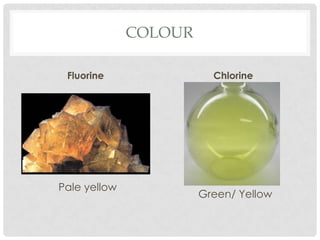
COLOUR
Fluorine

Pale yellow

Chlorine

Green/ Yellow
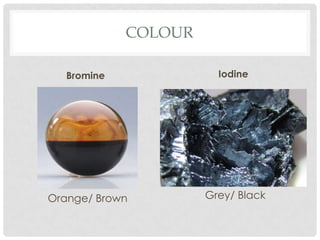
COLOUR
Bromine

Iodine

Orange/ Brown

Grey/ Black
REACTIONS
• The halogen atoms require just one more electron
to achieve a complete outer shell => they can
react with metallic elements by gaining an electron
to become ions with a 1- charge.
• For example:
• Cl2(g) + Ca(s)  CaCl2(s)

• Each halogen atom tends to gain one electron
• => halogens are oxidising agents, their oxidation no. is
reduced from 0 to -1 in the compound formed.
REACTIONS
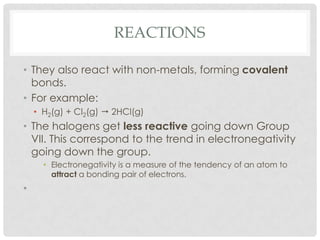
• They also react with non-metals, forming covalent
bonds.
• For example:
• H2(g) + Cl2(g)  2HCl(g)

• The halogens get less reactive going down Group
VII. This correspond to the trend in electronegativity
going down the group.
• Electronegativity is a measure of the tendency of an atom to
attract a bonding pair of electrons.

•
ELECTRONEGATIVITY
Electronegativity
4.5
4
3.5
3
2.5
2

Electronegativity

1.5
1
0.5
0
Fluorine

Chlorine

Bromine

Iodine
WHY?
• Causeeeee…
• The electrons are not as near to the nucleus as the
number of electrons increase. Therefore, the
nucleus and the electrons are not as attracted to
each other as much. An increase in shielding is
observed so the ability to attract electrons
decrease. Which means electronegativity decrease
down the group.
DISPLACEMENT REACTIONS
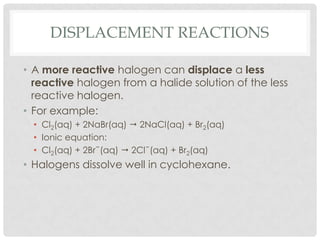
• A more reactive halogen can displace a less
reactive halogen from a halide solution of the less
reactive halogen.
• For example:
• Cl2(aq) + 2NaBr(aq)  2NaCl(aq) + Br2(aq)
• Ionic equation:
• Cl2(aq) + 2Brˉ(aq)  2Clˉ(aq) + Br2(aq)

• Halogens dissolve well in cyclohexane.
HALOGENS AND CYCLOHEXANE
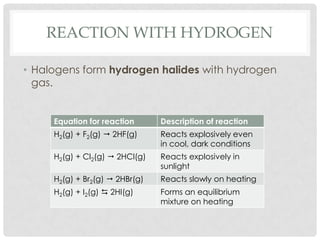
REACTION WITH HYDROGEN
• Halogens form hydrogen halides with hydrogen
gas.

Equation for reaction

Description of reaction

H2(g) + F2(g)  2HF(g)

Reacts explosively even
in cool, dark conditions

H2(g) + Cl2(g)  2HCl(g)

Reacts explosively in
sunlight

H2(g) + Br2(g)  2HBr(g)

Reacts slowly on heating

H2(g) + I2(g)  2HI(g)

Forms an equilibrium
mixture on heating
WHYYYY? T_T
• Because e e e e e. . . . . .. . .
Hydrogen-halogen bond

Bond energy / kJ/mol

H-F

562

H-Cl

431

H-Br

366

H-I

299

• => HF is most thermally stable; HI is the least
thermally stable.
THE END
YAYYYY!!!

Group VII elements - Halogens

  • 1.
  • 2.
    WHAT ARE GROUPVII ELEMENTS? • They are called halogens.
  • 3.
    PHYSICAL PROPERTIES • Theseelements are non-metals. • At room temperature (25°C), they exist as diatomic molecules: F2, Cl2, Br2, and I2. • Their atoms have seven electrons in the outer principal quantum shell.
  • 4.
  • 5.
    ATOMIC RADIUS Atomic Radius 0.14 0.12 0.1 0.08 AtomicRadius 0.06 0.04 0.02 0 Fluorine Chlorine Bromine Iodine
  • 6.
    WHY? • Causeeee… • Thenumber of layers of electrons around the nucleus. • The more layers, the bigger the atomic radius.
  • 7.
    MELTING AND BOILINGPOINTS 250 200 150 100 50 Melting point 0 -50 -100 -150 -200 -250 Fluorine Chlorine Bromine Iodine Boiling point
  • 8.
    MELTING AND BOILINGPOINTS • The boiling points show us the volatility (how easy can they evaporate) of the halogens. • They are relatively low cause they have simple molecular structure and weak van der Waals’ forces between their diatomic molecules. • These forces increase as the no. of electrons increase with increasing atomic number (the greater number no. of electrons, the greater the opportunities for dipoles arising within molecules). • => the larger the molecules, the stronger the van der Waals’ forces.
  • 9.
  • 10.
  • 11.
    REACTIONS • The halogenatoms require just one more electron to achieve a complete outer shell => they can react with metallic elements by gaining an electron to become ions with a 1- charge. • For example: • Cl2(g) + Ca(s)  CaCl2(s) • Each halogen atom tends to gain one electron • => halogens are oxidising agents, their oxidation no. is reduced from 0 to -1 in the compound formed.
  • 12.
    REACTIONS • They alsoreact with non-metals, forming covalent bonds. • For example: • H2(g) + Cl2(g)  2HCl(g) • The halogens get less reactive going down Group VII. This correspond to the trend in electronegativity going down the group. • Electronegativity is a measure of the tendency of an atom to attract a bonding pair of electrons. •
  • 13.
  • 14.
    WHY? • Causeeeee… • Theelectrons are not as near to the nucleus as the number of electrons increase. Therefore, the nucleus and the electrons are not as attracted to each other as much. An increase in shielding is observed so the ability to attract electrons decrease. Which means electronegativity decrease down the group.
  • 15.
    DISPLACEMENT REACTIONS • Amore reactive halogen can displace a less reactive halogen from a halide solution of the less reactive halogen. • For example: • Cl2(aq) + 2NaBr(aq)  2NaCl(aq) + Br2(aq) • Ionic equation: • Cl2(aq) + 2Brˉ(aq)  2Clˉ(aq) + Br2(aq) • Halogens dissolve well in cyclohexane.
  • 16.
  • 17.
    REACTION WITH HYDROGEN •Halogens form hydrogen halides with hydrogen gas. Equation for reaction Description of reaction H2(g) + F2(g)  2HF(g) Reacts explosively even in cool, dark conditions H2(g) + Cl2(g)  2HCl(g) Reacts explosively in sunlight H2(g) + Br2(g)  2HBr(g) Reacts slowly on heating H2(g) + I2(g)  2HI(g) Forms an equilibrium mixture on heating
  • 18.
    WHYYYY? T_T • Becausee e e e e. . . . . .. . . Hydrogen-halogen bond Bond energy / kJ/mol H-F 562 H-Cl 431 H-Br 366 H-I 299 • => HF is most thermally stable; HI is the least thermally stable.
  • 19.

Editor's Notes