3.3.1   Chem. Properties of groups
        Chem. Properties of groups
 •Discuss the similarities and differences
 in the chemical properties of elements
 in the same group
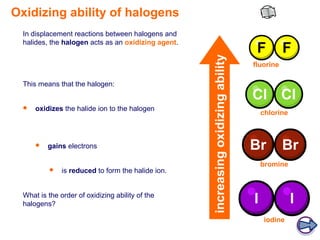
Oxidizing ability of halogens
  In displacement reactions between halogens and
  halides, the halogen acts as an oxidizing agent.


                                                     increasing oxidizing ability
                                                                                    fluorine

  This means that the halogen:


     oxidizes the halide ion to the halogen
                                                                                      chlorine


         gains electrons

                                                                                      bromine
              is reduced to form the halide ion.


  What is the order of oxidizing ability of the
  halogens?

                                                                                       iodine
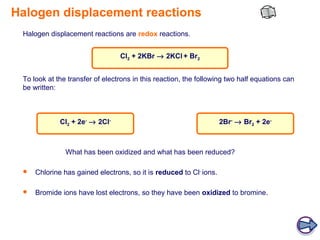
Halogen displacement reactions
 Halogen displacement reactions are redox reactions.


                                 Cl2 + 2KBr → 2KCl + Br2


 To look at the transfer of electrons in this reaction, the following two half equations can
 be written:


             Cl2 + 2e- → 2Cl-                                       2Br- → Br2 + 2e-


               What has been oxidized and what has been reduced?

    Chlorine has gained electrons, so it is reduced to Cl- ions.

    Bromide ions have lost electrons, so they have been oxidized to bromine.

5.displacement

  • 1.
    3.3.1 Chem. Properties of groups Chem. Properties of groups •Discuss the similarities and differences in the chemical properties of elements in the same group
  • 2.
    Oxidizing ability ofhalogens In displacement reactions between halogens and halides, the halogen acts as an oxidizing agent. increasing oxidizing ability fluorine This means that the halogen:  oxidizes the halide ion to the halogen chlorine  gains electrons bromine  is reduced to form the halide ion. What is the order of oxidizing ability of the halogens? iodine
  • 3.
    Halogen displacement reactions Halogen displacement reactions are redox reactions. Cl2 + 2KBr → 2KCl + Br2 To look at the transfer of electrons in this reaction, the following two half equations can be written: Cl2 + 2e- → 2Cl- 2Br- → Br2 + 2e- What has been oxidized and what has been reduced?  Chlorine has gained electrons, so it is reduced to Cl- ions.  Bromide ions have lost electrons, so they have been oxidized to bromine.

Editor's Notes

  • #3 Boardworks AS Chemistry Halogens Teacher notes Students could be encouraged to see the relative oxidizing ability of the halogens as their ability to accept electrons, relating it to the size, nuclear charge and shielding. Also they could connect this trend to the electronegativity values and with the electron structures of the ions.
  • #4 Boardworks AS Chemistry Halogens Teacher notes See the ‘ Redox Reactions ’ presentation for more information about redox reactions.