Group 18 Elements
: Noble Gases
Group 18 Elements : Noble Gases
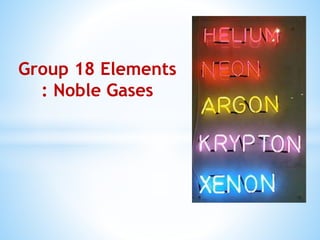
 Group 18 consists of six elements: helium, neon,
argon, krypton, xenon and radon.
 All these are gases and chemically unreactive. They
form very few compounds. Because of this they are
termed noble gases
 All the noble gases except radon occur in the
atmosphere.
 Their atmospheric abundance in dry air is ~ 1% by
volume of which argon is the major constituent.
 Radon is obtained as a decay product of 226Ra.
Atomic and Physical Properties of Group 18 Elements
Electronic Configuration:
General electronic configuration is ns2np6 except helium
which has 1s2
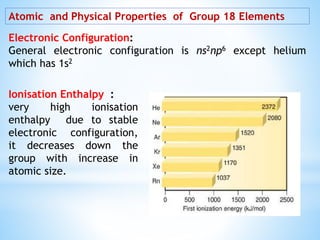
Ionisation Enthalpy :
very high ionisation
enthalpy due to stable
electronic configuration,
it decreases down the
group with increase in
atomic size.
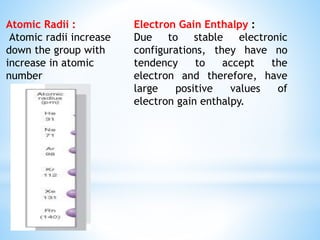
Atomic Radii :
Atomic radii increase
down the group with
increase in atomic
number
Electron Gain Enthalpy :
Due to stable electronic
configurations, they have no
tendency to accept the
electron and therefore, have
large positive values of
electron gain enthalpy.
Physical Properties
 All the noble gases are monoatomic.
 Colourless, odourless and tasteless.
 Sparingly soluble in water.
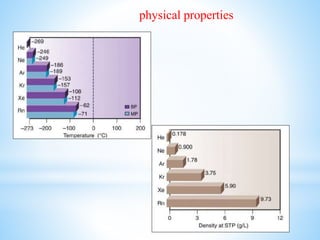
 Have very low melting and boiling points because the
only type of interatomic interaction in these elements is
weak dispersion forces.
 Helium has the lowest boiling point (4.2 K) of any known
substance
physical properties
Chemical Properties
In general, noble gases are least reactive due to the
following reasons :
1. except helium (1s2) all have completely filled ns2np6
electronic configuration in their valence shell.
2.They have high ionisation enthalpy and more positive
electron gain enthalpy
 But in 1962, Neil Bartlett, then at the University of
British Columbia, prepared a red compound which is
formulated as O2
+PtF6
-.
 He, then realised that the first IE of O2 (1175 kJmol–1)
was almost identical with that of Xe(1170 kJ mol–1).
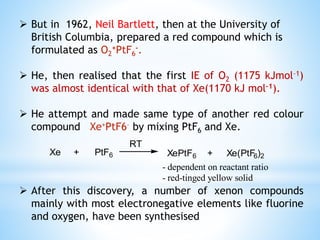
 He attempt and made same type of another red colour
compound Xe+PtF6– by mixing PtF6 and Xe.
 After this discovery, a number of xenon compounds
mainly with most electronegative elements like fluorine
and oxygen, have been synthesised
Xe + PtF6 XePtF6 + Xe(PtF6)2
RT
- dependent on reactant ratio
- red-tinged yellow solid
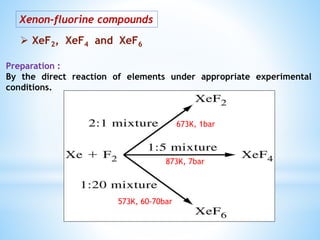
Xenon-fluorine compounds
 XeF2, XeF4 and XeF6
Preparation :
By the direct reaction of elements under appropriate experimental
conditions.
673K, 1bar
873K, 7bar
573K, 60-70bar
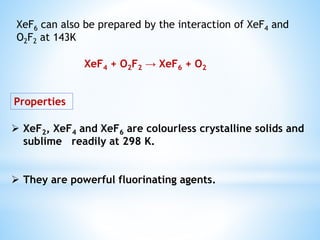
XeF6 can also be prepared by the interaction of XeF4 and
O2F2 at 143K
XeF4 + O2F2 → XeF6 + O2
Properties
 XeF2, XeF4 and XeF6 are colourless crystalline solids and
sublime readily at 298 K.
 They are powerful fluorinating agents.
Properties
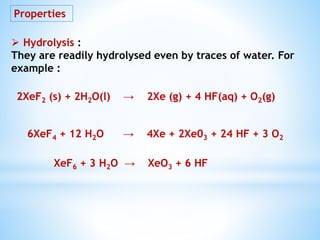
 Hydrolysis :
They are readily hydrolysed even by traces of water. For
example :
2XeF2 (s) + 2H2O(l) → 2Xe (g) + 4 HF(aq) + O2(g)
6XeF4 + 12 H2O → 4Xe + 2Xe03 + 24 HF + 3 O2
XeF6 + 3 H2O → XeO3 + 6 HF
 Xenon fluorides react with fluoride ion acceptors to
form cationic species and fluoride ion donors to form
fluoroanions.
XeF2 + PF5 → [XeF]+ [PF6]–
XeF4 + SbF5 → [XeF3]+ [SbF6]–
XeF6 + MF → M+ [XeF7]– (M = Na, K, Rb or Cs)
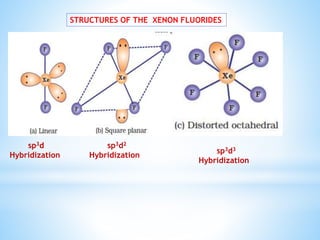
STRUCTURES OF THE XENON FLUORIDES
sp3d
Hybridization
sp3d2
Hybridization
sp3d3
Hybridization
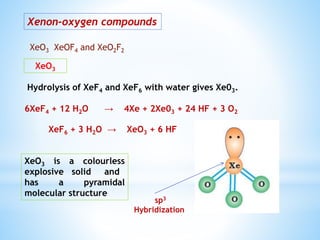
Xenon-oxygen compounds
XeO3 XeOF4 and XeO2F2
Hydrolysis of XeF4 and XeF6 with water gives Xe03.
XeO3
6XeF4 + 12 H2O → 4Xe + 2Xe03 + 24 HF + 3 O2
XeF6 + 3 H2O → XeO3 + 6 HF
XeO3 is a colourless
explosive solid and
has a pyramidal
molecular structure
sp3
Hybridization
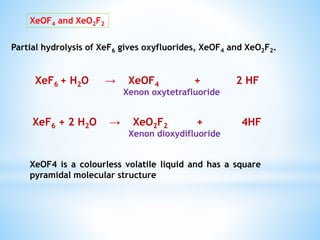
Partial hydrolysis of XeF6 gives oxyfluorides, XeOF4 and XeO2F2.
XeOF4 and XeO2F2
XeF6 + H2O → XeOF4 + 2 HF
Xenon oxytetrafluoride
XeF6 + 2 H2O → XeO2F2 + 4HF
Xenon dioxydifluoride
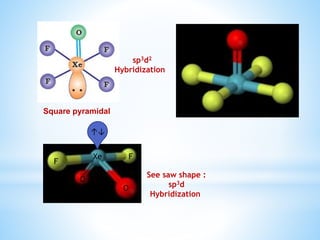
XeOF4 is a colourless volatile liquid and has a square
pyramidal molecular structure
Square pyramidal
F
F
O
O
Xe
sp3d2
Hybridization
↑↓
See saw shape :
sp3d
Hybridization
Neon :
 It is used in discharge tubes and fluorescent bulbs for
advertisement display purposes.
 Neon bulbs are used in botanical gardens and in green
houses.
Argon :
 It is used mainly to provide an inert atmosphere in high
temperature metallurgical processes (arc welding of
metals or alloys) and for filling electric bulbs.
 It is also used in the laboratory for handling substances
that are air-sensitive.
Xe & Kr :
 There are no significant uses of Xenon and Krypton. They
are used in light bulbs designed for special purposes.
THANK YOU…..
MADE BY
Name-AKHILESH PRATAP
UIKAY

Amazing facts about noble gases...........

  • 1.
  • 2.
    Group 18 Elements: Noble Gases  Group 18 consists of six elements: helium, neon, argon, krypton, xenon and radon.  All these are gases and chemically unreactive. They form very few compounds. Because of this they are termed noble gases  All the noble gases except radon occur in the atmosphere.  Their atmospheric abundance in dry air is ~ 1% by volume of which argon is the major constituent.  Radon is obtained as a decay product of 226Ra.
  • 3.
    Atomic and PhysicalProperties of Group 18 Elements Electronic Configuration: General electronic configuration is ns2np6 except helium which has 1s2 Ionisation Enthalpy : very high ionisation enthalpy due to stable electronic configuration, it decreases down the group with increase in atomic size.
  • 4.
    Atomic Radii : Atomicradii increase down the group with increase in atomic number Electron Gain Enthalpy : Due to stable electronic configurations, they have no tendency to accept the electron and therefore, have large positive values of electron gain enthalpy.
  • 5.
    Physical Properties  Allthe noble gases are monoatomic.  Colourless, odourless and tasteless.  Sparingly soluble in water.  Have very low melting and boiling points because the only type of interatomic interaction in these elements is weak dispersion forces.  Helium has the lowest boiling point (4.2 K) of any known substance
  • 6.
  • 7.
    Chemical Properties In general,noble gases are least reactive due to the following reasons : 1. except helium (1s2) all have completely filled ns2np6 electronic configuration in their valence shell. 2.They have high ionisation enthalpy and more positive electron gain enthalpy
  • 8.
     But in1962, Neil Bartlett, then at the University of British Columbia, prepared a red compound which is formulated as O2 +PtF6 -.  He, then realised that the first IE of O2 (1175 kJmol–1) was almost identical with that of Xe(1170 kJ mol–1).  He attempt and made same type of another red colour compound Xe+PtF6– by mixing PtF6 and Xe.  After this discovery, a number of xenon compounds mainly with most electronegative elements like fluorine and oxygen, have been synthesised Xe + PtF6 XePtF6 + Xe(PtF6)2 RT - dependent on reactant ratio - red-tinged yellow solid
  • 9.
    Xenon-fluorine compounds  XeF2,XeF4 and XeF6 Preparation : By the direct reaction of elements under appropriate experimental conditions. 673K, 1bar 873K, 7bar 573K, 60-70bar
  • 10.
    XeF6 can alsobe prepared by the interaction of XeF4 and O2F2 at 143K XeF4 + O2F2 → XeF6 + O2 Properties  XeF2, XeF4 and XeF6 are colourless crystalline solids and sublime readily at 298 K.  They are powerful fluorinating agents.
  • 11.
    Properties  Hydrolysis : Theyare readily hydrolysed even by traces of water. For example : 2XeF2 (s) + 2H2O(l) → 2Xe (g) + 4 HF(aq) + O2(g) 6XeF4 + 12 H2O → 4Xe + 2Xe03 + 24 HF + 3 O2 XeF6 + 3 H2O → XeO3 + 6 HF
  • 12.
     Xenon fluoridesreact with fluoride ion acceptors to form cationic species and fluoride ion donors to form fluoroanions. XeF2 + PF5 → [XeF]+ [PF6]– XeF4 + SbF5 → [XeF3]+ [SbF6]– XeF6 + MF → M+ [XeF7]– (M = Na, K, Rb or Cs)
  • 13.
    STRUCTURES OF THEXENON FLUORIDES sp3d Hybridization sp3d2 Hybridization sp3d3 Hybridization
  • 14.
    Xenon-oxygen compounds XeO3 XeOF4and XeO2F2 Hydrolysis of XeF4 and XeF6 with water gives Xe03. XeO3 6XeF4 + 12 H2O → 4Xe + 2Xe03 + 24 HF + 3 O2 XeF6 + 3 H2O → XeO3 + 6 HF XeO3 is a colourless explosive solid and has a pyramidal molecular structure sp3 Hybridization
  • 15.
    Partial hydrolysis ofXeF6 gives oxyfluorides, XeOF4 and XeO2F2. XeOF4 and XeO2F2 XeF6 + H2O → XeOF4 + 2 HF Xenon oxytetrafluoride XeF6 + 2 H2O → XeO2F2 + 4HF Xenon dioxydifluoride XeOF4 is a colourless volatile liquid and has a square pyramidal molecular structure
  • 16.
  • 17.
    Neon :  Itis used in discharge tubes and fluorescent bulbs for advertisement display purposes.  Neon bulbs are used in botanical gardens and in green houses. Argon :  It is used mainly to provide an inert atmosphere in high temperature metallurgical processes (arc welding of metals or alloys) and for filling electric bulbs.  It is also used in the laboratory for handling substances that are air-sensitive. Xe & Kr :  There are no significant uses of Xenon and Krypton. They are used in light bulbs designed for special purposes.
  • 18.

Editor's Notes