3.3.1   Chem. Properties of groups
        Chem. Properties of groups
 •Discuss the similarities and differences
 in the chemical properties of elements
 in the same group
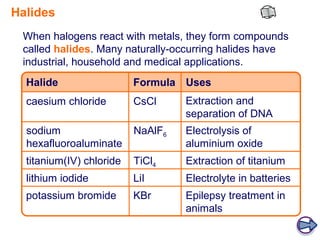
Halides
 When halogens react with metals, they form compounds
 called halides. Many naturally-occurring halides have
 industrial, household and medical applications.
  Halide                  Formula Uses
  caesium chloride        CsCl     Extraction and
                                   separation of DNA
  sodium                  NaAlF6   Electrolysis of
  hexafluoroaluminate              aluminium oxide
  titanium(IV) chloride   TiCl4    Extraction of titanium
  lithium iodide          LiI      Electrolyte in batteries
  potassium bromide       KBr      Epilepsy treatment in
                                   animals
Identifying halide ions
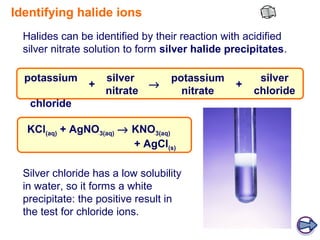
  Halides can be identified by their reaction with acidified
  silver nitrate solution to form silver halide precipitates.

  potassium         silver         potassium          silver
                +           →                    +
                    nitrate          nitrate         chloride
   chloride

  KCl(aq) + AgNO3(aq) → KNO3(aq)
                        + AgCl(s)

  Silver chloride has a low solubility
  in water, so it forms a white
  precipitate: the positive result in
  the test for chloride ions.
William Fox Talbot
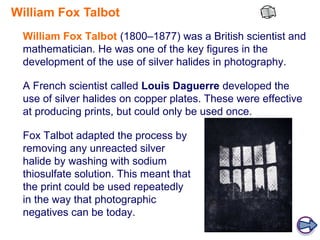
 William Fox Talbot (1800–1877) was a British scientist and
 mathematician. He was one of the key figures in the
 development of the use of silver halides in photography.

 A French scientist called Louis Daguerre developed the
 use of silver halides on copper plates. These were effective
 at producing prints, but could only be used once.

 Fox Talbot adapted the process by
 removing any unreacted silver
 halide by washing with sodium
 thiosulfate solution. This meant that
 the print could be used repeatedly
 in the way that photographic
 negatives can be today.
Hydrogen halides
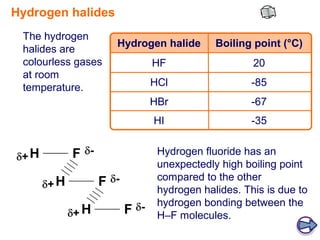
 The hydrogen
                    Hydrogen halide    Boiling point (°C)
 halides are
 colourless gases         HF                   20
 at room
 temperature.            HCl                   -85
                         HBr                   -67
                          HI                   -35

                           Hydrogen fluoride has an
                           unexpectedly high boiling point
                           compared to the other
                           hydrogen halides. This is due to
                           hydrogen bonding between the
                           H–F molecules.
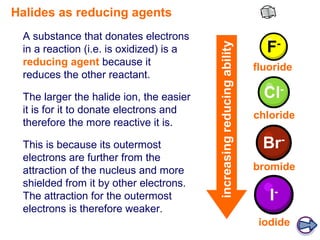
Halides as reducing agents
 A substance that donates electrons


                                         increasing reducing ability
 in a reaction (i.e. is oxidized) is a
 reducing agent because it                                             fluoride
 reduces the other reactant.

 The larger the halide ion, the easier
 it is for it to donate electrons and
                                                                       chloride
 therefore the more reactive it is.

 This is because its outermost
 electrons are further from the
 attraction of the nucleus and more                                    bromide
 shielded from it by other electrons.
 The attraction for the outermost
 electrons is therefore weaker.
                                                                        iodide

6. halides

  • 1.
    3.3.1 Chem. Properties of groups Chem. Properties of groups •Discuss the similarities and differences in the chemical properties of elements in the same group
  • 2.
    Halides When halogensreact with metals, they form compounds called halides. Many naturally-occurring halides have industrial, household and medical applications. Halide Formula Uses caesium chloride CsCl Extraction and separation of DNA sodium NaAlF6 Electrolysis of hexafluoroaluminate aluminium oxide titanium(IV) chloride TiCl4 Extraction of titanium lithium iodide LiI Electrolyte in batteries potassium bromide KBr Epilepsy treatment in animals
  • 3.
    Identifying halide ions Halides can be identified by their reaction with acidified silver nitrate solution to form silver halide precipitates. potassium silver potassium silver + → + nitrate nitrate chloride chloride KCl(aq) + AgNO3(aq) → KNO3(aq) + AgCl(s) Silver chloride has a low solubility in water, so it forms a white precipitate: the positive result in the test for chloride ions.
  • 4.
    William Fox Talbot William Fox Talbot (1800–1877) was a British scientist and mathematician. He was one of the key figures in the development of the use of silver halides in photography. A French scientist called Louis Daguerre developed the use of silver halides on copper plates. These were effective at producing prints, but could only be used once. Fox Talbot adapted the process by removing any unreacted silver halide by washing with sodium thiosulfate solution. This meant that the print could be used repeatedly in the way that photographic negatives can be today.
  • 5.
    Hydrogen halides Thehydrogen Hydrogen halide Boiling point (°C) halides are colourless gases HF 20 at room temperature. HCl -85 HBr -67 HI -35 Hydrogen fluoride has an unexpectedly high boiling point compared to the other hydrogen halides. This is due to hydrogen bonding between the H–F molecules.
  • 6.
    Halides as reducingagents A substance that donates electrons increasing reducing ability in a reaction (i.e. is oxidized) is a reducing agent because it fluoride reduces the other reactant. The larger the halide ion, the easier it is for it to donate electrons and chloride therefore the more reactive it is. This is because its outermost electrons are further from the attraction of the nucleus and more bromide shielded from it by other electrons. The attraction for the outermost electrons is therefore weaker. iodide

Editor's Notes

  • #3 Boardworks AS Chemistry Halogens Teacher notes Sodium hexafluoroaluminate is commonly known as cryolite. See the ‘ Redox Reactions ’ presentation for more information about the electrolysis of aluminium oxide and the extraction of titanium.
  • #4 Boardworks AS Chemistry Halogens Photo credit: Martyn F. Chillmaid / Science Photo Library Teacher notes The equation shows the reaction behind the detection of chloride ions in potassium chloride.
  • #5 Boardworks AS Chemistry Halogens Teacher notes The picture shown is an image by Talbot of a latticed window in Lacock Abbey in 1835. It is a print from the oldest photographic negative in existence. Images produced using Daguerre’s method are called daguerrotypes. Fox Talbot’s Pencil of Nature (1844) was the first book to be illustrated with photographs. Fox Talbot also made major contributions to the development of photography as an artistic medium.
  • #6 Boardworks AS Chemistry Halogens Teacher notes The hydrogen-fluorine bond is highly polar because fluorine is much more electronegative than hydrogen, and each fluorine atom in HF has three lone pairs of electrons. The hydrogen atoms therefore have a partial positive charge and the fluorine atoms have a partial negative charge. A lone pair of electrons on the fluorine atom in one molecule is attracted to the δ + hydrogen atom in a neighbouring molecule. This increases the strength of intermolecular forces, which increases the boiling point. The bonds in the other hydrogen halides are less polar because the other halogen atoms are less electronegative than fluorine. The lone pairs on the other halogen atoms are also in higher energy levels so their charge is less concentrated. Students could be asked to predict the boiling point of HAt. See the ‘ Bonding and Intermolecular Forces ’ presentation for more information about hydrogen bonding.
  • #7 Boardworks AS Chemistry Halogens Teacher notes See the ‘ Trends in Period 3 ’ presentation for more information about shielding.