Group 2 Elements
The Alkaline Earth Metals
Revision Slides
What are they?
• The elements in group 2 are sometimes called the alkaline earth
metals, as their oxides and hydroxides are alkaline.
• They are similar in many ways to group one but are less reactive.
• Beryllium is not typical of the group, however, and is thus not
considered here.
Trends in Atomic Radius
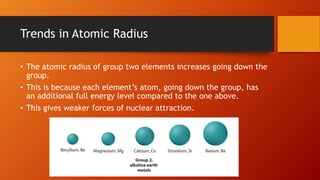
• The atomic radius of group two elements increases going down the
group.
• This is because each element’s atom, going down the group, has
an additional full energy level compared to the one above.
• This gives weaker forces of nuclear attraction.
Trend in Melting Points and Boiling Points
• Group two elements have high melting points, typical of giant
metallic structures.
• Going down the group, the delocalised electrons in the sea are
further away from the positively charged nuclei and, as a result,
the strength of metallic bonds decreases going down the group.
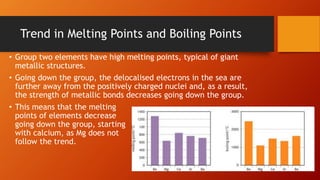
• This means that the melting
points of elements decrease
going down the group, starting
with calcium, as Mg does not
follow the trend.
Reactivity with Water
• With water, there is a trend in reactivity, increasing going down the
group. The basic reaction is as follows:
- M + 2H2O M(OH)2 + H2
• Magnesium hydroxide is called milk of magnesia and is a remedy for
indigestion, neutralising excess stomach acid.
• They react differently with steam to cold water, forming a alkaline oxide
and hydrogen.
- M + H2O  MO + H2
• Calcium oxide, slaked lime, is used to neutralise acidic soil.
M represents
the group two
element.
Solubility of Hydroxides
• There is a clear trend in solubilities- going down the group, they
become more soluble.
• The hydroxides are all white solids. Magnesium hydroxide is almost
insoluble and is sold as a suspension in water, rather than as a
solution.
• Calcium hydroxide is sparingly soluble and a solution is used as
limewater.
• Strontium hydroxide is more soluble, and barium hydroxide
produces a strongly alkaline solution.
Solubility of Sulfates
• The solubility of sulfates runs in the opposite direction- decreases
going down the group.
• This makes barium sulfate virtually insoluble. It is toxic, but is
used as barium meal to outline the gut in x-rays. As it’s insoluble,
it is not absorbed by the body and thus will not transfer the
toxicity to bodily systems.
• Its also used to test for sulfate ions in a solution. The solution is
acidified with nitric or hydrochloric acid and then barium chloride
solution is added. If there is a white precipitate then sulfate ions
are present.
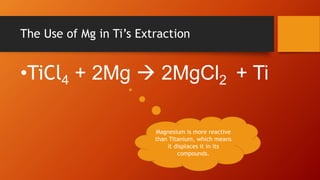
The Use of Mg in Ti’s Extraction
•TiCl4 + 2Mg  2MgCl2 + Ti
Magnesium is more reactive
than Titanium, which means
it displaces it in its
compounds.
Flue Gas Desulfurisation
• Calcium oxide and water are sprayed into the flue gas which
reacts to form calcium sulfite which can further be oxidised to
form calcium sulfate, also called gypsum. The overall reaction is
as follows:
- CaO + 2H2O + SO2 + ½O2  CaSO4∙H2O
• Gypsum is sold to be used in builders’ plaster or plasterboard.
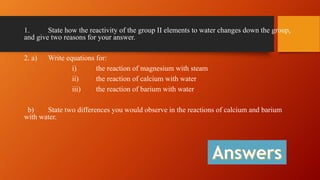
1. State how the reactivity of the group II elements to water changes down the group,
and give two reasons for your answer.
2. a) Write equations for:
i) the reaction of magnesium with steam
ii) the reaction of calcium with water
iii) the reaction of barium with water
b) State two differences you would observe in the reactions of calcium and barium
with water.
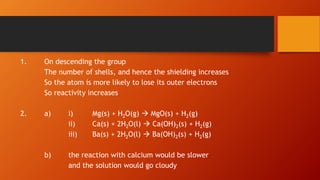
1. On descending the group
The number of shells, and hence the shielding increases
So the atom is more likely to lose its outer electrons
So reactivity increases
2. a) i) Mg(s) + H2O(g)  MgO(s) + H2(g)
ii) Ca(s) + 2H2O(l)  Ca(OH)2(s) + H2(g)
iii) Ba(s) + 2H2O(l)  Ba(OH)2(s) + H2(g)
b) the reaction with calcium would be slower
and the solution would go cloudy

Group 2- The Alkaline Earth Metals

  • 1.
    Group 2 Elements TheAlkaline Earth Metals Revision Slides
  • 2.
    What are they? •The elements in group 2 are sometimes called the alkaline earth metals, as their oxides and hydroxides are alkaline. • They are similar in many ways to group one but are less reactive. • Beryllium is not typical of the group, however, and is thus not considered here.
  • 3.
    Trends in AtomicRadius • The atomic radius of group two elements increases going down the group. • This is because each element’s atom, going down the group, has an additional full energy level compared to the one above. • This gives weaker forces of nuclear attraction.
  • 4.
    Trend in MeltingPoints and Boiling Points • Group two elements have high melting points, typical of giant metallic structures. • Going down the group, the delocalised electrons in the sea are further away from the positively charged nuclei and, as a result, the strength of metallic bonds decreases going down the group. • This means that the melting points of elements decrease going down the group, starting with calcium, as Mg does not follow the trend.
  • 5.
    Reactivity with Water •With water, there is a trend in reactivity, increasing going down the group. The basic reaction is as follows: - M + 2H2O M(OH)2 + H2 • Magnesium hydroxide is called milk of magnesia and is a remedy for indigestion, neutralising excess stomach acid. • They react differently with steam to cold water, forming a alkaline oxide and hydrogen. - M + H2O  MO + H2 • Calcium oxide, slaked lime, is used to neutralise acidic soil. M represents the group two element.
  • 6.
    Solubility of Hydroxides •There is a clear trend in solubilities- going down the group, they become more soluble. • The hydroxides are all white solids. Magnesium hydroxide is almost insoluble and is sold as a suspension in water, rather than as a solution. • Calcium hydroxide is sparingly soluble and a solution is used as limewater. • Strontium hydroxide is more soluble, and barium hydroxide produces a strongly alkaline solution.
  • 7.
    Solubility of Sulfates •The solubility of sulfates runs in the opposite direction- decreases going down the group. • This makes barium sulfate virtually insoluble. It is toxic, but is used as barium meal to outline the gut in x-rays. As it’s insoluble, it is not absorbed by the body and thus will not transfer the toxicity to bodily systems. • Its also used to test for sulfate ions in a solution. The solution is acidified with nitric or hydrochloric acid and then barium chloride solution is added. If there is a white precipitate then sulfate ions are present.
  • 8.
    The Use ofMg in Ti’s Extraction •TiCl4 + 2Mg  2MgCl2 + Ti Magnesium is more reactive than Titanium, which means it displaces it in its compounds.
  • 9.
    Flue Gas Desulfurisation •Calcium oxide and water are sprayed into the flue gas which reacts to form calcium sulfite which can further be oxidised to form calcium sulfate, also called gypsum. The overall reaction is as follows: - CaO + 2H2O + SO2 + ½O2  CaSO4∙H2O • Gypsum is sold to be used in builders’ plaster or plasterboard.
  • 10.
    1. State howthe reactivity of the group II elements to water changes down the group, and give two reasons for your answer. 2. a) Write equations for: i) the reaction of magnesium with steam ii) the reaction of calcium with water iii) the reaction of barium with water b) State two differences you would observe in the reactions of calcium and barium with water.
  • 11.
    1. On descendingthe group The number of shells, and hence the shielding increases So the atom is more likely to lose its outer electrons So reactivity increases 2. a) i) Mg(s) + H2O(g)  MgO(s) + H2(g) ii) Ca(s) + 2H2O(l)  Ca(OH)2(s) + H2(g) iii) Ba(s) + 2H2O(l)  Ba(OH)2(s) + H2(g) b) the reaction with calcium would be slower and the solution would go cloudy