Le Chatelier’s principle
Whenever a change is made to a reversible reaction in
dynamic equilibrium, the equilibrium will shift to try and
oppose the change.
Le Chatelier’s principle
 Whenever a change is made to a reversible reaction in
 dynamic equilibrium, the equilibrium will shift to try and
 oppose the change.

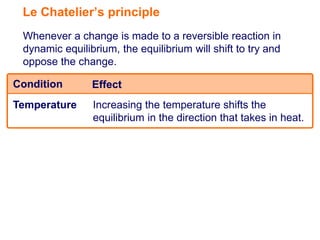
Condition       Effect
Temperature     Increasing the temperature shifts the
                equilibrium in the direction that takes in heat.
Le Chatelier’s principle
  Whenever a change is made to a reversible reaction in
  dynamic equilibrium, the equilibrium will shift to try and
  oppose the change.

Condition        Effect
Temperature      Increasing the temperature shifts the
                 equilibrium in the direction that takes in heat.

Concentration Increasing the concentration of a substance
              shifts the equilibrium in the direction that
              produces less of that substance.
Le Chatelier’s principle
  Whenever a change is made to a reversible reaction in
  dynamic equilibrium, the equilibrium will shift to try and
  oppose the change.

Condition        Effect
Temperature      Increasing the temperature shifts the
                 equilibrium in the direction that takes in heat.

Concentration Increasing the concentration of a substance
              shifts the equilibrium in the direction that
              produces less of that substance.
Pressure         Increasing the pressure shifts the equilibrium
                 in the direction that produces less gas.

1

  • 1.
  • 2.
    Le Chatelier’s principle Whenevera change is made to a reversible reaction in dynamic equilibrium, the equilibrium will shift to try and oppose the change.
  • 3.
    Le Chatelier’s principle Whenever a change is made to a reversible reaction in dynamic equilibrium, the equilibrium will shift to try and oppose the change. Condition Effect Temperature Increasing the temperature shifts the equilibrium in the direction that takes in heat.
  • 4.
    Le Chatelier’s principle Whenever a change is made to a reversible reaction in dynamic equilibrium, the equilibrium will shift to try and oppose the change. Condition Effect Temperature Increasing the temperature shifts the equilibrium in the direction that takes in heat. Concentration Increasing the concentration of a substance shifts the equilibrium in the direction that produces less of that substance.
  • 5.
    Le Chatelier’s principle Whenever a change is made to a reversible reaction in dynamic equilibrium, the equilibrium will shift to try and oppose the change. Condition Effect Temperature Increasing the temperature shifts the equilibrium in the direction that takes in heat. Concentration Increasing the concentration of a substance shifts the equilibrium in the direction that produces less of that substance. Pressure Increasing the pressure shifts the equilibrium in the direction that produces less gas.