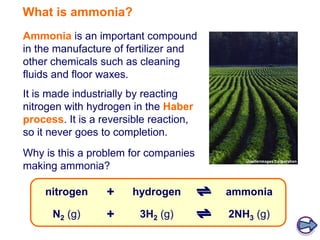
Ammonia is produced industrially through the Haber process, which involves reacting nitrogen and hydrogen at high pressures and temperatures. However, the reaction is reversible and does not go to completion. To maximize yield while keeping costs low, manufacturers use a compromise of 450°C and 200 atmospheres, as extremely high pressures require expensive equipment and low temperatures slow the reaction rate. Key costs in ammonia production include raw materials, energy, equipment, wages. Yield is maximized by using a catalyst, removing ammonia as it forms, and recycling unreacted gases.