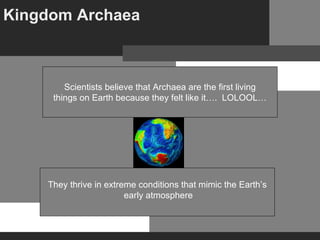
Kingdom Archaea      They thrive in extreme conditions that mimic the Earth’s early atmosphere Scientists believe that Archaea are the first living things on Earth because they felt like it….  LOLOOL…
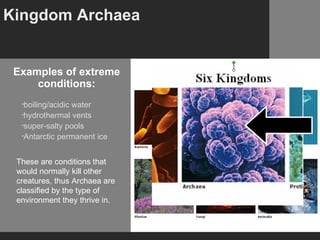
Examples of extreme conditions: Kingdom Archaea boiling/acidic water hydrothermal vents super-salty pools Antarctic permanent ice These are conditions that would normally kill other creatures, thus Archaea are classified by the type of environment they thrive in.
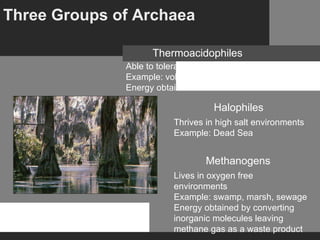
Thermoacidophiles Three Groups of Archaea         Methanogens Able to tolerate extreme temperature & acidity  Example: volcanoes, hot springs Energy obtained from sulfur Halophiles Thrives in high salt environments Example: Dead Sea Lives in oxygen free environments Example: swamp, marsh, sewage Energy obtained by converting inorganic molecules leaving methane gas as a waste product
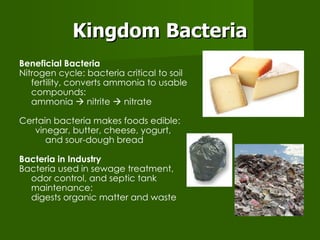
Kingdom Bacteria Beneficial Bacteria Nitrogen cycle: bacteria critical to soil fertility, converts ammonia to usable compounds: ammonia    nitrite    nitrate  Certain bacteria makes foods edible: vinegar, butter, cheese, yogurt, and sour-dough bread Bacteria in Industry Bacteria used in sewage treatment, odor control, and septic tank maintenance: digests organic matter and waste
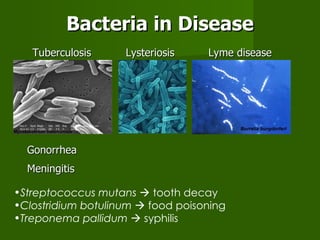
Bacteria in Disease Tuberculosis Lysteriosis Lyme disease Meningitis Gonorrhea Streptococcus mutans     tooth decay  Clostridium botulinum     food poisoning Treponema pallidum     syphilis
Bacterial Classification Shape – 3 types (more details to follow) Cell Wall – 2 types (more details to follow) Energy Source – 2 types Photosynthetic: obtain energy from light Chemosynthetic: obtain energy from inorganic compounds
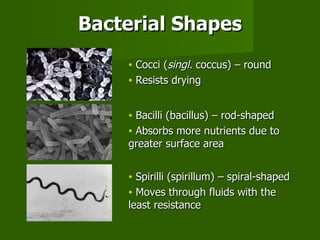
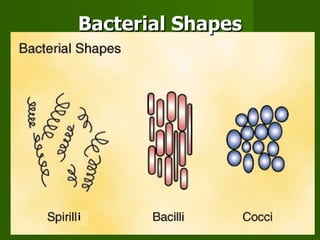
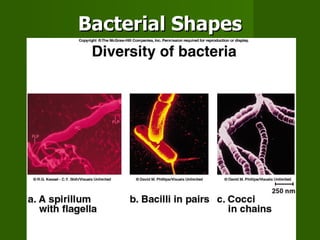
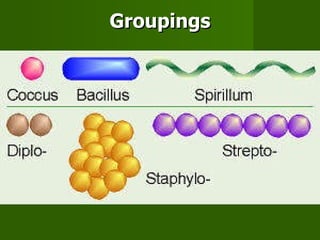
Bacterial Shapes Cocci ( singl.  coccus) – round  Resists drying Bacilli (bacillus) – rod-shaped  Absorbs more nutrients due to greater surface area Spirilli (spirillum) – spiral-shaped  Moves through fluids with the least resistance
Bacterial Shapes i
Bacterial Shapes
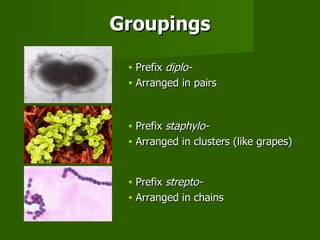
Groupings Prefix  diplo- Arranged in pairs Prefix  staphylo- Arranged in clusters (like grapes) Prefix  strepto- Arranged in chains
Groupings
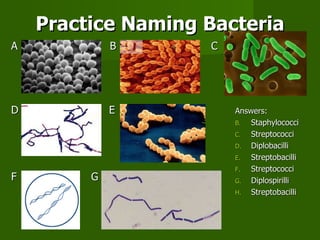
Practice Naming Bacteria A Answers: Staphylococci Streptococci Diplobacilli Streptobacilli Streptococci Diplospirilli Streptobacilli D C B G F E
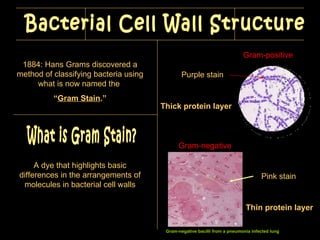
1884: Hans Grams discovered a method of classifying bacteria using what is now named the  “ Gram Stain .” What is Gram Stain? A dye that highlights basic differences in the arrangements of molecules in bacterial cell walls Bacterial Cell Wall Structure  Gram-negative bacilli  from  a pneumonia  infected  lu ng Gram-positive Purple stain Thick protein layer Gram-negative Pink stain Thin protein layer
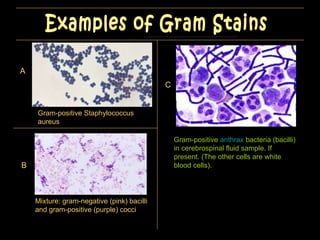
A B Examples of Gram Stains Gram-positive  anthrax  bacteria ( bacilli ) in  cerebrospinal fluid  sample. If present. (The other cells are  white blood cells ). Gram-positive Staphylococcus aureus Mixture:  gram-negative (pink) bacilli and gram-positive (purple) cocci C
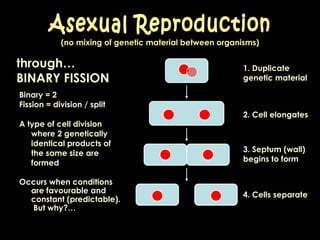
(no mixing of genetic material between organisms) Binary = 2 Fission = division / split A type of cell division where 2 genetically identical products of the same size are formed Asexual Reproduction through… BINARY FISSION Occurs when conditions are favourable and constant (predictable).  But why?… 1. Duplicate genetic material   2. Cell elongates  3. Septum (wall) begins to form 4. Cells separate
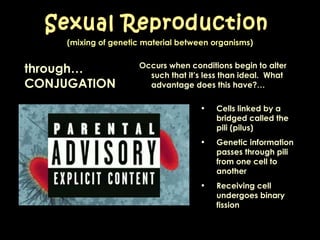
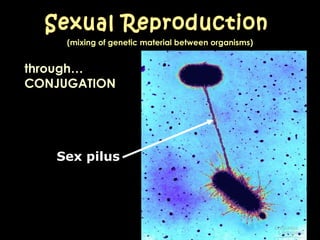
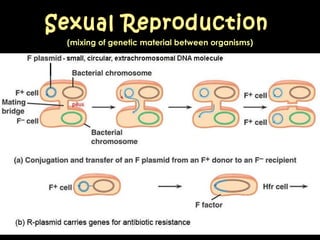
(mixing of genetic material between organisms) Occurs when conditions begin to alter such that it’s less than ideal.  What advantage does this have?… Sexual Reproduction through… CONJUGATION Cells linked by a bridged called the pili (pilus)   Genetic information passes through pili from one cell to another  Receiving cell undergoes binary fission
(mixing of genetic material between organisms) Sexual Reproduction through… CONJUGATION Sex pilus
(mixing of genetic material between organisms) Sexual Reproduction
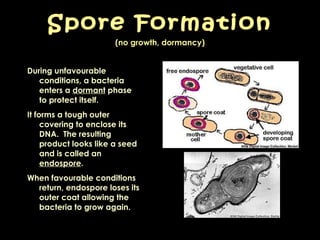
(no growth, dormancy) During unfavourable conditions, a bacteria enters a  dormant  phase to protect itself.  It forms a tough outer covering to enclose its DNA.  The resulting product looks like a seed and is called an  endospore . When favourable conditions return, endospore loses its outer coat allowing the bacteria to grow again. Spore Formation
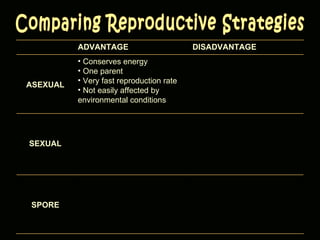
Comparing Reproductive Strategies ADVANTAGE DISADVANTAGE ASEXUAL SEXUAL SPORE
Comparing Reproductive Strategies ADVANTAGE DISADVANTAGE ASEXUAL Conserves energy One parent Very fast reproduction rate Not easily affected by environmental conditions SEXUAL SPORE
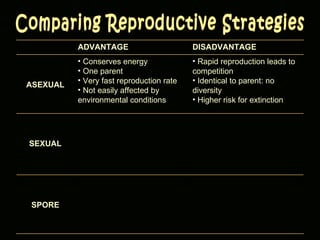
Comparing Reproductive Strategies ADVANTAGE DISADVANTAGE ASEXUAL Conserves energy One parent Very fast reproduction rate Not easily affected by environmental conditions Rapid reproduction leads to competition Identical to parent: no diversity Higher risk for extinction SEXUAL SPORE
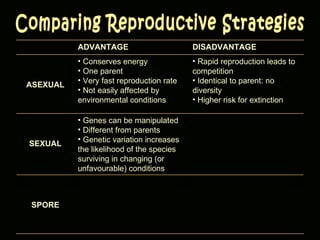
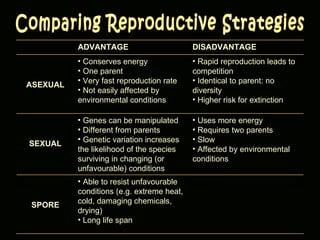
Comparing Reproductive Strategies ADVANTAGE DISADVANTAGE ASEXUAL Conserves energy One parent Very fast reproduction rate Not easily affected by environmental conditions Rapid reproduction leads to competition Identical to parent: no diversity Higher risk for extinction SEXUAL Genes can be manipulated Different from parents Genetic variation increases the likelihood of the species surviving in changing (or unfavourable) conditions SPORE
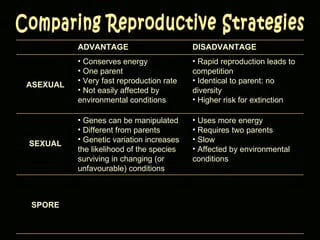
Comparing Reproductive Strategies ADVANTAGE DISADVANTAGE ASEXUAL Conserves energy One parent Very fast reproduction rate Not easily affected by environmental conditions Rapid reproduction leads to competition Identical to parent: no diversity Higher risk for extinction SEXUAL Genes can be manipulated Different from parents Genetic variation increases the likelihood of the species surviving in changing (or unfavourable) conditions Uses more energy Requires two parents Slow Affected by environmental conditions SPORE
Comparing Reproductive Strategies ADVANTAGE DISADVANTAGE ASEXUAL Conserves energy One parent Very fast reproduction rate Not easily affected by environmental conditions Rapid reproduction leads to competition Identical to parent: no diversity Higher risk for extinction SEXUAL Genes can be manipulated Different from parents Genetic variation increases the likelihood of the species surviving in changing (or unfavourable) conditions Uses more energy Requires two parents Slow Affected by environmental conditions SPORE Able to resist unfavourable conditions (e.g. extreme heat, cold, damaging chemicals, drying) Long life span
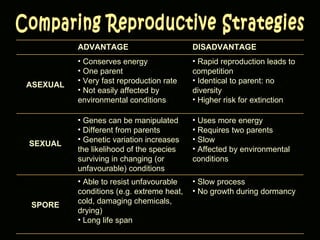
Comparing Reproductive Strategies ADVANTAGE DISADVANTAGE ASEXUAL Conserves energy One parent Very fast reproduction rate Not easily affected by environmental conditions Rapid reproduction leads to competition Identical to parent: no diversity Higher risk for extinction SEXUAL Genes can be manipulated Different from parents Genetic variation increases the likelihood of the species surviving in changing (or unfavourable) conditions Uses more energy Requires two parents Slow Affected by environmental conditions SPORE Able to resist unfavourable conditions (e.g. extreme heat, cold, damaging chemicals, drying) Long life span Slow process No growth during dormancy
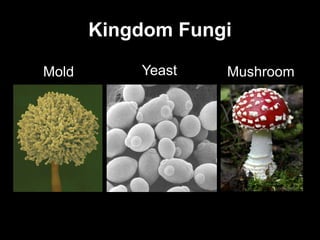
Kingdom Fungi Yeast Mold Mushroom
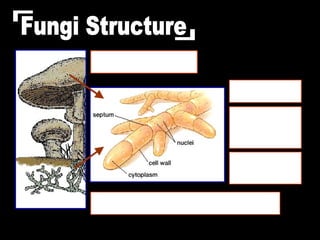
Mushroom:  Specialized reproductive part of fungus Mycelium:  loose, branching network of hyphae under the soil making up the main bulk of a fungus Septum:  porous walls that divide the hyphae into cells Chitin:  material that forms the cell wall of fungi Hyphae:   network of fine filaments Fungi Structure
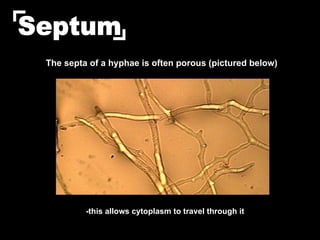
The septa of a hyphae is often porous (pictured below) -this allows cytoplasm to travel through it Septum
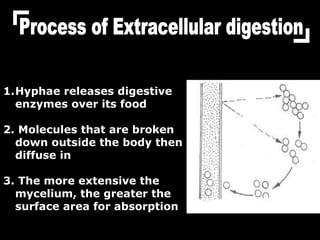
Hyphae releases digestive enzymes over its food  2. Molecules that are broken down outside the body then diffuse in 3. The more extensive the mycelium, the greater the surface area for absorption Process of Extracellular digestion 1 1 2
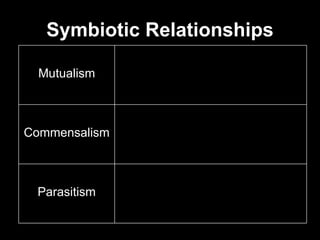
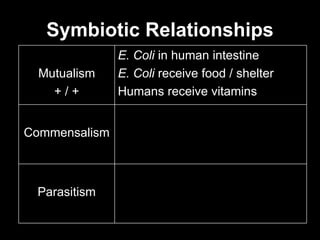
Symbiotic Relationships Mutualism Commensalism Parasitism
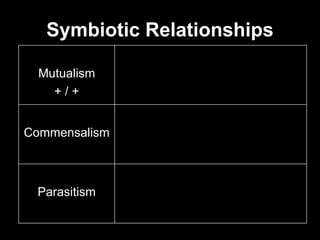
Symbiotic Relationships Mutualism + / + Commensalism Parasitism
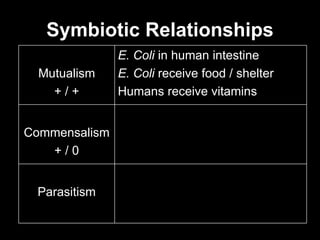
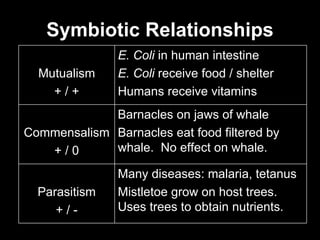
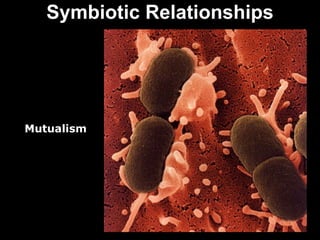
Symbiotic Relationships Mutualism + / + E. Coli  in human intestine E. Coli  receive food / shelter Humans receive vitamins Commensalism Parasitism
Symbiotic Relationships Mutualism + / + E. Coli  in human intestine E. Coli  receive food / shelter Humans receive vitamins Commensalism + / 0 Parasitism
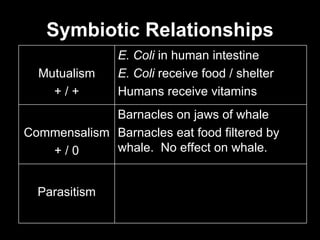
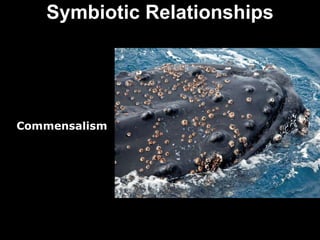
Symbiotic Relationships Mutualism + / + E. Coli  in human intestine E. Coli  receive food / shelter Humans receive vitamins Commensalism + / 0 Barnacles on jaws of whale Barnacles eat food filtered by whale.  No effect on whale. Parasitism
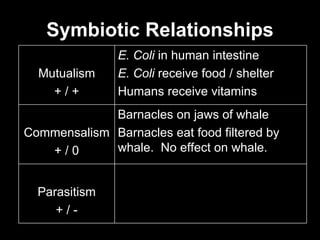
Symbiotic Relationships Mutualism + / + E. Coli  in human intestine E. Coli  receive food / shelter Humans receive vitamins Commensalism + / 0 Barnacles on jaws of whale Barnacles eat food filtered by whale.  No effect on whale. Parasitism + / -
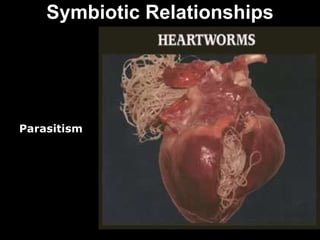
Symbiotic Relationships Mutualism + / + E. Coli  in human intestine E. Coli  receive food / shelter Humans receive vitamins Commensalism + / 0 Barnacles on jaws of whale Barnacles eat food filtered by whale.  No effect on whale. Parasitism + / - Many diseases: malaria, tetanus Mistletoe grow on host trees.  Uses trees to obtain nutrients.
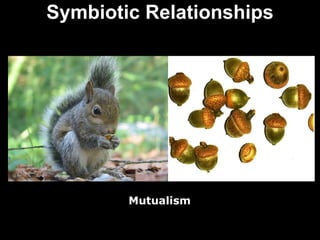
Symbiotic Relationships Mutualism
Symbiotic Relationships Commensalism
Symbiotic Relationships Parasitism
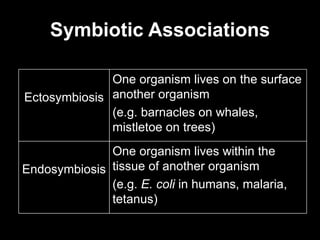
Symbiotic Associations Ectosymbiosis Endosymbiosis
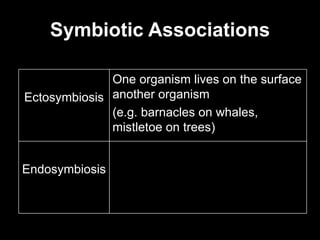
Symbiotic Associations Ectosymbiosis One organism lives on the surface another organism (e.g. barnacles on whales, mistletoe on trees) Endosymbiosis
Symbiotic Associations Ectosymbiosis One organism lives on the surface another organism (e.g. barnacles on whales, mistletoe on trees) Endosymbiosis One organism lives within the tissue of another organism (e.g.  E. coli  in humans, malaria, tetanus)
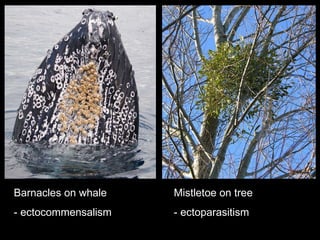
Barnacles on whale - ectocommensalism Mistletoe on tree - ectoparasitism

04 archae + bacteria

  • 1.
    Kingdom Archaea     They thrive in extreme conditions that mimic the Earth’s early atmosphere Scientists believe that Archaea are the first living things on Earth because they felt like it…. LOLOOL…
  • 2.
    Examples of extremeconditions: Kingdom Archaea boiling/acidic water hydrothermal vents super-salty pools Antarctic permanent ice These are conditions that would normally kill other creatures, thus Archaea are classified by the type of environment they thrive in.
  • 3.
    Thermoacidophiles Three Groupsof Archaea         Methanogens Able to tolerate extreme temperature & acidity Example: volcanoes, hot springs Energy obtained from sulfur Halophiles Thrives in high salt environments Example: Dead Sea Lives in oxygen free environments Example: swamp, marsh, sewage Energy obtained by converting inorganic molecules leaving methane gas as a waste product
  • 4.
    Kingdom Bacteria BeneficialBacteria Nitrogen cycle: bacteria critical to soil fertility, converts ammonia to usable compounds: ammonia  nitrite  nitrate Certain bacteria makes foods edible: vinegar, butter, cheese, yogurt, and sour-dough bread Bacteria in Industry Bacteria used in sewage treatment, odor control, and septic tank maintenance: digests organic matter and waste
  • 5.
    Bacteria in DiseaseTuberculosis Lysteriosis Lyme disease Meningitis Gonorrhea Streptococcus mutans  tooth decay Clostridium botulinum  food poisoning Treponema pallidum  syphilis
  • 6.
    Bacterial Classification Shape– 3 types (more details to follow) Cell Wall – 2 types (more details to follow) Energy Source – 2 types Photosynthetic: obtain energy from light Chemosynthetic: obtain energy from inorganic compounds
  • 7.
    Bacterial Shapes Cocci( singl. coccus) – round Resists drying Bacilli (bacillus) – rod-shaped Absorbs more nutrients due to greater surface area Spirilli (spirillum) – spiral-shaped Moves through fluids with the least resistance
  • 8.
  • 9.
  • 10.
    Groupings Prefix diplo- Arranged in pairs Prefix staphylo- Arranged in clusters (like grapes) Prefix strepto- Arranged in chains
  • 11.
  • 12.
    Practice Naming BacteriaA Answers: Staphylococci Streptococci Diplobacilli Streptobacilli Streptococci Diplospirilli Streptobacilli D C B G F E
  • 13.
    1884: Hans Gramsdiscovered a method of classifying bacteria using what is now named the “ Gram Stain .” What is Gram Stain? A dye that highlights basic differences in the arrangements of molecules in bacterial cell walls Bacterial Cell Wall Structure Gram-negative bacilli from a pneumonia infected lu ng Gram-positive Purple stain Thick protein layer Gram-negative Pink stain Thin protein layer
  • 14.
    A B Examplesof Gram Stains Gram-positive anthrax bacteria ( bacilli ) in cerebrospinal fluid sample. If present. (The other cells are white blood cells ). Gram-positive Staphylococcus aureus Mixture: gram-negative (pink) bacilli and gram-positive (purple) cocci C
  • 15.
    (no mixing ofgenetic material between organisms) Binary = 2 Fission = division / split A type of cell division where 2 genetically identical products of the same size are formed Asexual Reproduction through… BINARY FISSION Occurs when conditions are favourable and constant (predictable). But why?… 1. Duplicate genetic material 2. Cell elongates 3. Septum (wall) begins to form 4. Cells separate
  • 16.
    (mixing of geneticmaterial between organisms) Occurs when conditions begin to alter such that it’s less than ideal. What advantage does this have?… Sexual Reproduction through… CONJUGATION Cells linked by a bridged called the pili (pilus) Genetic information passes through pili from one cell to another Receiving cell undergoes binary fission
  • 17.
    (mixing of geneticmaterial between organisms) Sexual Reproduction through… CONJUGATION Sex pilus
  • 18.
    (mixing of geneticmaterial between organisms) Sexual Reproduction
  • 19.
    (no growth, dormancy)During unfavourable conditions, a bacteria enters a dormant phase to protect itself. It forms a tough outer covering to enclose its DNA. The resulting product looks like a seed and is called an endospore . When favourable conditions return, endospore loses its outer coat allowing the bacteria to grow again. Spore Formation
  • 20.
    Comparing Reproductive StrategiesADVANTAGE DISADVANTAGE ASEXUAL SEXUAL SPORE
  • 21.
    Comparing Reproductive StrategiesADVANTAGE DISADVANTAGE ASEXUAL Conserves energy One parent Very fast reproduction rate Not easily affected by environmental conditions SEXUAL SPORE
  • 22.
    Comparing Reproductive StrategiesADVANTAGE DISADVANTAGE ASEXUAL Conserves energy One parent Very fast reproduction rate Not easily affected by environmental conditions Rapid reproduction leads to competition Identical to parent: no diversity Higher risk for extinction SEXUAL SPORE
  • 23.
    Comparing Reproductive StrategiesADVANTAGE DISADVANTAGE ASEXUAL Conserves energy One parent Very fast reproduction rate Not easily affected by environmental conditions Rapid reproduction leads to competition Identical to parent: no diversity Higher risk for extinction SEXUAL Genes can be manipulated Different from parents Genetic variation increases the likelihood of the species surviving in changing (or unfavourable) conditions SPORE
  • 24.
    Comparing Reproductive StrategiesADVANTAGE DISADVANTAGE ASEXUAL Conserves energy One parent Very fast reproduction rate Not easily affected by environmental conditions Rapid reproduction leads to competition Identical to parent: no diversity Higher risk for extinction SEXUAL Genes can be manipulated Different from parents Genetic variation increases the likelihood of the species surviving in changing (or unfavourable) conditions Uses more energy Requires two parents Slow Affected by environmental conditions SPORE
  • 25.
    Comparing Reproductive StrategiesADVANTAGE DISADVANTAGE ASEXUAL Conserves energy One parent Very fast reproduction rate Not easily affected by environmental conditions Rapid reproduction leads to competition Identical to parent: no diversity Higher risk for extinction SEXUAL Genes can be manipulated Different from parents Genetic variation increases the likelihood of the species surviving in changing (or unfavourable) conditions Uses more energy Requires two parents Slow Affected by environmental conditions SPORE Able to resist unfavourable conditions (e.g. extreme heat, cold, damaging chemicals, drying) Long life span
  • 26.
    Comparing Reproductive StrategiesADVANTAGE DISADVANTAGE ASEXUAL Conserves energy One parent Very fast reproduction rate Not easily affected by environmental conditions Rapid reproduction leads to competition Identical to parent: no diversity Higher risk for extinction SEXUAL Genes can be manipulated Different from parents Genetic variation increases the likelihood of the species surviving in changing (or unfavourable) conditions Uses more energy Requires two parents Slow Affected by environmental conditions SPORE Able to resist unfavourable conditions (e.g. extreme heat, cold, damaging chemicals, drying) Long life span Slow process No growth during dormancy
  • 27.
    Kingdom Fungi YeastMold Mushroom
  • 28.
    Mushroom: Specializedreproductive part of fungus Mycelium: loose, branching network of hyphae under the soil making up the main bulk of a fungus Septum: porous walls that divide the hyphae into cells Chitin: material that forms the cell wall of fungi Hyphae: network of fine filaments Fungi Structure
  • 29.
    The septa ofa hyphae is often porous (pictured below) -this allows cytoplasm to travel through it Septum
  • 30.
    Hyphae releases digestiveenzymes over its food 2. Molecules that are broken down outside the body then diffuse in 3. The more extensive the mycelium, the greater the surface area for absorption Process of Extracellular digestion 1 1 2
  • 31.
    Symbiotic Relationships MutualismCommensalism Parasitism
  • 32.
    Symbiotic Relationships Mutualism+ / + Commensalism Parasitism
  • 33.
    Symbiotic Relationships Mutualism+ / + E. Coli in human intestine E. Coli receive food / shelter Humans receive vitamins Commensalism Parasitism
  • 34.
    Symbiotic Relationships Mutualism+ / + E. Coli in human intestine E. Coli receive food / shelter Humans receive vitamins Commensalism + / 0 Parasitism
  • 35.
    Symbiotic Relationships Mutualism+ / + E. Coli in human intestine E. Coli receive food / shelter Humans receive vitamins Commensalism + / 0 Barnacles on jaws of whale Barnacles eat food filtered by whale. No effect on whale. Parasitism
  • 36.
    Symbiotic Relationships Mutualism+ / + E. Coli in human intestine E. Coli receive food / shelter Humans receive vitamins Commensalism + / 0 Barnacles on jaws of whale Barnacles eat food filtered by whale. No effect on whale. Parasitism + / -
  • 37.
    Symbiotic Relationships Mutualism+ / + E. Coli in human intestine E. Coli receive food / shelter Humans receive vitamins Commensalism + / 0 Barnacles on jaws of whale Barnacles eat food filtered by whale. No effect on whale. Parasitism + / - Many diseases: malaria, tetanus Mistletoe grow on host trees. Uses trees to obtain nutrients.
  • 38.
  • 39.
  • 40.
  • 41.
  • 42.
  • 43.
    Symbiotic Associations EctosymbiosisOne organism lives on the surface another organism (e.g. barnacles on whales, mistletoe on trees) Endosymbiosis
  • 44.
    Symbiotic Associations EctosymbiosisOne organism lives on the surface another organism (e.g. barnacles on whales, mistletoe on trees) Endosymbiosis One organism lives within the tissue of another organism (e.g. E. coli in humans, malaria, tetanus)
  • 45.
    Barnacles on whale- ectocommensalism Mistletoe on tree - ectoparasitism

Editor's Notes

  • #38 http://www.youtube.com/watch?v=XuKjBIBBAL8 Killer Fungi (cordyceps) http://www.youtube.com/watch?v=EWB_COSUXMw&feature=related (snail w worms) http://www.youtube.com/watch?v=vMG-LWyNcAs&feature=related (parasitic wasp and caterpillar) http://www.youtube.com/watch?v=rLtUk-W5Gpk&feature=relmfu (parasitic wasp and aphids) http://www.youtube.com/watch?v=7UsvkfzTMFQ&feature=fvwrel (mutualism: wasp and parasitic mites)
  • #39 http://www.youtube.com/watch?v=XuKjBIBBAL8 Killer Fungi
  • #40 http://www.youtube.com/watch?v=XuKjBIBBAL8 Killer Fungi
  • #41 http://www.youtube.com/watch?v=XuKjBIBBAL8 Killer Fungi
  • #42 http://www.youtube.com/watch?v=XuKjBIBBAL8 Killer Fungi