GENERAL BIOLOGY
Lecture Notes For Health Science Students,
East Africa University - Garowe
Prepared by; H.Wahab [Lect. Nutrition & Food Science]
habibwahab8@gmail.com @habibwahab3
CHEMICAL BONDS
• Molecules are a group of atoms held together by energy in a stable
association.
• When a molecule contains atoms of more than one element, it is
called a compound.
• The atoms in a molecule are joined by chemical bonds
• The bonds can result when atoms with opposite charges attract (ionic
bonds).
• When two atoms share one or more pairs of electrons, this results into
a covalent bond.
CHEMICAL REACTIONS
• This refers to the formation and breaking of chemical bond.
• Reactants combine to form products.
A — B + C — D → A — C + B + D
Reactants products
FACTORS AFFECTING THE RATE OF A
CHEMICAL REACTION.
• Temperature: Heating up the reactants increases the rate of a
reaction (as long as the temperature isn’t so high as to destroy the
molecules).
• Concentration of reactants and products: Reactions proceed
more quickly when more reactants are available. An accumulation of
products typically speeds reactions in the reverse direction.
• Catalysts. A catalyst is a substance that increases the rate of a
reaction. It doesn’t alter the reaction’s equilibrium between
reactants and products, but it does shorten the time of the reaction.
BIOLOGICAL MACROMOLECULES
• Atoms are organized into hundreds of smaller molecules that
are linked together into long chains.
• Biological macromolecules are traditionally grouped into
four major categories:
• Proteins
• Nucleic Acids (DNA & RNA)
• Lipids, and
• Carbohydrates.
PROTEINS
Functions of Proteins
• Enzyme catalysis: Enzymes are biological catalysts that facilitate specific
chemical reactions.
• Defense: Other globular proteins form the core of the body’s hormone and
immune systems
• Transport: example the transport protein hemoglobin, that carries around oxygen.
• Support: Fibrous, or threadlike, proteins play structural roles; eg keratin in hair.
• Motion: Muscles contract through the sliding motion of proteins filament: actin and
myosin.
• Contractile proteins also play key roles in the cell’s cytoskeleton and in moving
materials within cells.
• Regulation: example; hormones serve as intercellular messengers in animals
AMINO ACIDS
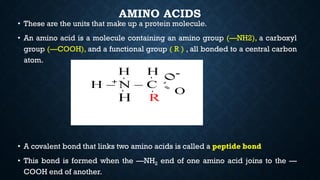
• These are the units that make up a protein molecule.
• An amino acid is a molecule containing an amino group (—NH2), a carboxyl
group (—COOH), and a functional group ( R ) , all bonded to a central carbon
atom.
• A covalent bond that links two amino acids is called a peptide bond
• This bond is formed when the —NH2 end of one amino acid joins to the —
COOH end of another.
NUCLEIC ACIDS
• There are of two types namely; deoxyribonucleic acid (DNA and ribonucleic
acid (RNA).
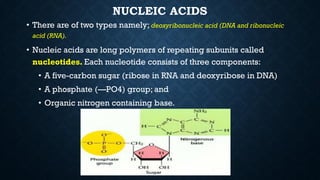
• Nucleic acids are long polymers of repeating subunits called
nucleotides. Each nucleotide consists of three components:
• A five-carbon sugar (ribose in RNA and deoxyribose in DNA)
• A phosphate (—PO4) group; and
• Organic nitrogen containing base.
CARBOHYDRATES
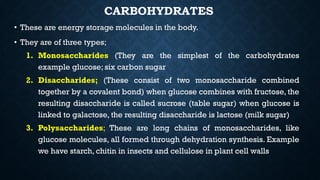
• These are energy storage molecules in the body.
• They are of three types;
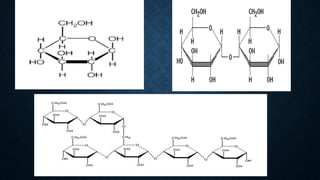
1. Monosaccharides (They are the simplest of the carbohydrates
example glucose; six carbon sugar
2. Disaccharides; (These consist of two monosaccharide combined
together by a covalent bond) when glucose combines with fructose, the
resulting disaccharide is called sucrose (table sugar) when glucose is
linked to galactose, the resulting disaccharide is lactose (milk sugar)
3. Polysaccharides; These are long chains of monosaccharides, like
glucose molecules, all formed through dehydration synthesis. Example
we have starch, chitin in insects and cellulose in plant cell walls
LIPIDS
• These are group of molecules that are insoluble in water.
• The four major classes of biologically important lipids are:
a) Phospholipids; the molecules of the cell which forms part of all
biological membranes.
b) Triacylglycerols (triglycerides); These are normal fats, consist of
three fatty acids attached to a glycerol molecule. When an organism
consumes excess carbohydrate, it is converted into starch, glycogen,
or fats and reserved for future use.
c) Terpenes; these are components of pigments such as chlorophyll and
visual pigment retina
d) Steroids/Cholesterol; example hormone testosterone and oestrogen.
• Tryglycerols
• Cholesterol
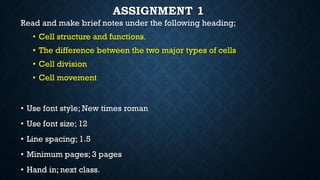
ASSIGNMENT 1
Read and make brief notes under the following heading;
• Cell structure and functions.
• The difference between the two major types of cells
• Cell division
• Cell movement
• Use font style; New times roman
• Use font size; 12
• Line spacing; 1.5
• Minimum pages; 3 pages
• Hand in; next class.

GENERAL BIOLOGY LECTURE NOTES PART 1.pdf

  • 1.
    GENERAL BIOLOGY Lecture NotesFor Health Science Students, East Africa University - Garowe Prepared by; H.Wahab [Lect. Nutrition & Food Science] habibwahab8@gmail.com @habibwahab3
  • 2.
    CHEMICAL BONDS • Moleculesare a group of atoms held together by energy in a stable association. • When a molecule contains atoms of more than one element, it is called a compound. • The atoms in a molecule are joined by chemical bonds • The bonds can result when atoms with opposite charges attract (ionic bonds). • When two atoms share one or more pairs of electrons, this results into a covalent bond.
  • 3.
    CHEMICAL REACTIONS • Thisrefers to the formation and breaking of chemical bond. • Reactants combine to form products. A — B + C — D → A — C + B + D Reactants products
  • 4.
    FACTORS AFFECTING THERATE OF A CHEMICAL REACTION. • Temperature: Heating up the reactants increases the rate of a reaction (as long as the temperature isn’t so high as to destroy the molecules). • Concentration of reactants and products: Reactions proceed more quickly when more reactants are available. An accumulation of products typically speeds reactions in the reverse direction. • Catalysts. A catalyst is a substance that increases the rate of a reaction. It doesn’t alter the reaction’s equilibrium between reactants and products, but it does shorten the time of the reaction.
  • 5.
    BIOLOGICAL MACROMOLECULES • Atomsare organized into hundreds of smaller molecules that are linked together into long chains. • Biological macromolecules are traditionally grouped into four major categories: • Proteins • Nucleic Acids (DNA & RNA) • Lipids, and • Carbohydrates.
  • 6.
    PROTEINS Functions of Proteins •Enzyme catalysis: Enzymes are biological catalysts that facilitate specific chemical reactions. • Defense: Other globular proteins form the core of the body’s hormone and immune systems • Transport: example the transport protein hemoglobin, that carries around oxygen. • Support: Fibrous, or threadlike, proteins play structural roles; eg keratin in hair. • Motion: Muscles contract through the sliding motion of proteins filament: actin and myosin. • Contractile proteins also play key roles in the cell’s cytoskeleton and in moving materials within cells. • Regulation: example; hormones serve as intercellular messengers in animals
  • 7.
    AMINO ACIDS • Theseare the units that make up a protein molecule. • An amino acid is a molecule containing an amino group (—NH2), a carboxyl group (—COOH), and a functional group ( R ) , all bonded to a central carbon atom. • A covalent bond that links two amino acids is called a peptide bond • This bond is formed when the —NH2 end of one amino acid joins to the — COOH end of another.
  • 8.
    NUCLEIC ACIDS • Thereare of two types namely; deoxyribonucleic acid (DNA and ribonucleic acid (RNA). • Nucleic acids are long polymers of repeating subunits called nucleotides. Each nucleotide consists of three components: • A five-carbon sugar (ribose in RNA and deoxyribose in DNA) • A phosphate (—PO4) group; and • Organic nitrogen containing base.
  • 9.
    CARBOHYDRATES • These areenergy storage molecules in the body. • They are of three types; 1. Monosaccharides (They are the simplest of the carbohydrates example glucose; six carbon sugar 2. Disaccharides; (These consist of two monosaccharide combined together by a covalent bond) when glucose combines with fructose, the resulting disaccharide is called sucrose (table sugar) when glucose is linked to galactose, the resulting disaccharide is lactose (milk sugar) 3. Polysaccharides; These are long chains of monosaccharides, like glucose molecules, all formed through dehydration synthesis. Example we have starch, chitin in insects and cellulose in plant cell walls
  • 11.
    LIPIDS • These aregroup of molecules that are insoluble in water. • The four major classes of biologically important lipids are: a) Phospholipids; the molecules of the cell which forms part of all biological membranes. b) Triacylglycerols (triglycerides); These are normal fats, consist of three fatty acids attached to a glycerol molecule. When an organism consumes excess carbohydrate, it is converted into starch, glycogen, or fats and reserved for future use. c) Terpenes; these are components of pigments such as chlorophyll and visual pigment retina d) Steroids/Cholesterol; example hormone testosterone and oestrogen.
  • 12.
  • 13.
    ASSIGNMENT 1 Read andmake brief notes under the following heading; • Cell structure and functions. • The difference between the two major types of cells • Cell division • Cell movement • Use font style; New times roman • Use font size; 12 • Line spacing; 1.5 • Minimum pages; 3 pages • Hand in; next class.