Geo Ben Kuriakose
Paper: Aquatic toxicology
1st semester
MSc Aquatic Biology and
Fisheries
BIOINDICATORS AND BIOMARKERS
Introduction
• Bioindicator and biomarker are both biomonitoring
tools.
• They help in monitoring contaminant exposure.
Whats the difference ?
• Bioindicator is also a type of biomarker.
• Living organism that respond to the change in environment are called bioindicators.
• Difference is that bioindicator is any species that act as a biological indicator of the health of
an environment while biomarker is a substance used as an indicator of a biological state, most
commonly disease.
BIOINDICATOR USES
• Researchers often introduce Bioindicator
organism or organisms association to
environmental samples, such as soil or water to
monitor the progress of environmental cleanup
and test substances, like drinking water, for the
presence of contaminants.
•Bioindicators are used to: detect changes in the
natural environment, monitor for the presence of
pollution and its effect on the ecosystem in which
the organism lives
Based on iubs bioindicators are grouped into
• Microbial system
• Plant system
• Animal system
• Cell biology and genetics system
•They are useful in studying the degree of pollution and other contaminations.
•Microbial biomass, fungi, actinomycetes, lichens, as well as the population of
earthworms, nematodes, termites and ants can be used as bioindicators.
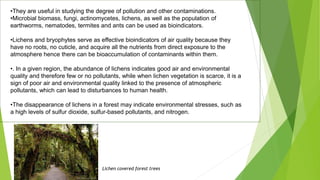
•Lichens and bryophytes serve as effective bioindicators of air quality because they
have no roots, no cuticle, and acquire all the nutrients from direct exposure to the
atmosphere hence there can be bioaccumulation of contaminants within them.
•. In a given region, the abundance of lichens indicates good air and environmental
quality and therefore few or no pollutants, while when lichen vegetation is scarce, it is a
sign of poor air and environmental quality linked to the presence of atmospheric
pollutants, which can lead to disturbances to human health.
•The disappearance of lichens in a forest may indicate environmental stresses, such as
a high levels of sulfur dioxide, sulfur-based pollutants, and nitrogen.
Lichen covered forest trees
Changes in the functioning of the nervous systems of worms are used to measure levels of
soil pollution. The numbers of earthworms in the soil can also be used to indicate the health
of the soil.
If pollutants are present, the organism may change its morphology, physiology or
behavior, or it could even die.
EARTHWORMS AS A BIOINDICATOR
MICRORGANISMS AS BIOINDICATOR
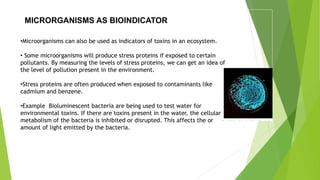
•Microorganisms can also be used as indicators of toxins in an ecosystem.
• Some microorganisms will produce stress proteins if exposed to certain
pollutants. By measuring the levels of stress proteins, we can get an idea of
the level of pollution present in the environment.
•Stress proteins are often produced when exposed to contaminants like
cadmium and benzene.
•Example Bioluminescent bacteria are being used to test water for
environmental toxins. If there are toxins present in the water, the cellular
metabolism of the bacteria is inhibited or disrupted. This affects the or
amount of light emitted by the bacteria.
ANIMAL INDICATORS
•An increase or decrease in an animal population may indicate
damage to ecosystem caused by pollution.
•For example, if pollution causes the depletion of important food
sources, animal species dependent upon these food sources will also
be reduced in number
•We can monitor the above said number to indicate damage to
ecosystem caused by pollution.
•monitoring the concentration of toxins in animal tissues, or
monitoring the rate at which deformities arise in animal population is
also a popular bioindicator.
• Abundance of Eichhornia indicates sewage and heavy metal pollution of water.
• Equisetum spp. indicate the presence of gold in the soil.
• annual wees and short lived perennials like
amaranthus chenopodiun and polygonus etc grow better in overgrazed
areas thus they are indicators of overgrazing.
Plants As Bioindicators
Aquatic Bioindicators
• Changes in diatom community, decrease in plankton algae
and aquatic hydrophyte indicated increased water acidity.
• Microorganisms when exposed to cadmium and benzene
contaminants develop new proteins known as stress proteins which can
be used as early warning
signs
• Plankton as indicators of fish production in ocean environment
•Fragilaria oceanica indicates the presence of oil sardine Sardinella
longiceps, Coccolithophores are the indicators of Herring fisheries and
Hemidiscus hardmanianus are indicators of Lesser Sardine.
Genetic and cell biology system
• Cellular and subcellular components including
chromosome adapted to specific environmental
conditions form an excellent parameters for
bioindicators.
• Many animals show behavioural response following the
detection of environmental change in the functioning of
endocrine nervous muscular cardiovascular and
excretory systems.
• Such changes may be investigated at morphological
biochemical or physiological levels and can indicate the
presence of toxic substances.
BioMarker
• A biomarker is a measurable trait in an organism that
responds to the toxicant thus a biomarker is actually a
disturbance of a normal physiology of an organism.
• Biomarker field requires an understanding of physiology
of organism to properly asses
• Biomarker results enable one to evaluate a potential
risk to population communities and ecosystem.
• They are used in monitoring possible effects of
environmental contamination and give early warning
signals before irreversible damage occurs.
• It is easily measured
• Measurements are fast and cheap
• Measurement is specific to a toxicant type
• The response shows a concentration response
(dose-response) relationship.
Properties of a good biomarker
Types of Biomarkers
Biomarker of exposure
Biomarker of effect
Biomarker of exposure
 Biomarkers of exposure are the
actual chemicals, or chemical
metabolites, that can be
measured in the body or after
excretion from the body to
determine different
characteristics of an organism’s
exposure. For example, a
person or fish’s blood can be
tested to see the levels of lead
and therefore determine the
exposure.
Biomarker of exposure
 Biomarkers of effect are the
quantifiable changes that an
individual endures, which
indicates an exposure to a
compound and may indicate a
resulting health effect. For
example, after exposure
to DDT, an organochlorine
insecticide known to cause
problems in the reproductive
system, a woman may
experience miscarriages, which
can be linked to her previous
exposure.
Examples of biomarkers
that have been used to
assess aquatic contaminants
Click to add text
Click to add text
Click to add text
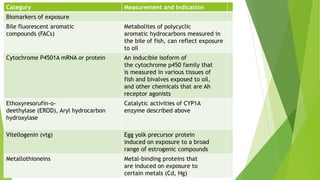
Category Measurement and Indication
Biomarkers of exposure
Bile fluorescent aromatic
compounds (FACs)
Metabolites of polycyclic
aromatic hydrocarbons measured in
the bile of fish, can reflect exposure
to oil
Cytochrome P4501A mRNA or protein An inducible isoform of
the cytochrome p450 family that
is measured in various tissues of
fish and bivalves exposed to oil,
and other chemicals that are Ah
receptor agonists
Ethoxyresorufin-o-
deethylase (EROD), Aryl hydrocarbon
hydroxylase
Catalytic activities of CYP1A
enzyme described above
Vitellogenin (vtg) Egg yolk precursor protein
induced on exposure to a broad
range of estrogenic compounds
Metallothioneins Metal-binding proteins that
are induced on exposure to
certain metals (Cd, Hg)
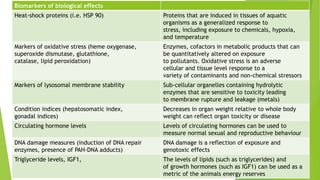
Biomarkers of biological effects
Heat-shock proteins (i.e. HSP 90) Proteins that are induced in tissues of aquatic
organisms as a generalized response to
stress, including exposure to chemicals, hypoxia,
and temperature
Markers of oxidative stress (heme oxygenase,
superoxide dismutase, glutathione,
catalase, lipid peroxidation)
Enzymes, cofactors in metabolic products that can
be quantitatively altered on exposure
to pollutants. Oxidative stress is an adverse
cellular and tissue level response to a
variety of contaminants and non-chemical stressors
Markers of lysosomal membrane stability Sub-cellular organelles containing hydrolytic
enzymes that are sensitive to toxicity leading
to membrane rupture and leakage (metals)
Condition indices (hepatosomatic index,
gonadal indices)
Decreases in organ weight relative to whole body
weight can reflect organ toxicity or disease
Circulating hormone levels Levels of circulating hormones can be used to
measure normal sexual and reproductive behaviour
DNA damage measures (induction of DNA repair
enzymes, presence of PAH-DNA adducts)
DNA damage is a reflection of exposure and
genotoxic effects
Triglyceride levels, IGF1, The levels of lipids (such as triglycerides) and
of growth hormones (such as IGF1) can be used as a
metric of the animals energy reserves
• Bioindicator have a remarkable potential in forecasting of disasters, prevention of
pollution, exploration and conservation of natural resources, all aiming at a sustainable
development
• with minimum destruction of the biosphere bioindicator can be apply in predicting the
impact of anthropogenic activities particularly pollutants and predicting environmental
change in a timely manner
• Biomarkers are considered as early warning systems involved in ecosystem quality
assessment. They can be used to assess chemical exposure and adverse effects of
pollutants on biota in situ. They are measured at an individual level but their responses
are meant to be predictive of effects at the population level.
Conclusion
BIOINDICATOR1 (1) (1).pptx

BIOINDICATOR1 (1) (1).pptx

  • 1.
    Geo Ben Kuriakose Paper:Aquatic toxicology 1st semester MSc Aquatic Biology and Fisheries BIOINDICATORS AND BIOMARKERS
  • 2.
    Introduction • Bioindicator andbiomarker are both biomonitoring tools. • They help in monitoring contaminant exposure.
  • 3.
    Whats the difference? • Bioindicator is also a type of biomarker. • Living organism that respond to the change in environment are called bioindicators. • Difference is that bioindicator is any species that act as a biological indicator of the health of an environment while biomarker is a substance used as an indicator of a biological state, most commonly disease.
  • 4.
    BIOINDICATOR USES • Researchersoften introduce Bioindicator organism or organisms association to environmental samples, such as soil or water to monitor the progress of environmental cleanup and test substances, like drinking water, for the presence of contaminants. •Bioindicators are used to: detect changes in the natural environment, monitor for the presence of pollution and its effect on the ecosystem in which the organism lives
  • 5.
    Based on iubsbioindicators are grouped into • Microbial system • Plant system • Animal system • Cell biology and genetics system
  • 6.
    •They are usefulin studying the degree of pollution and other contaminations. •Microbial biomass, fungi, actinomycetes, lichens, as well as the population of earthworms, nematodes, termites and ants can be used as bioindicators. •Lichens and bryophytes serve as effective bioindicators of air quality because they have no roots, no cuticle, and acquire all the nutrients from direct exposure to the atmosphere hence there can be bioaccumulation of contaminants within them. •. In a given region, the abundance of lichens indicates good air and environmental quality and therefore few or no pollutants, while when lichen vegetation is scarce, it is a sign of poor air and environmental quality linked to the presence of atmospheric pollutants, which can lead to disturbances to human health. •The disappearance of lichens in a forest may indicate environmental stresses, such as a high levels of sulfur dioxide, sulfur-based pollutants, and nitrogen. Lichen covered forest trees
  • 7.
    Changes in thefunctioning of the nervous systems of worms are used to measure levels of soil pollution. The numbers of earthworms in the soil can also be used to indicate the health of the soil. If pollutants are present, the organism may change its morphology, physiology or behavior, or it could even die. EARTHWORMS AS A BIOINDICATOR
  • 8.
    MICRORGANISMS AS BIOINDICATOR •Microorganismscan also be used as indicators of toxins in an ecosystem. • Some microorganisms will produce stress proteins if exposed to certain pollutants. By measuring the levels of stress proteins, we can get an idea of the level of pollution present in the environment. •Stress proteins are often produced when exposed to contaminants like cadmium and benzene. •Example Bioluminescent bacteria are being used to test water for environmental toxins. If there are toxins present in the water, the cellular metabolism of the bacteria is inhibited or disrupted. This affects the or amount of light emitted by the bacteria.
  • 9.
    ANIMAL INDICATORS •An increaseor decrease in an animal population may indicate damage to ecosystem caused by pollution. •For example, if pollution causes the depletion of important food sources, animal species dependent upon these food sources will also be reduced in number •We can monitor the above said number to indicate damage to ecosystem caused by pollution. •monitoring the concentration of toxins in animal tissues, or monitoring the rate at which deformities arise in animal population is also a popular bioindicator.
  • 10.
    • Abundance ofEichhornia indicates sewage and heavy metal pollution of water. • Equisetum spp. indicate the presence of gold in the soil. • annual wees and short lived perennials like amaranthus chenopodiun and polygonus etc grow better in overgrazed areas thus they are indicators of overgrazing. Plants As Bioindicators
  • 11.
    Aquatic Bioindicators • Changesin diatom community, decrease in plankton algae and aquatic hydrophyte indicated increased water acidity. • Microorganisms when exposed to cadmium and benzene contaminants develop new proteins known as stress proteins which can be used as early warning signs • Plankton as indicators of fish production in ocean environment •Fragilaria oceanica indicates the presence of oil sardine Sardinella longiceps, Coccolithophores are the indicators of Herring fisheries and Hemidiscus hardmanianus are indicators of Lesser Sardine.
  • 12.
    Genetic and cellbiology system • Cellular and subcellular components including chromosome adapted to specific environmental conditions form an excellent parameters for bioindicators. • Many animals show behavioural response following the detection of environmental change in the functioning of endocrine nervous muscular cardiovascular and excretory systems. • Such changes may be investigated at morphological biochemical or physiological levels and can indicate the presence of toxic substances.
  • 13.
    BioMarker • A biomarkeris a measurable trait in an organism that responds to the toxicant thus a biomarker is actually a disturbance of a normal physiology of an organism. • Biomarker field requires an understanding of physiology of organism to properly asses • Biomarker results enable one to evaluate a potential risk to population communities and ecosystem. • They are used in monitoring possible effects of environmental contamination and give early warning signals before irreversible damage occurs.
  • 14.
    • It iseasily measured • Measurements are fast and cheap • Measurement is specific to a toxicant type • The response shows a concentration response (dose-response) relationship. Properties of a good biomarker
  • 15.
    Types of Biomarkers Biomarkerof exposure Biomarker of effect
  • 16.
    Biomarker of exposure Biomarkers of exposure are the actual chemicals, or chemical metabolites, that can be measured in the body or after excretion from the body to determine different characteristics of an organism’s exposure. For example, a person or fish’s blood can be tested to see the levels of lead and therefore determine the exposure. Biomarker of exposure  Biomarkers of effect are the quantifiable changes that an individual endures, which indicates an exposure to a compound and may indicate a resulting health effect. For example, after exposure to DDT, an organochlorine insecticide known to cause problems in the reproductive system, a woman may experience miscarriages, which can be linked to her previous exposure.
  • 17.
    Examples of biomarkers thathave been used to assess aquatic contaminants Click to add text Click to add text Click to add text Category Measurement and Indication Biomarkers of exposure Bile fluorescent aromatic compounds (FACs) Metabolites of polycyclic aromatic hydrocarbons measured in the bile of fish, can reflect exposure to oil Cytochrome P4501A mRNA or protein An inducible isoform of the cytochrome p450 family that is measured in various tissues of fish and bivalves exposed to oil, and other chemicals that are Ah receptor agonists Ethoxyresorufin-o- deethylase (EROD), Aryl hydrocarbon hydroxylase Catalytic activities of CYP1A enzyme described above Vitellogenin (vtg) Egg yolk precursor protein induced on exposure to a broad range of estrogenic compounds Metallothioneins Metal-binding proteins that are induced on exposure to certain metals (Cd, Hg)
  • 18.
    Biomarkers of biologicaleffects Heat-shock proteins (i.e. HSP 90) Proteins that are induced in tissues of aquatic organisms as a generalized response to stress, including exposure to chemicals, hypoxia, and temperature Markers of oxidative stress (heme oxygenase, superoxide dismutase, glutathione, catalase, lipid peroxidation) Enzymes, cofactors in metabolic products that can be quantitatively altered on exposure to pollutants. Oxidative stress is an adverse cellular and tissue level response to a variety of contaminants and non-chemical stressors Markers of lysosomal membrane stability Sub-cellular organelles containing hydrolytic enzymes that are sensitive to toxicity leading to membrane rupture and leakage (metals) Condition indices (hepatosomatic index, gonadal indices) Decreases in organ weight relative to whole body weight can reflect organ toxicity or disease Circulating hormone levels Levels of circulating hormones can be used to measure normal sexual and reproductive behaviour DNA damage measures (induction of DNA repair enzymes, presence of PAH-DNA adducts) DNA damage is a reflection of exposure and genotoxic effects Triglyceride levels, IGF1, The levels of lipids (such as triglycerides) and of growth hormones (such as IGF1) can be used as a metric of the animals energy reserves
  • 19.
    • Bioindicator havea remarkable potential in forecasting of disasters, prevention of pollution, exploration and conservation of natural resources, all aiming at a sustainable development • with minimum destruction of the biosphere bioindicator can be apply in predicting the impact of anthropogenic activities particularly pollutants and predicting environmental change in a timely manner • Biomarkers are considered as early warning systems involved in ecosystem quality assessment. They can be used to assess chemical exposure and adverse effects of pollutants on biota in situ. They are measured at an individual level but their responses are meant to be predictive of effects at the population level. Conclusion

Editor's Notes

  • #3 Micro ecosystem or microsm are small scale ecosystem that are subsets of biotic community Miniature form of everything Eg: terrestrial hot springs, Soil microsm, tree hole(natural)