Animal Diversity
Rowel P. David
Biodiversity
ATHS Science for Grade 8
Sir Rowel P. David
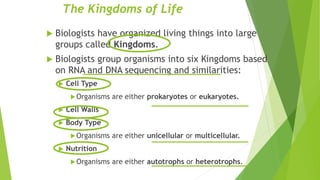
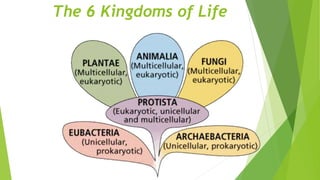
The Kingdoms of Life
 Biologists have organized living things into large
groups called Kingdoms.
 Biologists group organisms into six Kingdoms based
on RNA and DNA sequencing and similarities:
 Cell Type
Organisms are either prokaryotes or eukaryotes.
 Cell Walls
 Body Type
Organisms are either unicellular or multicellular.
 Nutrition
Organisms are either autotrophs or heterotrophs.
The 6 Kingdoms of Life
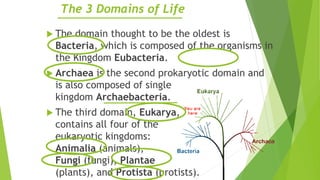
The 3 Domains of Life
 The domain thought to be the oldest is
Bacteria, which is composed of the organisms in
the Kingdom Eubacteria.
 Archaea is the second prokaryotic domain and
is also composed of single
kingdom Archaebacteria.
 The third domain, Eukarya,
contains all four of the
eukaryotic kingdoms:
Animalia (animals),
Fungi (fungi), Plantae
(plants), and Protista (protists).
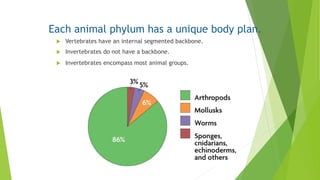
Each animal phylum has a unique body plan.
 Vertebrates have an internal segmented backbone.
 Invertebrates do not have a backbone.
 Invertebrates encompass most animal groups.
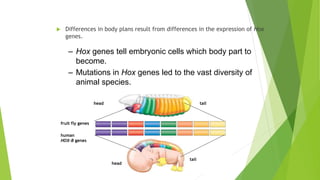
 Differences in body plans result from differences in the expression of Hox
genes.
– Hox genes tell embryonic cells which body part to
become.
– Mutations in Hox genes led to the vast diversity of
animal species.
head tail
head
tail
fruit fly genes
human
HOX-B genes
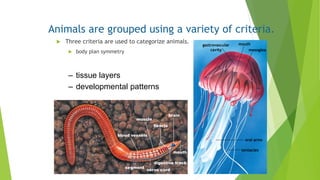
Animals are grouped using a variety of criteria.
 Three criteria are used to categorize animals.
 body plan symmetry
– tissue layers
– developmental patterns
gastrovascular
cavity
mouth
mesoglea
oral arms
tentacles
blood vessels
brain
hearts
muscle
segment
nerve cord
mouth
digestive track
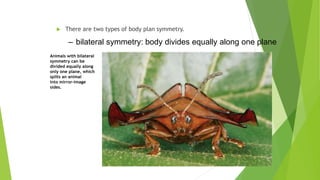
 There are two types of body plan symmetry.
– bilateral symmetry: body divides equally along one plane
Animals with bilateral
symmetry can be
divided equally along
only one plane, which
splits an animal
into mirror-image
sides.
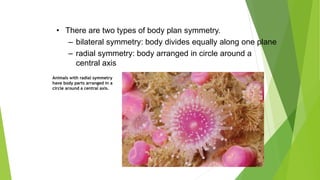
– radial symmetry: body arranged in circle around a
central axis
• There are two types of body plan symmetry.
– bilateral symmetry: body divides equally along one plane
Animals with radial symmetry
have body parts arranged in a
circle around a central axis.
 The current organization of the animal kingdom shows some unexpected
relationships.
• Technological advancements
help to clarify evolutionary
relationships.
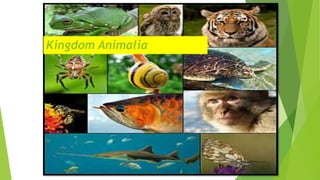
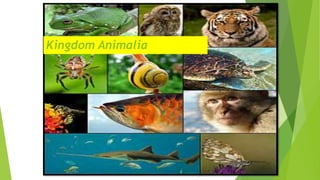
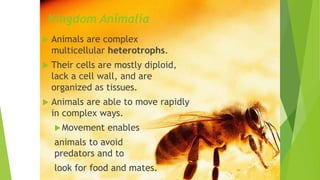
Kingdom Animalia
Kingdom Animalia
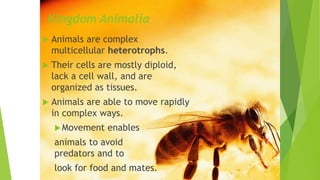
 Animals are complex
multicellular heterotrophs.
 Their cells are mostly diploid,
lack a cell wall, and are
organized as tissues.
 Animals are able to move rapidly
in complex ways.
Movement enables
animals to avoid
predators and to
look for food and mates.
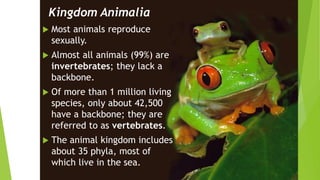
Kingdom Animalia
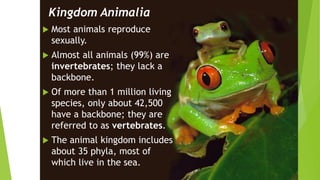
 Most animals reproduce
sexually.
 Almost all animals (99%) are
invertebrates; they lack a
backbone.
 Of more than 1 million living
species, only about 42,500
have a backbone; they are
referred to as vertebrates.
 The animal kingdom includes
about 35 phyla, most of
which live in the sea.
Kingdom Animalia
Characteristics
 Heterotrophs
 Eukaryotic
 Multicellular
 No cell wall, no chloroplasts
 Motile
 Sense Organs
9 phyla we will mention
 Porifera—sponges
 Cnidaria—jellyfish, sea anemones,
coral
 Platyhelminthes—flatworms
 Nematoda—roundworms
 Annelida—earthworms
 Mollusca—shelled animals
 Arthropoda—insects, spiders
 Echinodermata—spiny-skinned
 Chordata—vertebrates (and others)
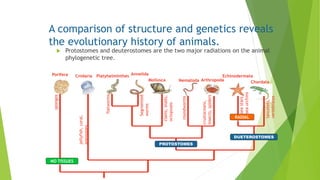
A comparison of structure and genetics reveals
the evolutionary history of animals.
 Protostomes and deuterostomes are the two major radiations on the animal
phylogenetic tree.
Porifera Cnidaria Platyhelminthes Annelida
Mollusca Nematoda Arthropoda
Echinodermata
Chordata
RADIAL
NO TISSUES
PROTOSTOMES
DUETEROSTOMES
jellyfish,coral,
anemones
sponges
flatworms
Segmented
worms
clams,snails,
octopuses
roundworms
crustaceans,
insects,spiders
seastars,
seaurchins
lancelets,
vertebrates
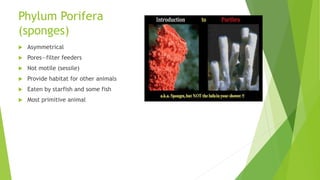
Phylum Porifera
(sponges)
 Asymmetrical
 Pores—filter feeders
 Not motile (sessile)
 Provide habitat for other animals
 Eaten by starfish and some fish
 Most primitive animal
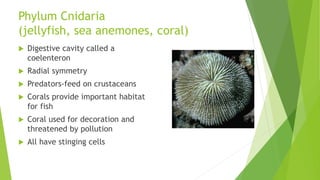
Phylum Cnidaria
(jellyfish, sea anemones, coral)
 Digestive cavity called a
coelenteron
 Radial symmetry
 Predators-feed on crustaceans
 Corals provide important habitat
for fish
 Coral used for decoration and
threatened by pollution
 All have stinging cells
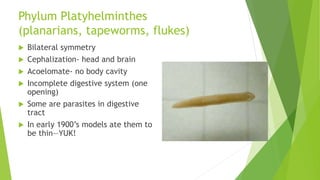
Phylum Platyhelminthes
(planarians, tapeworms, flukes)
 Bilateral symmetry
 Cephalization- head and brain
 Acoelomate- no body cavity
 Incomplete digestive system (one
opening)
 Some are parasites in digestive
tract
 In early 1900’s models ate them to
be thin—YUK!
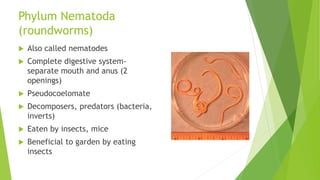
Phylum Nematoda
(roundworms)
 Also called nematodes
 Complete digestive system-
separate mouth and anus (2
openings)
 Pseudocoelomate
 Decomposers, predators (bacteria,
inverts)
 Eaten by insects, mice
 Beneficial to garden by eating
insects
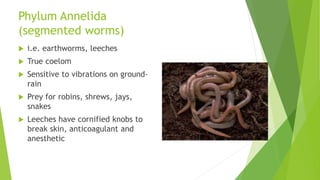
Phylum Annelida
(segmented worms)
 i.e. earthworms, leeches
 True coelom
 Sensitive to vibrations on ground-
rain
 Prey for robins, shrews, jays,
snakes
 Leeches have cornified knobs to
break skin, anticoagulant and
anesthetic
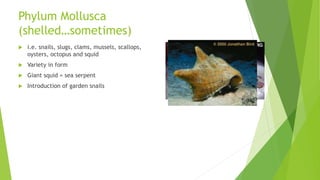
Phylum Mollusca
(shelled…sometimes)
 i.e. snails, slugs, clams, mussels, scallops,
oysters, octopus and squid
 Variety in form
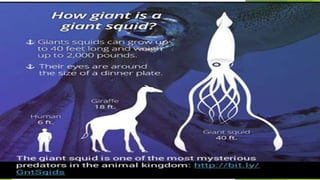
 Giant squid = sea serpent
 Introduction of garden snails
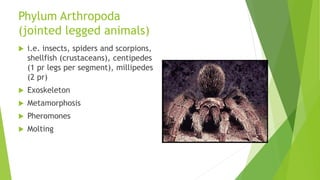
Phylum Arthropoda
(jointed legged animals)
 i.e. insects, spiders and scorpions,
shellfish (crustaceans), centipedes
(1 pr legs per segment), millipedes
(2 pr)
 Exoskeleton
 Metamorphosis
 Pheromones
 Molting
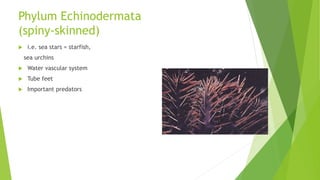
Phylum Echinodermata
(spiny-skinned)
 i.e. sea stars = starfish,
sea urchins
 Water vascular system
 Tube feet
 Important predators
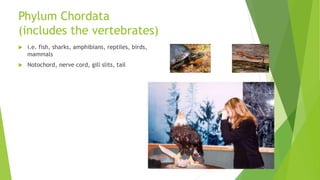
Phylum Chordata
(includes the vertebrates)
 i.e. fish, sharks, amphibians, reptiles, birds,
mammals
 Notochord, nerve cord, gill slits, tail
Kingdom Animalia
Kingdom Animalia
 Animals are complex
multicellular heterotrophs.
 Their cells are mostly diploid,
lack a cell wall, and are
organized as tissues.
 Animals are able to move rapidly
in complex ways.
Movement enables
animals to avoid
predators and to
look for food and mates.
Kingdom Animalia
 Most animals reproduce
sexually.
 Almost all animals (99%) are
invertebrates; they lack a
backbone.
 Of more than 1 million living
species, only about 42,500
have a backbone; they are
referred to as vertebrates.
 The animal kingdom includes
about 35 phyla, most of
which live in the sea.
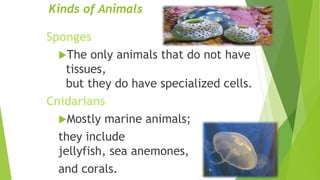
Kinds of Animals
Sponges
The only animals that do not have
tissues,
but they do have specialized cells.
Cnidarians
Mostly marine animals;
they include
jellyfish, sea anemones,
and corals.
Kinds of Animals
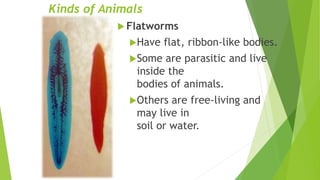
 Flatworms
Have flat, ribbon-like bodies.
Some are parasitic and live
inside the
bodies of animals.
Others are free-living and
may live in
soil or water.
Kinds of Animals
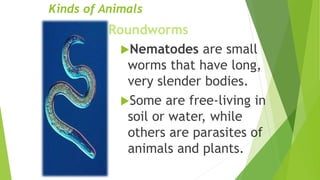
Roundworms
Nematodes are small
worms that have long,
very slender bodies.
Some are free-living in
soil or water, while
others are parasites of
animals and plants.
Kinds of Animals
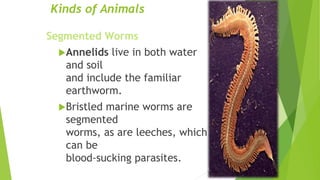
Segmented Worms
Annelids live in both water
and soil
and include the familiar
earthworm.
Bristled marine worms are
segmented
worms, as are leeches, which
can be
blood-sucking parasites.
Kinds of Animals
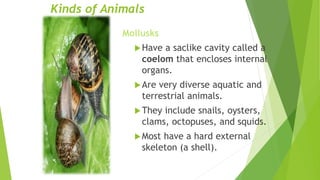
Mollusks
Have a saclike cavity called a
coelom that encloses internal
organs.
Are very diverse aquatic and
terrestrial animals.
They include snails, oysters,
clams, octopuses, and squids.
Most have a hard external
skeleton (a shell).
Kinds of Animals
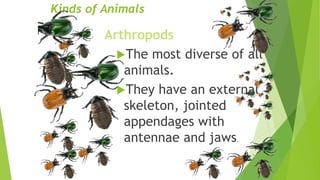
Arthropods
The most diverse of all
animals.
They have an external
skeleton, jointed
appendages with
antennae and jaws.
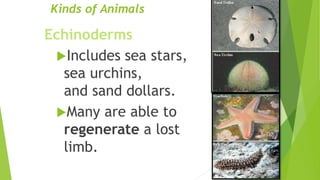
Kinds of Animals
Echinoderms
Includes sea stars,
sea urchins,
and sand dollars.
Many are able to
regenerate a lost
limb.
Kinds of Animals
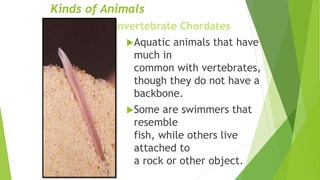
Invertebrate Chordates
Aquatic animals that have
much in
common with vertebrates,
though they do not have a
backbone.
Some are swimmers that
resemble
fish, while others live
attached to
a rock or other object.
Kinds of Animals
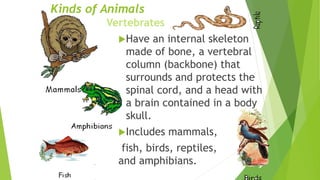
Vertebrates
Have an internal skeleton
made of bone, a vertebral
column (backbone) that
surrounds and protects the
spinal cord, and a head with
a brain contained in a body
skull.
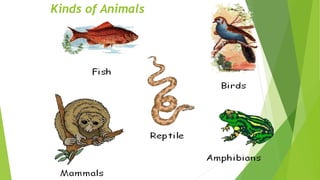
Includes mammals,
fish, birds, reptiles,
and amphibians.
Kinds of Animals

Animal biodiversity

  • 1.
  • 3.
    Biodiversity ATHS Science forGrade 8 Sir Rowel P. David
  • 7.
    The Kingdoms ofLife  Biologists have organized living things into large groups called Kingdoms.  Biologists group organisms into six Kingdoms based on RNA and DNA sequencing and similarities:  Cell Type Organisms are either prokaryotes or eukaryotes.  Cell Walls  Body Type Organisms are either unicellular or multicellular.  Nutrition Organisms are either autotrophs or heterotrophs.
  • 8.
  • 9.
    The 3 Domainsof Life  The domain thought to be the oldest is Bacteria, which is composed of the organisms in the Kingdom Eubacteria.  Archaea is the second prokaryotic domain and is also composed of single kingdom Archaebacteria.  The third domain, Eukarya, contains all four of the eukaryotic kingdoms: Animalia (animals), Fungi (fungi), Plantae (plants), and Protista (protists).
  • 10.
    Each animal phylumhas a unique body plan.  Vertebrates have an internal segmented backbone.  Invertebrates do not have a backbone.  Invertebrates encompass most animal groups.
  • 11.
     Differences inbody plans result from differences in the expression of Hox genes. – Hox genes tell embryonic cells which body part to become. – Mutations in Hox genes led to the vast diversity of animal species. head tail head tail fruit fly genes human HOX-B genes
  • 12.
    Animals are groupedusing a variety of criteria.  Three criteria are used to categorize animals.  body plan symmetry – tissue layers – developmental patterns gastrovascular cavity mouth mesoglea oral arms tentacles blood vessels brain hearts muscle segment nerve cord mouth digestive track
  • 13.
     There aretwo types of body plan symmetry. – bilateral symmetry: body divides equally along one plane Animals with bilateral symmetry can be divided equally along only one plane, which splits an animal into mirror-image sides.
  • 14.
    – radial symmetry:body arranged in circle around a central axis • There are two types of body plan symmetry. – bilateral symmetry: body divides equally along one plane Animals with radial symmetry have body parts arranged in a circle around a central axis.
  • 15.
     The currentorganization of the animal kingdom shows some unexpected relationships. • Technological advancements help to clarify evolutionary relationships.
  • 16.
  • 17.
    Kingdom Animalia  Animalsare complex multicellular heterotrophs.  Their cells are mostly diploid, lack a cell wall, and are organized as tissues.  Animals are able to move rapidly in complex ways. Movement enables animals to avoid predators and to look for food and mates.
  • 18.
    Kingdom Animalia  Mostanimals reproduce sexually.  Almost all animals (99%) are invertebrates; they lack a backbone.  Of more than 1 million living species, only about 42,500 have a backbone; they are referred to as vertebrates.  The animal kingdom includes about 35 phyla, most of which live in the sea.
  • 19.
    Kingdom Animalia Characteristics  Heterotrophs Eukaryotic  Multicellular  No cell wall, no chloroplasts  Motile  Sense Organs
  • 20.
    9 phyla wewill mention  Porifera—sponges  Cnidaria—jellyfish, sea anemones, coral  Platyhelminthes—flatworms  Nematoda—roundworms  Annelida—earthworms  Mollusca—shelled animals  Arthropoda—insects, spiders  Echinodermata—spiny-skinned  Chordata—vertebrates (and others)
  • 21.
    A comparison ofstructure and genetics reveals the evolutionary history of animals.  Protostomes and deuterostomes are the two major radiations on the animal phylogenetic tree. Porifera Cnidaria Platyhelminthes Annelida Mollusca Nematoda Arthropoda Echinodermata Chordata RADIAL NO TISSUES PROTOSTOMES DUETEROSTOMES jellyfish,coral, anemones sponges flatworms Segmented worms clams,snails, octopuses roundworms crustaceans, insects,spiders seastars, seaurchins lancelets, vertebrates
  • 22.
    Phylum Porifera (sponges)  Asymmetrical Pores—filter feeders  Not motile (sessile)  Provide habitat for other animals  Eaten by starfish and some fish  Most primitive animal
  • 23.
    Phylum Cnidaria (jellyfish, seaanemones, coral)  Digestive cavity called a coelenteron  Radial symmetry  Predators-feed on crustaceans  Corals provide important habitat for fish  Coral used for decoration and threatened by pollution  All have stinging cells
  • 24.
    Phylum Platyhelminthes (planarians, tapeworms,flukes)  Bilateral symmetry  Cephalization- head and brain  Acoelomate- no body cavity  Incomplete digestive system (one opening)  Some are parasites in digestive tract  In early 1900’s models ate them to be thin—YUK!
  • 25.
    Phylum Nematoda (roundworms)  Alsocalled nematodes  Complete digestive system- separate mouth and anus (2 openings)  Pseudocoelomate  Decomposers, predators (bacteria, inverts)  Eaten by insects, mice  Beneficial to garden by eating insects
  • 26.
    Phylum Annelida (segmented worms) i.e. earthworms, leeches  True coelom  Sensitive to vibrations on ground- rain  Prey for robins, shrews, jays, snakes  Leeches have cornified knobs to break skin, anticoagulant and anesthetic
  • 27.
    Phylum Mollusca (shelled…sometimes)  i.e.snails, slugs, clams, mussels, scallops, oysters, octopus and squid  Variety in form  Giant squid = sea serpent  Introduction of garden snails
  • 28.
    Phylum Arthropoda (jointed leggedanimals)  i.e. insects, spiders and scorpions, shellfish (crustaceans), centipedes (1 pr legs per segment), millipedes (2 pr)  Exoskeleton  Metamorphosis  Pheromones  Molting
  • 29.
    Phylum Echinodermata (spiny-skinned)  i.e.sea stars = starfish, sea urchins  Water vascular system  Tube feet  Important predators
  • 30.
    Phylum Chordata (includes thevertebrates)  i.e. fish, sharks, amphibians, reptiles, birds, mammals  Notochord, nerve cord, gill slits, tail
  • 31.
  • 32.
    Kingdom Animalia  Animalsare complex multicellular heterotrophs.  Their cells are mostly diploid, lack a cell wall, and are organized as tissues.  Animals are able to move rapidly in complex ways. Movement enables animals to avoid predators and to look for food and mates.
  • 33.
    Kingdom Animalia  Mostanimals reproduce sexually.  Almost all animals (99%) are invertebrates; they lack a backbone.  Of more than 1 million living species, only about 42,500 have a backbone; they are referred to as vertebrates.  The animal kingdom includes about 35 phyla, most of which live in the sea.
  • 34.
    Kinds of Animals Sponges Theonly animals that do not have tissues, but they do have specialized cells. Cnidarians Mostly marine animals; they include jellyfish, sea anemones, and corals.
  • 35.
    Kinds of Animals Flatworms Have flat, ribbon-like bodies. Some are parasitic and live inside the bodies of animals. Others are free-living and may live in soil or water.
  • 36.
    Kinds of Animals Roundworms Nematodesare small worms that have long, very slender bodies. Some are free-living in soil or water, while others are parasites of animals and plants.
  • 37.
    Kinds of Animals SegmentedWorms Annelids live in both water and soil and include the familiar earthworm. Bristled marine worms are segmented worms, as are leeches, which can be blood-sucking parasites.
  • 38.
    Kinds of Animals Mollusks Havea saclike cavity called a coelom that encloses internal organs. Are very diverse aquatic and terrestrial animals. They include snails, oysters, clams, octopuses, and squids. Most have a hard external skeleton (a shell).
  • 39.
    Kinds of Animals Arthropods Themost diverse of all animals. They have an external skeleton, jointed appendages with antennae and jaws.
  • 40.
    Kinds of Animals Echinoderms Includessea stars, sea urchins, and sand dollars. Many are able to regenerate a lost limb.
  • 41.
    Kinds of Animals InvertebrateChordates Aquatic animals that have much in common with vertebrates, though they do not have a backbone. Some are swimmers that resemble fish, while others live attached to a rock or other object.
  • 42.
    Kinds of Animals Vertebrates Havean internal skeleton made of bone, a vertebral column (backbone) that surrounds and protects the spinal cord, and a head with a brain contained in a body skull. Includes mammals, fish, birds, reptiles, and amphibians.
  • 44.