Lecture 6b: ‘Primitive’ Lifeforms
By far, most living organisms 4 groups: Viruses Viroids and Prions Prokaryotes Protists
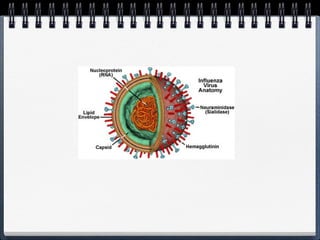
Viruses Do not have a cell Obligate intercellular parasites: they can not reproduce outside of a cell Do have DNA/ RNA Tend to be host specific to some degree Only attach to specific cells
 
Viruses Reproduce by taking over machinery of the host cell and using it to their own ends Some viruses are specific to bacteria, plants, or animals, and reproduce in slightly different ways Sometimes there are periods in which the virus is latent- not reproducing
Viruses Retroviruses: have RNA instead of DNA inside, make DNA by integrating with host genome Ex. HIV
Viruses Examples of human diseases caused by viruses Flu SARS West Nile HIV/ AIDS Ebola Viruses can travel around the world on an airplane, leading to their quick and easy spread
Viroids and Prions Even more weird than viruses! Viroids are just naked strands of DNA Several crop diseases Prions are misshapen proteins, the mechanism of damage is not known Ex: mad cow, Creutzfeldt-Jacob disease, scrapie
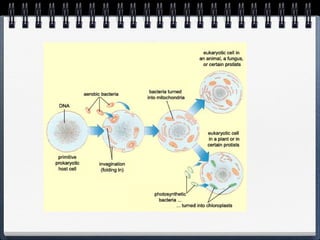
Prokaryotes Two main groups to discuss: Bacteria and the Archaea Have no membrane- bound organelles Oldest prokaryote fossils are 3.5 billion years old Origin of life?-  Endosymbiotic theory
 
Bacteria Millions of bacteria exist everywhere!  We do not know all the different types of bacteria that exist today They are in your intestine and on your skin, on the table, in the soil, etc. etc.
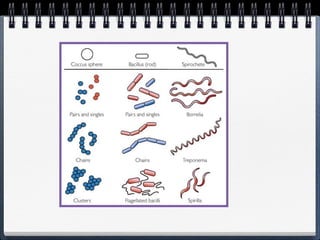
Bacteria Come in several shapes, most basic are sphere, rod, and spiral DNA is in single closed circle chromosome, plus sometimes also plasmids Can have flagella to move around Reproduce asexually- called  binary fission Not mitosis because no spindle fibers
 
Bacteria Can not recombine genes using sex, but have different ways of sharing DNA Conjugation - one cell donates DNA to another directly Transformation - one bacterium picks up DNA that is floating around in environment Transduction - bacterial viruses carry DNA from one bacterium to another
Bacteria Some bacteria are able to form endospores, in which the chromosome and some cytoplasm dehydrate and are encased in a protective coat Enables them to survive very harsh conditions: extreme heat or dryness, extreme cold, UV radiation Ex. botulism
Bacteria Can be autotrophs or heterotrophs Autotrophs- produce own food Photoautotrophs use photosynthesis Chemoautotrophs use a source other than the sun for electrons- S compounds, for example Heterotrophs- eat something else Chemoheterotrophs take in organic nutrients as food, break down large molecules into smaller ones that are absorbable  Bacteria in our intestines are this type
Bacteria Important to our everyday life: They fix atmospheric N and make it available for plants to use Decompose dead organisms into usable organic materials Can be used to clean polluted areas Used to make cheese, pickles, etc. Can be engineered to make useful molecules, like insulin
Bacteria Also cause human diseases Some leave behind toxins when they die- Ex. tetanus toxin prevents relaxation of muscles Some bind to other cells Ex. Shigella dysentaeriae binds to intestinal wall, results in severe diarrhea Some invade organs or cells Ex. Salmonella, may only result in food poisoning, but sometimes can invade the body and cause typhoid
Archaea Archaea and eukaryotes probably share a common ancestor, because tRNA, ribosomal proteins, and other characteristics are shared between them but not bacteria
Archaea Many found in extreme environments Methanogens- produce methane in the production of their ATP- live in intestines and swamps Halophiles- found in high saline environments, such as Great Salt Lake Thermoacidophiles- found in HOT and acidic environments, such as hot springs, geysers, volcanos
Protists Eukaryotic Very diverse Endosymbiotic theory: Eukaryotes arose when bacterial cells lived in close association with a proto-eukaryote that had a nucleus and ER- the bacterial cells became absorbed into the eukaryote and became what we know as mitochondria and chloroplasts
Protists So diverse, we don’t have a good classification system yet Book, and therefore we, divide them by modes of nutrition: Algae, protozoans, slime molds and water molds
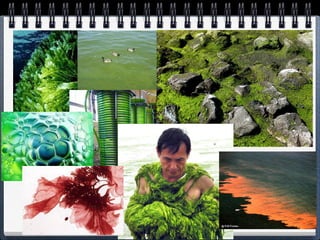
Protists- algae Aquatic photosynthesizers Phytoplankton in oceans provide base of food web Some Oceanic algae form seaweeds Can be symbiotic- corals, lichen
 
Protists- protozoans Unicellular, but complex Are heterotrophic, many feed by engulfing food particles Usually able to move using cilia, flagella, or pseudopods
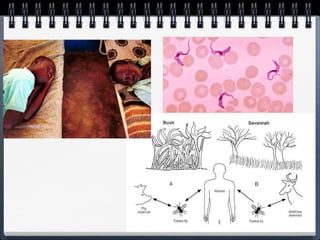
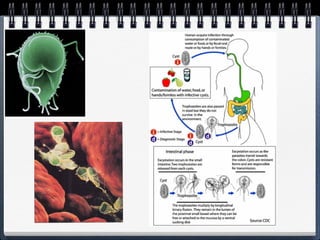
Protists- protozoans Human diseases caused by protozoans: Amoebic dysentery (Entamoeba) African sleeping sickness (trypanosome) Girardia Malaria (Plasmodium) Toxoplasmosis (carried by cats)
 
 
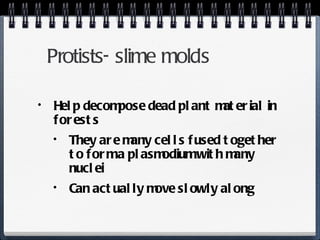
Protists- slime molds Help decompose dead plant material in forests They are many cells fused together to form a plasmodium with many nuclei Can actually move slowly along
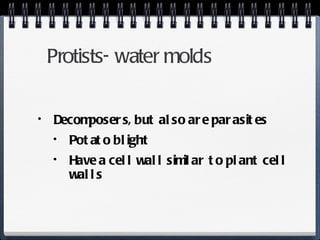
Protists- water molds Decomposers, but also are parasites Potato blight Have a cell wall similar to plant cell walls
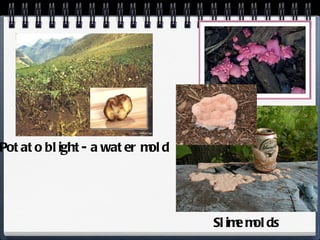
Potato blight- a water mold Slime molds

Primitive life photos

  • 1.
  • 2.
    By far, mostliving organisms 4 groups: Viruses Viroids and Prions Prokaryotes Protists
  • 3.
    Viruses Do nothave a cell Obligate intercellular parasites: they can not reproduce outside of a cell Do have DNA/ RNA Tend to be host specific to some degree Only attach to specific cells
  • 4.
  • 5.
    Viruses Reproduce bytaking over machinery of the host cell and using it to their own ends Some viruses are specific to bacteria, plants, or animals, and reproduce in slightly different ways Sometimes there are periods in which the virus is latent- not reproducing
  • 6.
    Viruses Retroviruses: haveRNA instead of DNA inside, make DNA by integrating with host genome Ex. HIV
  • 7.
    Viruses Examples ofhuman diseases caused by viruses Flu SARS West Nile HIV/ AIDS Ebola Viruses can travel around the world on an airplane, leading to their quick and easy spread
  • 8.
    Viroids and PrionsEven more weird than viruses! Viroids are just naked strands of DNA Several crop diseases Prions are misshapen proteins, the mechanism of damage is not known Ex: mad cow, Creutzfeldt-Jacob disease, scrapie
  • 9.
    Prokaryotes Two maingroups to discuss: Bacteria and the Archaea Have no membrane- bound organelles Oldest prokaryote fossils are 3.5 billion years old Origin of life?- Endosymbiotic theory
  • 10.
  • 11.
    Bacteria Millions ofbacteria exist everywhere! We do not know all the different types of bacteria that exist today They are in your intestine and on your skin, on the table, in the soil, etc. etc.
  • 12.
    Bacteria Come inseveral shapes, most basic are sphere, rod, and spiral DNA is in single closed circle chromosome, plus sometimes also plasmids Can have flagella to move around Reproduce asexually- called binary fission Not mitosis because no spindle fibers
  • 13.
  • 14.
    Bacteria Can notrecombine genes using sex, but have different ways of sharing DNA Conjugation - one cell donates DNA to another directly Transformation - one bacterium picks up DNA that is floating around in environment Transduction - bacterial viruses carry DNA from one bacterium to another
  • 15.
    Bacteria Some bacteriaare able to form endospores, in which the chromosome and some cytoplasm dehydrate and are encased in a protective coat Enables them to survive very harsh conditions: extreme heat or dryness, extreme cold, UV radiation Ex. botulism
  • 16.
    Bacteria Can beautotrophs or heterotrophs Autotrophs- produce own food Photoautotrophs use photosynthesis Chemoautotrophs use a source other than the sun for electrons- S compounds, for example Heterotrophs- eat something else Chemoheterotrophs take in organic nutrients as food, break down large molecules into smaller ones that are absorbable Bacteria in our intestines are this type
  • 17.
    Bacteria Important toour everyday life: They fix atmospheric N and make it available for plants to use Decompose dead organisms into usable organic materials Can be used to clean polluted areas Used to make cheese, pickles, etc. Can be engineered to make useful molecules, like insulin
  • 18.
    Bacteria Also causehuman diseases Some leave behind toxins when they die- Ex. tetanus toxin prevents relaxation of muscles Some bind to other cells Ex. Shigella dysentaeriae binds to intestinal wall, results in severe diarrhea Some invade organs or cells Ex. Salmonella, may only result in food poisoning, but sometimes can invade the body and cause typhoid
  • 19.
    Archaea Archaea andeukaryotes probably share a common ancestor, because tRNA, ribosomal proteins, and other characteristics are shared between them but not bacteria
  • 20.
    Archaea Many foundin extreme environments Methanogens- produce methane in the production of their ATP- live in intestines and swamps Halophiles- found in high saline environments, such as Great Salt Lake Thermoacidophiles- found in HOT and acidic environments, such as hot springs, geysers, volcanos
  • 21.
    Protists Eukaryotic Verydiverse Endosymbiotic theory: Eukaryotes arose when bacterial cells lived in close association with a proto-eukaryote that had a nucleus and ER- the bacterial cells became absorbed into the eukaryote and became what we know as mitochondria and chloroplasts
  • 22.
    Protists So diverse,we don’t have a good classification system yet Book, and therefore we, divide them by modes of nutrition: Algae, protozoans, slime molds and water molds
  • 23.
    Protists- algae Aquaticphotosynthesizers Phytoplankton in oceans provide base of food web Some Oceanic algae form seaweeds Can be symbiotic- corals, lichen
  • 24.
  • 25.
    Protists- protozoans Unicellular,but complex Are heterotrophic, many feed by engulfing food particles Usually able to move using cilia, flagella, or pseudopods
  • 26.
    Protists- protozoans Humandiseases caused by protozoans: Amoebic dysentery (Entamoeba) African sleeping sickness (trypanosome) Girardia Malaria (Plasmodium) Toxoplasmosis (carried by cats)
  • 27.
  • 28.
  • 29.
    Protists- slime moldsHelp decompose dead plant material in forests They are many cells fused together to form a plasmodium with many nuclei Can actually move slowly along
  • 30.
    Protists- water moldsDecomposers, but also are parasites Potato blight Have a cell wall similar to plant cell walls
  • 31.
    Potato blight- awater mold Slime molds