Calculating Diversity
Class 3
Presentation 2
Outline
• Lecture
• Class room exercise to calculate diversity
indices
Why quantify biodiversity?
• Initially thought that more diversity = more
stable ecosystem*
• Now used to measure and track changes
*MacArthur, R. 1955. Fluctuations of animal
populations and a measure of community stability.
Ecology 35:533-536
How do we measure
biodiversity?
• Use functional categories
– Ecosystem, species, genetic
• Use theoretical categories*
– Alpha
– Beta
– Gamma
* Whittaker, R.H. 1960. Vegetation of the
Siskiyou Mountains, Oregon and California.
Ecol. Mono. 30:279-338.
Alpha diversity
• Diversity within a particular sample
• E.g. the number of species surveyed
Beta Diversity
• Changes in sample composition along an
environmental gradient
• E.g. composition of forest stands on the
slope of a mountain
Gamma Diversity
• Diversity due to differences in samples
when all samples combined
• E.g. diversity of a forest landscape
Describing Communities
• Two methods
– Describe physical attributes (e.g. age
class, size class)
– Describe number of species and their
abundance
Biodiversity
• Diversity of living things
• Term often misused and overused
• Current focus in conservation studies
• Includes interest in genetic, species and
ecosystem diversity
• We will use species as our focus but
concepts can be used for genetic and
ecosystem diversity as well.
Species Richness
• Number of species in a community
• The simplest measure
• Can count all spp only is few simple ecosystems
• Does not consider number of individuals
• Difficulties
– When is it a specie?
• Aphids
• Clonal plants
– Cannot count all species with limited time
Species Richness
• How?
• Identify organism groups of interest
• Identify boundaries of community
• Survey area for organisms of interest
Species diversity
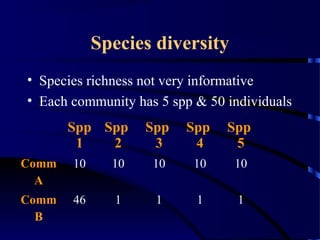
• Species richness not very informative
• Each community has 5 spp & 50 individuals
Spp
1
Spp
2
Spp
3
Spp
4
Spp
5
Comm
A
10 10 10 10 10
Comm
B
46 1 1 1 1
Diversity indices
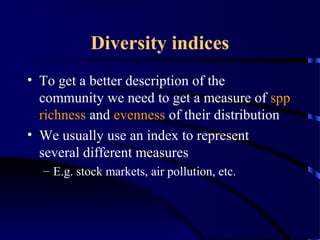
• To get a better description of the
community we need to get a measure of spp
richness and evenness of their distribution
• We usually use an index to represent
several different measures
– E.g. stock markets, air pollution, etc.
Diversity indices
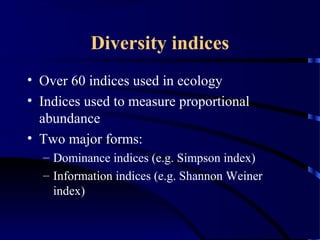
• Over 60 indices used in ecology
• Indices used to measure proportional
abundance
• Two major forms:
– Dominance indices (e.g. Simpson index)
– Information indices (e.g. Shannon Weiner
index)
Simpson Diversity Index (D)
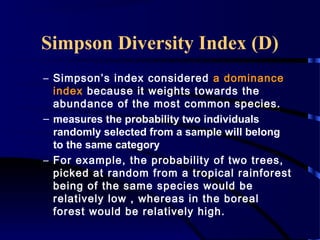
– Simpson’s index considered a dominance
index because it weights towards the
abundance of the most common species.
– measures the probability two individuals
randomly selected from a sample will belong
to the same category
– For example, the probability of two trees,
picked at random from a tropical rainforest
being of the same species would be
relatively low , whereas in the boreal
forest would be relatively high.
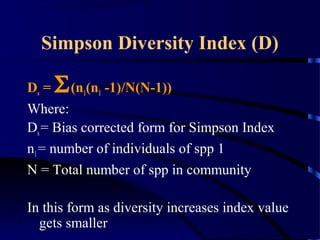
Simpson Diversity Index (D)
Ds = Σ(n1(n1 -1)/N(N-1))
Where:
Ds= Bias corrected form for Simpson Index
n1= number of individuals of spp 1
N = Total number of spp in community
In this form as diversity increases index value
gets smaller
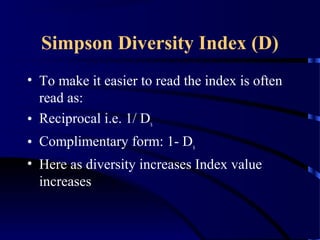
Simpson Diversity Index (D)
• To make it easier to read the index is often
read as:
• Reciprocal i.e. 1/ Ds
• Complimentary form: 1- Ds
• Here as diversity increases Index value
increases
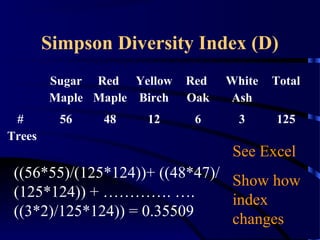
Simpson Diversity Index (D)
Sugar
Maple
Red
Maple
Yellow
Birch
Red
Oak
White
Ash
Total
#
Trees
56 48 12 6 3 125
((56*55)/(125*124))+ ((48*47)/
(125*124)) + …………. ….
((3*2)/125*124)) = 0.35509
See Excel
Show how
index
changes
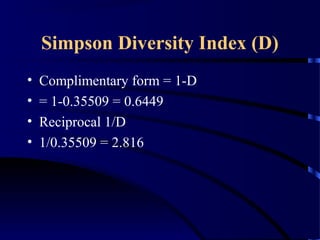
Simpson Diversity Index (D)
• Complimentary form = 1-D
• = 1-0.35509 = 0.6449
• Reciprocal 1/D
• 1/0.35509 = 2.816
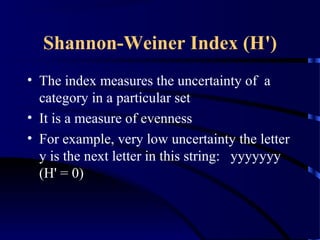
Shannon-Weiner Index (H')
• The index measures the uncertainty of a
category in a particular set
• It is a measure of evenness
• For example, very low uncertainty the letter
y is the next letter in this string: yyyyyyy
(H' = 0)
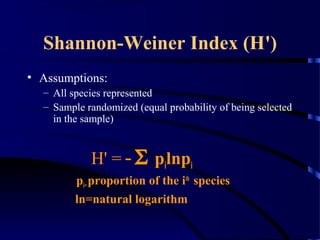
Shannon-Weiner Index (H')
• Assumptions:
– All species represented
– Sample randomized (equal probability of being selected
in the sample)
H' = -Σ pilnpi
pi=proportion of the ith
species
ln=natural logarithm
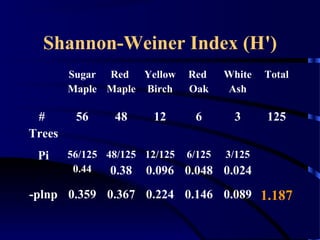
Shannon-Weiner Index (H')
Sugar
Maple
Red
Maple
Yellow
Birch
Red
Oak
White
Ash
Total
#
Trees
56 48 12 6 3 125
Pi 56/125
0.44
48/125
0.38
12/125
0.096
6/125
0.048
3/125
0.024
-plnp 0.359 0.367 0.224 0.146 0.089 1.187
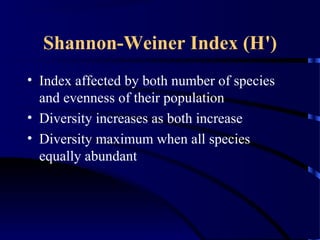
Shannon-Weiner Index (H')
• Index affected by both number of species
and evenness of their population
• Diversity increases as both increase
• Diversity maximum when all species
equally abundant
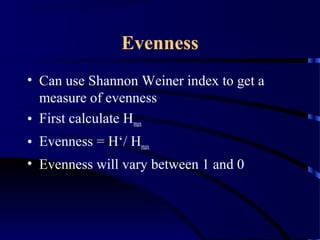
Evenness
• Can use Shannon Weiner index to get a
measure of evenness
• First calculate Hmax
• Evenness = H‘/ Hmax
• Evenness will vary between 1 and 0
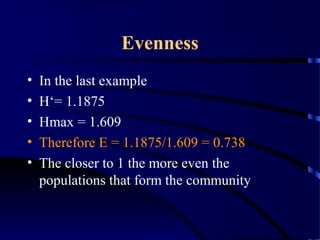
Evenness
• In the last example
• H‘= 1.1875
• Hmax = 1.609
• Therefore E = 1.1875/1.609 = 0.738
• The closer to 1 the more even the
populations that form the community
Questions?

Species Diversity Concepts

  • 1.
  • 2.
    Outline • Lecture • Classroom exercise to calculate diversity indices
  • 3.
    Why quantify biodiversity? •Initially thought that more diversity = more stable ecosystem* • Now used to measure and track changes *MacArthur, R. 1955. Fluctuations of animal populations and a measure of community stability. Ecology 35:533-536
  • 4.
    How do wemeasure biodiversity? • Use functional categories – Ecosystem, species, genetic • Use theoretical categories* – Alpha – Beta – Gamma * Whittaker, R.H. 1960. Vegetation of the Siskiyou Mountains, Oregon and California. Ecol. Mono. 30:279-338.
  • 5.
    Alpha diversity • Diversitywithin a particular sample • E.g. the number of species surveyed
  • 6.
    Beta Diversity • Changesin sample composition along an environmental gradient • E.g. composition of forest stands on the slope of a mountain
  • 7.
    Gamma Diversity • Diversitydue to differences in samples when all samples combined • E.g. diversity of a forest landscape
  • 8.
    Describing Communities • Twomethods – Describe physical attributes (e.g. age class, size class) – Describe number of species and their abundance
  • 9.
    Biodiversity • Diversity ofliving things • Term often misused and overused • Current focus in conservation studies • Includes interest in genetic, species and ecosystem diversity • We will use species as our focus but concepts can be used for genetic and ecosystem diversity as well.
  • 10.
    Species Richness • Numberof species in a community • The simplest measure • Can count all spp only is few simple ecosystems • Does not consider number of individuals • Difficulties – When is it a specie? • Aphids • Clonal plants – Cannot count all species with limited time
  • 11.
    Species Richness • How? •Identify organism groups of interest • Identify boundaries of community • Survey area for organisms of interest
  • 12.
    Species diversity • Speciesrichness not very informative • Each community has 5 spp & 50 individuals Spp 1 Spp 2 Spp 3 Spp 4 Spp 5 Comm A 10 10 10 10 10 Comm B 46 1 1 1 1
  • 13.
    Diversity indices • Toget a better description of the community we need to get a measure of spp richness and evenness of their distribution • We usually use an index to represent several different measures – E.g. stock markets, air pollution, etc.
  • 14.
    Diversity indices • Over60 indices used in ecology • Indices used to measure proportional abundance • Two major forms: – Dominance indices (e.g. Simpson index) – Information indices (e.g. Shannon Weiner index)
  • 15.
    Simpson Diversity Index(D) – Simpson’s index considered a dominance index because it weights towards the abundance of the most common species. – measures the probability two individuals randomly selected from a sample will belong to the same category – For example, the probability of two trees, picked at random from a tropical rainforest being of the same species would be relatively low , whereas in the boreal forest would be relatively high.
  • 16.
    Simpson Diversity Index(D) Ds = Σ(n1(n1 -1)/N(N-1)) Where: Ds= Bias corrected form for Simpson Index n1= number of individuals of spp 1 N = Total number of spp in community In this form as diversity increases index value gets smaller
  • 17.
    Simpson Diversity Index(D) • To make it easier to read the index is often read as: • Reciprocal i.e. 1/ Ds • Complimentary form: 1- Ds • Here as diversity increases Index value increases
  • 18.
    Simpson Diversity Index(D) Sugar Maple Red Maple Yellow Birch Red Oak White Ash Total # Trees 56 48 12 6 3 125 ((56*55)/(125*124))+ ((48*47)/ (125*124)) + …………. …. ((3*2)/125*124)) = 0.35509 See Excel Show how index changes
  • 19.
    Simpson Diversity Index(D) • Complimentary form = 1-D • = 1-0.35509 = 0.6449 • Reciprocal 1/D • 1/0.35509 = 2.816
  • 20.
    Shannon-Weiner Index (H') •The index measures the uncertainty of a category in a particular set • It is a measure of evenness • For example, very low uncertainty the letter y is the next letter in this string: yyyyyyy (H' = 0)
  • 21.
    Shannon-Weiner Index (H') •Assumptions: – All species represented – Sample randomized (equal probability of being selected in the sample) H' = -Σ pilnpi pi=proportion of the ith species ln=natural logarithm
  • 22.
    Shannon-Weiner Index (H') Sugar Maple Red Maple Yellow Birch Red Oak White Ash Total # Trees 5648 12 6 3 125 Pi 56/125 0.44 48/125 0.38 12/125 0.096 6/125 0.048 3/125 0.024 -plnp 0.359 0.367 0.224 0.146 0.089 1.187
  • 23.
    Shannon-Weiner Index (H') •Index affected by both number of species and evenness of their population • Diversity increases as both increase • Diversity maximum when all species equally abundant
  • 24.
    Evenness • Can useShannon Weiner index to get a measure of evenness • First calculate Hmax • Evenness = H‘/ Hmax • Evenness will vary between 1 and 0
  • 25.
    Evenness • In thelast example • H‘= 1.1875 • Hmax = 1.609 • Therefore E = 1.1875/1.609 = 0.738 • The closer to 1 the more even the populations that form the community
  • 26.