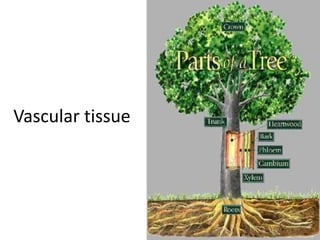
Vascular tissue
PLANTS
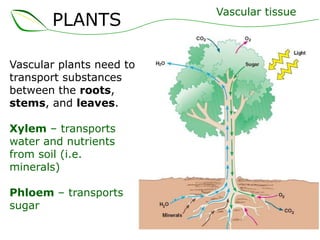
Vascular plants need to
transport substances
between the roots,
stems, and leaves.
Xylem – transports
water and nutrients
from soil (i.e.
minerals)
Phloem – transports
sugar
Vascular tissue
PLANTS
Some key terms:
Diffusion
Osmosis
Passive Transport
Active Transport
Vascular tissue
PLANTS
Vascular tissue
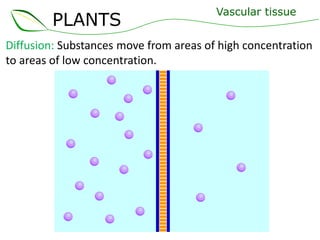
Diffusion: Substances move from areas of high concentration
to areas of low concentration.
PLANTS
Vascular tissue
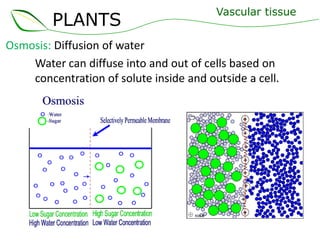
Osmosis: Diffusion of water
Water can diffuse into and out of cells based on
concentration of solute inside and outside a cell.
PLANTS
Vascular tissue
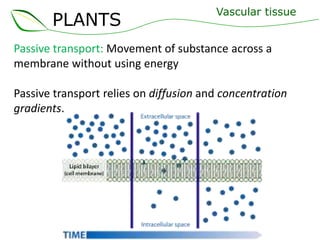
Passive transport: Movement of substance across a
membrane without using energy
Passive transport relies on diffusion and concentration
gradients.
PLANTS
Vascular tissue
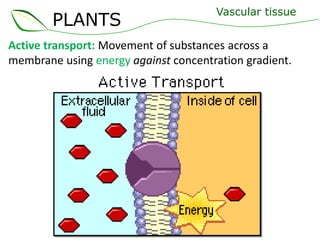
Active transport: Movement of substances across a
membrane using energy against concentration gradient.
PLANTS
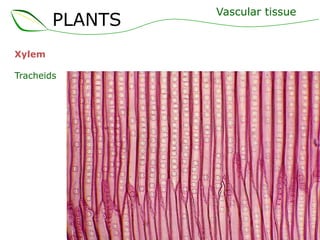
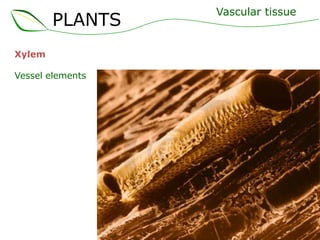
Xylem
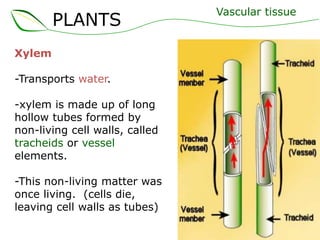
-Transports water.
-xylem is made up of long
hollow tubes formed by
non-living cell walls, called
tracheids or vessel
elements.
-This non-living matter was
once living. (cells die,
leaving cell walls as tubes)
Vascular tissue
PLANTS
Xylem
Tracheids
Vascular tissue
PLANTS
Xylem
Vessel elements
Vascular tissue
PLANTS
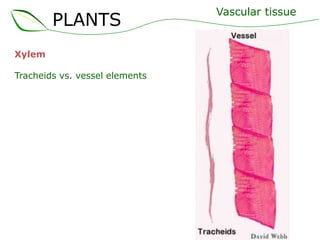
Xylem
Tracheids vs. vessel elements
Vascular tissue
PLANTS
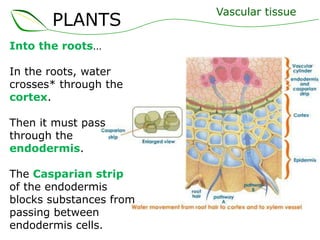
Into the roots…
In the roots, water
crosses* through the
cortex.
Then it must pass
through the
endodermis.
The Casparian strip
of the endodermis
blocks substances from
passing between
endodermis cells.
Vascular tissue
PLANTS
Into the roots…
*Water either enters
the cortex cells by
1) osmosis from cell
to cell
2) flows between
cells.
Minerals are actively
pumped across cell
membranes into the
xylem.
Vascular tissue
H2O
PLANTS
Into the roots…
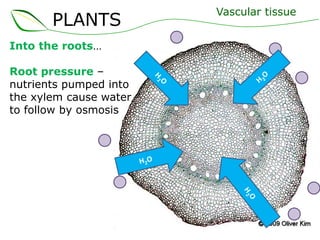
Root pressure –
nutrients pumped into
the xylem cause water
to follow by osmosis
Vascular tissue
PLANTS
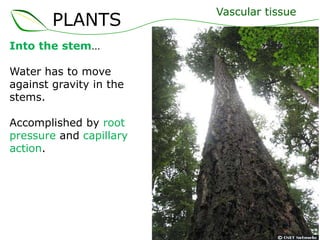
Into the stem…
Water has to move
against gravity in the
stems.
Accomplished by root
pressure and capillary
action.
Vascular tissue
PLANTS
Into the stem…
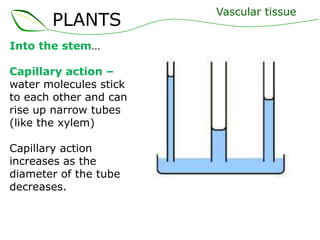
Capillary action –
water molecules stick
to each other and can
rise up narrow tubes
(like the xylem)
Capillary action
increases as the
diameter of the tube
decreases.
Vascular tissue
PLANTS
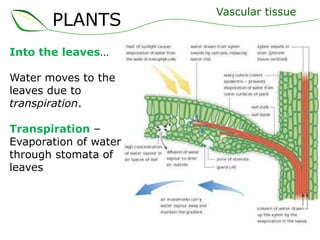
Into the leaves…
Water moves to the
leaves due to
transpiration.
Transpiration –
Evaporation of water
through stomata of
leaves
Vascular tissue
PLANTS
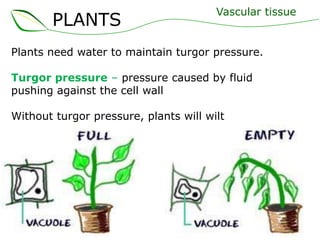
Plants need water to maintain turgor pressure.
Turgor pressure – pressure caused by fluid
pushing against the cell wall
Without turgor pressure, plants will wilt
Vascular tissue
PLANTS
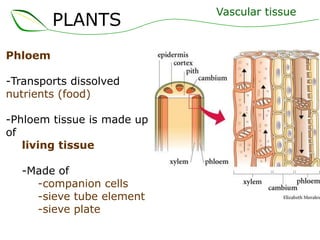
Phloem
-Transports dissolved
nutrients (food)
-Phloem tissue is made up
of
living tissue
-Made of
-companion cells
-sieve tube element
-sieve plate
Vascular tissue
PLANTS
Phloem
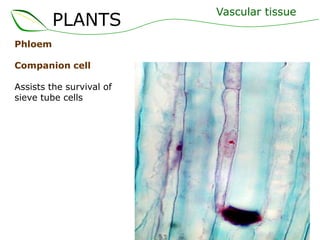
Companion cell
Assists the survival of
sieve tube cells
Vascular tissue
PLANTS
Phloem
Sieve tube (cells without a
nucleus forming a hollow tube)
Sieve plate (perforated
end of sieve tube cells)
Vascular tissue
PLANTS
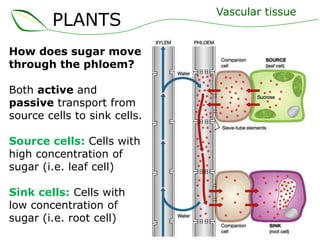
How does sugar move
through the phloem?
Both active and
passive transport from
source cells to sink cells.
Source cells: Cells with
high concentration of
sugar (i.e. leaf cell)
Sink cells: Cells with
low concentration of
sugar (i.e. root cell)
Vascular tissue
PLANTS
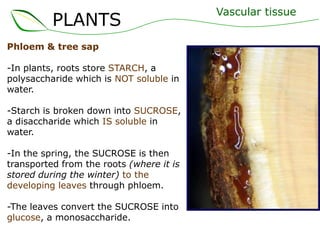
Phloem & tree sap
-In plants, roots store STARCH, a
polysaccharide which is NOT soluble in
water.
-Starch is broken down into SUCROSE,
a disaccharide which IS soluble in
water.
-In the spring, the SUCROSE is then
transported from the roots (where it is
stored during the winter) to the
developing leaves through phloem.
-The leaves convert the SUCROSE into
glucose, a monosaccharide.
Vascular tissue
PLANTS
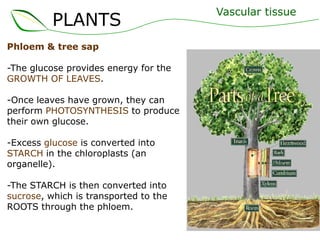
Phloem & tree sap
-The glucose provides energy for the
GROWTH OF LEAVES.
-Once leaves have grown, they can
perform PHOTOSYNTHESIS to produce
their own glucose.
-Excess glucose is converted into
STARCH in the chloroplasts (an
organelle).
-The STARCH is then converted into
sucrose, which is transported to the
ROOTS through the phloem.
Vascular tissue
PLANTS
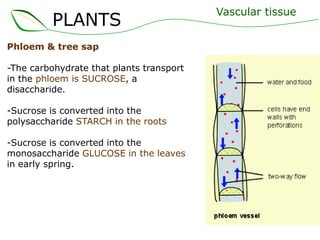
Phloem & tree sap
-The carbohydrate that plants transport
in the phloem is SUCROSE, a
disaccharide.
-Sucrose is converted into the
polysaccharide STARCH in the roots
-Sucrose is converted into the
monosaccharide GLUCOSE in the leaves
in early spring.
Vascular tissue
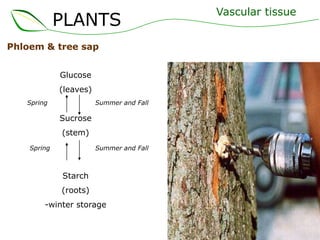
Glucose
(leaves)
Sucrose
(stem)
Starch
(roots)
-winter storage
PLANTS
Phloem & tree sap
Summer and Fall
Summer and Fall
Spring
Spring
Vascular tissue

02 plant structure supplement - vascular tissue