Transport in
Vascular
Plants
By
Sharanya k
nambiar
Natural science
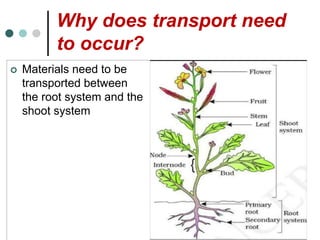
Why does transport need
to occur?
 Materials need to be
transported between
the root system and the
shoot system
Transport Within Plants
 Water and minerals
absorbed by roots are
drawn upward in the
xylem to the shoots
 Sugar produced by
photosynthesis is
exported from leaves
to other organs via the
phloem
Passive & Active
Transport
 Passive Transport
 Does NOT require ATP to occur
Diffusion
Osmosis
Facilitated Diffusion
 Active Transport
 Requires ATP to occur
Bulk transport (endo/exocytosis)
Water Potential
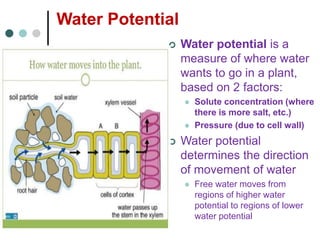
 Water potential is a
measure of where water
wants to go in a plant,
based on 2 factors:
 Solute concentration (where
there is more salt, etc.)
 Pressure (due to cell wall)
 Water potential
determines the direction
of movement of water
 Free water moves from
regions of higher water
potential to regions of lower
water potential
Water Potential
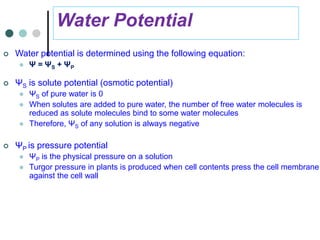
 Water potential is determined using the following equation:
 Ψ = ΨS + ΨP
 ΨS is solute potential (osmotic potential)
 ΨS of pure water is 0
 When solutes are added to pure water, the number of free water molecules is
reduced as solute molecules bind to some water molecules
 Therefore, ΨS of any solution is always negative
 ΨP is pressure potential
 ΨP is the physical pressure on a solution
 Turgor pressure in plants is produced when cell contents press the cell membrane
against the cell wall
Turgor Pressure
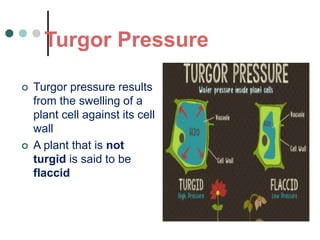
 Turgor pressure results
from the swelling of a
plant cell against its cell
wall
 A plant that is not
turgid is said to be
flaccid
Short- and Long-
Distance Transport in
Plants
Water and sugars move differently in
plants, depending on whether they’re going
a short or a long distance
Short-Distance Transport
1. Simple diffusion/osmosis
 substances in one cell move out of one cell, across the cell wall, and
into another cell
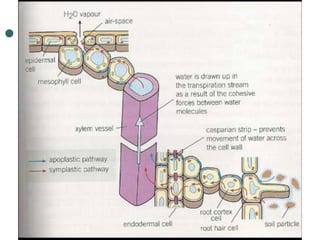
2. Plasmodesmata
 Plasmodesmata are connections between the cytoplasm of adjacent
plant cells
 Substances move between cells through these openings
 This connection of the cytoplasm is called the symplast
3. Apoplast
 The extracellular pathway of cell walls
 Substances move between cells through the cell walls, which are
connected
Long-Distance Transport
 Over long distances, these 3
processes (simple diffusion,
apoplast,& symplast) take too long
 Water and solutes move through
xylem and phloem by bulk flow, the
movement of a fluid driven by
pressure
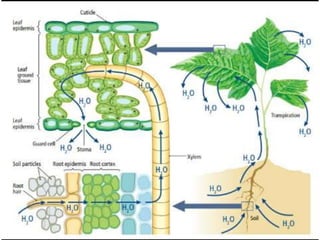
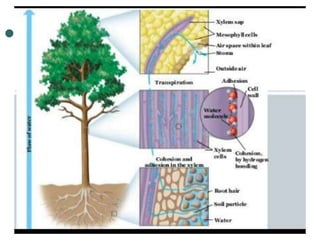
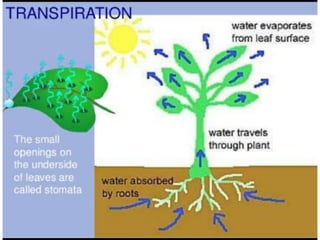
Transpiration
 Transpiration is the evaporation of water from
leaves and other parts of the plant
 An average maple tree loses more than 200L of
water per hour during the summer!
 Unless this water is replaced by water absorbed by
the roots, leaves will wilt and die
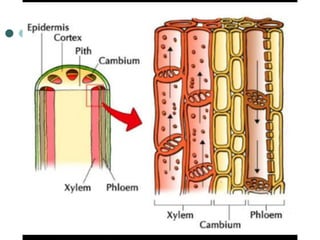
 Xylem transports the water throughout the plant
 PUSHING and PULLING
PUSHING Xylem Sap
 Water is still “collected” by the roots at night, when
transpiration is not occurring as much
 As water flows in, pressure is generated which forces
the fluid to go up the xylem
 This upward push of xylem sap is called root pressure
 Can cause guttation (exuding water from margins of
the leaf, not through stomata).
 This, however, can only move xylem sap a few meters
at most
 Straw analogy
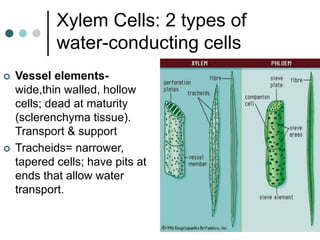
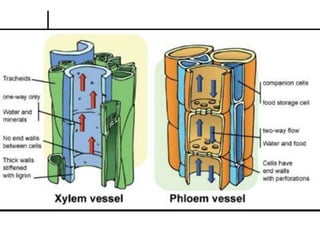
Xylem Cells: 2 types of
water-conducting cells
 Vessel elements-
wide,thin walled, hollow
cells; dead at maturity
(sclerenchyma tissue).
Transport & support
 Tracheids= narrower,
tapered cells; have pits at
ends that allow water
transport.
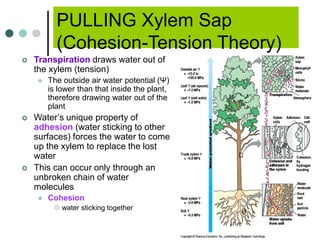
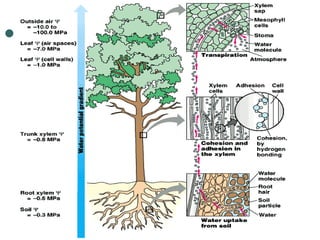
PULLING Xylem Sap
(Cohesion-Tension Theory)
 Transpiration draws water out of
the xylem (tension)
 The outside air water potential (Ψ)
is lower than that inside the plant,
therefore drawing water out of the
plant
 Water’s unique property of
adhesion (water sticking to other
surfaces) forces the water to come
up the xylem to replace the lost
water
 This can occur only through an
unbroken chain of water
molecules
 Cohesion
 water sticking together
The Photosynthesis &
Transpiration
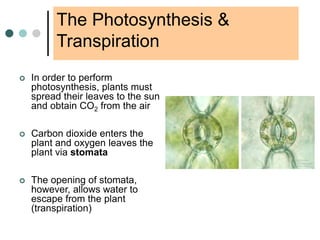
 In order to perform
photosynthesis, plants must
spread their leaves to the sun
and obtain CO2 from the air
 Carbon dioxide enters the
plant and oxygen leaves the
plant via stomata
 The opening of stomata,
however, allows water to
escape from the plant
(transpiration)
Mechanism for Stomatal
Opening & Closing
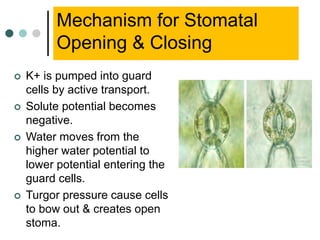
 K+ is pumped into guard
cells by active transport.
 Solute potential becomes
negative.
 Water moves from the
higher water potential to
lower potential entering the
guard cells.
 Turgor pressure cause cells
to bow out & creates open
stoma.
Phloem – Sugar Transport
 Phloem carries phloem sap (food) from a
sugar source to a sugar sink
 Sugar source:
an organ where sugar is being produced
Usually leaves
 Sugar sink:
an organ that consumes or stores sugar
Usually roots, growing stems, buds, and fruits
Phloem cells
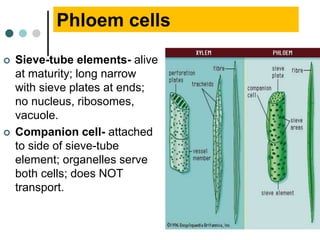
 Sieve-tube elements- alive
at maturity; long narrow
with sieve plates at ends;
no nucleus, ribosomes,
vacuole.
 Companion cell- attached
to side of sieve-tube
element; organelles serve
both cells; does NOT
transport.
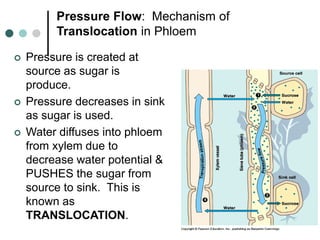
Pressure Flow: Mechanism of
Translocation in Phloem
 Pressure is created at
source as sugar is
produce.
 Pressure decreases in sink
as sugar is used.
 Water diffuses into phloem
from xylem due to
decrease water potential &
PUSHES the sugar from
source to sink. This is
known as
TRANSLOCATION.
Videos..
https://youtu.be/bvPM6sfidY4
Transportation in PlantsYouTube - Feb
24, 2014
THANK YOU
REFERENCE
Book
•11 Biology text book
Websites
www.studiestoday.com
www.vedantu.com
www.aisigcsescience.com
www.slideplayer.com
www.biologyjunction.com

Transport in vascular_plants..

  • 1.
  • 2.
    Why does transportneed to occur?  Materials need to be transported between the root system and the shoot system
  • 3.
    Transport Within Plants Water and minerals absorbed by roots are drawn upward in the xylem to the shoots  Sugar produced by photosynthesis is exported from leaves to other organs via the phloem
  • 4.
    Passive & Active Transport Passive Transport  Does NOT require ATP to occur Diffusion Osmosis Facilitated Diffusion  Active Transport  Requires ATP to occur Bulk transport (endo/exocytosis)
  • 5.
    Water Potential  Waterpotential is a measure of where water wants to go in a plant, based on 2 factors:  Solute concentration (where there is more salt, etc.)  Pressure (due to cell wall)  Water potential determines the direction of movement of water  Free water moves from regions of higher water potential to regions of lower water potential
  • 6.
    Water Potential  Waterpotential is determined using the following equation:  Ψ = ΨS + ΨP  ΨS is solute potential (osmotic potential)  ΨS of pure water is 0  When solutes are added to pure water, the number of free water molecules is reduced as solute molecules bind to some water molecules  Therefore, ΨS of any solution is always negative  ΨP is pressure potential  ΨP is the physical pressure on a solution  Turgor pressure in plants is produced when cell contents press the cell membrane against the cell wall
  • 7.
    Turgor Pressure  Turgorpressure results from the swelling of a plant cell against its cell wall  A plant that is not turgid is said to be flaccid
  • 8.
    Short- and Long- DistanceTransport in Plants Water and sugars move differently in plants, depending on whether they’re going a short or a long distance
  • 9.
    Short-Distance Transport 1. Simplediffusion/osmosis  substances in one cell move out of one cell, across the cell wall, and into another cell 2. Plasmodesmata  Plasmodesmata are connections between the cytoplasm of adjacent plant cells  Substances move between cells through these openings  This connection of the cytoplasm is called the symplast 3. Apoplast  The extracellular pathway of cell walls  Substances move between cells through the cell walls, which are connected
  • 12.
    Long-Distance Transport  Overlong distances, these 3 processes (simple diffusion, apoplast,& symplast) take too long  Water and solutes move through xylem and phloem by bulk flow, the movement of a fluid driven by pressure
  • 14.
    Transpiration  Transpiration isthe evaporation of water from leaves and other parts of the plant  An average maple tree loses more than 200L of water per hour during the summer!  Unless this water is replaced by water absorbed by the roots, leaves will wilt and die  Xylem transports the water throughout the plant  PUSHING and PULLING
  • 16.
    PUSHING Xylem Sap Water is still “collected” by the roots at night, when transpiration is not occurring as much  As water flows in, pressure is generated which forces the fluid to go up the xylem  This upward push of xylem sap is called root pressure  Can cause guttation (exuding water from margins of the leaf, not through stomata).  This, however, can only move xylem sap a few meters at most  Straw analogy
  • 17.
    Xylem Cells: 2types of water-conducting cells  Vessel elements- wide,thin walled, hollow cells; dead at maturity (sclerenchyma tissue). Transport & support  Tracheids= narrower, tapered cells; have pits at ends that allow water transport.
  • 19.
    PULLING Xylem Sap (Cohesion-TensionTheory)  Transpiration draws water out of the xylem (tension)  The outside air water potential (Ψ) is lower than that inside the plant, therefore drawing water out of the plant  Water’s unique property of adhesion (water sticking to other surfaces) forces the water to come up the xylem to replace the lost water  This can occur only through an unbroken chain of water molecules  Cohesion  water sticking together
  • 21.
    The Photosynthesis & Transpiration In order to perform photosynthesis, plants must spread their leaves to the sun and obtain CO2 from the air  Carbon dioxide enters the plant and oxygen leaves the plant via stomata  The opening of stomata, however, allows water to escape from the plant (transpiration)
  • 22.
    Mechanism for Stomatal Opening& Closing  K+ is pumped into guard cells by active transport.  Solute potential becomes negative.  Water moves from the higher water potential to lower potential entering the guard cells.  Turgor pressure cause cells to bow out & creates open stoma.
  • 23.
    Phloem – SugarTransport  Phloem carries phloem sap (food) from a sugar source to a sugar sink  Sugar source: an organ where sugar is being produced Usually leaves  Sugar sink: an organ that consumes or stores sugar Usually roots, growing stems, buds, and fruits
  • 24.
    Phloem cells  Sieve-tubeelements- alive at maturity; long narrow with sieve plates at ends; no nucleus, ribosomes, vacuole.  Companion cell- attached to side of sieve-tube element; organelles serve both cells; does NOT transport.
  • 26.
    Pressure Flow: Mechanismof Translocation in Phloem  Pressure is created at source as sugar is produce.  Pressure decreases in sink as sugar is used.  Water diffuses into phloem from xylem due to decrease water potential & PUSHES the sugar from source to sink. This is known as TRANSLOCATION.
  • 27.
  • 28.
  • 29.
    REFERENCE Book •11 Biology textbook Websites www.studiestoday.com www.vedantu.com www.aisigcsescience.com www.slideplayer.com www.biologyjunction.com