Transportation In Plants
“Transportation is the process that involves the
movement of water and necessary nutrients to
all parts of the plant for its survival. “
Network Of Transportation
• Plants contain a vast network of conduits which consist
of xylem and phloem.
• This is more like the circulatory system that transports
blood throughout the human body.
• Similar to the circulatory system in humans, the xylem
and phloem tissues extend throughout the plant.
• These conducting tissues originate from the roots and
move up through the trunks of trees.
• Later they branch off into the branches and then
branching even further into every leaf, like spider webs.
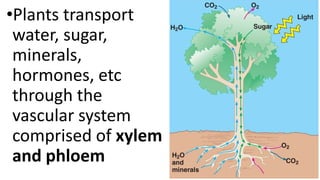
•Plants transport
water, sugar,
minerals,
hormones, etc
through the
vascular system
comprised of xylem
and phloem
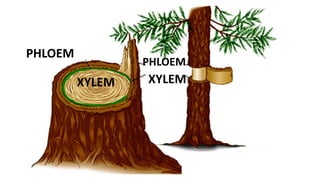
PHLOEM
XYLEM XYLEM
PHLOEM
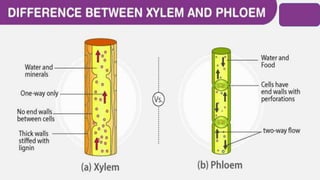
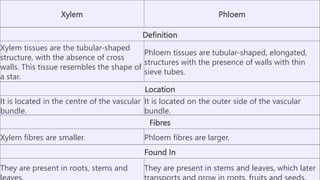
Xylem Phloem
Definition
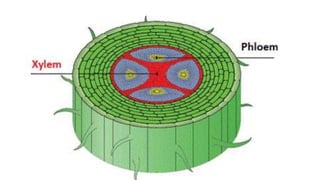
Xylem tissues are the tubular-shaped
structure, with the absence of cross
walls. This tissue resembles the shape of
a star.
Phloem tissues are tubular-shaped, elongated,
structures with the presence of walls with thin
sieve tubes.
Location
It is located in the centre of the vascular
bundle.
It is located on the outer side of the vascular
bundle.
Fibres
Xylem fibres are smaller. Phloem fibres are larger.
Found In
They are present in roots, stems and They are present in stems and leaves, which later
Movements
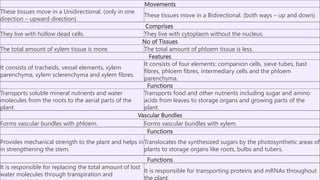
These tissues move in a Unidirectional. (only in one
direction – upward direction)
These tissues move in a Bidirectional. (both ways – up and down)
Comprises
They live with hollow dead cells. They live with cytoplasm without the nucleus.
No of Tissues
The total amount of xylem tissue is more. The total amount of phloem tissue is less.
Features
It consists of tracheids, vessel elements, xylem
parenchyma, xylem sclerenchyma and xylem fibres.
It consists of four elements: companion cells, sieve tubes, bast
fibres, phloem fibres, intermediary cells and the phloem
parenchyma.
Functions
Transports soluble mineral nutrients and water
molecules from the roots to the aerial parts of the
plant.
Transports food and other nutrients including sugar and amino
acids from leaves to storage organs and growing parts of the
plant.
Vascular Bundles
Forms vascular bundles with phloem. Forms vascular bundles with xylem.
Functions
Provides mechanical strength to the plant and helps in
in strengthening the stem.
Translocates the synthesized sugars by the photosynthetic areas of
plants to storage organs like roots, bulbs and tubers.
Functions
It is responsible for replacing the total amount of lost
water molecules through transpiration and
It is responsible for transporting proteins and mRNAs throughout
the plant.
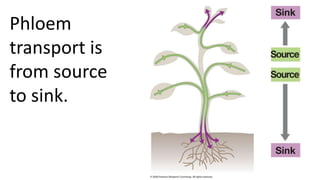
Phloem
transport is
from source
to sink.
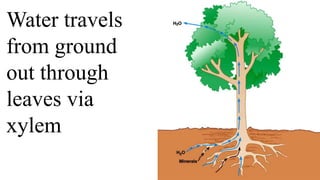
Water travels
from ground
out through
leaves via
xylem
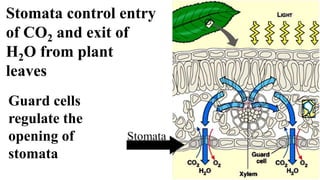
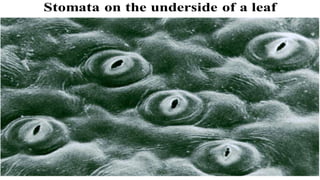
Stomata control entry
of CO2 and exit of
H2O from plant
leaves
Guard cells
regulate the
opening of
stomata
Transportation In Plants.pptx

Transportation In Plants.pptx

  • 1.
    Transportation In Plants “Transportationis the process that involves the movement of water and necessary nutrients to all parts of the plant for its survival. “
  • 2.
    Network Of Transportation •Plants contain a vast network of conduits which consist of xylem and phloem. • This is more like the circulatory system that transports blood throughout the human body. • Similar to the circulatory system in humans, the xylem and phloem tissues extend throughout the plant. • These conducting tissues originate from the roots and move up through the trunks of trees. • Later they branch off into the branches and then branching even further into every leaf, like spider webs.
  • 3.
    •Plants transport water, sugar, minerals, hormones,etc through the vascular system comprised of xylem and phloem
  • 4.
  • 6.
    Xylem Phloem Definition Xylem tissuesare the tubular-shaped structure, with the absence of cross walls. This tissue resembles the shape of a star. Phloem tissues are tubular-shaped, elongated, structures with the presence of walls with thin sieve tubes. Location It is located in the centre of the vascular bundle. It is located on the outer side of the vascular bundle. Fibres Xylem fibres are smaller. Phloem fibres are larger. Found In They are present in roots, stems and They are present in stems and leaves, which later
  • 7.
    Movements These tissues movein a Unidirectional. (only in one direction – upward direction) These tissues move in a Bidirectional. (both ways – up and down) Comprises They live with hollow dead cells. They live with cytoplasm without the nucleus. No of Tissues The total amount of xylem tissue is more. The total amount of phloem tissue is less. Features It consists of tracheids, vessel elements, xylem parenchyma, xylem sclerenchyma and xylem fibres. It consists of four elements: companion cells, sieve tubes, bast fibres, phloem fibres, intermediary cells and the phloem parenchyma. Functions Transports soluble mineral nutrients and water molecules from the roots to the aerial parts of the plant. Transports food and other nutrients including sugar and amino acids from leaves to storage organs and growing parts of the plant. Vascular Bundles Forms vascular bundles with phloem. Forms vascular bundles with xylem. Functions Provides mechanical strength to the plant and helps in in strengthening the stem. Translocates the synthesized sugars by the photosynthetic areas of plants to storage organs like roots, bulbs and tubers. Functions It is responsible for replacing the total amount of lost water molecules through transpiration and It is responsible for transporting proteins and mRNAs throughout the plant.
  • 9.
  • 10.
    Water travels from ground outthrough leaves via xylem
  • 11.
    Stomata control entry ofCO2 and exit of H2O from plant leaves Guard cells regulate the opening of stomata