
The Flower
Definition:
- It is morphologically compressed fertile shoot
with modified leaves or floral leaves.
- adapted for the production of fruits and seeds
(propagation of the plant).
- It is very important for the identification of
unknown plants.
INTRODUCTION
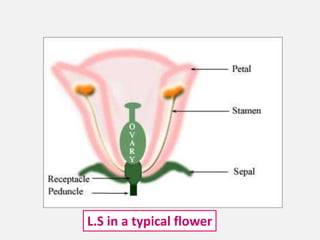
L.S in a typical flower
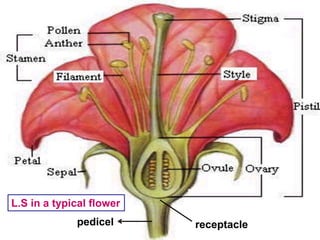
receptaclepedicel
L.S in a typical flower
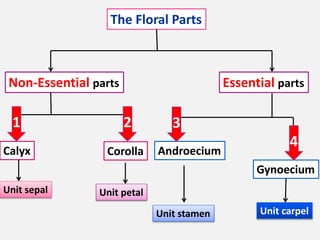
The Floral Parts
Non-Essential parts Essential parts
Calyx Corolla Androecium
Gynoecium
Unit sepal Unit petal
Unit stamen Unit carpel
1 2 3
4
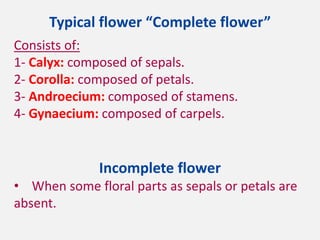
Typical flower “Complete flower”
Consists of:
1- Calyx: composed of sepals.
2- Corolla: composed of petals.
3- Androecium: composed of stamens.
4- Gynaecium: composed of carpels.
Incomplete flower
• When some floral parts as sepals or petals are
absent.
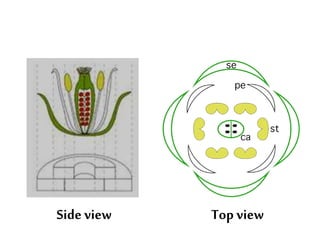
Side view Top view
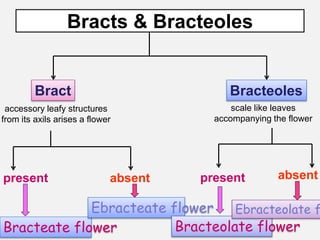
Bracts & Bracteoles
Bract Bracteoles
accessory leafy structures
from its axils arises a flower
scale like leaves
accompanying the flower
present presentabsent absent
Bracteate flower
Ebracteate flower
Bracteolate flower
Ebracteolate f
Involucre: when bracts or bracteoles are present in
crowded form in one or more whorls.
Kinds of Flowers
Flowers are classified according to:
1-The arrangement of the floral leaves on the
flower axis.
2-The number of whorls present.
3-The number of segments in different whorls.
4-The presence of all floral parts.
5-The symmetry of all floral leaves.
6-The presence or absence of sexual organs.
• 1- The arrangement of the floral leaves
on the flower axis.
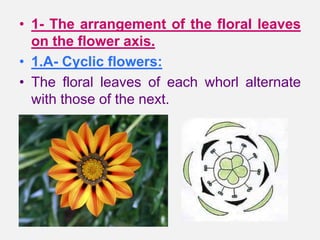
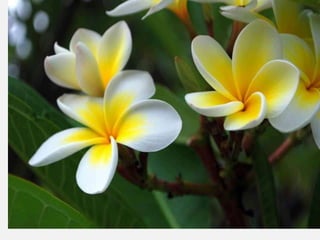
• 1.A- Cyclic flowers:
• The floral leaves of each whorl alternate
with those of the next.
• 1.B- Acyclic flowers:
• The floral leaves are spirally arranged
• 1.C- Hemicyclic flowers:
• The perianth is spirally arranged while the
stamens and carpels are in whorls.
• The calyx only is arranged in spiral
manner while the rest floral parts in
whorls.
2-According to number of whorls present
• Tetracyclic: four whorls
• Pentacyclic: five whorls
3- According to the segments in different
whorls
• Isomerous: number of segments in different
whorls is usually the same
• Heteromerous: number of segments in different
whorls is unequal
4- According to the presence of all floral
parts:
• Complete: The flower has all the usual parts.
• Incomplete: The flower is lacking one or some
of the regular parts.
5- According to the presence or absence
of sexual organs:
• a- Hermaphrodite: when both the male and
female organs are present.
• b-Sterile: when both male and female organs
are absent or not functioning.
c- Unisexual (imperfect):
• only one of the sexual organs is present
and functioning
i) Staminate: only male organ is present
ii) Pistillate: only female organ is present
6- According to the symmetry of all
floral leaves:
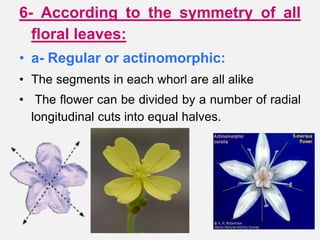
• a- Regular or actinomorphic:
• The segments in each whorl are all alike
• The flower can be divided by a number of radial
longitudinal cuts into equal halves.
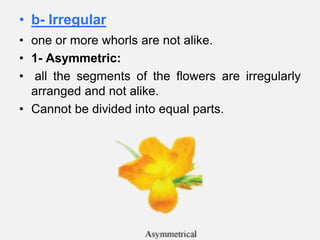
• b- Irregular
• one or more whorls are not alike.
• 1- Asymmetric:
• all the segments of the flowers are irregularly
arranged and not alike.
• Cannot be divided into equal parts.
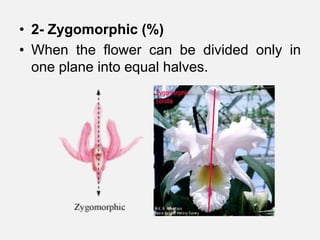
• 2- Zygomorphic (%)
• When the flower can be divided only in
one plane into equal halves.
Parts of the flower
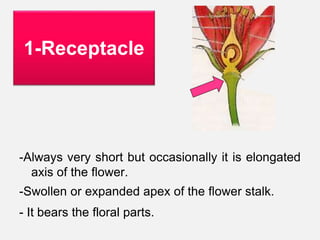
-Always very short but occasionally it is elongated
axis of the flower.
-Swollen or expanded apex of the flower stalk.
- It bears the floral parts.
1-Receptacle
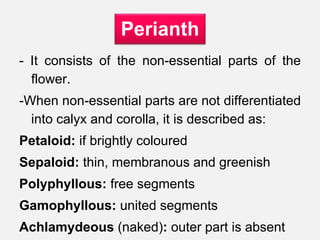
- It consists of the non-essential parts of the
flower.
-When non-essential parts are not differentiated
into calyx and corolla, it is described as:
Petaloid: if brightly coloured
Sepaloid: thin, membranous and greenish
Polyphyllous: free segments
Gamophyllous: united segments
Achlamydeous (naked): outer part is absent
Perianth
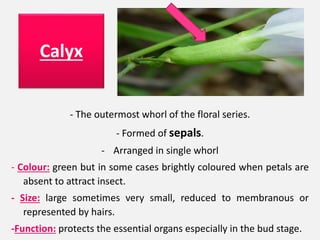
- The outermost whorl of the floral series.
- Formed of sepals.
- Arranged in single whorl
- Colour: green but in some cases brightly coloured when petals are
absent to attract insect.
- Size: large sometimes very small, reduced to membranous or
represented by hairs.
-Function: protects the essential organs especially in the bud stage.
Calyx
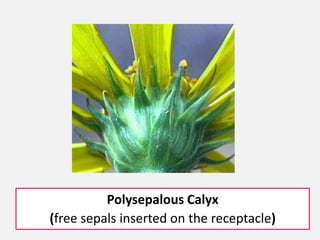
Polysepalous Calyx
(free sepals inserted on the receptacle)
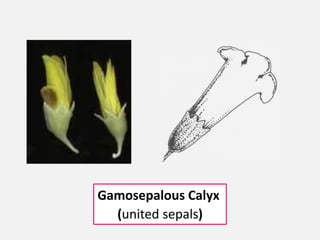
Gamosepalous Calyx
(united sepals)
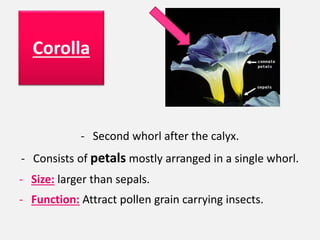
- Second whorl after the calyx.
- Consists of petals mostly arranged in a single whorl.
- Size: larger than sepals.
- Function: Attract pollen grain carrying insects.
Corolla
- Colour: usually brightly coloured, this colour
may be due to the following pigments.
- Anthocyanins (red, blue and violet depending
on the pH of the cell sap).
- Flavone derivatives (yellow colour).
- Pigments such as carotin, xanthophyll (yellow,
orange and red colours).
- The white colour is due to the reflection of
light from the intercellular spaces of the
mesophyll but not to pigments.
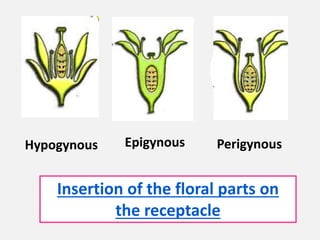
Insertion of the floral parts on
the receptacle
PerigynousHypogynous Epigynous
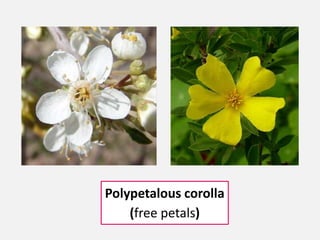
Polypetalous corolla
(free petals)
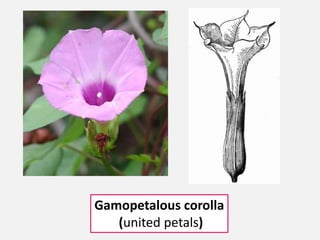
Gamopetalous corolla
(united petals)
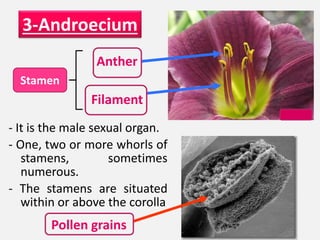
- It is the male sexual organ.
- One, two or more whorls of
stamens, sometimes
numerous.
- The stamens are situated
within or above the corolla
3-Androecium
Anther
Filament
Stamen
Pollen grains
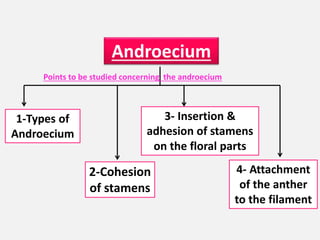
Androecium
1-Types of
Androecium
2-Cohesion
of stamens
3- Insertion &
adhesion of stamens
on the floral parts
4- Attachment
of the anther
to the filament
Points to be studied concerning the androecium
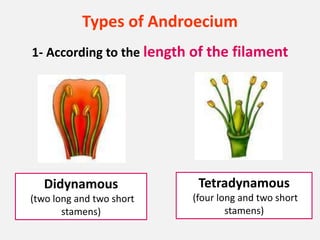
Types of Androecium
1- According to the length of the filament
Didynamous
(two long and two short
stamens)
Tetradynamous
(four long and two short
stamens)
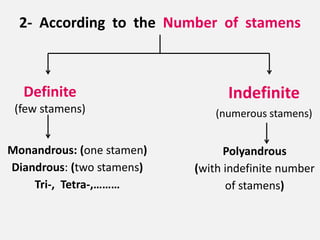
2- According to the Number of stamens
Definite
(few stamens)
Indefinite
(numerous stamens)
Monandrous: (one stamen)
Diandrous: (two stamens)
Tri-, Tetra-,………
Polyandrous
(with indefinite number
of stamens)
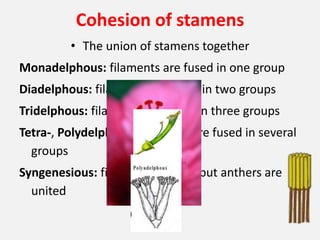
Cohesion of stamens
• The union of stamens together
Monadelphous: filaments are fused in one group
Diadelphous: filaments are fused in two groups
Tridelphous: filaments are fused in three groups
Tetra-, Polydelphous: filaments are fused in several
groups
Syngenesious: filaments are free but anthers are
united
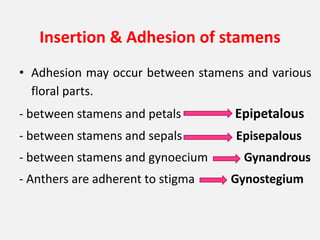
Insertion & Adhesion of stamens
• Adhesion may occur between stamens and various
floral parts.
- between stamens and petals Epipetalous
- between stamens and sepals Episepalous
- between stamens and gynoecium Gynandrous
- Anthers are adherent to stigma Gynostegium
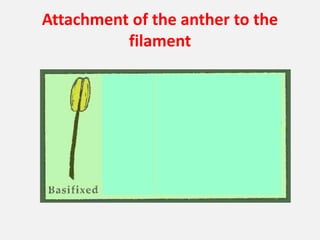
Attachment of the anther to the
filament
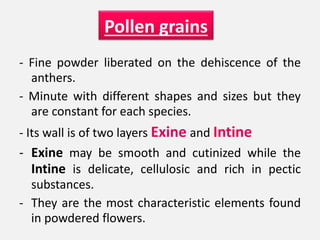
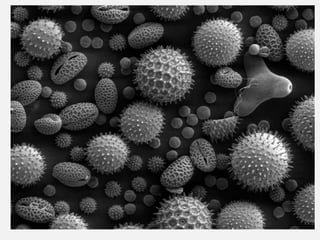
- Fine powder liberated on the dehiscence of the
anthers.
- Minute with different shapes and sizes but they
are constant for each species.
- Its wall is of two layers Exine and Intine
- Exine may be smooth and cutinized while the
Intine is delicate, cellulosic and rich in pectic
substances.
- They are the most characteristic elements found
in powdered flowers.
Pollen grains
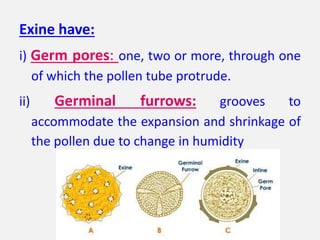
Exine have:
i) Germ pores: one, two or more, through one
of which the pollen tube protrude.
ii) Germinal furrows: grooves to
accommodate the expansion and shrinkage of
the pollen due to change in humidity
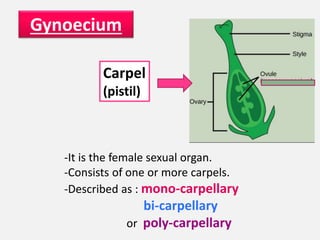
Gynoecium
Carpel
(pistil)
-It is the female sexual organ.
-Consists of one or more carpels.
-Described as : mono-carpellary
bi-carpellary
or poly-carpellary
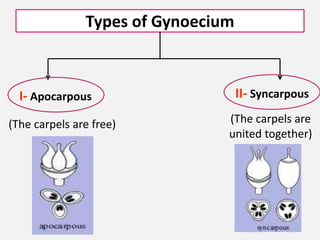
Types of Gynoecium
I- Apocarpous II- Syncarpous
(The carpels are free) (The carpels are
united together)
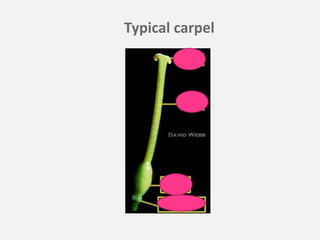
Typical carpel
Description of the different parts of
a carpel
• 1- Ovary:
- may be simple formed of a single carpel.
- or compound formed of more than one
carpel.
- The compound ovary may be formed of two,
three or more compartments
bi-, tri- or multi-locular ovary
- The walls separating the compartments are
called septum.
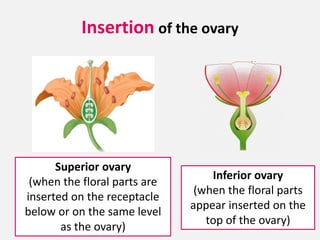
Insertion of the ovary
Inferior ovary
(when the floral parts
appear inserted on the
top of the ovary)
Superior ovary
(when the floral parts are
inserted on the receptacle
below or on the same level
as the ovary)
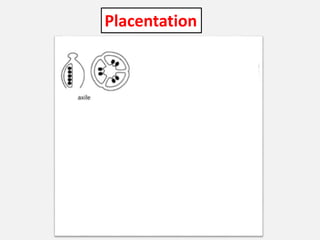
Placentation
• It is the position or arrangement of placenta in
the ovary.
• The ovules are normally arranged on double
parallel cords
Placentation
2- Style and stigma
Stigma with or without style is inserted on the apex of
the ovary.
Style may be long or short or totally wanting.
Style may be united with stamens Gynostemium
Stigma may be united with anthers Gynostegium
If the style is present, the stigma is called stalked
while if absent it is called sessile.
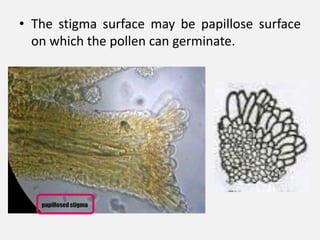
• The stigma surface may be papillose surface
on which the pollen can germinate.
Inflorescence
• Definition:
It is the aggregation of the flowers on the
plant.
• Kinds of inflorescence:
(According to the mode of branching)
I- Racemose inflorescence.
II- Cymose inflorescence.
III- Mixed inflorescence.
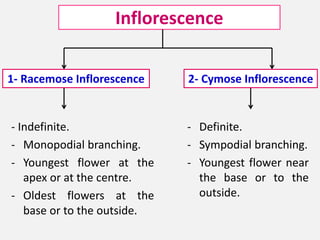
Inflorescence
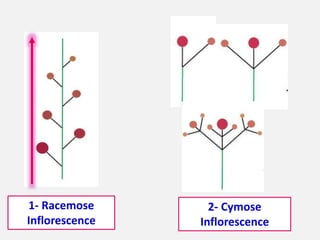
- Indefinite.
- Monopodial branching.
- Youngest flower at the
apex or at the centre.
- Oldest flowers at the
base or to the outside.
1- Racemose Inflorescence 2- Cymose Inflorescence
- Definite.
- Sympodial branching.
- Youngest flower near
the base or to the
outside.
1- Racemose
Inflorescence
2- Cymose
Inflorescence
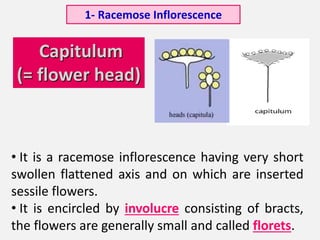
Capitulum
(= flower head)
• It is a racemose inflorescence having very short
swollen flattened axis and on which are inserted
sessile flowers.
• It is encircled by involucre consisting of bracts,
the flowers are generally small and called florets.
1- Racemose Inflorescence
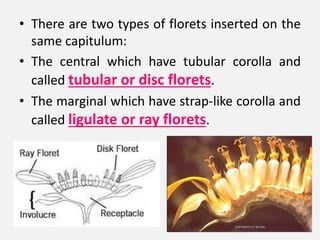
• There are two types of florets inserted on the
same capitulum:
• The central which have tubular corolla and
called tubular or disc florets.
• The marginal which have strap-like corolla and
called ligulate or ray florets.
III- Mixed Inflorescence
When both racemose
and cymose types of
branching occur on the
same inflorescence.

Flower intr.

  • 1.
  • 2.
    Definition: - It ismorphologically compressed fertile shoot with modified leaves or floral leaves. - adapted for the production of fruits and seeds (propagation of the plant). - It is very important for the identification of unknown plants. INTRODUCTION
  • 3.
    L.S in atypical flower
  • 4.
  • 5.
    The Floral Parts Non-Essentialparts Essential parts Calyx Corolla Androecium Gynoecium Unit sepal Unit petal Unit stamen Unit carpel 1 2 3 4
  • 6.
    Typical flower “Completeflower” Consists of: 1- Calyx: composed of sepals. 2- Corolla: composed of petals. 3- Androecium: composed of stamens. 4- Gynaecium: composed of carpels. Incomplete flower • When some floral parts as sepals or petals are absent.
  • 7.
  • 8.
    Bracts & Bracteoles BractBracteoles accessory leafy structures from its axils arises a flower scale like leaves accompanying the flower present presentabsent absent Bracteate flower Ebracteate flower Bracteolate flower Ebracteolate f
  • 9.
    Involucre: when bractsor bracteoles are present in crowded form in one or more whorls. Kinds of Flowers Flowers are classified according to: 1-The arrangement of the floral leaves on the flower axis. 2-The number of whorls present. 3-The number of segments in different whorls. 4-The presence of all floral parts. 5-The symmetry of all floral leaves. 6-The presence or absence of sexual organs.
  • 10.
    • 1- Thearrangement of the floral leaves on the flower axis. • 1.A- Cyclic flowers: • The floral leaves of each whorl alternate with those of the next.
  • 11.
    • 1.B- Acyclicflowers: • The floral leaves are spirally arranged
  • 12.
    • 1.C- Hemicyclicflowers: • The perianth is spirally arranged while the stamens and carpels are in whorls. • The calyx only is arranged in spiral manner while the rest floral parts in whorls.
  • 13.
    2-According to numberof whorls present • Tetracyclic: four whorls • Pentacyclic: five whorls 3- According to the segments in different whorls • Isomerous: number of segments in different whorls is usually the same • Heteromerous: number of segments in different whorls is unequal
  • 14.
    4- According tothe presence of all floral parts: • Complete: The flower has all the usual parts. • Incomplete: The flower is lacking one or some of the regular parts. 5- According to the presence or absence of sexual organs: • a- Hermaphrodite: when both the male and female organs are present. • b-Sterile: when both male and female organs are absent or not functioning.
  • 15.
    c- Unisexual (imperfect): •only one of the sexual organs is present and functioning i) Staminate: only male organ is present ii) Pistillate: only female organ is present
  • 16.
    6- According tothe symmetry of all floral leaves: • a- Regular or actinomorphic: • The segments in each whorl are all alike • The flower can be divided by a number of radial longitudinal cuts into equal halves.
  • 18.
    • b- Irregular •one or more whorls are not alike. • 1- Asymmetric: • all the segments of the flowers are irregularly arranged and not alike. • Cannot be divided into equal parts.
  • 19.
    • 2- Zygomorphic(%) • When the flower can be divided only in one plane into equal halves.
  • 20.
  • 21.
    -Always very shortbut occasionally it is elongated axis of the flower. -Swollen or expanded apex of the flower stalk. - It bears the floral parts. 1-Receptacle
  • 22.
    - It consistsof the non-essential parts of the flower. -When non-essential parts are not differentiated into calyx and corolla, it is described as: Petaloid: if brightly coloured Sepaloid: thin, membranous and greenish Polyphyllous: free segments Gamophyllous: united segments Achlamydeous (naked): outer part is absent Perianth
  • 23.
    - The outermostwhorl of the floral series. - Formed of sepals. - Arranged in single whorl - Colour: green but in some cases brightly coloured when petals are absent to attract insect. - Size: large sometimes very small, reduced to membranous or represented by hairs. -Function: protects the essential organs especially in the bud stage. Calyx
  • 24.
    Polysepalous Calyx (free sepalsinserted on the receptacle)
  • 25.
  • 26.
    - Second whorlafter the calyx. - Consists of petals mostly arranged in a single whorl. - Size: larger than sepals. - Function: Attract pollen grain carrying insects. Corolla
  • 27.
    - Colour: usuallybrightly coloured, this colour may be due to the following pigments. - Anthocyanins (red, blue and violet depending on the pH of the cell sap). - Flavone derivatives (yellow colour). - Pigments such as carotin, xanthophyll (yellow, orange and red colours). - The white colour is due to the reflection of light from the intercellular spaces of the mesophyll but not to pigments.
  • 28.
    Insertion of thefloral parts on the receptacle PerigynousHypogynous Epigynous
  • 29.
  • 30.
  • 31.
    - It isthe male sexual organ. - One, two or more whorls of stamens, sometimes numerous. - The stamens are situated within or above the corolla 3-Androecium Anther Filament Stamen Pollen grains
  • 32.
    Androecium 1-Types of Androecium 2-Cohesion of stamens 3-Insertion & adhesion of stamens on the floral parts 4- Attachment of the anther to the filament Points to be studied concerning the androecium
  • 33.
    Types of Androecium 1-According to the length of the filament Didynamous (two long and two short stamens) Tetradynamous (four long and two short stamens)
  • 34.
    2- According tothe Number of stamens Definite (few stamens) Indefinite (numerous stamens) Monandrous: (one stamen) Diandrous: (two stamens) Tri-, Tetra-,……… Polyandrous (with indefinite number of stamens)
  • 35.
    Cohesion of stamens •The union of stamens together Monadelphous: filaments are fused in one group Diadelphous: filaments are fused in two groups Tridelphous: filaments are fused in three groups Tetra-, Polydelphous: filaments are fused in several groups Syngenesious: filaments are free but anthers are united
  • 36.
    Insertion & Adhesionof stamens • Adhesion may occur between stamens and various floral parts. - between stamens and petals Epipetalous - between stamens and sepals Episepalous - between stamens and gynoecium Gynandrous - Anthers are adherent to stigma Gynostegium
  • 37.
    Attachment of theanther to the filament
  • 38.
    - Fine powderliberated on the dehiscence of the anthers. - Minute with different shapes and sizes but they are constant for each species. - Its wall is of two layers Exine and Intine - Exine may be smooth and cutinized while the Intine is delicate, cellulosic and rich in pectic substances. - They are the most characteristic elements found in powdered flowers. Pollen grains
  • 40.
    Exine have: i) Germpores: one, two or more, through one of which the pollen tube protrude. ii) Germinal furrows: grooves to accommodate the expansion and shrinkage of the pollen due to change in humidity
  • 41.
    Gynoecium Carpel (pistil) -It is thefemale sexual organ. -Consists of one or more carpels. -Described as : mono-carpellary bi-carpellary or poly-carpellary
  • 42.
    Types of Gynoecium I-Apocarpous II- Syncarpous (The carpels are free) (The carpels are united together)
  • 43.
  • 44.
    Description of thedifferent parts of a carpel • 1- Ovary: - may be simple formed of a single carpel. - or compound formed of more than one carpel. - The compound ovary may be formed of two, three or more compartments bi-, tri- or multi-locular ovary - The walls separating the compartments are called septum.
  • 45.
    Insertion of theovary Inferior ovary (when the floral parts appear inserted on the top of the ovary) Superior ovary (when the floral parts are inserted on the receptacle below or on the same level as the ovary)
  • 46.
    Placentation • It isthe position or arrangement of placenta in the ovary. • The ovules are normally arranged on double parallel cords
  • 47.
  • 48.
    2- Style andstigma Stigma with or without style is inserted on the apex of the ovary. Style may be long or short or totally wanting. Style may be united with stamens Gynostemium Stigma may be united with anthers Gynostegium If the style is present, the stigma is called stalked while if absent it is called sessile.
  • 49.
    • The stigmasurface may be papillose surface on which the pollen can germinate.
  • 50.
    Inflorescence • Definition: It isthe aggregation of the flowers on the plant. • Kinds of inflorescence: (According to the mode of branching) I- Racemose inflorescence. II- Cymose inflorescence. III- Mixed inflorescence.
  • 51.
    Inflorescence - Indefinite. - Monopodialbranching. - Youngest flower at the apex or at the centre. - Oldest flowers at the base or to the outside. 1- Racemose Inflorescence 2- Cymose Inflorescence - Definite. - Sympodial branching. - Youngest flower near the base or to the outside.
  • 52.
  • 53.
    Capitulum (= flower head) •It is a racemose inflorescence having very short swollen flattened axis and on which are inserted sessile flowers. • It is encircled by involucre consisting of bracts, the flowers are generally small and called florets. 1- Racemose Inflorescence
  • 54.
    • There aretwo types of florets inserted on the same capitulum: • The central which have tubular corolla and called tubular or disc florets. • The marginal which have strap-like corolla and called ligulate or ray florets.
  • 55.
    III- Mixed Inflorescence Whenboth racemose and cymose types of branching occur on the same inflorescence.