CHAPTER 1:CHAPTER 1:
TRANSPORTTRANSPORT
PlantPlant
Plants
Water & mineral Food
xylem phloem
Vascular
tissues
involves
stem root leaf
structure
translocation
need
Transported by
Relate to
Relate to
involves
Root
pressure
Transpirational pull
Factors
1. Air movement
2. Temperature
3. Light intensity
4. Relative humidity
Capillary
action
affecting
Transpiration
Results in
Found in
The Transport of SubstancesThe Transport of Substances
in Plantsin Plants
Necessity for Transport of Substances in PlantsNecessity for Transport of Substances in Plants
 Plants absorbPlants absorb waterwater andand mineral ionsmineral ions from the soilfrom the soil
to all parts of the body.to all parts of the body.
 Water needed by plants to carry outWater needed by plants to carry out photosynthesisphotosynthesis,,
acts as a solvent andacts as a solvent and reactantreactant in the cellin the cell
metabolisms.metabolisms.
 Mineral ions are required for healthy growth andMineral ions are required for healthy growth and
developmentdevelopment..
 Small multicellular plants such asSmall multicellular plants such as mossesmosses
andand liverwortsliverworts have a large TSA/V ratio and ahave a large TSA/V ratio and a
short distance for diffusion of substances.short distance for diffusion of substances.
Therefore, they do not require transportTherefore, they do not require transport
system.system.
 However, in large flowering plants, conifersHowever, in large flowering plants, conifers
and ferns, they have aand ferns, they have a smallsmall TSA/V ratio andTSA/V ratio and
greatergreater distance for a diffusion of substances.distance for a diffusion of substances.
Hence, they require an internal transportHence, they require an internal transport
system in their body.system in their body.
Vascular Tissue in PlantVascular Tissue in Plant
 Transportation of substances in plant is carried outTransportation of substances in plant is carried out
byby vascular tissuevascular tissue..
 There are two types of vascular tissue;There are two types of vascular tissue; xylemxylem andand
phloemphloem tissues.tissues.
 Xylem transportXylem transport waterwater andand dissolved mineral saltsdissolved mineral salts
absorbed by roots to the upper parts of the plants. Itabsorbed by roots to the upper parts of the plants. It
also givesalso gives supportsupport to the plant.to the plant.
 Phloem transportsPhloem transports organic substancesorganic substances synthesizedsynthesized
by the leaves during photosynthesis to other parts ofby the leaves during photosynthesis to other parts of
the plant.the plant.
Cross-section of a LeafCross-section of a Leaf
Cuticle
Xylem
Phloem
Stoma
CuticleCuticle
 Wax substances to reduce water lossWax substances to reduce water loss
Xylem and PhloemXylem and Phloem
 Vascular bundle or veinVascular bundle or vein
Cross-section of a StemCross-section of a Stem
Epidermis
Cortex
Pith
Vascular bun
EpidermisEpidermis
 One-celled thick with cuticle layerOne-celled thick with cuticle layer
outsideoutside
 HasHas lenticelslenticels for respirationfor respiration
CortexCortex
 Consists ofConsists of collenchymacollenchyma cells in outercells in outer
region andregion and parenchymaparenchyma cells in innercells in inner
region.region.
 Provides support to the stemProvides support to the stem
PithPith
 Consists of largeConsists of large parenchymaparenchyma cells.cells.
 FoodFood storagestorage
Vascular bundleVascular bundle
 Arranged in theArranged in the ringring around the pith.around the pith.
 Xylem and phloem separated byXylem and phloem separated by
cambiumcambium tissuetissue
Cross-section of a RootCross-section of a Root
Epidermis
Endodermis
Pericycle
Vascular
cylinder
Phloem
Root hair
Xylem
Root hairRoot hair
 A specialisedA specialised epidermalepidermal cellcell
 Increase theIncrease the surface areasurface area for waterfor water
absorption.absorption.
EpidermisEpidermis
 Does not haveDoes not have cuticlecuticle
 Absorbs water andAbsorbs water and ionsions from soilfrom soil
EndodermisEndodermis
 Single layer of cellsSingle layer of cells
PericyclePericycle
 Consists ofConsists of sclerenchymasclerenchyma tissuetissue
which provide mechanical support towhich provide mechanical support to
the root.the root.
Vascular cylinderVascular cylinder
 Consists of vascular tissue andConsists of vascular tissue and
pericyclepericycle
 Xylem radiates from the centreXylem radiates from the centre
formingforming starstar shapeshape
 Phloem fills the area between xylemPhloem fills the area between xylem
Structure of Vascular TissueStructure of Vascular Tissue
Related to the TransportRelated to the Transport
XylemXylem
 Consists of four types of cells; vessel,Consists of four types of cells; vessel, tracheid,tracheid,
parenchyma andparenchyma and fibresfibres..
1.1. Xylem vesselXylem vessel
 Xylem vessel are long, hollow andXylem vessel are long, hollow and continuouscontinuous tubes.tubes.
 Dead cellsDead cells, no protoplasm to easier the flow of water., no protoplasm to easier the flow of water.
 The cell walls are strengthened byThe cell walls are strengthened by ligninlignin, deposited in, deposited in
various patterns and givesvarious patterns and gives mechanicalmechanical support.support.
 The cell wall with numerous hole orThe cell wall with numerous hole or pitpit to allowto allow waterwater
and mineral pass side way between the cells.and mineral pass side way between the cells.
2.2. TracheidTracheid
 Also dead cells andAlso dead cells and
hollow but more longerhollow but more longer
and smaller than xylemand smaller than xylem
vessel.vessel.
 Pointed end andPointed end and
pitted.pitted.
2.2. Parenchyma and fibresParenchyma and fibres
 Parenchyma storesParenchyma stores
food.food.
 Fibres provide supportFibres provide support
LS of tracheid
LS of xylem vessel
PhloemPhloem
 Also consists of four types of cells; sieve tube,Also consists of four types of cells; sieve tube,
companion cell,companion cell, fibre and parenchyma.fibre and parenchyma.
1.1. Sieve tubeSieve tube
 Cylindrical in shape, consisting of elongatedCylindrical in shape, consisting of elongated sievesieve cellcell,,
arranged end to end.arranged end to end.
 The end wall of each cell are perforated to formThe end wall of each cell are perforated to form sievesieve
plateplate and allow food substances such asand allow food substances such as sucrosesucrose andand
amino acidamino acid to pass from one cell to another.to pass from one cell to another.
 The sieve tube is a living cell but during maturation, manyThe sieve tube is a living cell but during maturation, many
organelle including nucleus disintegrates.organelle including nucleus disintegrates.
 There is a thin layer ofThere is a thin layer of cytoplasmcytoplasm lining the cellulose walllining the cellulose wall
of sieve tube.of sieve tube.
2.2. Companion cellCompanion cell
 Normal cell with nucleus, cytoplasm and manyNormal cell with nucleus, cytoplasm and many
mitochondria.mitochondria.
 They are adjacent and closely related to the sieve cell.They are adjacent and closely related to the sieve cell.
 It provides ATP to help the food transport on the sieveIt provides ATP to help the food transport on the sieve
tube.tube.
3.3. Parenchyma and fibreParenchyma and fibre
 Parenchyma cells store food.Parenchyma cells store food.
 Fibres provide support.Fibres provide support.
cytoplasm
Companion
cell
nucleus
Sieve plate
Thin
cytoplasm
Sieve tube
LS of the phloem
Transport of Substances in PlantsTransport of Substances in Plants
Transport of Organic Substances (Translocation)Transport of Organic Substances (Translocation)
1.1. Definition: Translocation is a transport of solubleDefinition: Translocation is a transport of soluble
organic substancesorganic substances such as sucrose andsuch as sucrose and aminoamino
acidacid from the leaves to other parts of the plants.from the leaves to other parts of the plants.
Translocation is a two directional transport,Translocation is a two directional transport,
upwardupward andand downwarddownward and occurs in theand occurs in the sievesieve
tubetube of phloem tissue.of phloem tissue.
2.2. The importance of translocation : to enableThe importance of translocation : to enable
the product of photosynthesis moves fromthe product of photosynthesis moves from
the leaves to the:the leaves to the:
a)a) GrowthGrowth region such as shoots, roots, and youngregion such as shoots, roots, and young
fruits.fruits.
b)b) Storage organs likeStorage organs like tubertuber..
c)c) Other parts of the plants to be a raw materialOther parts of the plants to be a raw material
for cellfor cell respirationrespiration..
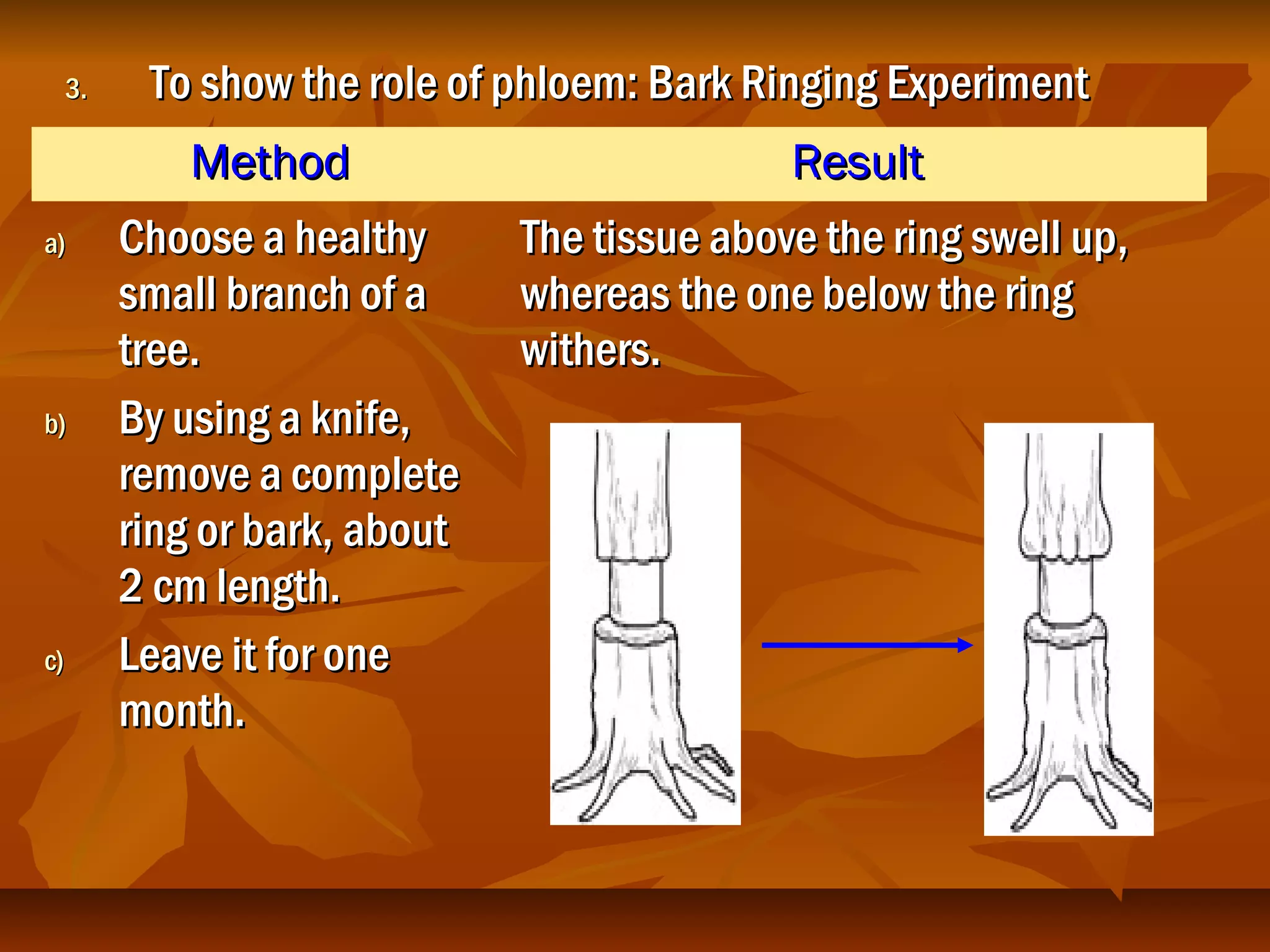
3.3. To show the role of phloem: Bark Ringing ExperimentTo show the role of phloem: Bark Ringing Experiment
MethodMethod ResultResult
a)a) Choose a healthyChoose a healthy
small branch of asmall branch of a
tree.tree.
b)b) By using a knife,By using a knife,
remove a completeremove a complete
ring or bark, aboutring or bark, about
2 cm length.2 cm length.
c)c) Leave it for oneLeave it for one
month.month.
The tissue above the ring swell up,The tissue above the ring swell up,
whereas the one below the ringwhereas the one below the ring
withers.withers.
 ExplanationExplanation
a)a) The tissue removed together with the bark isThe tissue removed together with the bark is
phloemphloem..
b)b) This disrupts the flow of organic substancesThis disrupts the flow of organic substances
from the leaves down to the root.from the leaves down to the root.
c)c) Accumulation of these substances causes aAccumulation of these substances causes a
swellingswelling above the ring.above the ring.
d)d) The leaves of small branch do not wilt becauseThe leaves of small branch do not wilt because
thethe xylemxylem has not been removed. So, upwardhas not been removed. So, upward
flow of water is not disrupted.flow of water is not disrupted.
Transport of Substances in PlantsTransport of Substances in Plants
Transport of Water and Mineral IonsTransport of Water and Mineral Ions
1.1. From the soil, water enters the root byFrom the soil, water enters the root by osmosisosmosis
whereas mineral ions bywhereas mineral ions by active transportactive transport..
2.2. The presence of root hairs increase theThe presence of root hairs increase the surfacesurface
areaarea for absorption.for absorption.
3.3. The movement of water from the root to the leavesThe movement of water from the root to the leaves
is aided by three factors:is aided by three factors:
 Root pressureRoot pressure
 Capillary (capillary action)Capillary (capillary action)
 Transpirational pullTranspirational pull
Transport of Substances in PlantsTransport of Substances in Plants
Root PressureRoot Pressure
 The surrounding soil water isThe surrounding soil water is hypotonichypotonic to the cellto the cell
sap of root hair because it contains salt, sugarsap of root hair because it contains salt, sugar
and amino acid.and amino acid.
 Therefore, water diffuses into root hair byTherefore, water diffuses into root hair by osmosisosmosis..
 The entry of water into root hair dilutes its cell sapThe entry of water into root hair dilutes its cell sap
to become hypotonic to the adjacent cells.to become hypotonic to the adjacent cells.
 The water moves again to the next cell until itThe water moves again to the next cell until it
crosses the cortex tissue by osmosiscrosses the cortex tissue by osmosis
Root PressureRoot Pressure ……contcont
 This water concentration gradient existed in theThis water concentration gradient existed in the
cortex creates a force calledcortex creates a force called root pressureroot pressure to pushto push
water into xylem.water into xylem.
H2O
Transport of Substances in PlantsTransport of Substances in Plants
Capillary actionCapillary action
 Capillary action is a combination force ofCapillary action is a combination force of cohesioncohesion
andand adhesionadhesion which enable the water move up alongwhich enable the water move up along
the narrow xylem vessel.the narrow xylem vessel.
 CohesiveCohesive force is the attraction of one molecule toforce is the attraction of one molecule to
other molecule of water.other molecule of water.
 Meanwhile,Meanwhile, adhesiveadhesive force is the attraction betweenforce is the attraction between
water molecules and the wall of xylem vessel.water molecules and the wall of xylem vessel.
 Therefore, xylem vessel forms a continuous column ofTherefore, xylem vessel forms a continuous column of
water from root through the stem to the leaf.water from root through the stem to the leaf.
Transport of Substances in PlantsTransport of Substances in Plants
Transpirational PullTranspirational Pull
 During the day, waterDuring the day, water evaporatesevaporates from the mesophyllfrom the mesophyll
cells into the intercellular space in the leaves.cells into the intercellular space in the leaves.
 From here, the water vapour diffuses to theFrom here, the water vapour diffuses to the
surrounding air through the stoma.surrounding air through the stoma.
 The loss of water from the leaves to the atmosphereThe loss of water from the leaves to the atmosphere
is calledis called transpirationtranspiration..
 Transpiration in the leaves pull up the water from theTranspiration in the leaves pull up the water from the
soil, a force calledsoil, a force called transpirational pulltranspirational pull..
Water Loss from the PlantsWater Loss from the Plants
(Transpiration)(Transpiration)
1.1. Definition: The loss of water in the form ofDefinition: The loss of water in the form of waterwater
vapourvapour from a plant to the atmosphere.from a plant to the atmosphere.
Almost (99%) of the water taken by plants isAlmost (99%) of the water taken by plants is
evaporatedevaporated by transpiration, only 1% is usedby transpiration, only 1% is used
forfor photosynthesisphotosynthesis and to remainand to remain turgidturgid..
2.2. About 90% of transpiration takes place throughAbout 90% of transpiration takes place through
thethe stomatastomata, 5% through the, 5% through the cuticlecuticle and 5%and 5%
evaporated from theevaporated from the lenticelslenticels of the stem.of the stem.
3.3. The importance of transpiration:The importance of transpiration:
a)a) Creates aCreates a transpirational pulltranspirational pull that sucks waterthat sucks water
and dissolved mineral salts from the soil.and dissolved mineral salts from the soil.
Mineral salts are used forMineral salts are used for cell activitiescell activities whilewhile
the water is used photosynthesis and keeps thethe water is used photosynthesis and keeps the
cells turgid to give support to the leaves.cells turgid to give support to the leaves.
b)b) MaintainsMaintains osmotic pressureosmotic pressure in the cells due toin the cells due to
elimination of excessive water in plant body.elimination of excessive water in plant body.
c)c) GivesGives cooling effectcooling effect due to absorption of latentdue to absorption of latent
heat by water to evaporate.heat by water to evaporate.
4.4. Measuring the rate of transpiration:Measuring the rate of transpiration:
a)a) The pulling force developed by transpiration canThe pulling force developed by transpiration can
be demonstrated in an experiment by usingbe demonstrated in an experiment by using
potometerpotometer..
b)b) This potometer can also be used to measure theThis potometer can also be used to measure the
rate of photosynthesis under differentrate of photosynthesis under different
environmental condition.environmental condition.
c)c) From the diagram above, the rate of water lossFrom the diagram above, the rate of water loss
is indicated by the speed of which the airis indicated by the speed of which the air
bubble moves along the graduated capillarybubble moves along the graduated capillary
tube (from X to Y)tube (from X to Y)
A potometer
Capillaries tube
with scale
Resevoir
Air bubble
Water
Leafy
shoot
Y X
Rate of = Distance X – Y (cm)
water loss time
d)d) Notice that, the potometer does not measureNotice that, the potometer does not measure
transpiration directly and will give an accuratetranspiration directly and will give an accurate
indication only if the rate of water loss isindication only if the rate of water loss is
precisely equal to the rate of water uptake.precisely equal to the rate of water uptake.
However, for most purpose the estimated ofHowever, for most purpose the estimated of
transpiration obtained from the experiment istranspiration obtained from the experiment is
satisfactory.satisfactory.
Factors Affecting the Rate ofFactors Affecting the Rate of
TranspirationTranspiration
1.1. Air movementAir movement
 Water vapour that diffusesWater vapour that diffuses
out of stomataout of stomata
accumulatesaccumulates around thearound the
leaf surface.leaf surface.
 Moving air carries waterMoving air carries water
vapour away. Thisvapour away. This createscreates
the concentration gradientthe concentration gradient
between water vapourbetween water vapour
inside the leaf and outsideinside the leaf and outside
the leaf. Hence, the rate ofthe leaf. Hence, the rate of
transpiration is increased.transpiration is increased.
Air movement
TranspirationrateThe rate of transpiration
increases when the
movement of air is
increased.
Factors Affecting the Rate ofFactors Affecting the Rate of
TranspirationTranspiration
2.2. TemperatureTemperature
 An increase in temperature,An increase in temperature,
increase the rate ofincrease the rate of
transpiration due to:transpiration due to:
 Increase in waterIncrease in water
evaporationevaporation raterate
 Increase in diffusionIncrease in diffusion raterate
 DecreaseDecrease in humidity ofin humidity of
surrounding airsurrounding air
Air movement
TranspirationrateThe rate of transpiration
increases when the
temperature is increased.

Chap 1 transport in plant

  • 1.
  • 2.
    Plants Water & mineralFood xylem phloem Vascular tissues involves stem root leaf structure translocation need Transported by Relate to Relate to involves Root pressure Transpirational pull Factors 1. Air movement 2. Temperature 3. Light intensity 4. Relative humidity Capillary action affecting Transpiration Results in Found in
  • 3.
    The Transport ofSubstancesThe Transport of Substances in Plantsin Plants Necessity for Transport of Substances in PlantsNecessity for Transport of Substances in Plants  Plants absorbPlants absorb waterwater andand mineral ionsmineral ions from the soilfrom the soil to all parts of the body.to all parts of the body.  Water needed by plants to carry outWater needed by plants to carry out photosynthesisphotosynthesis,, acts as a solvent andacts as a solvent and reactantreactant in the cellin the cell metabolisms.metabolisms.  Mineral ions are required for healthy growth andMineral ions are required for healthy growth and developmentdevelopment..
  • 4.
     Small multicellularplants such asSmall multicellular plants such as mossesmosses andand liverwortsliverworts have a large TSA/V ratio and ahave a large TSA/V ratio and a short distance for diffusion of substances.short distance for diffusion of substances. Therefore, they do not require transportTherefore, they do not require transport system.system.  However, in large flowering plants, conifersHowever, in large flowering plants, conifers and ferns, they have aand ferns, they have a smallsmall TSA/V ratio andTSA/V ratio and greatergreater distance for a diffusion of substances.distance for a diffusion of substances. Hence, they require an internal transportHence, they require an internal transport system in their body.system in their body.
  • 5.
    Vascular Tissue inPlantVascular Tissue in Plant  Transportation of substances in plant is carried outTransportation of substances in plant is carried out byby vascular tissuevascular tissue..  There are two types of vascular tissue;There are two types of vascular tissue; xylemxylem andand phloemphloem tissues.tissues.  Xylem transportXylem transport waterwater andand dissolved mineral saltsdissolved mineral salts absorbed by roots to the upper parts of the plants. Itabsorbed by roots to the upper parts of the plants. It also givesalso gives supportsupport to the plant.to the plant.  Phloem transportsPhloem transports organic substancesorganic substances synthesizedsynthesized by the leaves during photosynthesis to other parts ofby the leaves during photosynthesis to other parts of the plant.the plant.
  • 8.
    Cross-section of aLeafCross-section of a Leaf Cuticle Xylem Phloem Stoma
  • 9.
    CuticleCuticle  Wax substancesto reduce water lossWax substances to reduce water loss
  • 10.
    Xylem and PhloemXylemand Phloem  Vascular bundle or veinVascular bundle or vein
  • 11.
    Cross-section of aStemCross-section of a Stem Epidermis Cortex Pith Vascular bun
  • 12.
    EpidermisEpidermis  One-celled thickwith cuticle layerOne-celled thick with cuticle layer outsideoutside  HasHas lenticelslenticels for respirationfor respiration
  • 13.
    CortexCortex  Consists ofConsistsof collenchymacollenchyma cells in outercells in outer region andregion and parenchymaparenchyma cells in innercells in inner region.region.  Provides support to the stemProvides support to the stem
  • 14.
    PithPith  Consists oflargeConsists of large parenchymaparenchyma cells.cells.  FoodFood storagestorage
  • 15.
    Vascular bundleVascular bundle Arranged in theArranged in the ringring around the pith.around the pith.  Xylem and phloem separated byXylem and phloem separated by cambiumcambium tissuetissue
  • 16.
    Cross-section of aRootCross-section of a Root Epidermis Endodermis Pericycle Vascular cylinder Phloem Root hair Xylem
  • 17.
    Root hairRoot hair A specialisedA specialised epidermalepidermal cellcell  Increase theIncrease the surface areasurface area for waterfor water absorption.absorption.
  • 18.
    EpidermisEpidermis  Does nothaveDoes not have cuticlecuticle  Absorbs water andAbsorbs water and ionsions from soilfrom soil
  • 19.
    EndodermisEndodermis  Single layerof cellsSingle layer of cells
  • 20.
    PericyclePericycle  Consists ofConsistsof sclerenchymasclerenchyma tissuetissue which provide mechanical support towhich provide mechanical support to the root.the root.
  • 21.
    Vascular cylinderVascular cylinder Consists of vascular tissue andConsists of vascular tissue and pericyclepericycle  Xylem radiates from the centreXylem radiates from the centre formingforming starstar shapeshape  Phloem fills the area between xylemPhloem fills the area between xylem
  • 22.
    Structure of VascularTissueStructure of Vascular Tissue Related to the TransportRelated to the Transport XylemXylem  Consists of four types of cells; vessel,Consists of four types of cells; vessel, tracheid,tracheid, parenchyma andparenchyma and fibresfibres.. 1.1. Xylem vesselXylem vessel  Xylem vessel are long, hollow andXylem vessel are long, hollow and continuouscontinuous tubes.tubes.  Dead cellsDead cells, no protoplasm to easier the flow of water., no protoplasm to easier the flow of water.  The cell walls are strengthened byThe cell walls are strengthened by ligninlignin, deposited in, deposited in various patterns and givesvarious patterns and gives mechanicalmechanical support.support.  The cell wall with numerous hole orThe cell wall with numerous hole or pitpit to allowto allow waterwater and mineral pass side way between the cells.and mineral pass side way between the cells.
  • 23.
    2.2. TracheidTracheid  Alsodead cells andAlso dead cells and hollow but more longerhollow but more longer and smaller than xylemand smaller than xylem vessel.vessel.  Pointed end andPointed end and pitted.pitted. 2.2. Parenchyma and fibresParenchyma and fibres  Parenchyma storesParenchyma stores food.food.  Fibres provide supportFibres provide support LS of tracheid LS of xylem vessel
  • 26.
    PhloemPhloem  Also consistsof four types of cells; sieve tube,Also consists of four types of cells; sieve tube, companion cell,companion cell, fibre and parenchyma.fibre and parenchyma. 1.1. Sieve tubeSieve tube  Cylindrical in shape, consisting of elongatedCylindrical in shape, consisting of elongated sievesieve cellcell,, arranged end to end.arranged end to end.  The end wall of each cell are perforated to formThe end wall of each cell are perforated to form sievesieve plateplate and allow food substances such asand allow food substances such as sucrosesucrose andand amino acidamino acid to pass from one cell to another.to pass from one cell to another.  The sieve tube is a living cell but during maturation, manyThe sieve tube is a living cell but during maturation, many organelle including nucleus disintegrates.organelle including nucleus disintegrates.  There is a thin layer ofThere is a thin layer of cytoplasmcytoplasm lining the cellulose walllining the cellulose wall of sieve tube.of sieve tube.
  • 27.
    2.2. Companion cellCompanioncell  Normal cell with nucleus, cytoplasm and manyNormal cell with nucleus, cytoplasm and many mitochondria.mitochondria.  They are adjacent and closely related to the sieve cell.They are adjacent and closely related to the sieve cell.  It provides ATP to help the food transport on the sieveIt provides ATP to help the food transport on the sieve tube.tube. 3.3. Parenchyma and fibreParenchyma and fibre  Parenchyma cells store food.Parenchyma cells store food.  Fibres provide support.Fibres provide support.
  • 28.
  • 31.
    Transport of Substancesin PlantsTransport of Substances in Plants Transport of Organic Substances (Translocation)Transport of Organic Substances (Translocation) 1.1. Definition: Translocation is a transport of solubleDefinition: Translocation is a transport of soluble organic substancesorganic substances such as sucrose andsuch as sucrose and aminoamino acidacid from the leaves to other parts of the plants.from the leaves to other parts of the plants. Translocation is a two directional transport,Translocation is a two directional transport, upwardupward andand downwarddownward and occurs in theand occurs in the sievesieve tubetube of phloem tissue.of phloem tissue.
  • 32.
    2.2. The importanceof translocation : to enableThe importance of translocation : to enable the product of photosynthesis moves fromthe product of photosynthesis moves from the leaves to the:the leaves to the: a)a) GrowthGrowth region such as shoots, roots, and youngregion such as shoots, roots, and young fruits.fruits. b)b) Storage organs likeStorage organs like tubertuber.. c)c) Other parts of the plants to be a raw materialOther parts of the plants to be a raw material for cellfor cell respirationrespiration..
  • 33.
    3.3. To showthe role of phloem: Bark Ringing ExperimentTo show the role of phloem: Bark Ringing Experiment MethodMethod ResultResult a)a) Choose a healthyChoose a healthy small branch of asmall branch of a tree.tree. b)b) By using a knife,By using a knife, remove a completeremove a complete ring or bark, aboutring or bark, about 2 cm length.2 cm length. c)c) Leave it for oneLeave it for one month.month. The tissue above the ring swell up,The tissue above the ring swell up, whereas the one below the ringwhereas the one below the ring withers.withers.
  • 34.
     ExplanationExplanation a)a) Thetissue removed together with the bark isThe tissue removed together with the bark is phloemphloem.. b)b) This disrupts the flow of organic substancesThis disrupts the flow of organic substances from the leaves down to the root.from the leaves down to the root. c)c) Accumulation of these substances causes aAccumulation of these substances causes a swellingswelling above the ring.above the ring. d)d) The leaves of small branch do not wilt becauseThe leaves of small branch do not wilt because thethe xylemxylem has not been removed. So, upwardhas not been removed. So, upward flow of water is not disrupted.flow of water is not disrupted.
  • 35.
    Transport of Substancesin PlantsTransport of Substances in Plants Transport of Water and Mineral IonsTransport of Water and Mineral Ions 1.1. From the soil, water enters the root byFrom the soil, water enters the root by osmosisosmosis whereas mineral ions bywhereas mineral ions by active transportactive transport.. 2.2. The presence of root hairs increase theThe presence of root hairs increase the surfacesurface areaarea for absorption.for absorption. 3.3. The movement of water from the root to the leavesThe movement of water from the root to the leaves is aided by three factors:is aided by three factors:  Root pressureRoot pressure  Capillary (capillary action)Capillary (capillary action)  Transpirational pullTranspirational pull
  • 37.
    Transport of Substancesin PlantsTransport of Substances in Plants Root PressureRoot Pressure  The surrounding soil water isThe surrounding soil water is hypotonichypotonic to the cellto the cell sap of root hair because it contains salt, sugarsap of root hair because it contains salt, sugar and amino acid.and amino acid.  Therefore, water diffuses into root hair byTherefore, water diffuses into root hair by osmosisosmosis..  The entry of water into root hair dilutes its cell sapThe entry of water into root hair dilutes its cell sap to become hypotonic to the adjacent cells.to become hypotonic to the adjacent cells.  The water moves again to the next cell until itThe water moves again to the next cell until it crosses the cortex tissue by osmosiscrosses the cortex tissue by osmosis
  • 38.
    Root PressureRoot Pressure……contcont  This water concentration gradient existed in theThis water concentration gradient existed in the cortex creates a force calledcortex creates a force called root pressureroot pressure to pushto push water into xylem.water into xylem. H2O
  • 39.
    Transport of Substancesin PlantsTransport of Substances in Plants Capillary actionCapillary action  Capillary action is a combination force ofCapillary action is a combination force of cohesioncohesion andand adhesionadhesion which enable the water move up alongwhich enable the water move up along the narrow xylem vessel.the narrow xylem vessel.  CohesiveCohesive force is the attraction of one molecule toforce is the attraction of one molecule to other molecule of water.other molecule of water.  Meanwhile,Meanwhile, adhesiveadhesive force is the attraction betweenforce is the attraction between water molecules and the wall of xylem vessel.water molecules and the wall of xylem vessel.  Therefore, xylem vessel forms a continuous column ofTherefore, xylem vessel forms a continuous column of water from root through the stem to the leaf.water from root through the stem to the leaf.
  • 40.
    Transport of Substancesin PlantsTransport of Substances in Plants Transpirational PullTranspirational Pull  During the day, waterDuring the day, water evaporatesevaporates from the mesophyllfrom the mesophyll cells into the intercellular space in the leaves.cells into the intercellular space in the leaves.  From here, the water vapour diffuses to theFrom here, the water vapour diffuses to the surrounding air through the stoma.surrounding air through the stoma.  The loss of water from the leaves to the atmosphereThe loss of water from the leaves to the atmosphere is calledis called transpirationtranspiration..  Transpiration in the leaves pull up the water from theTranspiration in the leaves pull up the water from the soil, a force calledsoil, a force called transpirational pulltranspirational pull..
  • 41.
    Water Loss fromthe PlantsWater Loss from the Plants (Transpiration)(Transpiration) 1.1. Definition: The loss of water in the form ofDefinition: The loss of water in the form of waterwater vapourvapour from a plant to the atmosphere.from a plant to the atmosphere. Almost (99%) of the water taken by plants isAlmost (99%) of the water taken by plants is evaporatedevaporated by transpiration, only 1% is usedby transpiration, only 1% is used forfor photosynthesisphotosynthesis and to remainand to remain turgidturgid.. 2.2. About 90% of transpiration takes place throughAbout 90% of transpiration takes place through thethe stomatastomata, 5% through the, 5% through the cuticlecuticle and 5%and 5% evaporated from theevaporated from the lenticelslenticels of the stem.of the stem.
  • 42.
    3.3. The importanceof transpiration:The importance of transpiration: a)a) Creates aCreates a transpirational pulltranspirational pull that sucks waterthat sucks water and dissolved mineral salts from the soil.and dissolved mineral salts from the soil. Mineral salts are used forMineral salts are used for cell activitiescell activities whilewhile the water is used photosynthesis and keeps thethe water is used photosynthesis and keeps the cells turgid to give support to the leaves.cells turgid to give support to the leaves. b)b) MaintainsMaintains osmotic pressureosmotic pressure in the cells due toin the cells due to elimination of excessive water in plant body.elimination of excessive water in plant body. c)c) GivesGives cooling effectcooling effect due to absorption of latentdue to absorption of latent heat by water to evaporate.heat by water to evaporate.
  • 43.
    4.4. Measuring therate of transpiration:Measuring the rate of transpiration: a)a) The pulling force developed by transpiration canThe pulling force developed by transpiration can be demonstrated in an experiment by usingbe demonstrated in an experiment by using potometerpotometer.. b)b) This potometer can also be used to measure theThis potometer can also be used to measure the rate of photosynthesis under differentrate of photosynthesis under different environmental condition.environmental condition. c)c) From the diagram above, the rate of water lossFrom the diagram above, the rate of water loss is indicated by the speed of which the airis indicated by the speed of which the air bubble moves along the graduated capillarybubble moves along the graduated capillary tube (from X to Y)tube (from X to Y)
  • 44.
    A potometer Capillaries tube withscale Resevoir Air bubble Water Leafy shoot Y X Rate of = Distance X – Y (cm) water loss time
  • 45.
    d)d) Notice that,the potometer does not measureNotice that, the potometer does not measure transpiration directly and will give an accuratetranspiration directly and will give an accurate indication only if the rate of water loss isindication only if the rate of water loss is precisely equal to the rate of water uptake.precisely equal to the rate of water uptake. However, for most purpose the estimated ofHowever, for most purpose the estimated of transpiration obtained from the experiment istranspiration obtained from the experiment is satisfactory.satisfactory.
  • 46.
    Factors Affecting theRate ofFactors Affecting the Rate of TranspirationTranspiration 1.1. Air movementAir movement  Water vapour that diffusesWater vapour that diffuses out of stomataout of stomata accumulatesaccumulates around thearound the leaf surface.leaf surface.  Moving air carries waterMoving air carries water vapour away. Thisvapour away. This createscreates the concentration gradientthe concentration gradient between water vapourbetween water vapour inside the leaf and outsideinside the leaf and outside the leaf. Hence, the rate ofthe leaf. Hence, the rate of transpiration is increased.transpiration is increased. Air movement TranspirationrateThe rate of transpiration increases when the movement of air is increased.
  • 47.
    Factors Affecting theRate ofFactors Affecting the Rate of TranspirationTranspiration 2.2. TemperatureTemperature  An increase in temperature,An increase in temperature, increase the rate ofincrease the rate of transpiration due to:transpiration due to:  Increase in waterIncrease in water evaporationevaporation raterate  Increase in diffusionIncrease in diffusion raterate  DecreaseDecrease in humidity ofin humidity of surrounding airsurrounding air Air movement TranspirationrateThe rate of transpiration increases when the temperature is increased.