Transport in Plants

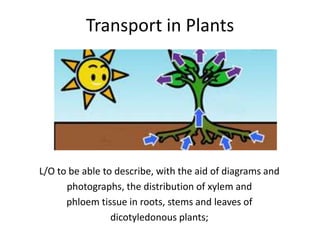
L/O to be able to describe, with the aid of diagrams and
photographs, the distribution of xylem and
phloem tissue in roots, stems and leaves of
dicotyledonous plants;
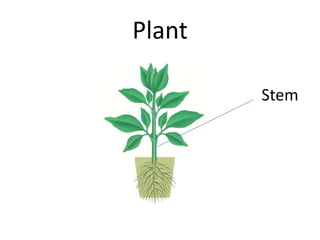
Plant
Stem
Role of the stem
• Support – hold leaves in place for sunlight
• Support – hold flowers in place for pollination
• Movement of materials from leaves to other
parts
• Movement of water in stream from the roots
to leaves. Also move ions.
• Are green and carry out a small amount of
photosynthesis
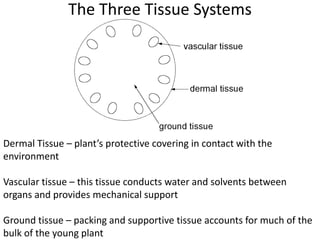
The Three Tissue Systems

Dermal Tissue – plant’s protective covering in contact with the
environment
Vascular tissue – this tissue conducts water and solvents between
organs and provides mechanical support

Ground tissue – packing and supportive tissue accounts for much of the
bulk of the young plant
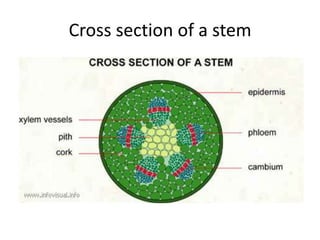
Cross section of a stem
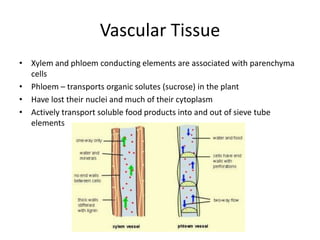
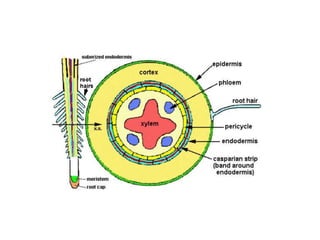
Vascular Tissue
• Xylem and phloem conducting elements are associated with parenchyma
cells
• Phloem – transports organic solutes (sucrose) in the plant
• Have lost their nuclei and much of their cytoplasm
• Actively transport soluble food products into and out of sieve tube
elements
Vascular Tissue - Xylem
• Carries water and dissolved ions in the plant
• Dead cells at maturity that lack a plasma
membrane
• Cell wall has been secondarily thickened and
lignified (lignified tissue called metaxylem)
• Enables very long continuous tubes to be
formed
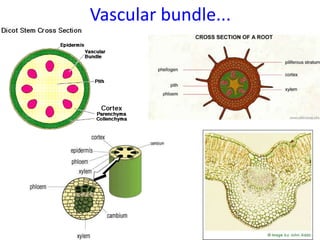
Vascular bundle...
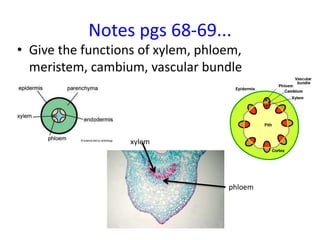
Notes pgs 68-69...
• Give the functions of xylem, phloem,
meristem, cambium, vascular bundle

xylem

phloem
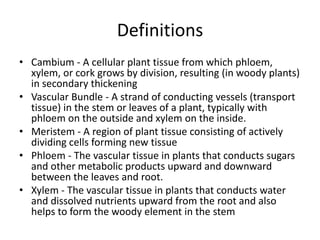
Definitions
• Cambium - A cellular plant tissue from which phloem,
xylem, or cork grows by division, resulting (in woody plants)
in secondary thickening
• Vascular Bundle - A strand of conducting vessels (transport
tissue) in the stem or leaves of a plant, typically with
phloem on the outside and xylem on the inside.
• Meristem - A region of plant tissue consisting of actively
dividing cells forming new tissue
• Phloem - The vascular tissue in plants that conducts sugars
and other metabolic products upward and downward
between the leaves and root.
• Xylem - The vascular tissue in plants that conducts water
and dissolved nutrients upward from the root and also
helps to form the woody element in the stem
Summary...
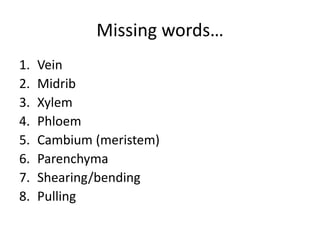
• The vascular tissue in a leaf forms a network of bundles
that finally merge to form one central (1) which runs
into the stalk of the leaf that is also called the (2). The
vascular tissue found nearest to the upper surface of
the leaf is (3). In stems, the vascular tissue nearest the
outside of the stem is (4). Inside this tissue is a layer of
dividing tissue called (5) and outside it there is often a
region of supporting tissue called (6). The vascular
tissue in stems forms a cylinder towards the outer edge
as this arrangement best resists the (7) forces that
stems are subjected to. In roots, the vascular tissue is
central in order to resist the (8) forces experienced by
the roots.
Missing words…
1.
2.
3.
4.
5.
6.
7.
8.

Vein
Midrib
Xylem
Phloem
Cambium (meristem)
Parenchyma
Shearing/bending
Pulling