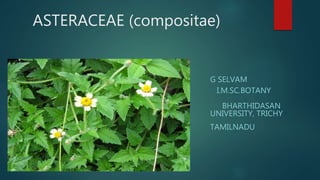
ASTERACEAE (compositae)
G SELVAM
I.M.SC.BOTANY
BHARTHIDASAN
UNIVERSITY, TRICHY
TAMILNADU
CLASSIFICATION
SYSTEMATIC POSITION
Class - Dicotyledons
Sub-class - Gamopetalae
Series - Inferae
Order - Asterales
Family - Asteraceae
DISTRIBUTION
 The family Asteraceae includes about 950 genera with probably 20,ooo
species.
 The family comparises about 10% of the total number of flowering plants.
 In india family is represented by 697 species .
 They can live in all types of localities such as deserts , arctic regions and
aquatic habitats
Vegetative Characters
Habitat :
The plants are usually herbaceous annuals or shrubs.
The plants contain a milky or watery or resinous sap. Outer
surface of these plants is covered with different types of hairs.
ROOT :
The roots constitute a branched , tap-root system.
STEM :
The stem is herbaceous or woody and erect. It is
tuberous in Helianthus tuberosus and leaf-like in Baccharis.
LEAVES :
The leaves are usually alternate , simple ,
petiolate and extipulate. In some species leaves are
opposite (eg.Helianthus) or whorld (eg.Eupatorium).
Sometimes , The leaves may be pinnately or palmately
lobed. leaf Surface is covered with hairs. Leaf margin may
be entire or Serrate.
FLORAL CHARACTERS
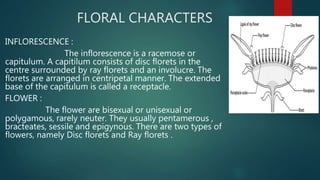
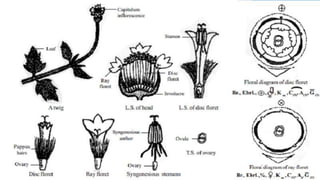
INFLORESCENCE :
The inflorescence is a racemose or
capitulum. A capitilum consists of disc florets in the
centre surrounded by ray florets and an involucre. The
florets are arranged in centripetal manner. The extended
base of the capitulum is called a receptacle.
FLOWER :
The flower are bisexual or unisexual or
polygamous, rarely neuter. They usually pentamerous ,
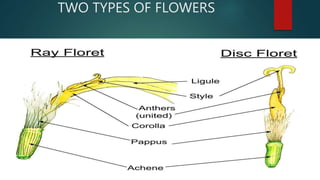
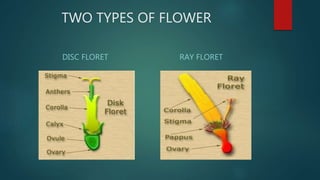
bracteates, sessile and epigynous. There are two types of
flowers, namely Disc florets and Ray florets .
TWO TYPES OF FLOWERS
TWO TYPES OF FLOWER
DISC FLORET RAY FLORET
DISC FLORET :
The disc floret occupy the centre of the
capitulum. They are bracteates, sessile , bisexual,
regular, actinomorphic and epigynous.
CALYX :
The calyx is usually represented by a pappus.
The pappus is considered to be a reduced and highly
modified calyx. In some cases, the calyx is represented
by spines
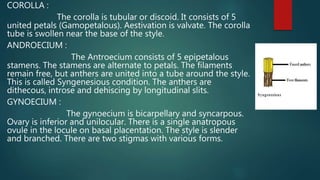
COROLLA :
The corolla is tubular or discoid. It consists of 5
united petals (Gamopetalous). Aestivation is valvate. The corolla
tube is swollen near the base of the style.
ANDROECIUM :
The Antroecium consists of 5 epipetalous
stamens. The stamens are alternate to petals. The filaments
remain free, but anthers are united into a tube around the style.
This is called Syngenesious condition. The anthers are
dithecous, introse and dehiscing by longitudinal slits.
GYNOECIUM :
The gynoecium is bicarpellary and syncarpous.
Ovary is inferior and unilocular. There is a single anatropous
ovule in the locule on basal placentation. The style is slender
and branched. There are two stigmas with various forms.
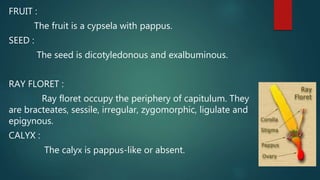
FRUIT :
The fruit is a cypsela with pappus.
SEED :
The seed is dicotyledonous and exalbuminous.
RAY FLORET :
Ray floret occupy the periphery of capitulum. They
are bracteates, sessile, irregular, zygomorphic, ligulate and
epigynous.
CALYX :
The calyx is pappus-like or absent.
COROLLA :
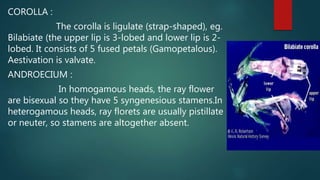
The corolla is ligulate (strap-shaped), eg.
Bilabiate (the upper lip is 3-lobed and lower lip is 2-
lobed. It consists of 5 fused petals (Gamopetalous).
Aestivation is valvate.
ANDROECIUM :
In homogamous heads, the ray flower
are bisexual so they have 5 syngenesious stamens.In
heterogamous heads, ray florets are usually pistillate
or neuter, so stamens are altogether absent.
GYNOECIUM :
Bicarpellary, syncarpous, inferior ovary with a
single locule as in disc florets ovule is one and placentation is
basal. Style is bilobed and stigma is variable.
FRUIT :
Cypsela
SEED:
Dicotyledonous and exalbuminous.
COMMON PLANTS
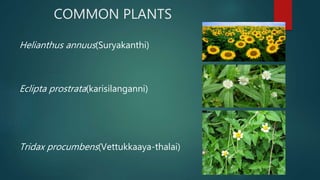
Helianthus annuus(Suryakanthi)
Eclipta prostrata(karisilanganni)
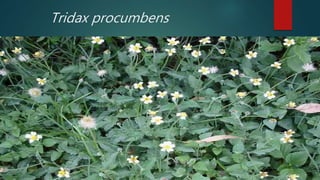
Tridax procumbens(Vettukkaaya-thalai)
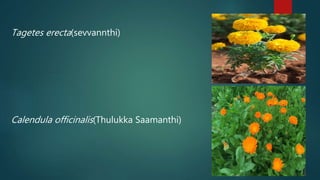
Tagetes erecta(sevvannthi)
Calendula officinalis(Thulukka Saamanthi)
Tridax procumbens
CLASSIFICATION
SYSTEMATIC POSITION
CLASS - Dicotyledone
Sub-class - Gamopetalae
Series - Inferae
Order - Asterales
Family - Asteraceae
Genus - Tridax
Species - procumbens
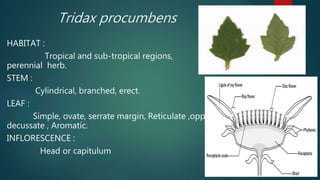
Tridax procumbens
HABITAT :
Tropical and sub-tropical regions,
perennial herb.
STEM :
Cylindrical, branched, erect.
LEAF :
Simple, ovate, serrate margin, Reticulate ,opposite
decussate , Aromatic.
INFLORESCENCE :
Head or capitulum
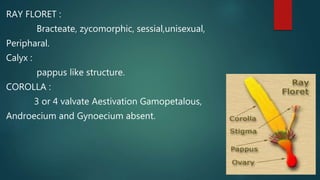
RAY FLORET :
Bracteate, zycomorphic, sessial,unisexual,
Peripharal.
Calyx :
pappus like structure.
COROLLA :
3 or 4 valvate Aestivation Gamopetalous,
Androecium and Gynoecium absent.
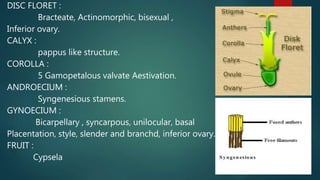
DISC FLORET :
Bracteate, Actinomorphic, bisexual ,
Inferior ovary.
CALYX :
pappus like structure.
COROLLA :
5 Gamopetalous valvate Aestivation.
ANDROECIUM :
Syngenesious stamens.
GYNOECIUM :
Bicarpellary , syncarpous, unilocular, basal
Placentation, style, slender and branchd, inferior ovary.
FRUIT :
Cypsela
ECONOMIC IMPORTANCE
1.OIL :
Many plants gives oil seeds to extract oils. The oil is used for cooking, burning, soap-
making, varnish preparations and as lubricant. Examples –
Helianthus annuus (Suryakanthi) – Seed
Carthamus tinctorius (Sendurakam) – Flower
Guizotia abyssinica (Payellu) – Seed
2.DYES :
Some plants yield dyes for colouring different materials.
Flower heads of Carthamus tinctorius gives a red dye called safflower.
Flower heads of Tagetes erecta (Tulukka-samandi) gives a yellow-dye for colouring
cotten
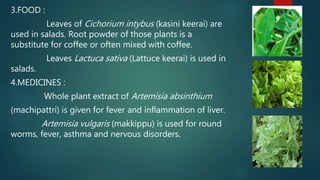
3.FOOD :
Leaves of Cichorium intybus (kasini keerai) are
used in salads. Root powder of those plants is a
substitute for coffee or often mixed with coffee.
Leaves Lactuca sativa (Lattuce keerai) is used in
salads.
4.MEDICINES :
Whole plant extract of Artemisia absinthium
(machipattri) is given for fever and inflammation of liver.
Artemisia vulgaris (makkippu) is used for round
worms, fever, asthma and nervous disorders.
5.ORNAMENTAL PLANTS :
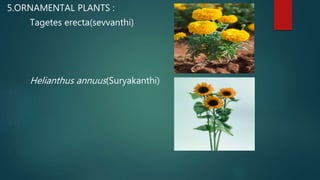
Tagetes erecta(sevvanthi)
Helianthus annuus(Suryakanthi)
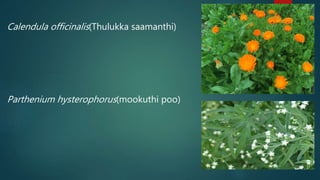
Calendula officinalis(Thulukka saamanthi)
Parthenium hysterophorus(mookuthi poo)
Asteraceae