Section 2-6
Algebraic Proof

Wednesday, November 6, 13
Essential Questions

How do you use Algebra to write two-column proofs?

How do you use properties of equality to write geometric
proofs?

Wednesday, November 6, 13
Vocabulary
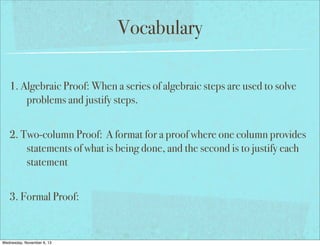
1. Algebraic Proof:

2. Two-column Proof:

3. Formal Proof:

Wednesday, November 6, 13
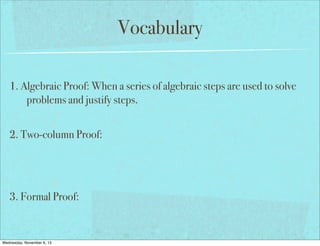
Vocabulary
1. Algebraic Proof: When a series of algebraic steps are used to solve
problems and justify steps.
2. Two-column Proof:

3. Formal Proof:

Wednesday, November 6, 13
Vocabulary
1. Algebraic Proof: When a series of algebraic steps are used to solve
problems and justify steps.
2. Two-column Proof: A format for a proof where one column provides
statements of what is being done, and the second is to justify each
statement
3. Formal Proof:

Wednesday, November 6, 13
Vocabulary
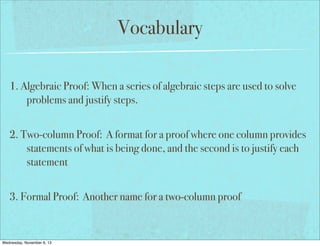
1. Algebraic Proof: When a series of algebraic steps are used to solve
problems and justify steps.
2. Two-column Proof: A format for a proof where one column provides
statements of what is being done, and the second is to justify each
statement
3. Formal Proof: Another name for a two-column proof

Wednesday, November 6, 13
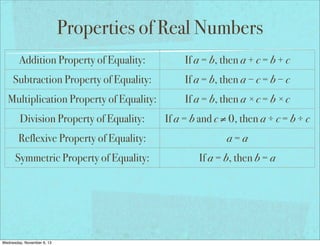
Properties of Real Numbers

Wednesday, November 6, 13
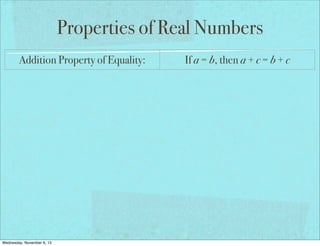
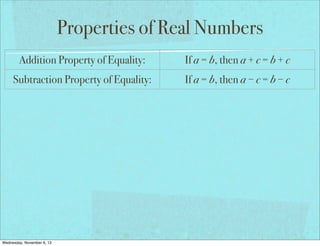
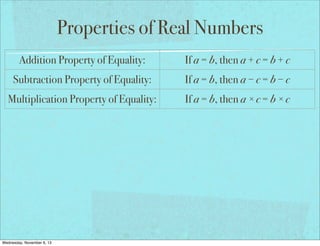
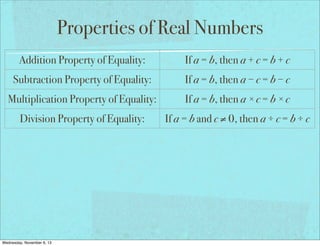
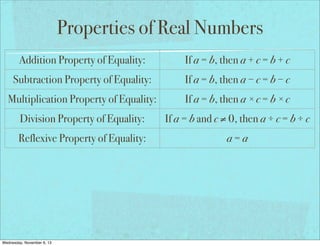
Properties of Real Numbers
Addition Property of Equality:

If a = b, then a + c = b + c

Subtraction Property of Equality:

If a = b, then a − c = b − c

Multiplication Property of Equality:

If a = b, then a × c = b × c

Division Property of Equality:

If a = b and c ≠ 0, then a ÷ c = b ÷ c

Reflexive Property of Equality:

a=a

Symmetric Property of Equality:

If a = b, then b = a

Transitive Property of Equality:

If a = b and b = c, then a = c

If a = b, then a may be replaced by b
Substitution Property of Equality:
in any equation/expression
Distributive Property:
Wednesday, November 6, 13

a(b + c) = ab + ac
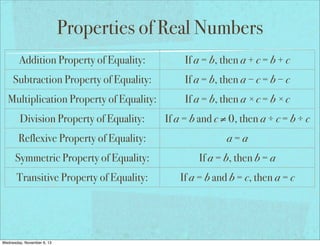
Properties of Real Numbers
Addition Property of Equality:

If a = b, then a + c = b + c

Subtraction Property of Equality:

If a = b, then a − c = b − c

Multiplication Property of Equality:

If a = b, then a × c = b × c

Division Property of Equality:

If a = b and c ≠ 0, then a ÷ c = b ÷ c

Reflexive Property of Equality:

a=a

Symmetric Property of Equality:

If a = b, then b = a

Transitive Property of Equality:

If a = b and b = c, then a = c

If a = b, then a may be replaced by b
Substitution Property of Equality:
in any equation/expression
Distributive Property:
Wednesday, November 6, 13

a(b + c) = ab + ac
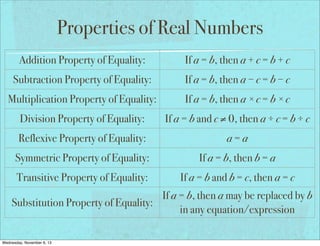
Properties of Real Numbers
Addition Property of Equality:

If a = b, then a + c = b + c

Subtraction Property of Equality:

If a = b, then a − c = b − c

Multiplication Property of Equality:

If a = b, then a × c = b × c

Division Property of Equality:

If a = b and c ≠ 0, then a ÷ c = b ÷ c

Reflexive Property of Equality:

a=a

Symmetric Property of Equality:

If a = b, then b = a

Transitive Property of Equality:

If a = b and b = c, then a = c

If a = b, then a may be replaced by b
Substitution Property of Equality:
in any equation/expression
Distributive Property:
Wednesday, November 6, 13

a(b + c) = ab + ac
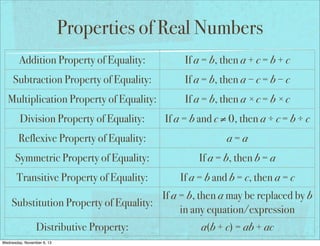
Properties of Real Numbers
Addition Property of Equality:

If a = b, then a + c = b + c

Subtraction Property of Equality:

If a = b, then a − c = b − c

Multiplication Property of Equality:

If a = b, then a × c = b × c

Division Property of Equality:

If a = b and c ≠ 0, then a ÷ c = b ÷ c

Reflexive Property of Equality:

a=a

Symmetric Property of Equality:

If a = b, then b = a

Transitive Property of Equality:

If a = b and b = c, then a = c

If a = b, then a may be replaced by b
Substitution Property of Equality:
in any equation/expression
Distributive Property:
Wednesday, November 6, 13

a(b + c) = ab + ac
Properties of Real Numbers
Addition Property of Equality:

If a = b, then a + c = b + c

Subtraction Property of Equality:

If a = b, then a − c = b − c

Multiplication Property of Equality:

If a = b, then a × c = b × c

Division Property of Equality:

If a = b and c ≠ 0, then a ÷ c = b ÷ c

Reflexive Property of Equality:

a=a

Symmetric Property of Equality:

If a = b, then b = a

Transitive Property of Equality:

If a = b and b = c, then a = c

If a = b, then a may be replaced by b
Substitution Property of Equality:
in any equation/expression
Distributive Property:
Wednesday, November 6, 13

a(b + c) = ab + ac
Properties of Real Numbers
Addition Property of Equality:

If a = b, then a + c = b + c

Subtraction Property of Equality:

If a = b, then a − c = b − c

Multiplication Property of Equality:

If a = b, then a × c = b × c

Division Property of Equality:

If a = b and c ≠ 0, then a ÷ c = b ÷ c

Reflexive Property of Equality:

a=a

Symmetric Property of Equality:

If a = b, then b = a

Transitive Property of Equality:

If a = b and b = c, then a = c

If a = b, then a may be replaced by b
Substitution Property of Equality:
in any equation/expression
Distributive Property:
Wednesday, November 6, 13

a(b + c) = ab + ac
Properties of Real Numbers
Addition Property of Equality:

If a = b, then a + c = b + c

Subtraction Property of Equality:

If a = b, then a − c = b − c

Multiplication Property of Equality:

If a = b, then a × c = b × c

Division Property of Equality:

If a = b and c ≠ 0, then a ÷ c = b ÷ c

Reflexive Property of Equality:

a=a

Symmetric Property of Equality:

If a = b, then b = a

Transitive Property of Equality:

If a = b and b = c, then a = c

If a = b, then a may be replaced by b
Substitution Property of Equality:
in any equation/expression
Distributive Property:
Wednesday, November 6, 13

a(b + c) = ab + ac
Properties of Real Numbers
Addition Property of Equality:

If a = b, then a + c = b + c

Subtraction Property of Equality:

If a = b, then a − c = b − c

Multiplication Property of Equality:

If a = b, then a × c = b × c

Division Property of Equality:

If a = b and c ≠ 0, then a ÷ c = b ÷ c

Reflexive Property of Equality:

a=a

Symmetric Property of Equality:

If a = b, then b = a

Transitive Property of Equality:

If a = b and b = c, then a = c

If a = b, then a may be replaced by b
Substitution Property of Equality:
in any equation/expression
Distributive Property:
Wednesday, November 6, 13

a(b + c) = ab + ac
Properties of Real Numbers
Addition Property of Equality:

If a = b, then a + c = b + c

Subtraction Property of Equality:

If a = b, then a − c = b − c

Multiplication Property of Equality:

If a = b, then a × c = b × c

Division Property of Equality:

If a = b and c ≠ 0, then a ÷ c = b ÷ c

Reflexive Property of Equality:

a=a

Symmetric Property of Equality:

If a = b, then b = a

Transitive Property of Equality:

If a = b and b = c, then a = c

If a = b, then a may be replaced by b
Substitution Property of Equality:
in any equation/expression
Distributive Property:
Wednesday, November 6, 13

a(b + c) = ab + ac
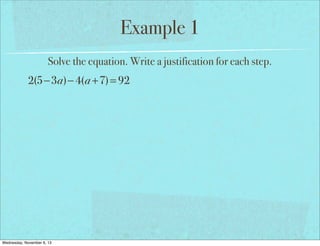
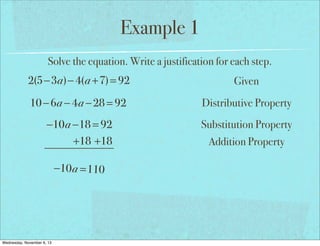
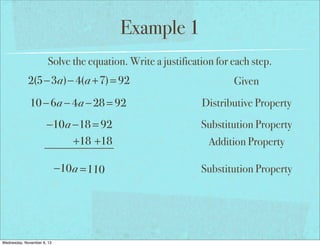
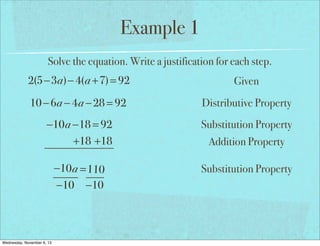
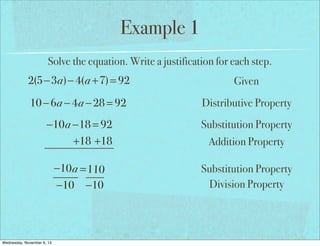
Example 1
Solve the equation. Write a justification for each step.

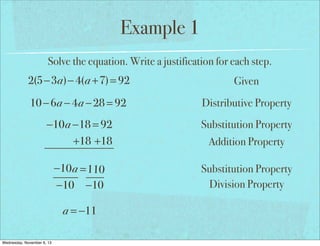
2(5−3a)− 4(a +7) = 92

Wednesday, November 6, 13
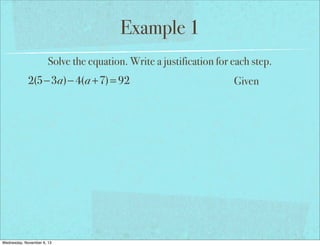
Example 1
Solve the equation. Write a justification for each step.

2(5−3a)− 4(a +7) = 92

Wednesday, November 6, 13

Given
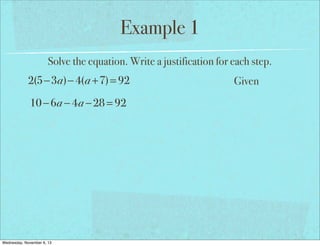
Example 1
Solve the equation. Write a justification for each step.

2(5−3a)− 4(a +7) = 92
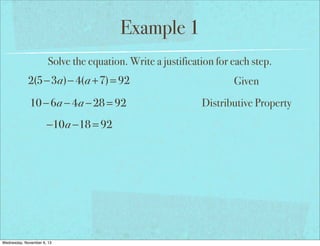
10 − 6a − 4a − 28 = 92

Wednesday, November 6, 13

Given
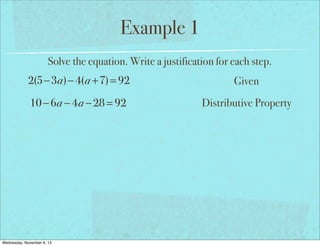
Example 1
Solve the equation. Write a justification for each step.

2(5−3a)− 4(a +7) = 92

Given

10 − 6a − 4a − 28 = 92

Distributive Property

Wednesday, November 6, 13
Example 1
Solve the equation. Write a justification for each step.

2(5−3a)− 4(a +7) = 92

Given

10 − 6a − 4a − 28 = 92

Distributive Property

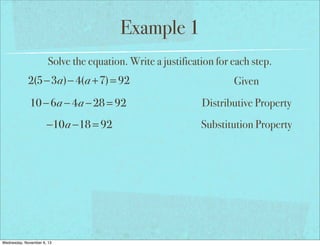
−10a −18 = 92

Wednesday, November 6, 13
Example 1
Solve the equation. Write a justification for each step.

2(5−3a)− 4(a +7) = 92

Given

10 − 6a − 4a − 28 = 92

Distributive Property

−10a −18 = 92

Substitution Property

Wednesday, November 6, 13
Example 1
Solve the equation. Write a justification for each step.

2(5−3a)− 4(a +7) = 92

Given

10 − 6a − 4a − 28 = 92

Distributive Property

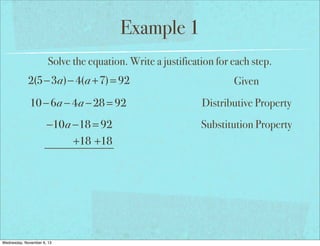
−10a −18 = 92
+18 +18

Substitution Property

Wednesday, November 6, 13
Example 1
Solve the equation. Write a justification for each step.

2(5−3a)− 4(a +7) = 92

Given

10 − 6a − 4a − 28 = 92

Distributive Property

−10a −18 = 92
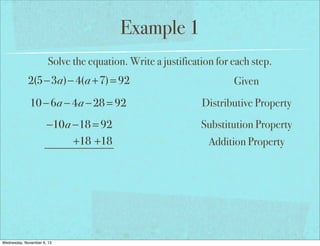
+18 +18

Substitution Property

Wednesday, November 6, 13

Addition Property
Example 1
Solve the equation. Write a justification for each step.

2(5−3a)− 4(a +7) = 92

Given

10 − 6a − 4a − 28 = 92

Distributive Property

−10a −18 = 92
+18 +18

Substitution Property

−10 a = 110

Wednesday, November 6, 13

Addition Property
Example 1
Solve the equation. Write a justification for each step.

2(5−3a)− 4(a +7) = 92

Given

10 − 6a − 4a − 28 = 92

Distributive Property

−10a −18 = 92
+18 +18

Substitution Property

−10 a = 110

Substitution Property

Wednesday, November 6, 13

Addition Property
Example 1
Solve the equation. Write a justification for each step.

2(5−3a)− 4(a +7) = 92

Given

10 − 6a − 4a − 28 = 92

Distributive Property

−10a −18 = 92
+18 +18

Substitution Property

−10 a = 110
−10 −10

Substitution Property

Wednesday, November 6, 13

Addition Property
Example 1
Solve the equation. Write a justification for each step.

2(5−3a)− 4(a +7) = 92

Given

10 − 6a − 4a − 28 = 92

Distributive Property

−10a −18 = 92
+18 +18

Substitution Property

−10 a = 110
−10 −10

Substitution Property
Division Property

Wednesday, November 6, 13

Addition Property
Example 1
Solve the equation. Write a justification for each step.

2(5−3a)− 4(a +7) = 92

Given

10 − 6a − 4a − 28 = 92

Distributive Property

−10a −18 = 92
+18 +18

Substitution Property

−10 a = 110
−10 −10

Substitution Property
Division Property

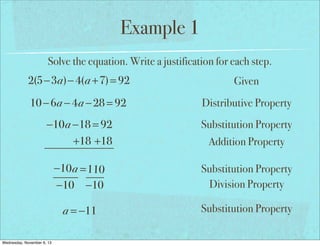
a = −11
Wednesday, November 6, 13

Addition Property
Example 1
Solve the equation. Write a justification for each step.

2(5−3a)− 4(a +7) = 92

Given

10 − 6a − 4a − 28 = 92

Distributive Property

−10a −18 = 92
+18 +18

Substitution Property

−10 a = 110
−10 −10

Substitution Property
Division Property

a = −11

Substitution Property

Wednesday, November 6, 13

Addition Property
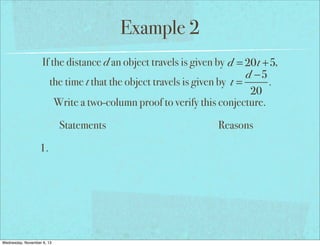
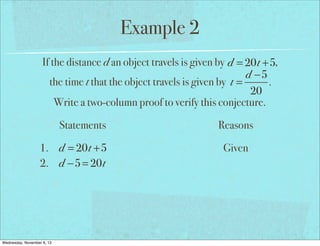
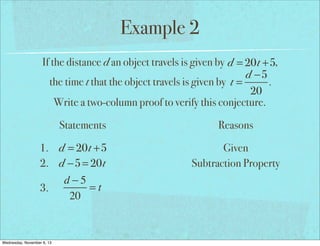
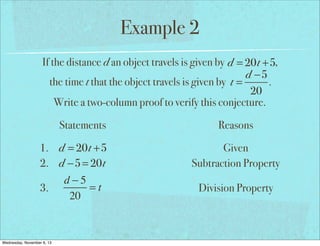
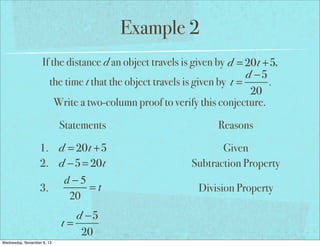
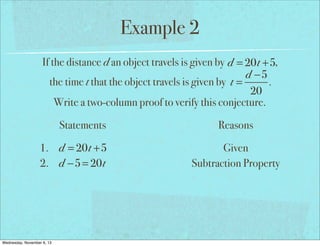
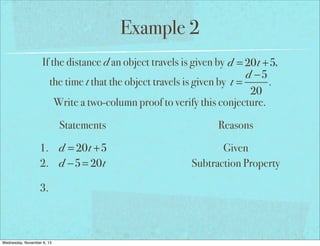
Example 2
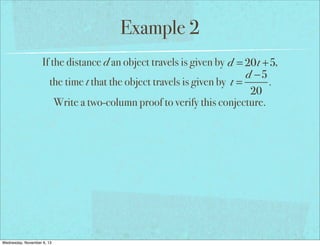
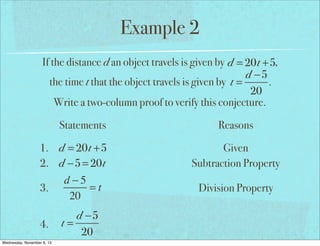
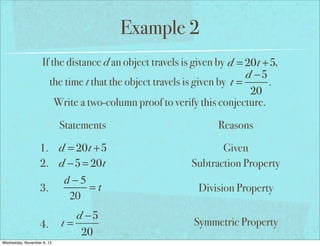
If the distance d an object travels is given by d = 20t +5,
d −5
the time t that the object travels is given by t =
.
20
Write a two-column proof to verify this conjecture.

Wednesday, November 6, 13
Example 2
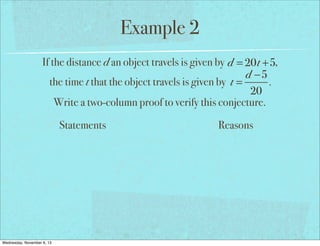
If the distance d an object travels is given by d = 20t +5,
d −5
the time t that the object travels is given by t =
.
20
Write a two-column proof to verify this conjecture.
Statements

Wednesday, November 6, 13

Reasons
Example 2
If the distance d an object travels is given by d = 20t +5,
d −5
the time t that the object travels is given by t =
.
20
Write a two-column proof to verify this conjecture.
Statements
1.

Wednesday, November 6, 13

Reasons
Example 2
If the distance d an object travels is given by d = 20t +5,
d −5
the time t that the object travels is given by t =
.
20
Write a two-column proof to verify this conjecture.
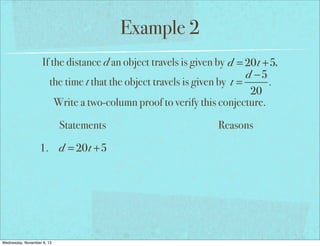
Statements
1. d = 20t +5

Wednesday, November 6, 13

Reasons
Example 2
If the distance d an object travels is given by d = 20t +5,
d −5
the time t that the object travels is given by t =
.
20
Write a two-column proof to verify this conjecture.
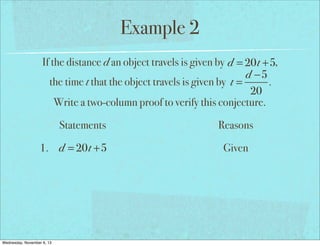
Statements
1. d = 20t +5

Wednesday, November 6, 13

Reasons
Given
Example 2
If the distance d an object travels is given by d = 20t +5,
d −5
the time t that the object travels is given by t =
.
20
Write a two-column proof to verify this conjecture.
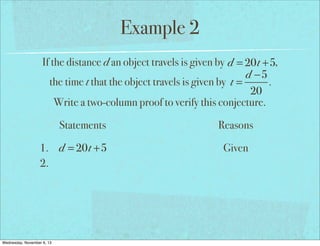
Statements
1. d = 20t +5
2.

Wednesday, November 6, 13

Reasons
Given
Example 2
If the distance d an object travels is given by d = 20t +5,
d −5
the time t that the object travels is given by t =
.
20
Write a two-column proof to verify this conjecture.
Statements
1. d = 20t +5
2. d −5 = 20t

Wednesday, November 6, 13

Reasons
Given
Example 2
If the distance d an object travels is given by d = 20t +5,
d −5
the time t that the object travels is given by t =
.
20
Write a two-column proof to verify this conjecture.
Statements
1. d = 20t +5
2. d −5 = 20t

Wednesday, November 6, 13

Reasons
Given
Subtraction Property
Example 2
If the distance d an object travels is given by d = 20t +5,
d −5
the time t that the object travels is given by t =
.
20
Write a two-column proof to verify this conjecture.
Statements
1. d = 20t +5
2. d −5 = 20t
3.

Wednesday, November 6, 13

Reasons
Given
Subtraction Property
Example 2
If the distance d an object travels is given by d = 20t +5,
d −5
the time t that the object travels is given by t =
.
20
Write a two-column proof to verify this conjecture.
Statements
1. d = 20t +5
2. d −5 = 20t
d−5
=t
3.
20

Wednesday, November 6, 13

Reasons
Given
Subtraction Property
Example 2
If the distance d an object travels is given by d = 20t +5,
d −5
the time t that the object travels is given by t =
.
20
Write a two-column proof to verify this conjecture.
Statements
1. d = 20t +5
2. d −5 = 20t
d−5
=t
3.
20

Wednesday, November 6, 13

Reasons
Given
Subtraction Property
Division Property
Example 2
If the distance d an object travels is given by d = 20t +5,
d −5
the time t that the object travels is given by t =
.
20
Write a two-column proof to verify this conjecture.
Statements
1. d = 20t +5
2. d −5 = 20t
d−5
=t
3.
20
4.
Wednesday, November 6, 13

Reasons
Given
Subtraction Property
Division Property
Example 2
If the distance d an object travels is given by d = 20t +5,
d −5
the time t that the object travels is given by t =
.
20
Write a two-column proof to verify this conjecture.
Statements
1. d = 20t +5
2. d −5 = 20t
d−5
=t
3.
20
4.
Wednesday, November 6, 13

d −5
t=
20

Reasons
Given
Subtraction Property
Division Property
Example 2
If the distance d an object travels is given by d = 20t +5,
d −5
the time t that the object travels is given by t =
.
20
Write a two-column proof to verify this conjecture.
Statements
1. d = 20t +5
2. d −5 = 20t
d−5
=t
3.
20
4.
Wednesday, November 6, 13

d −5
t=
20

Reasons
Given
Subtraction Property
Division Property
Symmetric Property
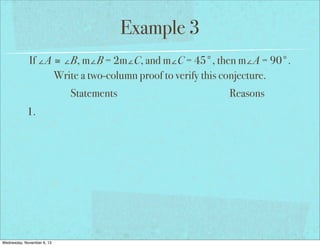
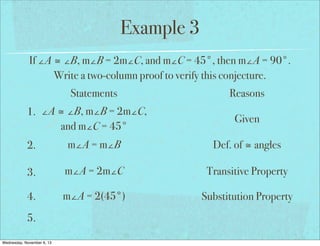
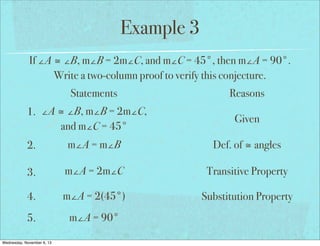
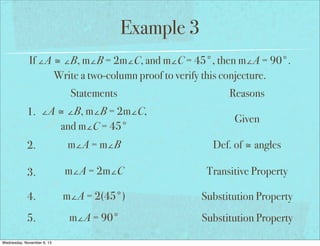
Example 3
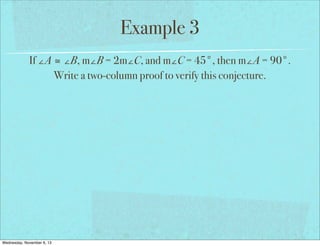
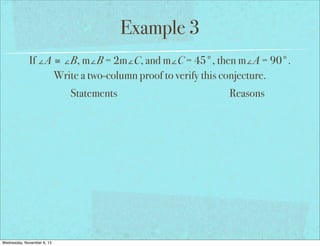
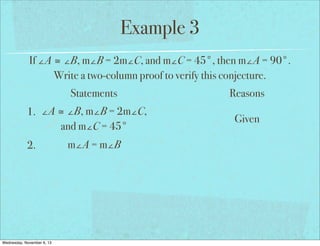
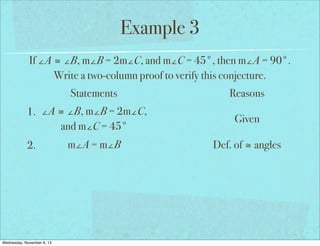
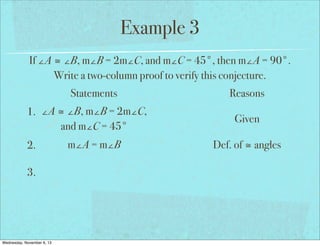
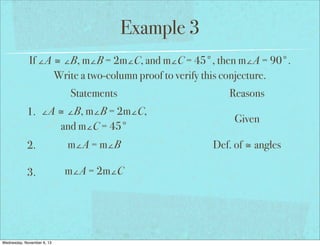
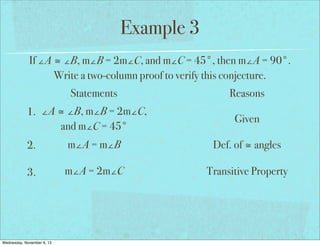
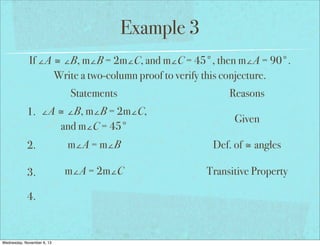
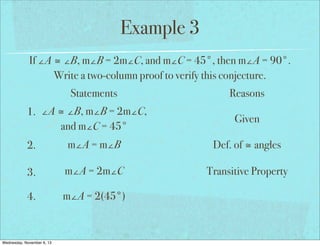
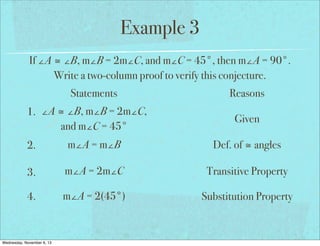
If ∠A ≅ ∠B, m∠B = 2m∠C, and m∠C = 45°, then m∠A = 90°.
Write a two-column proof to verify this conjecture.

Wednesday, November 6, 13
Example 3
If ∠A ≅ ∠B, m∠B = 2m∠C, and m∠C = 45°, then m∠A = 90°.
Write a two-column proof to verify this conjecture.
Statements

Wednesday, November 6, 13

Reasons
Example 3
If ∠A ≅ ∠B, m∠B = 2m∠C, and m∠C = 45°, then m∠A = 90°.
Write a two-column proof to verify this conjecture.
Statements
1.

Wednesday, November 6, 13

Reasons
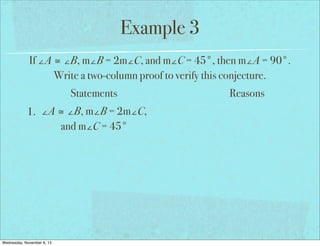
Example 3
If ∠A ≅ ∠B, m∠B = 2m∠C, and m∠C = 45°, then m∠A = 90°.
Write a two-column proof to verify this conjecture.
Statements
1. ∠A ≅ ∠B, m∠B = 2m∠C,
and m∠C = 45°

Wednesday, November 6, 13

Reasons
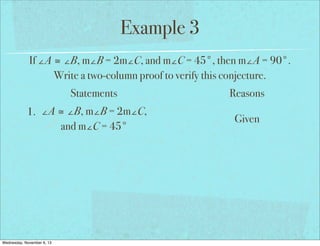
Example 3
If ∠A ≅ ∠B, m∠B = 2m∠C, and m∠C = 45°, then m∠A = 90°.
Write a two-column proof to verify this conjecture.
Statements
1. ∠A ≅ ∠B, m∠B = 2m∠C,
and m∠C = 45°

Wednesday, November 6, 13

Reasons
Given
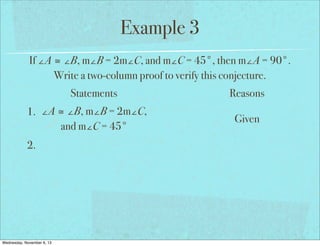
Example 3
If ∠A ≅ ∠B, m∠B = 2m∠C, and m∠C = 45°, then m∠A = 90°.
Write a two-column proof to verify this conjecture.
Statements
1. ∠A ≅ ∠B, m∠B = 2m∠C,
and m∠C = 45°
2.

Wednesday, November 6, 13

Reasons
Given
Example 3
If ∠A ≅ ∠B, m∠B = 2m∠C, and m∠C = 45°, then m∠A = 90°.
Write a two-column proof to verify this conjecture.
Statements
1. ∠A ≅ ∠B, m∠B = 2m∠C,
and m∠C = 45°
2.

Wednesday, November 6, 13

m∠A = m∠B

Reasons
Given
Example 3
If ∠A ≅ ∠B, m∠B = 2m∠C, and m∠C = 45°, then m∠A = 90°.
Write a two-column proof to verify this conjecture.
Statements
1. ∠A ≅ ∠B, m∠B = 2m∠C,
and m∠C = 45°
2.

Wednesday, November 6, 13

m∠A = m∠B

Reasons
Given
Def. of ≅ angles
Example 3
If ∠A ≅ ∠B, m∠B = 2m∠C, and m∠C = 45°, then m∠A = 90°.
Write a two-column proof to verify this conjecture.
Statements
1. ∠A ≅ ∠B, m∠B = 2m∠C,
and m∠C = 45°
2.
3.

Wednesday, November 6, 13

m∠A = m∠B

Reasons
Given
Def. of ≅ angles
Example 3
If ∠A ≅ ∠B, m∠B = 2m∠C, and m∠C = 45°, then m∠A = 90°.
Write a two-column proof to verify this conjecture.
Statements
1. ∠A ≅ ∠B, m∠B = 2m∠C,
and m∠C = 45°
2.

m∠A = m∠B

3.

m∠A = 2m∠C

Wednesday, November 6, 13

Reasons
Given
Def. of ≅ angles
Example 3
If ∠A ≅ ∠B, m∠B = 2m∠C, and m∠C = 45°, then m∠A = 90°.
Write a two-column proof to verify this conjecture.
Statements
1. ∠A ≅ ∠B, m∠B = 2m∠C,
and m∠C = 45°

Reasons
Given

2.

m∠A = m∠B

Def. of ≅ angles

3.

m∠A = 2m∠C

Transitive Property

Wednesday, November 6, 13
Example 3
If ∠A ≅ ∠B, m∠B = 2m∠C, and m∠C = 45°, then m∠A = 90°.
Write a two-column proof to verify this conjecture.
Statements
1. ∠A ≅ ∠B, m∠B = 2m∠C,
and m∠C = 45°

Reasons
Given

2.

m∠A = m∠B

Def. of ≅ angles

3.

m∠A = 2m∠C

Transitive Property

4.

Wednesday, November 6, 13
Example 3
If ∠A ≅ ∠B, m∠B = 2m∠C, and m∠C = 45°, then m∠A = 90°.
Write a two-column proof to verify this conjecture.
Statements
1. ∠A ≅ ∠B, m∠B = 2m∠C,
and m∠C = 45°

Reasons
Given

2.

m∠A = m∠B

Def. of ≅ angles

3.

m∠A = 2m∠C

Transitive Property

4.

m∠A = 2(45°)

Wednesday, November 6, 13
Example 3
If ∠A ≅ ∠B, m∠B = 2m∠C, and m∠C = 45°, then m∠A = 90°.
Write a two-column proof to verify this conjecture.
Statements
1. ∠A ≅ ∠B, m∠B = 2m∠C,
and m∠C = 45°

Reasons
Given

2.

m∠A = m∠B

Def. of ≅ angles

3.

m∠A = 2m∠C

Transitive Property

4.

m∠A = 2(45°)

Substitution Property

Wednesday, November 6, 13
Example 3
If ∠A ≅ ∠B, m∠B = 2m∠C, and m∠C = 45°, then m∠A = 90°.
Write a two-column proof to verify this conjecture.
Statements
1. ∠A ≅ ∠B, m∠B = 2m∠C,
and m∠C = 45°

Reasons
Given

2.

m∠A = m∠B

Def. of ≅ angles

3.

m∠A = 2m∠C

Transitive Property

4.

m∠A = 2(45°)

Substitution Property

5.
Wednesday, November 6, 13
Example 3
If ∠A ≅ ∠B, m∠B = 2m∠C, and m∠C = 45°, then m∠A = 90°.
Write a two-column proof to verify this conjecture.
Statements
1. ∠A ≅ ∠B, m∠B = 2m∠C,
and m∠C = 45°

Reasons
Given

2.

m∠A = m∠B

Def. of ≅ angles

3.

m∠A = 2m∠C

Transitive Property

4.

m∠A = 2(45°)

Substitution Property

5.

m∠A = 90°

Wednesday, November 6, 13
Example 3
If ∠A ≅ ∠B, m∠B = 2m∠C, and m∠C = 45°, then m∠A = 90°.
Write a two-column proof to verify this conjecture.
Statements
1. ∠A ≅ ∠B, m∠B = 2m∠C,
and m∠C = 45°

Reasons
Given

2.

m∠A = m∠B

Def. of ≅ angles

3.

m∠A = 2m∠C

Transitive Property

4.

m∠A = 2(45°)

Substitution Property

5.

m∠A = 90°

Substitution Property

Wednesday, November 6, 13
Problem Set

Wednesday, November 6, 13
Problem Set

p. 137 #1-27 odd, 36

“The greatest challenge to any thinker is stating the problem in a way that
will allow a solution.” - Bertrand Russell
Wednesday, November 6, 13

Geometry Section 2-6

  • 1.
  • 2.
    Essential Questions How doyou use Algebra to write two-column proofs? How do you use properties of equality to write geometric proofs? Wednesday, November 6, 13
  • 3.
    Vocabulary 1. Algebraic Proof: 2.Two-column Proof: 3. Formal Proof: Wednesday, November 6, 13
  • 4.
    Vocabulary 1. Algebraic Proof:When a series of algebraic steps are used to solve problems and justify steps. 2. Two-column Proof: 3. Formal Proof: Wednesday, November 6, 13
  • 5.
    Vocabulary 1. Algebraic Proof:When a series of algebraic steps are used to solve problems and justify steps. 2. Two-column Proof: A format for a proof where one column provides statements of what is being done, and the second is to justify each statement 3. Formal Proof: Wednesday, November 6, 13
  • 6.
    Vocabulary 1. Algebraic Proof:When a series of algebraic steps are used to solve problems and justify steps. 2. Two-column Proof: A format for a proof where one column provides statements of what is being done, and the second is to justify each statement 3. Formal Proof: Another name for a two-column proof Wednesday, November 6, 13
  • 7.
    Properties of RealNumbers Wednesday, November 6, 13
  • 8.
    Properties of RealNumbers Addition Property of Equality: If a = b, then a + c = b + c Subtraction Property of Equality: If a = b, then a − c = b − c Multiplication Property of Equality: If a = b, then a × c = b × c Division Property of Equality: If a = b and c ≠ 0, then a ÷ c = b ÷ c Reflexive Property of Equality: a=a Symmetric Property of Equality: If a = b, then b = a Transitive Property of Equality: If a = b and b = c, then a = c If a = b, then a may be replaced by b Substitution Property of Equality: in any equation/expression Distributive Property: Wednesday, November 6, 13 a(b + c) = ab + ac
  • 9.
    Properties of RealNumbers Addition Property of Equality: If a = b, then a + c = b + c Subtraction Property of Equality: If a = b, then a − c = b − c Multiplication Property of Equality: If a = b, then a × c = b × c Division Property of Equality: If a = b and c ≠ 0, then a ÷ c = b ÷ c Reflexive Property of Equality: a=a Symmetric Property of Equality: If a = b, then b = a Transitive Property of Equality: If a = b and b = c, then a = c If a = b, then a may be replaced by b Substitution Property of Equality: in any equation/expression Distributive Property: Wednesday, November 6, 13 a(b + c) = ab + ac
  • 10.
    Properties of RealNumbers Addition Property of Equality: If a = b, then a + c = b + c Subtraction Property of Equality: If a = b, then a − c = b − c Multiplication Property of Equality: If a = b, then a × c = b × c Division Property of Equality: If a = b and c ≠ 0, then a ÷ c = b ÷ c Reflexive Property of Equality: a=a Symmetric Property of Equality: If a = b, then b = a Transitive Property of Equality: If a = b and b = c, then a = c If a = b, then a may be replaced by b Substitution Property of Equality: in any equation/expression Distributive Property: Wednesday, November 6, 13 a(b + c) = ab + ac
  • 11.
    Properties of RealNumbers Addition Property of Equality: If a = b, then a + c = b + c Subtraction Property of Equality: If a = b, then a − c = b − c Multiplication Property of Equality: If a = b, then a × c = b × c Division Property of Equality: If a = b and c ≠ 0, then a ÷ c = b ÷ c Reflexive Property of Equality: a=a Symmetric Property of Equality: If a = b, then b = a Transitive Property of Equality: If a = b and b = c, then a = c If a = b, then a may be replaced by b Substitution Property of Equality: in any equation/expression Distributive Property: Wednesday, November 6, 13 a(b + c) = ab + ac
  • 12.
    Properties of RealNumbers Addition Property of Equality: If a = b, then a + c = b + c Subtraction Property of Equality: If a = b, then a − c = b − c Multiplication Property of Equality: If a = b, then a × c = b × c Division Property of Equality: If a = b and c ≠ 0, then a ÷ c = b ÷ c Reflexive Property of Equality: a=a Symmetric Property of Equality: If a = b, then b = a Transitive Property of Equality: If a = b and b = c, then a = c If a = b, then a may be replaced by b Substitution Property of Equality: in any equation/expression Distributive Property: Wednesday, November 6, 13 a(b + c) = ab + ac
  • 13.
    Properties of RealNumbers Addition Property of Equality: If a = b, then a + c = b + c Subtraction Property of Equality: If a = b, then a − c = b − c Multiplication Property of Equality: If a = b, then a × c = b × c Division Property of Equality: If a = b and c ≠ 0, then a ÷ c = b ÷ c Reflexive Property of Equality: a=a Symmetric Property of Equality: If a = b, then b = a Transitive Property of Equality: If a = b and b = c, then a = c If a = b, then a may be replaced by b Substitution Property of Equality: in any equation/expression Distributive Property: Wednesday, November 6, 13 a(b + c) = ab + ac
  • 14.
    Properties of RealNumbers Addition Property of Equality: If a = b, then a + c = b + c Subtraction Property of Equality: If a = b, then a − c = b − c Multiplication Property of Equality: If a = b, then a × c = b × c Division Property of Equality: If a = b and c ≠ 0, then a ÷ c = b ÷ c Reflexive Property of Equality: a=a Symmetric Property of Equality: If a = b, then b = a Transitive Property of Equality: If a = b and b = c, then a = c If a = b, then a may be replaced by b Substitution Property of Equality: in any equation/expression Distributive Property: Wednesday, November 6, 13 a(b + c) = ab + ac
  • 15.
    Properties of RealNumbers Addition Property of Equality: If a = b, then a + c = b + c Subtraction Property of Equality: If a = b, then a − c = b − c Multiplication Property of Equality: If a = b, then a × c = b × c Division Property of Equality: If a = b and c ≠ 0, then a ÷ c = b ÷ c Reflexive Property of Equality: a=a Symmetric Property of Equality: If a = b, then b = a Transitive Property of Equality: If a = b and b = c, then a = c If a = b, then a may be replaced by b Substitution Property of Equality: in any equation/expression Distributive Property: Wednesday, November 6, 13 a(b + c) = ab + ac
  • 16.
    Properties of RealNumbers Addition Property of Equality: If a = b, then a + c = b + c Subtraction Property of Equality: If a = b, then a − c = b − c Multiplication Property of Equality: If a = b, then a × c = b × c Division Property of Equality: If a = b and c ≠ 0, then a ÷ c = b ÷ c Reflexive Property of Equality: a=a Symmetric Property of Equality: If a = b, then b = a Transitive Property of Equality: If a = b and b = c, then a = c If a = b, then a may be replaced by b Substitution Property of Equality: in any equation/expression Distributive Property: Wednesday, November 6, 13 a(b + c) = ab + ac
  • 17.
    Example 1 Solve theequation. Write a justification for each step. 2(5−3a)− 4(a +7) = 92 Wednesday, November 6, 13
  • 18.
    Example 1 Solve theequation. Write a justification for each step. 2(5−3a)− 4(a +7) = 92 Wednesday, November 6, 13 Given
  • 19.
    Example 1 Solve theequation. Write a justification for each step. 2(5−3a)− 4(a +7) = 92 10 − 6a − 4a − 28 = 92 Wednesday, November 6, 13 Given
  • 20.
    Example 1 Solve theequation. Write a justification for each step. 2(5−3a)− 4(a +7) = 92 Given 10 − 6a − 4a − 28 = 92 Distributive Property Wednesday, November 6, 13
  • 21.
    Example 1 Solve theequation. Write a justification for each step. 2(5−3a)− 4(a +7) = 92 Given 10 − 6a − 4a − 28 = 92 Distributive Property −10a −18 = 92 Wednesday, November 6, 13
  • 22.
    Example 1 Solve theequation. Write a justification for each step. 2(5−3a)− 4(a +7) = 92 Given 10 − 6a − 4a − 28 = 92 Distributive Property −10a −18 = 92 Substitution Property Wednesday, November 6, 13
  • 23.
    Example 1 Solve theequation. Write a justification for each step. 2(5−3a)− 4(a +7) = 92 Given 10 − 6a − 4a − 28 = 92 Distributive Property −10a −18 = 92 +18 +18 Substitution Property Wednesday, November 6, 13
  • 24.
    Example 1 Solve theequation. Write a justification for each step. 2(5−3a)− 4(a +7) = 92 Given 10 − 6a − 4a − 28 = 92 Distributive Property −10a −18 = 92 +18 +18 Substitution Property Wednesday, November 6, 13 Addition Property
  • 25.
    Example 1 Solve theequation. Write a justification for each step. 2(5−3a)− 4(a +7) = 92 Given 10 − 6a − 4a − 28 = 92 Distributive Property −10a −18 = 92 +18 +18 Substitution Property −10 a = 110 Wednesday, November 6, 13 Addition Property
  • 26.
    Example 1 Solve theequation. Write a justification for each step. 2(5−3a)− 4(a +7) = 92 Given 10 − 6a − 4a − 28 = 92 Distributive Property −10a −18 = 92 +18 +18 Substitution Property −10 a = 110 Substitution Property Wednesday, November 6, 13 Addition Property
  • 27.
    Example 1 Solve theequation. Write a justification for each step. 2(5−3a)− 4(a +7) = 92 Given 10 − 6a − 4a − 28 = 92 Distributive Property −10a −18 = 92 +18 +18 Substitution Property −10 a = 110 −10 −10 Substitution Property Wednesday, November 6, 13 Addition Property
  • 28.
    Example 1 Solve theequation. Write a justification for each step. 2(5−3a)− 4(a +7) = 92 Given 10 − 6a − 4a − 28 = 92 Distributive Property −10a −18 = 92 +18 +18 Substitution Property −10 a = 110 −10 −10 Substitution Property Division Property Wednesday, November 6, 13 Addition Property
  • 29.
    Example 1 Solve theequation. Write a justification for each step. 2(5−3a)− 4(a +7) = 92 Given 10 − 6a − 4a − 28 = 92 Distributive Property −10a −18 = 92 +18 +18 Substitution Property −10 a = 110 −10 −10 Substitution Property Division Property a = −11 Wednesday, November 6, 13 Addition Property
  • 30.
    Example 1 Solve theequation. Write a justification for each step. 2(5−3a)− 4(a +7) = 92 Given 10 − 6a − 4a − 28 = 92 Distributive Property −10a −18 = 92 +18 +18 Substitution Property −10 a = 110 −10 −10 Substitution Property Division Property a = −11 Substitution Property Wednesday, November 6, 13 Addition Property
  • 31.
    Example 2 If thedistance d an object travels is given by d = 20t +5, d −5 the time t that the object travels is given by t = . 20 Write a two-column proof to verify this conjecture. Wednesday, November 6, 13
  • 32.
    Example 2 If thedistance d an object travels is given by d = 20t +5, d −5 the time t that the object travels is given by t = . 20 Write a two-column proof to verify this conjecture. Statements Wednesday, November 6, 13 Reasons
  • 33.
    Example 2 If thedistance d an object travels is given by d = 20t +5, d −5 the time t that the object travels is given by t = . 20 Write a two-column proof to verify this conjecture. Statements 1. Wednesday, November 6, 13 Reasons
  • 34.
    Example 2 If thedistance d an object travels is given by d = 20t +5, d −5 the time t that the object travels is given by t = . 20 Write a two-column proof to verify this conjecture. Statements 1. d = 20t +5 Wednesday, November 6, 13 Reasons
  • 35.
    Example 2 If thedistance d an object travels is given by d = 20t +5, d −5 the time t that the object travels is given by t = . 20 Write a two-column proof to verify this conjecture. Statements 1. d = 20t +5 Wednesday, November 6, 13 Reasons Given
  • 36.
    Example 2 If thedistance d an object travels is given by d = 20t +5, d −5 the time t that the object travels is given by t = . 20 Write a two-column proof to verify this conjecture. Statements 1. d = 20t +5 2. Wednesday, November 6, 13 Reasons Given
  • 37.
    Example 2 If thedistance d an object travels is given by d = 20t +5, d −5 the time t that the object travels is given by t = . 20 Write a two-column proof to verify this conjecture. Statements 1. d = 20t +5 2. d −5 = 20t Wednesday, November 6, 13 Reasons Given
  • 38.
    Example 2 If thedistance d an object travels is given by d = 20t +5, d −5 the time t that the object travels is given by t = . 20 Write a two-column proof to verify this conjecture. Statements 1. d = 20t +5 2. d −5 = 20t Wednesday, November 6, 13 Reasons Given Subtraction Property
  • 39.
    Example 2 If thedistance d an object travels is given by d = 20t +5, d −5 the time t that the object travels is given by t = . 20 Write a two-column proof to verify this conjecture. Statements 1. d = 20t +5 2. d −5 = 20t 3. Wednesday, November 6, 13 Reasons Given Subtraction Property
  • 40.
    Example 2 If thedistance d an object travels is given by d = 20t +5, d −5 the time t that the object travels is given by t = . 20 Write a two-column proof to verify this conjecture. Statements 1. d = 20t +5 2. d −5 = 20t d−5 =t 3. 20 Wednesday, November 6, 13 Reasons Given Subtraction Property
  • 41.
    Example 2 If thedistance d an object travels is given by d = 20t +5, d −5 the time t that the object travels is given by t = . 20 Write a two-column proof to verify this conjecture. Statements 1. d = 20t +5 2. d −5 = 20t d−5 =t 3. 20 Wednesday, November 6, 13 Reasons Given Subtraction Property Division Property
  • 42.
    Example 2 If thedistance d an object travels is given by d = 20t +5, d −5 the time t that the object travels is given by t = . 20 Write a two-column proof to verify this conjecture. Statements 1. d = 20t +5 2. d −5 = 20t d−5 =t 3. 20 4. Wednesday, November 6, 13 Reasons Given Subtraction Property Division Property
  • 43.
    Example 2 If thedistance d an object travels is given by d = 20t +5, d −5 the time t that the object travels is given by t = . 20 Write a two-column proof to verify this conjecture. Statements 1. d = 20t +5 2. d −5 = 20t d−5 =t 3. 20 4. Wednesday, November 6, 13 d −5 t= 20 Reasons Given Subtraction Property Division Property
  • 44.
    Example 2 If thedistance d an object travels is given by d = 20t +5, d −5 the time t that the object travels is given by t = . 20 Write a two-column proof to verify this conjecture. Statements 1. d = 20t +5 2. d −5 = 20t d−5 =t 3. 20 4. Wednesday, November 6, 13 d −5 t= 20 Reasons Given Subtraction Property Division Property Symmetric Property
  • 45.
    Example 3 If ∠A≅ ∠B, m∠B = 2m∠C, and m∠C = 45°, then m∠A = 90°. Write a two-column proof to verify this conjecture. Wednesday, November 6, 13
  • 46.
    Example 3 If ∠A≅ ∠B, m∠B = 2m∠C, and m∠C = 45°, then m∠A = 90°. Write a two-column proof to verify this conjecture. Statements Wednesday, November 6, 13 Reasons
  • 47.
    Example 3 If ∠A≅ ∠B, m∠B = 2m∠C, and m∠C = 45°, then m∠A = 90°. Write a two-column proof to verify this conjecture. Statements 1. Wednesday, November 6, 13 Reasons
  • 48.
    Example 3 If ∠A≅ ∠B, m∠B = 2m∠C, and m∠C = 45°, then m∠A = 90°. Write a two-column proof to verify this conjecture. Statements 1. ∠A ≅ ∠B, m∠B = 2m∠C, and m∠C = 45° Wednesday, November 6, 13 Reasons
  • 49.
    Example 3 If ∠A≅ ∠B, m∠B = 2m∠C, and m∠C = 45°, then m∠A = 90°. Write a two-column proof to verify this conjecture. Statements 1. ∠A ≅ ∠B, m∠B = 2m∠C, and m∠C = 45° Wednesday, November 6, 13 Reasons Given
  • 50.
    Example 3 If ∠A≅ ∠B, m∠B = 2m∠C, and m∠C = 45°, then m∠A = 90°. Write a two-column proof to verify this conjecture. Statements 1. ∠A ≅ ∠B, m∠B = 2m∠C, and m∠C = 45° 2. Wednesday, November 6, 13 Reasons Given
  • 51.
    Example 3 If ∠A≅ ∠B, m∠B = 2m∠C, and m∠C = 45°, then m∠A = 90°. Write a two-column proof to verify this conjecture. Statements 1. ∠A ≅ ∠B, m∠B = 2m∠C, and m∠C = 45° 2. Wednesday, November 6, 13 m∠A = m∠B Reasons Given
  • 52.
    Example 3 If ∠A≅ ∠B, m∠B = 2m∠C, and m∠C = 45°, then m∠A = 90°. Write a two-column proof to verify this conjecture. Statements 1. ∠A ≅ ∠B, m∠B = 2m∠C, and m∠C = 45° 2. Wednesday, November 6, 13 m∠A = m∠B Reasons Given Def. of ≅ angles
  • 53.
    Example 3 If ∠A≅ ∠B, m∠B = 2m∠C, and m∠C = 45°, then m∠A = 90°. Write a two-column proof to verify this conjecture. Statements 1. ∠A ≅ ∠B, m∠B = 2m∠C, and m∠C = 45° 2. 3. Wednesday, November 6, 13 m∠A = m∠B Reasons Given Def. of ≅ angles
  • 54.
    Example 3 If ∠A≅ ∠B, m∠B = 2m∠C, and m∠C = 45°, then m∠A = 90°. Write a two-column proof to verify this conjecture. Statements 1. ∠A ≅ ∠B, m∠B = 2m∠C, and m∠C = 45° 2. m∠A = m∠B 3. m∠A = 2m∠C Wednesday, November 6, 13 Reasons Given Def. of ≅ angles
  • 55.
    Example 3 If ∠A≅ ∠B, m∠B = 2m∠C, and m∠C = 45°, then m∠A = 90°. Write a two-column proof to verify this conjecture. Statements 1. ∠A ≅ ∠B, m∠B = 2m∠C, and m∠C = 45° Reasons Given 2. m∠A = m∠B Def. of ≅ angles 3. m∠A = 2m∠C Transitive Property Wednesday, November 6, 13
  • 56.
    Example 3 If ∠A≅ ∠B, m∠B = 2m∠C, and m∠C = 45°, then m∠A = 90°. Write a two-column proof to verify this conjecture. Statements 1. ∠A ≅ ∠B, m∠B = 2m∠C, and m∠C = 45° Reasons Given 2. m∠A = m∠B Def. of ≅ angles 3. m∠A = 2m∠C Transitive Property 4. Wednesday, November 6, 13
  • 57.
    Example 3 If ∠A≅ ∠B, m∠B = 2m∠C, and m∠C = 45°, then m∠A = 90°. Write a two-column proof to verify this conjecture. Statements 1. ∠A ≅ ∠B, m∠B = 2m∠C, and m∠C = 45° Reasons Given 2. m∠A = m∠B Def. of ≅ angles 3. m∠A = 2m∠C Transitive Property 4. m∠A = 2(45°) Wednesday, November 6, 13
  • 58.
    Example 3 If ∠A≅ ∠B, m∠B = 2m∠C, and m∠C = 45°, then m∠A = 90°. Write a two-column proof to verify this conjecture. Statements 1. ∠A ≅ ∠B, m∠B = 2m∠C, and m∠C = 45° Reasons Given 2. m∠A = m∠B Def. of ≅ angles 3. m∠A = 2m∠C Transitive Property 4. m∠A = 2(45°) Substitution Property Wednesday, November 6, 13
  • 59.
    Example 3 If ∠A≅ ∠B, m∠B = 2m∠C, and m∠C = 45°, then m∠A = 90°. Write a two-column proof to verify this conjecture. Statements 1. ∠A ≅ ∠B, m∠B = 2m∠C, and m∠C = 45° Reasons Given 2. m∠A = m∠B Def. of ≅ angles 3. m∠A = 2m∠C Transitive Property 4. m∠A = 2(45°) Substitution Property 5. Wednesday, November 6, 13
  • 60.
    Example 3 If ∠A≅ ∠B, m∠B = 2m∠C, and m∠C = 45°, then m∠A = 90°. Write a two-column proof to verify this conjecture. Statements 1. ∠A ≅ ∠B, m∠B = 2m∠C, and m∠C = 45° Reasons Given 2. m∠A = m∠B Def. of ≅ angles 3. m∠A = 2m∠C Transitive Property 4. m∠A = 2(45°) Substitution Property 5. m∠A = 90° Wednesday, November 6, 13
  • 61.
    Example 3 If ∠A≅ ∠B, m∠B = 2m∠C, and m∠C = 45°, then m∠A = 90°. Write a two-column proof to verify this conjecture. Statements 1. ∠A ≅ ∠B, m∠B = 2m∠C, and m∠C = 45° Reasons Given 2. m∠A = m∠B Def. of ≅ angles 3. m∠A = 2m∠C Transitive Property 4. m∠A = 2(45°) Substitution Property 5. m∠A = 90° Substitution Property Wednesday, November 6, 13
  • 62.
  • 63.
    Problem Set p. 137#1-27 odd, 36 “The greatest challenge to any thinker is stating the problem in a way that will allow a solution.” - Bertrand Russell Wednesday, November 6, 13