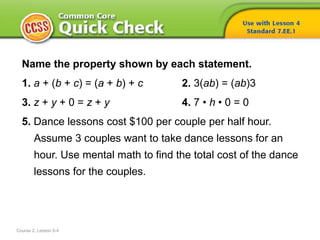
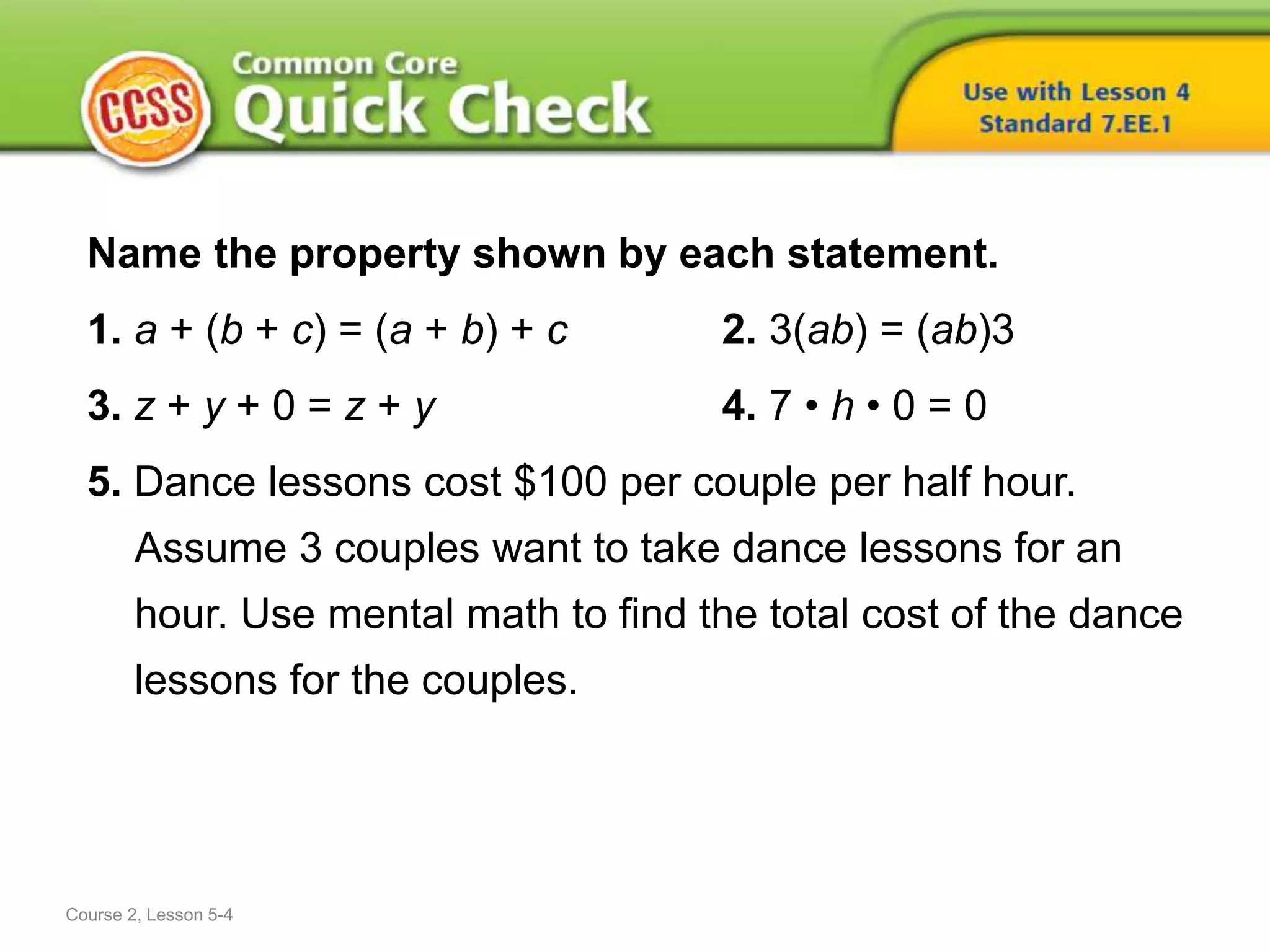
Name the property shown by each statement.
1. a + (b + c) = (a + b) + c 2. 3(ab) = (ab)3
3. z + y + 0 = z + y 4. 7 • h • 0 = 0
5. Dance lessons cost $100 per couple per half hour.
Assume 3 couples want to take dance lessons for an
hour. Use mental math to find the total cost of the dance
lessons for the couples.
Course 2, Lesson 5-4
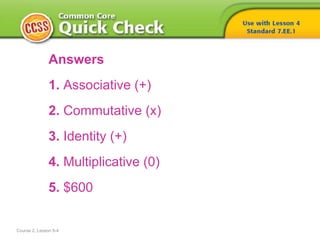
Answers
1. Associative (+)
2. Commutative (x)
3. Identity (+)
4. Multiplicative (0)
5. $600
Course 2, Lesson 5-4
HOW can you use numbers and
symbols to represent mathematical
ideas?
Expressions and Equations
Course 2, Lesson 5-4
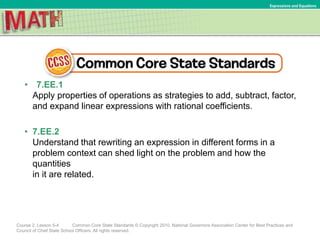
• 7.EE.1
Apply properties of operations as strategies to add, subtract, factor,
and expand linear expressions with rational coefficients.
• 7.EE.2
Understand that rewriting an expression in different forms in a
problem context can shed light on the problem and how the
quantities
in it are related.
Course 2, Lesson 5-4 Common Core State Standards © Copyright 2010. National Governors Association Center for Best Practices and
Council of Chief State School Officers. All rights reserved.
Expressions and Equations
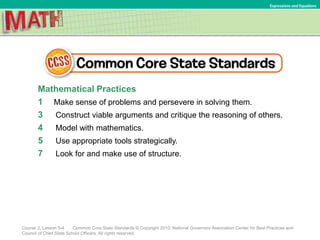
Mathematical Practices
1 Make sense of problems and persevere in solving them.
3 Construct viable arguments and critique the reasoning of others.
4 Model with mathematics.
5 Use appropriate tools strategically.
7 Look for and make use of structure.
Course 2, Lesson 5-4 Common Core State Standards © Copyright 2010. National Governors Association Center for Best Practices and
Council of Chief State School Officers. All rights reserved.
Expressions and Equations
• To model the Distributive Property
using algebra tiles
• To use the Distributive Property to
evaluate numerical expressions
Course 2, Lesson 5-4
Expressions and Equations
Course 2, Lesson 5-4
Expressions and Equations
• Distributive Property
• equivalent expressions
Course 2, Lesson 5-4
Expressions and Equations
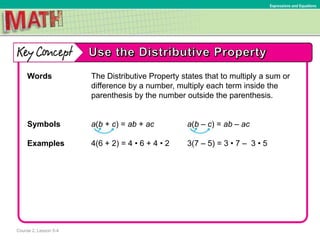
Words The Distributive Property states that to multiply a sum or
difference by a number, multiply each term inside the
parenthesis by the number outside the parenthesis.
Symbols a(b + c) = ab + ac a(b – c) = ab – ac
Examples 4(6 + 2) = 4 • 6 + 4 • 2 3(7 – 5) = 3 • 7 – 3 • 5
1
Need Another Example?
2
Step-by-Step Example
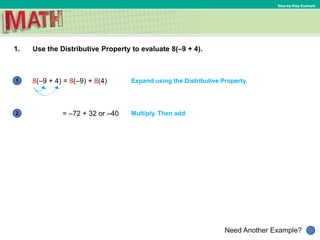
1. Use the Distributive Property to evaluate 8(–9 + 4).
Expand using the Distributive Property.
Multiply. Then add.
8(–9 + 4) = 8(–9) + 8(4)
= –72 + 32 or –40
Answer
Need Another Example?
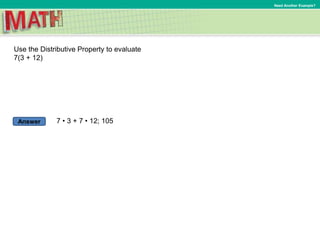
Use the Distributive Property to evaluate
7(3 + 12)
7 • 3 + 7 • 12; 105
1
Need Another Example?
2
Step-by-Step Example
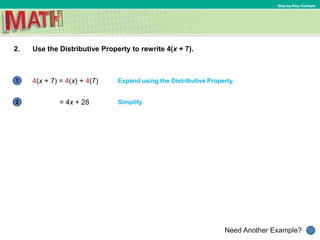
2. Use the Distributive Property to rewrite 4(x + 7).
Expand using the Distributive Property.
Simplify.
4(x + 7) = 4(x) + 4(7)
= 4x + 28
Answer
Need Another Example?
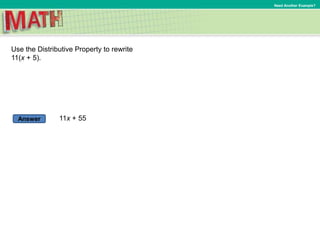
Use the Distributive Property to rewrite
11(x + 5).
11x + 55
1
Need Another Example?
2
3
4
Step-by-Step Example
3. Use the Distributive Property to rewrite 6(p – 5).
Rewrite p – 5 as p + (–5).
Expand using the Distributive Property.
6(p – 5) = 6[p + (–5)]
= 6(p) + 6(–5)
Simplify.= 6p + (–30)
Definition of subtraction= 6p – 30
Answer
Need Another Example?
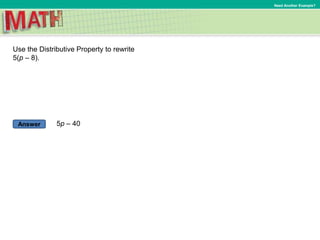
Use the Distributive Property to rewrite
5(p – 8).
5p – 40
1
Need Another Example?
2
3
Step-by-Step Example
4. Use the Distributive Property to rewrite –2(x – 8).
Rewrite x – 8 as x + (–8).
Expand using the Distributive Property.
–2(x – 8) = –2[x + (–8)]
= –2(x) + –2(–8)
Simplify.= –2x + 16
Answer
Need Another Example?
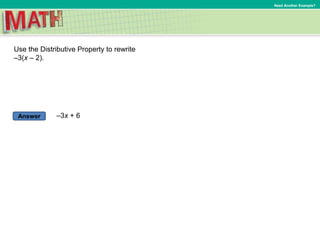
Use the Distributive Property to rewrite
–3(x – 2).
–3x + 6
1
Need Another Example?
2
Step-by-Step Example
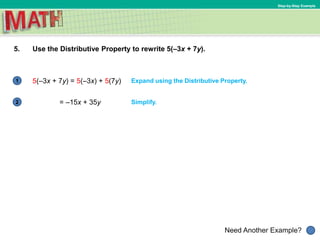
5. Use the Distributive Property to rewrite 5(–3x + 7y).
Expand using the Distributive Property.
Simplify.
5(–3x + 7y) = 5(–3x) + 5(7y)
= –15x + 35y
Answer
Need Another Example?
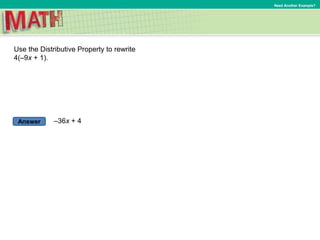
Use the Distributive Property to rewrite
4(–9x + 1).
–36x + 4
1
Need Another Example?
2
3
4
Step-by-Step Example
6. Use the Distributive Property to rewrite (x – 6).
Rewrite x – 6 as x + (–6).
Expand using the Distributive Property.
(x – 6) = [x + (–6)]
= x + (–2) Simplify.
= x – 2 Definition of subtraction
Answer
Need Another Example?
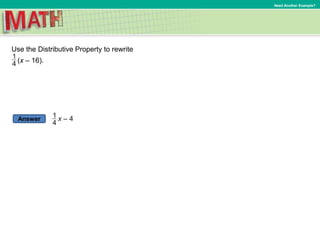
Use the Distributive Property to rewrite
(x – 16).
1
Need Another Example?
2
3
4
5
Step-by-Step Example
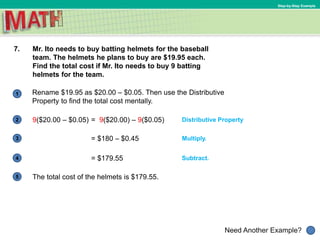
7. Mr. Ito needs to buy batting helmets for the baseball
team. The helmets he plans to buy are $19.95 each.
Find the total cost if Mr. Ito needs to buy 9 batting
helmets for the team.
Distributive Property
Multiply.
Rename $19.95 as $20.00 – $0.05. Then use the Distributive
Property to find the total cost mentally.
= $180 – $0.45
Subtract.= $179.55
= 9($20.00) – 9($0.05)9($20.00 – $0.05)
The total cost of the helmets is $179.55.
Answer
Need Another Example?
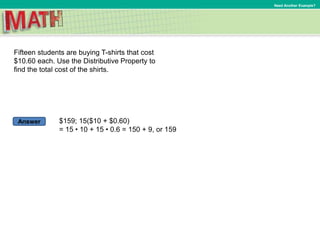
Fifteen students are buying T-shirts that cost
$10.60 each. Use the Distributive Property to
find the total cost of the shirts.
$159; 15($10 + $0.60)
= 15 • 10 + 15 • 0.6 = 150 + 9, or 159
How did what you learned
today help you answer the
HOW can you use numbers and symbols
to represent mathematical ideas?
Course 2, Lesson 5-4
Expressions and Equations
How did what you learned
today help you answer the
HOW can you use numbers and symbols
to represent mathematical ideas?
Course 2, Lesson 5-4
Expressions and Equations
Sample answers:
• By using the Distributive Property to evaluate
numerical expressions
• By using the Distributive Property to rewrite algebraic
expressions
• By using the Distributive Property to solve real-world
problems
Explain how today’s lesson
on the Distributive Property
will help you with simplifying
algebraic expressions.
Ratios and Proportional RelationshipsExpressions and Equations
Course 2, Lesson 5-4
dnpickens7@yahoo.com

(7) Lesson 5.4 - The Distributive Property

  • 1.
    Name the propertyshown by each statement. 1. a + (b + c) = (a + b) + c 2. 3(ab) = (ab)3 3. z + y + 0 = z + y 4. 7 • h • 0 = 0 5. Dance lessons cost $100 per couple per half hour. Assume 3 couples want to take dance lessons for an hour. Use mental math to find the total cost of the dance lessons for the couples. Course 2, Lesson 5-4
  • 2.
    Answers 1. Associative (+) 2.Commutative (x) 3. Identity (+) 4. Multiplicative (0) 5. $600 Course 2, Lesson 5-4
  • 3.
    HOW can youuse numbers and symbols to represent mathematical ideas? Expressions and Equations Course 2, Lesson 5-4
  • 4.
    • 7.EE.1 Apply propertiesof operations as strategies to add, subtract, factor, and expand linear expressions with rational coefficients. • 7.EE.2 Understand that rewriting an expression in different forms in a problem context can shed light on the problem and how the quantities in it are related. Course 2, Lesson 5-4 Common Core State Standards © Copyright 2010. National Governors Association Center for Best Practices and Council of Chief State School Officers. All rights reserved. Expressions and Equations
  • 5.
    Mathematical Practices 1 Makesense of problems and persevere in solving them. 3 Construct viable arguments and critique the reasoning of others. 4 Model with mathematics. 5 Use appropriate tools strategically. 7 Look for and make use of structure. Course 2, Lesson 5-4 Common Core State Standards © Copyright 2010. National Governors Association Center for Best Practices and Council of Chief State School Officers. All rights reserved. Expressions and Equations
  • 6.
    • To modelthe Distributive Property using algebra tiles • To use the Distributive Property to evaluate numerical expressions Course 2, Lesson 5-4 Expressions and Equations
  • 7.
    Course 2, Lesson5-4 Expressions and Equations • Distributive Property • equivalent expressions
  • 8.
    Course 2, Lesson5-4 Expressions and Equations Words The Distributive Property states that to multiply a sum or difference by a number, multiply each term inside the parenthesis by the number outside the parenthesis. Symbols a(b + c) = ab + ac a(b – c) = ab – ac Examples 4(6 + 2) = 4 • 6 + 4 • 2 3(7 – 5) = 3 • 7 – 3 • 5
  • 9.
    1 Need Another Example? 2 Step-by-StepExample 1. Use the Distributive Property to evaluate 8(–9 + 4). Expand using the Distributive Property. Multiply. Then add. 8(–9 + 4) = 8(–9) + 8(4) = –72 + 32 or –40
  • 10.
    Answer Need Another Example? Usethe Distributive Property to evaluate 7(3 + 12) 7 • 3 + 7 • 12; 105
  • 11.
    1 Need Another Example? 2 Step-by-StepExample 2. Use the Distributive Property to rewrite 4(x + 7). Expand using the Distributive Property. Simplify. 4(x + 7) = 4(x) + 4(7) = 4x + 28
  • 12.
    Answer Need Another Example? Usethe Distributive Property to rewrite 11(x + 5). 11x + 55
  • 13.
    1 Need Another Example? 2 3 4 Step-by-StepExample 3. Use the Distributive Property to rewrite 6(p – 5). Rewrite p – 5 as p + (–5). Expand using the Distributive Property. 6(p – 5) = 6[p + (–5)] = 6(p) + 6(–5) Simplify.= 6p + (–30) Definition of subtraction= 6p – 30
  • 14.
    Answer Need Another Example? Usethe Distributive Property to rewrite 5(p – 8). 5p – 40
  • 15.
    1 Need Another Example? 2 3 Step-by-StepExample 4. Use the Distributive Property to rewrite –2(x – 8). Rewrite x – 8 as x + (–8). Expand using the Distributive Property. –2(x – 8) = –2[x + (–8)] = –2(x) + –2(–8) Simplify.= –2x + 16
  • 16.
    Answer Need Another Example? Usethe Distributive Property to rewrite –3(x – 2). –3x + 6
  • 17.
    1 Need Another Example? 2 Step-by-StepExample 5. Use the Distributive Property to rewrite 5(–3x + 7y). Expand using the Distributive Property. Simplify. 5(–3x + 7y) = 5(–3x) + 5(7y) = –15x + 35y
  • 18.
    Answer Need Another Example? Usethe Distributive Property to rewrite 4(–9x + 1). –36x + 4
  • 19.
    1 Need Another Example? 2 3 4 Step-by-StepExample 6. Use the Distributive Property to rewrite (x – 6). Rewrite x – 6 as x + (–6). Expand using the Distributive Property. (x – 6) = [x + (–6)] = x + (–2) Simplify. = x – 2 Definition of subtraction
  • 20.
    Answer Need Another Example? Usethe Distributive Property to rewrite (x – 16).
  • 21.
    1 Need Another Example? 2 3 4 5 Step-by-StepExample 7. Mr. Ito needs to buy batting helmets for the baseball team. The helmets he plans to buy are $19.95 each. Find the total cost if Mr. Ito needs to buy 9 batting helmets for the team. Distributive Property Multiply. Rename $19.95 as $20.00 – $0.05. Then use the Distributive Property to find the total cost mentally. = $180 – $0.45 Subtract.= $179.55 = 9($20.00) – 9($0.05)9($20.00 – $0.05) The total cost of the helmets is $179.55.
  • 22.
    Answer Need Another Example? Fifteenstudents are buying T-shirts that cost $10.60 each. Use the Distributive Property to find the total cost of the shirts. $159; 15($10 + $0.60) = 15 • 10 + 15 • 0.6 = 150 + 9, or 159
  • 23.
    How did whatyou learned today help you answer the HOW can you use numbers and symbols to represent mathematical ideas? Course 2, Lesson 5-4 Expressions and Equations
  • 24.
    How did whatyou learned today help you answer the HOW can you use numbers and symbols to represent mathematical ideas? Course 2, Lesson 5-4 Expressions and Equations Sample answers: • By using the Distributive Property to evaluate numerical expressions • By using the Distributive Property to rewrite algebraic expressions • By using the Distributive Property to solve real-world problems
  • 25.
    Explain how today’slesson on the Distributive Property will help you with simplifying algebraic expressions. Ratios and Proportional RelationshipsExpressions and Equations Course 2, Lesson 5-4 dnpickens7@yahoo.com