Solving Equations
You'll Learn To: Solving Equations  Vocabulary 1) open sentence 2) equation 3) solution Translate verbal expressions into algebraic   expression and equations and vice versa. Solve equations using the properties of equality.
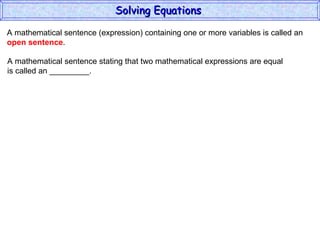
A mathematical sentence (expression) containing one or more variables is called an  open sentence . Solving Equations
A mathematical sentence (expression) containing one or more variables is called an  open sentence . A mathematical sentence stating that two mathematical expressions are equal is called an _________. Solving Equations
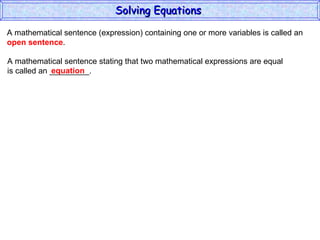
A mathematical sentence (expression) containing one or more variables is called an  open sentence . A mathematical sentence stating that two mathematical expressions are equal is called an _________. equation Solving Equations
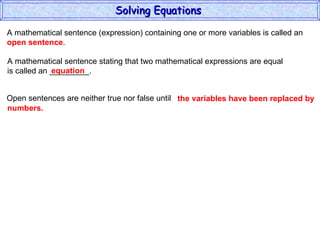
A mathematical sentence (expression) containing one or more variables is called an  open sentence . A mathematical sentence stating that two mathematical expressions are equal is called an _________. equation Open sentences are neither true nor false until the variables have been replaced by  numbers. Solving Equations
A mathematical sentence (expression) containing one or more variables is called an  open sentence . A mathematical sentence stating that two mathematical expressions are equal is called an _________. equation Open sentences are neither true nor false until the variables have been replaced by  numbers. Each replacement that results in a true statement is called a ________ of the open sentence. Solving Equations
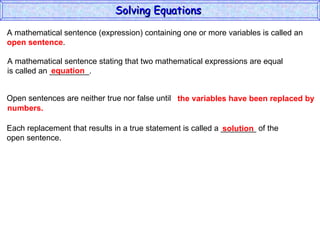
Solving Equations  A mathematical sentence (expression) containing one or more variables is called an  open sentence . A mathematical sentence stating that two mathematical expressions are equal is called an _________. equation Open sentences are neither true nor false until the variables have been replaced by  numbers. Each replacement that results in a true statement is called a ________ of the open sentence. solution
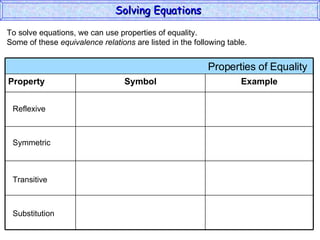
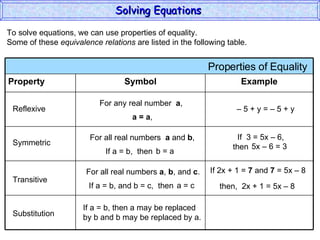
To solve equations, we can use properties of equality. Some of these  equivalence relations  are listed in the following table. Solving Equations
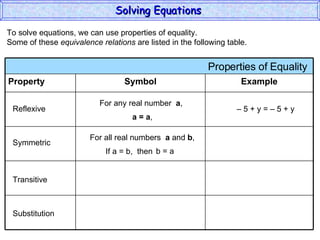
To solve equations, we can use properties of equality. Some of these  equivalence relations  are listed in the following table. Reflexive Symmetric Transitive Substitution Solving Equations  Properties of Equality  Property Symbol Example
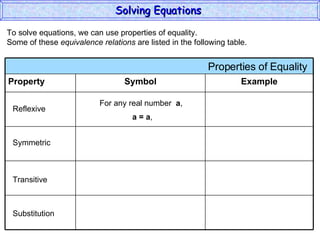
To solve equations, we can use properties of equality. Some of these  equivalence relations  are listed in the following table. Reflexive Symmetric Transitive Substitution For any real number  a , a = a , Solving Equations  Properties of Equality  Property Symbol Example
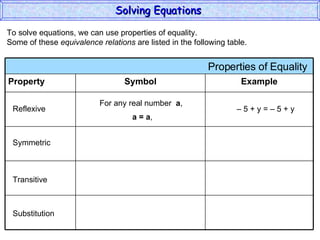
To solve equations, we can use properties of equality. Some of these  equivalence relations  are listed in the following table. Reflexive Symmetric Transitive Substitution For any real number  a , a = a , –  5 + y = – 5 + y Solving Equations  Properties of Equality  Property Symbol Example
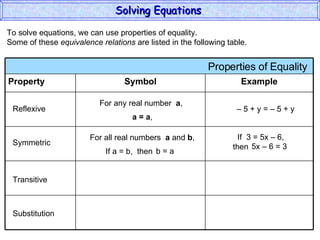
To solve equations, we can use properties of equality. Some of these  equivalence relations  are listed in the following table. Reflexive Symmetric Transitive Substitution For any real number  a , a = a , For all real numbers  a  and  b , If a = b,  then  b = a –  5 + y = – 5 + y Solving Equations  Properties of Equality  Property Symbol Example
To solve equations, we can use properties of equality. Some of these  equivalence relations  are listed in the following table. Reflexive Symmetric Transitive Substitution For any real number  a , a = a , For all real numbers  a  and  b , If a = b,  then  b = a –  5 + y = – 5 + y If  3 = 5x – 6,  then 5x – 6 = 3 Solving Equations  Properties of Equality  Property Symbol Example
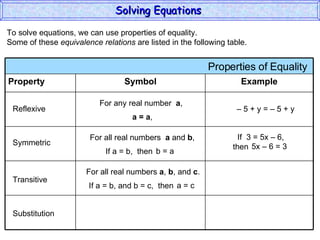
To solve equations, we can use properties of equality. Some of these  equivalence relations  are listed in the following table. Reflexive Symmetric Transitive Substitution For any real number  a , a = a , For all real numbers  a  and  b , If a = b,  then  For all real numbers  a ,  b , and  c . If a = b, and b = c,  then  b = a a = c –  5 + y = – 5 + y If  3 = 5x – 6,  then 5x – 6 = 3 Solving Equations  Properties of Equality  Property Symbol Example
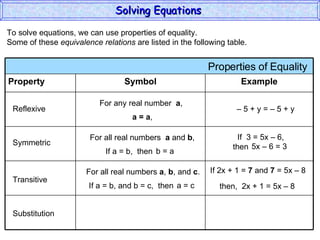
To solve equations, we can use properties of equality. Some of these  equivalence relations  are listed in the following table. Reflexive Symmetric Transitive Substitution For any real number  a , a = a , For all real numbers  a  and  b , If a = b,  then  For all real numbers  a ,  b , and  c . If a = b, and b = c,  then  b = a a = c –  5 + y = – 5 + y If  3 = 5x – 6,  then 5x – 6 = 3 If 2x + 1 =  7  and  7  = 5x – 8  then,  2x + 1 = 5x – 8 Solving Equations  Properties of Equality  Property Symbol Example
To solve equations, we can use properties of equality. Some of these  equivalence relations  are listed in the following table. Reflexive Symmetric Transitive Substitution For any real number  a , a = a , For all real numbers  a  and  b , If a = b,  then  For all real numbers  a ,  b , and  c . If a = b, and b = c,  then  If a = b, then a may be replaced by b and b may be replaced by a. b = a a = c –  5 + y = – 5 + y If  3 = 5x – 6,  then 5x – 6 = 3 If 2x + 1 =  7  and  7  = 5x – 8  then,  2x + 1 = 5x – 8 Solving Equations  Properties of Equality  Property Symbol Example
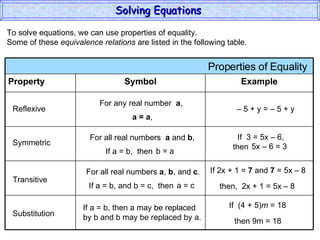
To solve equations, we can use properties of equality. Some of these  equivalence relations  are listed in the following table. Reflexive Symmetric Transitive Substitution For any real number  a , a = a , For all real numbers  a  and  b , If a = b,  then  For all real numbers  a ,  b , and  c . If a = b, and b = c,  then  If a = b, then a may be replaced by b and b may be replaced by a. b = a a = c –  5 + y = – 5 + y If  3 = 5x – 6,  then 5x – 6 = 3 If 2x + 1 =  7  and  7  = 5x – 8  then,  2x + 1 = 5x – 8 If  (4 + 5) m  = 18 then 9m = 18 Solving Equations  Properties of Equality  Property Symbol Example
Sometimes an equation can be solved by  adding  the same number to each side or by subtracting  the same number from each side or by  multiplying  or  dividing  each  side by the same number. Solving Equations
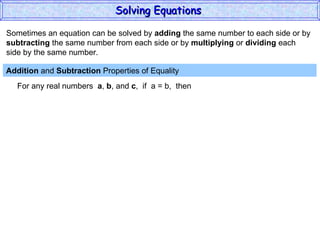
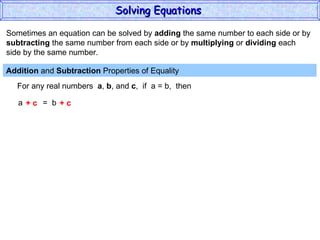
Sometimes an equation can be solved by  adding  the same number to each side or by subtracting  the same number from each side or by  multiplying  or  dividing  each  side by the same number. Addition  and  Subtraction  Properties of Equality  For any real numbers  a ,  b , and  c ,  if  a = b,  then Solving Equations
Sometimes an equation can be solved by  adding  the same number to each side or by subtracting  the same number from each side or by  multiplying  or  dividing  each  side by the same number. Addition  and  Subtraction  Properties of Equality  For any real numbers  a ,  b , and  c ,  if  a = b,  then a  =  b + c  + c Solving Equations

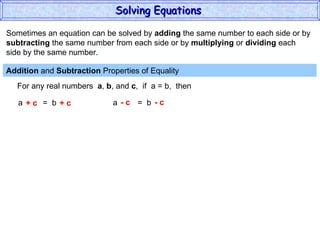
Sometimes an equation can be solved by  adding  the same number to each side or by subtracting  the same number from each side or by  multiplying  or  dividing  each  side by the same number. Addition  and  Subtraction  Properties of Equality  For any real numbers  a ,  b , and  c ,  if  a = b,  then a  =  b + c  + c a  =  b - c  - c Solving Equations
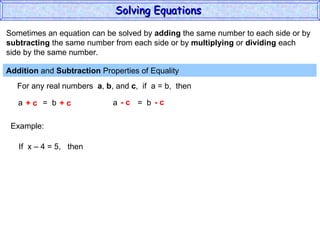
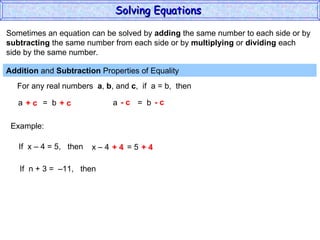
Sometimes an equation can be solved by  adding  the same number to each side or by subtracting  the same number from each side or by  multiplying  or  dividing  each  side by the same number. Addition  and  Subtraction  Properties of Equality  For any real numbers  a ,  b , and  c ,  if  a = b,  then a  =  b + c  + c a  =  b - c  - c Example: If  x – 4 = 5,  then Solving Equations
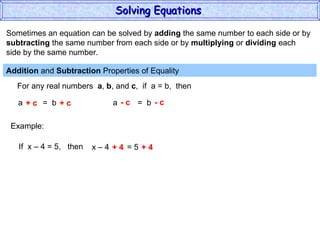
Sometimes an equation can be solved by  adding  the same number to each side or by subtracting  the same number from each side or by  multiplying  or  dividing  each  side by the same number. Addition  and  Subtraction  Properties of Equality  For any real numbers  a ,  b , and  c ,  if  a = b,  then a  =  b + c  + c a  =  b - c  - c Example: If  x – 4 = 5,  then x – 4  = 5 + 4  + 4 Solving Equations
Sometimes an equation can be solved by  adding  the same number to each side or by subtracting  the same number from each side or by  multiplying  or  dividing  each  side by the same number. Addition  and  Subtraction  Properties of Equality  For any real numbers  a ,  b , and  c ,  if  a = b,  then a  =  b + c  + c a  =  b - c  - c Example: If  x – 4 = 5,  then x – 4  = 5 + 4  + 4 If  n + 3 =  –11,  then Solving Equations
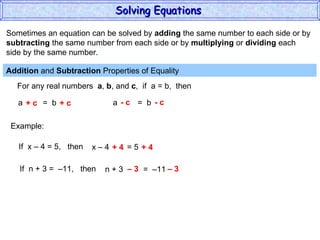
Sometimes an equation can be solved by  adding  the same number to each side or by subtracting  the same number from each side or by  multiplying  or  dividing  each  side by the same number. Addition  and  Subtraction  Properties of Equality  For any real numbers  a ,  b , and  c ,  if  a = b,  then a  =  b + c  + c a  =  b - c  - c Example: If  x – 4 = 5,  then x – 4  = 5 + 4  + 4 If  n + 3 =  –11,  then n + 3  =  –11 –  3  – 3 Solving Equations
Sometimes an equation can be solved by  adding  the same number to each side or by subtracting  the same number from each side or by  multiplying  or  dividing  each  side by the same number. Solving Equations
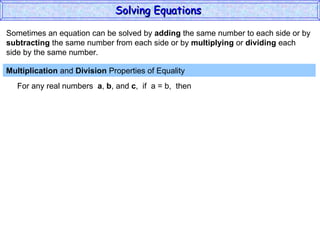
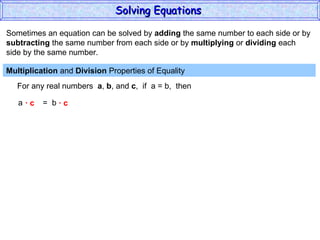
Sometimes an equation can be solved by  adding  the same number to each side or by subtracting  the same number from each side or by  multiplying  or  dividing  each  side by the same number. Multiplication  and  Division  Properties of Equality  For any real numbers  a ,  b , and  c ,  if  a = b,  then Solving Equations
Sometimes an equation can be solved by  adding  the same number to each side or by subtracting  the same number from each side or by  multiplying  or  dividing  each  side by the same number. Multiplication  and  Division  Properties of Equality  For any real numbers  a ,  b , and  c ,  if  a = b,  then a  =  b ·  c  ·  c Solving Equations
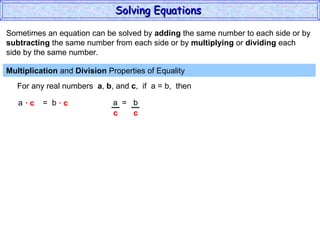
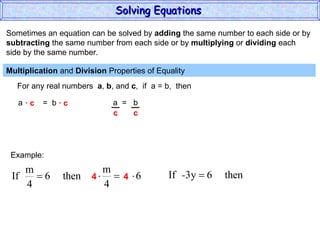
Sometimes an equation can be solved by  adding  the same number to each side or by subtracting  the same number from each side or by  multiplying  or  dividing  each  side by the same number. Multiplication  and  Division  Properties of Equality  For any real numbers  a ,  b , and  c ,  if  a = b,  then a  =  b ·  c  ·  c a  =  b Solving Equations  c  c
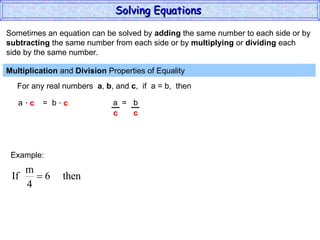
Sometimes an equation can be solved by  adding  the same number to each side or by subtracting  the same number from each side or by  multiplying  or  dividing  each  side by the same number. Multiplication  and  Division  Properties of Equality  For any real numbers  a ,  b , and  c ,  if  a = b,  then a  =  b ·  c  ·  c a  =  b Example: Solving Equations  c  c
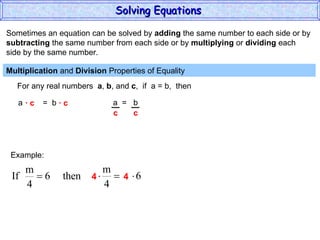
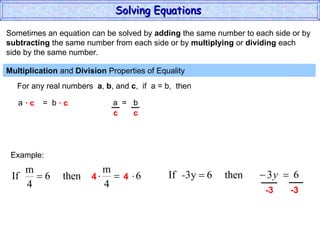
Sometimes an equation can be solved by  adding  the same number to each side or by subtracting  the same number from each side or by  multiplying  or  dividing  each  side by the same number. Multiplication  and  Division  Properties of Equality  For any real numbers  a ,  b , and  c ,  if  a = b,  then a  =  b ·  c  ·  c a  =  b Example: 4  4 Solving Equations  c  c
Sometimes an equation can be solved by  adding  the same number to each side or by subtracting  the same number from each side or by  multiplying  or  dividing  each  side by the same number. Multiplication  and  Division  Properties of Equality  For any real numbers  a ,  b , and  c ,  if  a = b,  then a  =  b ·  c  ·  c a  =  b Example: 4  4 Solving Equations  c  c - 3  -3
Java Applet – Solving Functions End  of  Lesson
Credits  PowerPoint created by Using Glencoe’s Algebra 2 text, © 2005 Robert Fant

Solving Equations (Algebra 2)

  • 1.
  • 2.
    You'll Learn To:Solving Equations Vocabulary 1) open sentence 2) equation 3) solution Translate verbal expressions into algebraic expression and equations and vice versa. Solve equations using the properties of equality.
  • 3.
    A mathematical sentence(expression) containing one or more variables is called an open sentence . Solving Equations
  • 4.
    A mathematical sentence(expression) containing one or more variables is called an open sentence . A mathematical sentence stating that two mathematical expressions are equal is called an _________. Solving Equations
  • 5.
    A mathematical sentence(expression) containing one or more variables is called an open sentence . A mathematical sentence stating that two mathematical expressions are equal is called an _________. equation Solving Equations
  • 6.
    A mathematical sentence(expression) containing one or more variables is called an open sentence . A mathematical sentence stating that two mathematical expressions are equal is called an _________. equation Open sentences are neither true nor false until the variables have been replaced by numbers. Solving Equations
  • 7.
    A mathematical sentence(expression) containing one or more variables is called an open sentence . A mathematical sentence stating that two mathematical expressions are equal is called an _________. equation Open sentences are neither true nor false until the variables have been replaced by numbers. Each replacement that results in a true statement is called a ________ of the open sentence. Solving Equations
  • 8.
    Solving Equations A mathematical sentence (expression) containing one or more variables is called an open sentence . A mathematical sentence stating that two mathematical expressions are equal is called an _________. equation Open sentences are neither true nor false until the variables have been replaced by numbers. Each replacement that results in a true statement is called a ________ of the open sentence. solution
  • 9.
    To solve equations,we can use properties of equality. Some of these equivalence relations are listed in the following table. Solving Equations
  • 10.
    To solve equations,we can use properties of equality. Some of these equivalence relations are listed in the following table. Reflexive Symmetric Transitive Substitution Solving Equations Properties of Equality Property Symbol Example
  • 11.
    To solve equations,we can use properties of equality. Some of these equivalence relations are listed in the following table. Reflexive Symmetric Transitive Substitution For any real number a , a = a , Solving Equations Properties of Equality Property Symbol Example
  • 12.
    To solve equations,we can use properties of equality. Some of these equivalence relations are listed in the following table. Reflexive Symmetric Transitive Substitution For any real number a , a = a , – 5 + y = – 5 + y Solving Equations Properties of Equality Property Symbol Example
  • 13.
    To solve equations,we can use properties of equality. Some of these equivalence relations are listed in the following table. Reflexive Symmetric Transitive Substitution For any real number a , a = a , For all real numbers a and b , If a = b, then b = a – 5 + y = – 5 + y Solving Equations Properties of Equality Property Symbol Example
  • 14.
    To solve equations,we can use properties of equality. Some of these equivalence relations are listed in the following table. Reflexive Symmetric Transitive Substitution For any real number a , a = a , For all real numbers a and b , If a = b, then b = a – 5 + y = – 5 + y If 3 = 5x – 6, then 5x – 6 = 3 Solving Equations Properties of Equality Property Symbol Example
  • 15.
    To solve equations,we can use properties of equality. Some of these equivalence relations are listed in the following table. Reflexive Symmetric Transitive Substitution For any real number a , a = a , For all real numbers a and b , If a = b, then For all real numbers a , b , and c . If a = b, and b = c, then b = a a = c – 5 + y = – 5 + y If 3 = 5x – 6, then 5x – 6 = 3 Solving Equations Properties of Equality Property Symbol Example
  • 16.
    To solve equations,we can use properties of equality. Some of these equivalence relations are listed in the following table. Reflexive Symmetric Transitive Substitution For any real number a , a = a , For all real numbers a and b , If a = b, then For all real numbers a , b , and c . If a = b, and b = c, then b = a a = c – 5 + y = – 5 + y If 3 = 5x – 6, then 5x – 6 = 3 If 2x + 1 = 7 and 7 = 5x – 8 then, 2x + 1 = 5x – 8 Solving Equations Properties of Equality Property Symbol Example
  • 17.
    To solve equations,we can use properties of equality. Some of these equivalence relations are listed in the following table. Reflexive Symmetric Transitive Substitution For any real number a , a = a , For all real numbers a and b , If a = b, then For all real numbers a , b , and c . If a = b, and b = c, then If a = b, then a may be replaced by b and b may be replaced by a. b = a a = c – 5 + y = – 5 + y If 3 = 5x – 6, then 5x – 6 = 3 If 2x + 1 = 7 and 7 = 5x – 8 then, 2x + 1 = 5x – 8 Solving Equations Properties of Equality Property Symbol Example
  • 18.
    To solve equations,we can use properties of equality. Some of these equivalence relations are listed in the following table. Reflexive Symmetric Transitive Substitution For any real number a , a = a , For all real numbers a and b , If a = b, then For all real numbers a , b , and c . If a = b, and b = c, then If a = b, then a may be replaced by b and b may be replaced by a. b = a a = c – 5 + y = – 5 + y If 3 = 5x – 6, then 5x – 6 = 3 If 2x + 1 = 7 and 7 = 5x – 8 then, 2x + 1 = 5x – 8 If (4 + 5) m = 18 then 9m = 18 Solving Equations Properties of Equality Property Symbol Example
  • 19.
    Sometimes an equationcan be solved by adding the same number to each side or by subtracting the same number from each side or by multiplying or dividing each side by the same number. Solving Equations
  • 20.
    Sometimes an equationcan be solved by adding the same number to each side or by subtracting the same number from each side or by multiplying or dividing each side by the same number. Addition and Subtraction Properties of Equality For any real numbers a , b , and c , if a = b, then Solving Equations
  • 21.
    Sometimes an equationcan be solved by adding the same number to each side or by subtracting the same number from each side or by multiplying or dividing each side by the same number. Addition and Subtraction Properties of Equality For any real numbers a , b , and c , if a = b, then a = b + c + c Solving Equations
  • 22.
    Sometimes an equationcan be solved by adding the same number to each side or by subtracting the same number from each side or by multiplying or dividing each side by the same number. Addition and Subtraction Properties of Equality For any real numbers a , b , and c , if a = b, then a = b + c + c a = b - c - c Solving Equations
  • 23.
    Sometimes an equationcan be solved by adding the same number to each side or by subtracting the same number from each side or by multiplying or dividing each side by the same number. Addition and Subtraction Properties of Equality For any real numbers a , b , and c , if a = b, then a = b + c + c a = b - c - c Example: If x – 4 = 5, then Solving Equations
  • 24.
    Sometimes an equationcan be solved by adding the same number to each side or by subtracting the same number from each side or by multiplying or dividing each side by the same number. Addition and Subtraction Properties of Equality For any real numbers a , b , and c , if a = b, then a = b + c + c a = b - c - c Example: If x – 4 = 5, then x – 4 = 5 + 4 + 4 Solving Equations
  • 25.
    Sometimes an equationcan be solved by adding the same number to each side or by subtracting the same number from each side or by multiplying or dividing each side by the same number. Addition and Subtraction Properties of Equality For any real numbers a , b , and c , if a = b, then a = b + c + c a = b - c - c Example: If x – 4 = 5, then x – 4 = 5 + 4 + 4 If n + 3 = –11, then Solving Equations
  • 26.
    Sometimes an equationcan be solved by adding the same number to each side or by subtracting the same number from each side or by multiplying or dividing each side by the same number. Addition and Subtraction Properties of Equality For any real numbers a , b , and c , if a = b, then a = b + c + c a = b - c - c Example: If x – 4 = 5, then x – 4 = 5 + 4 + 4 If n + 3 = –11, then n + 3 = –11 – 3 – 3 Solving Equations
  • 27.
    Sometimes an equationcan be solved by adding the same number to each side or by subtracting the same number from each side or by multiplying or dividing each side by the same number. Solving Equations
  • 28.
    Sometimes an equationcan be solved by adding the same number to each side or by subtracting the same number from each side or by multiplying or dividing each side by the same number. Multiplication and Division Properties of Equality For any real numbers a , b , and c , if a = b, then Solving Equations
  • 29.
    Sometimes an equationcan be solved by adding the same number to each side or by subtracting the same number from each side or by multiplying or dividing each side by the same number. Multiplication and Division Properties of Equality For any real numbers a , b , and c , if a = b, then a = b · c · c Solving Equations
  • 30.
    Sometimes an equationcan be solved by adding the same number to each side or by subtracting the same number from each side or by multiplying or dividing each side by the same number. Multiplication and Division Properties of Equality For any real numbers a , b , and c , if a = b, then a = b · c · c a = b Solving Equations c c
  • 31.
    Sometimes an equationcan be solved by adding the same number to each side or by subtracting the same number from each side or by multiplying or dividing each side by the same number. Multiplication and Division Properties of Equality For any real numbers a , b , and c , if a = b, then a = b · c · c a = b Example: Solving Equations c c
  • 32.
    Sometimes an equationcan be solved by adding the same number to each side or by subtracting the same number from each side or by multiplying or dividing each side by the same number. Multiplication and Division Properties of Equality For any real numbers a , b , and c , if a = b, then a = b · c · c a = b Example: 4 4 Solving Equations c c
  • 33.
    Sometimes an equationcan be solved by adding the same number to each side or by subtracting the same number from each side or by multiplying or dividing each side by the same number. Multiplication and Division Properties of Equality For any real numbers a , b , and c , if a = b, then a = b · c · c a = b Example: 4 4 Solving Equations c c
  • 34.
    Sometimes an equationcan be solved by adding the same number to each side or by subtracting the same number from each side or by multiplying or dividing each side by the same number. Multiplication and Division Properties of Equality For any real numbers a , b , and c , if a = b, then a = b · c · c a = b Example: 4 4 Solving Equations c c - 3 -3
  • 35.
    Java Applet –Solving Functions End of Lesson
  • 36.
    Credits PowerPointcreated by Using Glencoe’s Algebra 2 text, © 2005 Robert Fant