Identity & Equality Properties 1-4
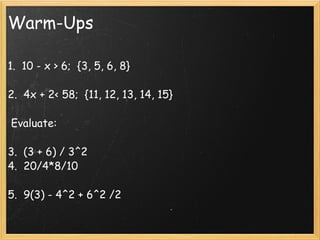
Warm-Ups 1.  10 - x > 6;  {3, 5, 6, 8} 2.  4x + 2< 58;  {11, 12, 13, 14, 15}   Evaluate:  3.  (3 + 6) / 3^2   4.  20/4*8/10   5.  9(3) - 4^2 + 6^2 /2
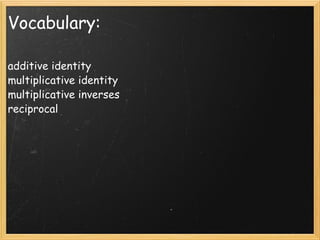
Vocabulary: additive identity multiplicative identity multiplicative inverses reciprocal
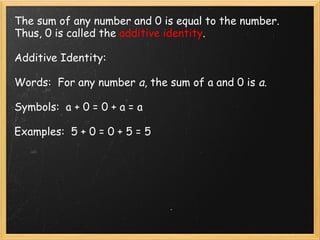
The sum of any number and 0 is equal to the number.  Thus, 0 is called the  additive identity . Additive Identity: Words:  For any number  a , the sum of a and 0 is  a . Symbols:  a + 0 = 0 + a = a Examples:  5 + 0 = 0 + 5 = 5
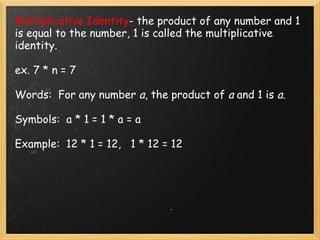
Multiplicative Identity - the product of any number and 1 is equal to the number, 1 is called the multiplicative identity. ex. 7 * n = 7 Words:  For any number  a , the product of  a  and 1 is  a . Symbols:  a * 1 = 1 * a = a Example:  12 * 1 = 12,   1 * 12 = 12
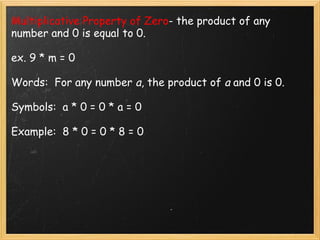
Multiplicative Property of Zero - the product of any number and 0 is equal to 0. ex. 9 * m = 0 Words:  For any number  a , the product of  a  and 0 is 0. Symbols:  a * 0 = 0 * a = 0 Example:  8 * 0 = 0 * 8 = 0
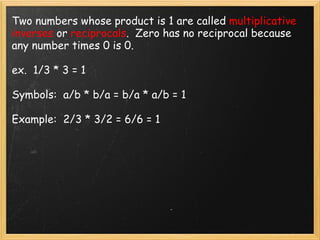
Two numbers whose product is 1 are called  multiplicative inverses  or  reciprocals .  Zero has no reciprocal because any number times 0 is 0. ex.  1/3 * 3 = 1 Symbols:  a/b * b/a = b/a * a/b = 1 Example:  2/3 * 3/2 = 6/6 = 1
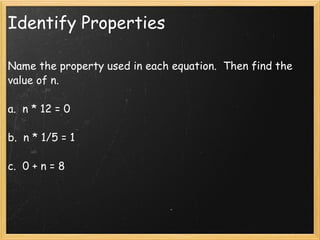
Identify Properties Name the property used in each equation.  Then find the value of n. a.  n * 12 = 0 b.  n * 1/5 = 1 c.  0 + n = 8
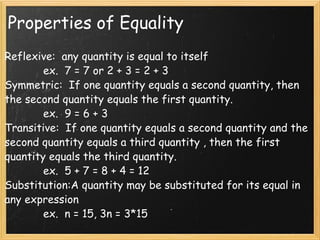
Properties of Equality Reflexive:  any quantity is equal to itself              ex.  7 = 7 or 2 + 3 = 2 + 3 Symmetric:  If one quantity equals a second quantity, then the second quantity equals the first quantity.              ex.  9 = 6 + 3 Transitive:  If one quantity equals a second quantity and the second quantity equals a third quantity , then the first quantity equals the third quantity.              ex.  5 + 7 = 8 + 4 = 12 Substitution:A quantity may be substituted for its equal in any expression                ex.  n = 15, 3n = 3*15
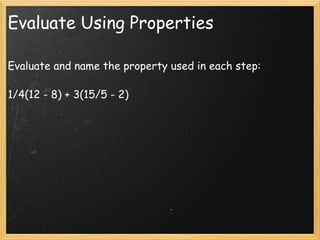
Evaluate Using Properties Evaluate and name the property used in each step: 1/4(12 - 8) + 3(15/5 - 2)
Glencoe/McGraw-Hill 2003

Identity equality properties

  • 1.
    Identity & EqualityProperties 1-4
  • 2.
    Warm-Ups 1.  10- x > 6;  {3, 5, 6, 8} 2.  4x + 2< 58;  {11, 12, 13, 14, 15}   Evaluate: 3.  (3 + 6) / 3^2  4.  20/4*8/10   5.  9(3) - 4^2 + 6^2 /2
  • 3.
    Vocabulary: additive identitymultiplicative identity multiplicative inverses reciprocal
  • 4.
    The sum ofany number and 0 is equal to the number.  Thus, 0 is called the additive identity . Additive Identity: Words:  For any number a , the sum of a and 0 is a . Symbols:  a + 0 = 0 + a = a Examples:  5 + 0 = 0 + 5 = 5
  • 5.
    Multiplicative Identity -the product of any number and 1 is equal to the number, 1 is called the multiplicative identity. ex. 7 * n = 7 Words:  For any number a , the product of a and 1 is a . Symbols:  a * 1 = 1 * a = a Example:  12 * 1 = 12,   1 * 12 = 12
  • 6.
    Multiplicative Property ofZero - the product of any number and 0 is equal to 0. ex. 9 * m = 0 Words:  For any number a , the product of a and 0 is 0. Symbols:  a * 0 = 0 * a = 0 Example:  8 * 0 = 0 * 8 = 0
  • 7.
    Two numbers whoseproduct is 1 are called multiplicative inverses or reciprocals .  Zero has no reciprocal because any number times 0 is 0. ex.  1/3 * 3 = 1 Symbols:  a/b * b/a = b/a * a/b = 1 Example:  2/3 * 3/2 = 6/6 = 1
  • 8.
    Identify Properties Namethe property used in each equation.  Then find the value of n. a.  n * 12 = 0 b.  n * 1/5 = 1 c.  0 + n = 8
  • 9.
    Properties of EqualityReflexive:  any quantity is equal to itself             ex.  7 = 7 or 2 + 3 = 2 + 3 Symmetric:  If one quantity equals a second quantity, then the second quantity equals the first quantity.             ex.  9 = 6 + 3 Transitive:  If one quantity equals a second quantity and the second quantity equals a third quantity , then the first quantity equals the third quantity.             ex.  5 + 7 = 8 + 4 = 12 Substitution:A quantity may be substituted for its equal in any expression              ex.  n = 15, 3n = 3*15
  • 10.
    Evaluate Using PropertiesEvaluate and name the property used in each step: 1/4(12 - 8) + 3(15/5 - 2)
  • 11.