INTRODUCTION TO STEM CELL
TECHNOLOGY
I. What are Stem Cells
1. Stem cells differ from other kinds of cells in
the body.
2. All stem cells regardless of their source have
three general properites.
a. Capable of dividing and renewing themselves for
long periods.
b. They are unspecialized.
c. They can give rise to specialized cell types.
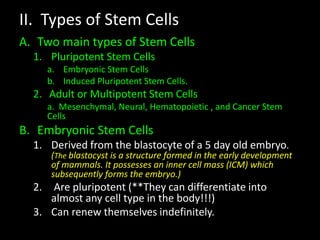
II. Types of Stem Cells
A. Two main types of Stem Cells
1. Pluripotent Stem Cells
a. Embryonic Stem Cells
b. Induced Pluripotent Stem Cells.
2. Adult or Multipotent Stem Cells
a. Mesenchymal, Neural, Hematopoietic , and Cancer Stem
Cells
B. Embryonic Stem Cells
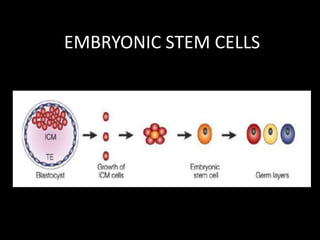
1. Derived from the blastocyte of a 5 day old embryo.
(The blastocyst is a structure formed in the early development
of mammals. It possesses an inner cell mass (ICM) which
subsequently forms the embryo.)
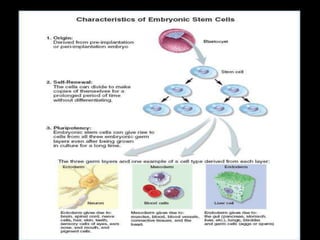
2. Are pluripotent (**They can differentiate into
almost any cell type in the body!!!)
3. Can renew themselves indefinitely.
EMBRYONIC STEM CELLS
C. Induced Pluripotent Stem Cells(iPSC’s)
1. Generated from reprogrammed somatic cells.
2. Similar or equivalent to ESC’s; they are also
pluripotent and the ability to renew themselves
indefinitely.
D. Adult Stem Cells (ex. MSCs, NSCs, ADSCs)
1. Isolated from adult tissues, organs or blood,
umbilical cord blood, etc.
2. Are multipotent- They can give rise to a number
of RELATED cell types.
3. Can renew themselves a number of times but
NOT INDEFINITELY.
**We will discuss the examples later in the notes!!!
II. Embryonic Stem Cells
A. Embryonic Stem Cell
1. Derived from the inner cell mass (ICM) fo the
blastocyte, an early-stage embryo.
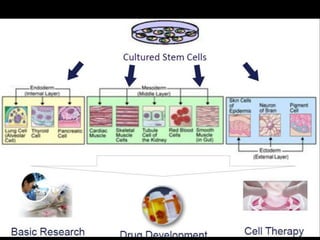
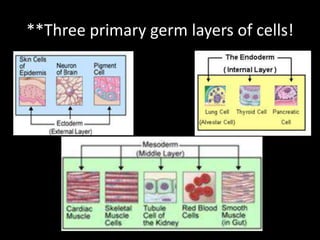
2. ESCs are able to differentiate into all derivatives
of the three primary germ layers which include
each of the more than 220 cell types in the adult
body.
3. Have a broad application base in basic research,
drug discovery, and cell therapy.
**Three primary germ layers of cells!
Do some RESEARCH!!
• In January 2009, Phase I clinical trials for
transplantation of oligodendrocytes derived
from human Embryonic Stem cells into spinal
cord-injured individuals receiving approval
from the FDA, marking it the worlds first ES
cell human trial.
• Go online and see if you can find any
information on the latest Embryonic Stem
Cell (ESC) clinical trials!!!!!
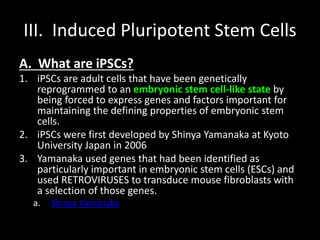
III. Induced Pluripotent Stem Cells
A. What are iPSCs?
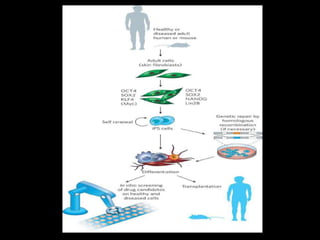
1. iPSCs are adult cells that have been genetically
reprogrammed to an embryonic stem cell-like state by
being forced to express genes and factors important for
maintaining the defining properties of embryonic stem
cells.
2. iPSCs were first developed by Shinya Yamanaka at Kyoto
University Japan in 2006
3. Yamanaka used genes that had been identified as
particularly important in embryonic stem cells (ESCs) and
used RETROVIRUSES to transduce mouse fibroblasts with
a selection of those genes.
a. Shinya Yamanaka
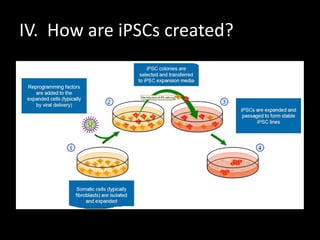
IV. How are iPSCs created?
V. Why are iPSCs important???
A. iPSC cell research allows
1. Both wild-type and disease specific pluripotent
cells to e derived from accessible tissue sources.
B. iPSC cells will help researchers
1. Create genetic models for disease
2. Understand molecular controls influencing cell
development.
V. Why are iPSCs important???
C. iPS cells hold the promise of:
1. Reducing drug development times.
2. Improving drug safety
3. Bringing us closer to PERSONALIZED MEDICINE
and specific PERSONALIZED targeted therapies
VI. Adult Stem Cells
A. Mesenchymal Stem Cells (MSCs)
1. Also called bone marrow stromal cells, are
MULTIPOTENT stem cells that differentiate into a
variety of cell types including:
a. Osteoblasts (bone cells)
b. Chondrocytes (cartilage cells)
c. Adipocytes (fat cells)
VI. Adult Stem Cells
A. Mesenchymal Stem Cells (MSCs)
2. Human MSCs are of interest in clinical
applications due to:
a. Wide range differentiation potential.
b. Immunosuppressive attributes.
3. Potential MSC Therapies.
a. Crohn’s Disease
b. Bone defects/Genetic Disease
c. Cardiac Repair
d. Trachea Repair
VI. Adult Stem Cells
B. Hematopoietic Stem Cells (HSCs)
1. HSCs are multipotent stem cells that give rise to all
the blood cell types.
2. The average human requires approximately one
hundred billion new hematopoietic cells each day.
3. The continued production of these cells depends
directly on the presence of HSCs, the ultimate, and
only, source of all these cells.
4. HSC transplants are now routinely used to treat
patients with cancers and other disorders of the
blood and immune systems.
VI. Adult Stem Cells
C. Neural Stem Cells (NSCs)
1. Are multipotent stem cells
2. Derived from brain tissue or differentiated from
pluripotent stem cells.
3. NSC research is currently focused on methods to
repair damage from degenerative diseases such
as Parkinson’s Disease and ALS (Lou Gherig’s
disease), as well as from brain and spinal cord
injuries resulting from stroke or trauma.
VI. Adult Stem Cells
D. Cancer Stem Cells(CSCs)
1. Found within tumors that possess characterisitics
associated with normal stem cells, specifically
the ability to give rise to all cell types found in a
particular cancer sample.
2. Current CSC theory states that if current
treatments of cancer do not properly destroy
enough CSCs the tumor will reappear.
3. Found in brain, breast, colon, ovary, pancreas,
prostate, and melanoma cancer cells.
VII. SUMMARY OF STEM CELLS!
A. All stem cells-regardless of their source- have
THREE general properties!
1. They are capable of dividing and renewing
themselves for long periods of time.
2. They are unspecialized
3. They can then give rise to a specialized cell type.
VII. SUMMARY OF STEM CELLS!
B. There are TWO main types of Stem Cells!!!
1. PLURIPOTENT STEM CELLS
a. Embryonic Stem Cells (ESCs)
b. Induced Pluripotent Stem Cells (iPSCs)
2. Adult or Multipotent Stem Cells
a. Mesenchymal Stem Cells (MSCs)
b. Neural Stem Cells (NSCs)
c. Hematopoietic Stem Cells (HSCs)
d. Cancer Stem Cells (CSCs)
VII. SUMMARY OF STEM CELLS!
C. Stem Cells have Application in:
1. Basic Research
2. Drug Discovery
3. Cell Therapy
4. Personalizing Medicine

Introduction to stem cell notes

  • 1.
    INTRODUCTION TO STEMCELL TECHNOLOGY
  • 2.
    I. What areStem Cells 1. Stem cells differ from other kinds of cells in the body. 2. All stem cells regardless of their source have three general properites. a. Capable of dividing and renewing themselves for long periods. b. They are unspecialized. c. They can give rise to specialized cell types.
  • 4.
    II. Types ofStem Cells A. Two main types of Stem Cells 1. Pluripotent Stem Cells a. Embryonic Stem Cells b. Induced Pluripotent Stem Cells. 2. Adult or Multipotent Stem Cells a. Mesenchymal, Neural, Hematopoietic , and Cancer Stem Cells B. Embryonic Stem Cells 1. Derived from the blastocyte of a 5 day old embryo. (The blastocyst is a structure formed in the early development of mammals. It possesses an inner cell mass (ICM) which subsequently forms the embryo.) 2. Are pluripotent (**They can differentiate into almost any cell type in the body!!!) 3. Can renew themselves indefinitely.
  • 5.
  • 6.
    C. Induced PluripotentStem Cells(iPSC’s) 1. Generated from reprogrammed somatic cells. 2. Similar or equivalent to ESC’s; they are also pluripotent and the ability to renew themselves indefinitely.
  • 7.
    D. Adult StemCells (ex. MSCs, NSCs, ADSCs) 1. Isolated from adult tissues, organs or blood, umbilical cord blood, etc. 2. Are multipotent- They can give rise to a number of RELATED cell types. 3. Can renew themselves a number of times but NOT INDEFINITELY. **We will discuss the examples later in the notes!!!
  • 8.
    II. Embryonic StemCells A. Embryonic Stem Cell 1. Derived from the inner cell mass (ICM) fo the blastocyte, an early-stage embryo. 2. ESCs are able to differentiate into all derivatives of the three primary germ layers which include each of the more than 220 cell types in the adult body. 3. Have a broad application base in basic research, drug discovery, and cell therapy.
  • 9.
    **Three primary germlayers of cells!
  • 11.
    Do some RESEARCH!! •In January 2009, Phase I clinical trials for transplantation of oligodendrocytes derived from human Embryonic Stem cells into spinal cord-injured individuals receiving approval from the FDA, marking it the worlds first ES cell human trial. • Go online and see if you can find any information on the latest Embryonic Stem Cell (ESC) clinical trials!!!!!
  • 12.
    III. Induced PluripotentStem Cells A. What are iPSCs? 1. iPSCs are adult cells that have been genetically reprogrammed to an embryonic stem cell-like state by being forced to express genes and factors important for maintaining the defining properties of embryonic stem cells. 2. iPSCs were first developed by Shinya Yamanaka at Kyoto University Japan in 2006 3. Yamanaka used genes that had been identified as particularly important in embryonic stem cells (ESCs) and used RETROVIRUSES to transduce mouse fibroblasts with a selection of those genes. a. Shinya Yamanaka
  • 14.
    IV. How areiPSCs created?
  • 15.
    V. Why areiPSCs important??? A. iPSC cell research allows 1. Both wild-type and disease specific pluripotent cells to e derived from accessible tissue sources. B. iPSC cells will help researchers 1. Create genetic models for disease 2. Understand molecular controls influencing cell development.
  • 16.
    V. Why areiPSCs important??? C. iPS cells hold the promise of: 1. Reducing drug development times. 2. Improving drug safety 3. Bringing us closer to PERSONALIZED MEDICINE and specific PERSONALIZED targeted therapies
  • 17.
    VI. Adult StemCells A. Mesenchymal Stem Cells (MSCs) 1. Also called bone marrow stromal cells, are MULTIPOTENT stem cells that differentiate into a variety of cell types including: a. Osteoblasts (bone cells) b. Chondrocytes (cartilage cells) c. Adipocytes (fat cells)
  • 18.
    VI. Adult StemCells A. Mesenchymal Stem Cells (MSCs) 2. Human MSCs are of interest in clinical applications due to: a. Wide range differentiation potential. b. Immunosuppressive attributes. 3. Potential MSC Therapies. a. Crohn’s Disease b. Bone defects/Genetic Disease c. Cardiac Repair d. Trachea Repair
  • 19.
    VI. Adult StemCells B. Hematopoietic Stem Cells (HSCs) 1. HSCs are multipotent stem cells that give rise to all the blood cell types. 2. The average human requires approximately one hundred billion new hematopoietic cells each day. 3. The continued production of these cells depends directly on the presence of HSCs, the ultimate, and only, source of all these cells. 4. HSC transplants are now routinely used to treat patients with cancers and other disorders of the blood and immune systems.
  • 20.
    VI. Adult StemCells C. Neural Stem Cells (NSCs) 1. Are multipotent stem cells 2. Derived from brain tissue or differentiated from pluripotent stem cells. 3. NSC research is currently focused on methods to repair damage from degenerative diseases such as Parkinson’s Disease and ALS (Lou Gherig’s disease), as well as from brain and spinal cord injuries resulting from stroke or trauma.
  • 21.
    VI. Adult StemCells D. Cancer Stem Cells(CSCs) 1. Found within tumors that possess characterisitics associated with normal stem cells, specifically the ability to give rise to all cell types found in a particular cancer sample. 2. Current CSC theory states that if current treatments of cancer do not properly destroy enough CSCs the tumor will reappear. 3. Found in brain, breast, colon, ovary, pancreas, prostate, and melanoma cancer cells.
  • 22.
    VII. SUMMARY OFSTEM CELLS! A. All stem cells-regardless of their source- have THREE general properties! 1. They are capable of dividing and renewing themselves for long periods of time. 2. They are unspecialized 3. They can then give rise to a specialized cell type.
  • 23.
    VII. SUMMARY OFSTEM CELLS! B. There are TWO main types of Stem Cells!!! 1. PLURIPOTENT STEM CELLS a. Embryonic Stem Cells (ESCs) b. Induced Pluripotent Stem Cells (iPSCs) 2. Adult or Multipotent Stem Cells a. Mesenchymal Stem Cells (MSCs) b. Neural Stem Cells (NSCs) c. Hematopoietic Stem Cells (HSCs) d. Cancer Stem Cells (CSCs)
  • 24.
    VII. SUMMARY OFSTEM CELLS! C. Stem Cells have Application in: 1. Basic Research 2. Drug Discovery 3. Cell Therapy 4. Personalizing Medicine