What are stem cells?
● Stem cells are unspecialized cells of the human body.
● They can transform and/or multiply into specialized cells.
● Through a laboratory procedure known as differentiation stem cells
procured from one part of the body can become/grow into other kinds
of cells.
● They work to repair the body by generating healthy cells that can
replace the cells damaged by disease.
The Four Types of Stem Cells
● Embryonic Stem Cells (ESCs)
● Adult Stem Cells (ASCs)
● Induced Pluripotent Stem Cells (iPSCs)
● Mesenchymal Stem Cells (MSCs)
Embryonic Stem Cells (ESCs)
● Derived from unused embryos that are from an IVF procedure
● Derived from the inner cell mass of an embryo in its early stages of
development
● Typically grown in laboratory conditions
● Have self-renewing potential
● Can differentiate into clinically relevant cell types like dopamine
neurons, cardiomyocytes, beta cells, etc
● Do not have any specific characteristics like shape, or gene
expression pattern
Ban on ECS in 2001
Former US President George W. Bush put a ban on the funding
of research on stem cells derived from human embryos because
it involved the ‘destruction of human life.
Adult Stem Cells (ASCs)
● Undifferentiated cells Procured from fully developed tissues
like the brain, bone marrow, etc
● Multipotent cells (limited ability to differentiate into other
types of cells)
● Essential for maintaining the integrity of the tissue in which
they are found
● May be used for tissue repair and regenerative medicine,
like stem cell therapy
Induced Pluripotent Stem Cells (iPSCs)
● First developed by Japanese physician and researcher Shinya
Yamanaka in 2006
● Derived from blood cells
● Genetically reprogrammed to exhibit the characteristics of
embryonic stem cells
● Generated by introducing specific types of genes into adult cells
● Can self-renew and also differentiate into any cell type in the body
● Reduced risk of immune rejection (iPSCs are sourced from the
patient’s own cells
Mesenchymal Stem Cells (MSCs)
● First found in the bone marrow
● Capable of making bone, cartilage, and even fat cells
● Similar to adult stem cells
● Possess anti-inflammatory, immunomodulatory, self-renewal, cell-
division, signaling, and differentiation properties
● Can divide and develop into many specialized cell types in specific
organs and/or tissues
● Can become unique stem cell types and create more stem cells
when cultured in a lab
● Can replace cells that are diseased or damaged
Mesenchymal stem cell transplantation can help slow down the
rate of degeneration caused by MND, Parkinson’s and other illnesses.
Source of MSCs
● Umbilical cord
● Bone marrow
● Adipose tissue
● Peripheral blood
● Placental tissue
● Synovial fluid (present in joints)
● Dental pulp
MSCs may also be derived from endometrial polyps and menses blood.
Differentiation properties of MSCs
MSCs can differentiate into a variety of cell types like -
● Osteoblasts (bone cells)
● Adipocytes (fat cells)
● Chondrocytes (cartilage cells)
Research suggests MSCs can also differentiate into -
● Epithelial cells (found inner and outer surfaces of your body)
● Endothelial cells (found in blood vessels)
● Neurocytes (nerve cells)
● Myocytes (muscle cells)
● Cardiomyocytes (heart muscle cells)
● Hepatocyte (liver cells)
● Pancreatic cells
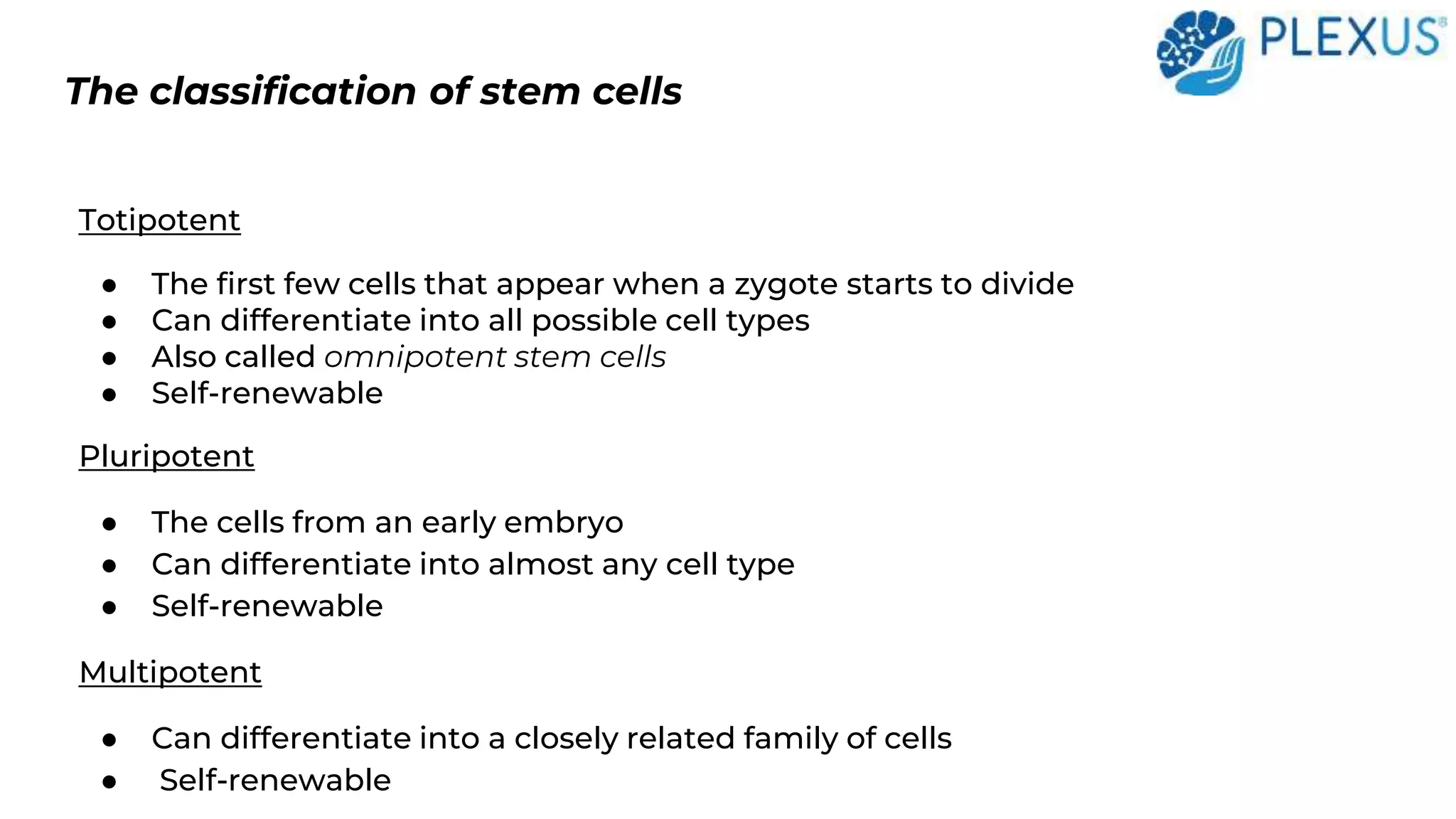
The classification of stem cells
Totipotent
● The first few cells that appear when a zygote starts to divide
● Can differentiate into all possible cell types
● Also called omnipotent stem cells
● Self-renewable
Pluripotent
● The cells from an early embryo
● Can differentiate into almost any cell type
● Self-renewable
Multipotent
● Can differentiate into a closely related family of cells
● Self-renewable
The classification of stem cells
Oligopotent
● Adult lymphoid and myeloid stem cells
● Can differentiate into a few different types
of cells
● Self-renewable
Unipotent
● Can only produce their own type of cells
● Self-renewable
Types of stem cell therapy
Autologous therapy
● Cells are procured from patient’s own
bone marrow, blood, or fat tissue
Allogeneic therapy
● Cells are procured from external donors
Administering stem cells
Stem cells can be administered in the following
ways:
● Intravenous
● Intrathecal (directly into the spinal canal)
● Inject into problem areas like hips, hands,
knees, etc.
Stem cell therapy at India’s first ISO-Certified Stem Cell Research
Center
● Plexus Neuro and Stem Cell Research Centre uses autologous
mesenchymal stem cells.
● The procedure is conducted by Dr. Sadiq, India’s no. 1 stem cell
specialist, and his team of highly-skilled and experienced stem cell
specialists.
Book an appointment with us today.
Call +91 89048 42087 | 080-2546 0886
080-2547 0886 | 080-2549 0886

Types Of Stem Cells.pptx

  • 2.
    What are stemcells? ● Stem cells are unspecialized cells of the human body. ● They can transform and/or multiply into specialized cells. ● Through a laboratory procedure known as differentiation stem cells procured from one part of the body can become/grow into other kinds of cells. ● They work to repair the body by generating healthy cells that can replace the cells damaged by disease.
  • 3.
    The Four Typesof Stem Cells ● Embryonic Stem Cells (ESCs) ● Adult Stem Cells (ASCs) ● Induced Pluripotent Stem Cells (iPSCs) ● Mesenchymal Stem Cells (MSCs)
  • 4.
    Embryonic Stem Cells(ESCs) ● Derived from unused embryos that are from an IVF procedure ● Derived from the inner cell mass of an embryo in its early stages of development ● Typically grown in laboratory conditions ● Have self-renewing potential ● Can differentiate into clinically relevant cell types like dopamine neurons, cardiomyocytes, beta cells, etc ● Do not have any specific characteristics like shape, or gene expression pattern
  • 5.
    Ban on ECSin 2001 Former US President George W. Bush put a ban on the funding of research on stem cells derived from human embryos because it involved the ‘destruction of human life.
  • 6.
    Adult Stem Cells(ASCs) ● Undifferentiated cells Procured from fully developed tissues like the brain, bone marrow, etc ● Multipotent cells (limited ability to differentiate into other types of cells) ● Essential for maintaining the integrity of the tissue in which they are found ● May be used for tissue repair and regenerative medicine, like stem cell therapy
  • 7.
    Induced Pluripotent StemCells (iPSCs) ● First developed by Japanese physician and researcher Shinya Yamanaka in 2006 ● Derived from blood cells ● Genetically reprogrammed to exhibit the characteristics of embryonic stem cells ● Generated by introducing specific types of genes into adult cells ● Can self-renew and also differentiate into any cell type in the body ● Reduced risk of immune rejection (iPSCs are sourced from the patient’s own cells
  • 8.
    Mesenchymal Stem Cells(MSCs) ● First found in the bone marrow ● Capable of making bone, cartilage, and even fat cells ● Similar to adult stem cells ● Possess anti-inflammatory, immunomodulatory, self-renewal, cell- division, signaling, and differentiation properties ● Can divide and develop into many specialized cell types in specific organs and/or tissues ● Can become unique stem cell types and create more stem cells when cultured in a lab ● Can replace cells that are diseased or damaged Mesenchymal stem cell transplantation can help slow down the rate of degeneration caused by MND, Parkinson’s and other illnesses.
  • 9.
    Source of MSCs ●Umbilical cord ● Bone marrow ● Adipose tissue ● Peripheral blood ● Placental tissue ● Synovial fluid (present in joints) ● Dental pulp MSCs may also be derived from endometrial polyps and menses blood.
  • 10.
    Differentiation properties ofMSCs MSCs can differentiate into a variety of cell types like - ● Osteoblasts (bone cells) ● Adipocytes (fat cells) ● Chondrocytes (cartilage cells) Research suggests MSCs can also differentiate into - ● Epithelial cells (found inner and outer surfaces of your body) ● Endothelial cells (found in blood vessels) ● Neurocytes (nerve cells) ● Myocytes (muscle cells) ● Cardiomyocytes (heart muscle cells) ● Hepatocyte (liver cells) ● Pancreatic cells
  • 11.
    The classification ofstem cells Totipotent ● The first few cells that appear when a zygote starts to divide ● Can differentiate into all possible cell types ● Also called omnipotent stem cells ● Self-renewable Pluripotent ● The cells from an early embryo ● Can differentiate into almost any cell type ● Self-renewable Multipotent ● Can differentiate into a closely related family of cells ● Self-renewable
  • 12.
    The classification ofstem cells Oligopotent ● Adult lymphoid and myeloid stem cells ● Can differentiate into a few different types of cells ● Self-renewable Unipotent ● Can only produce their own type of cells ● Self-renewable
  • 13.
    Types of stemcell therapy Autologous therapy ● Cells are procured from patient’s own bone marrow, blood, or fat tissue Allogeneic therapy ● Cells are procured from external donors
  • 14.
    Administering stem cells Stemcells can be administered in the following ways: ● Intravenous ● Intrathecal (directly into the spinal canal) ● Inject into problem areas like hips, hands, knees, etc.
  • 15.
    Stem cell therapyat India’s first ISO-Certified Stem Cell Research Center ● Plexus Neuro and Stem Cell Research Centre uses autologous mesenchymal stem cells. ● The procedure is conducted by Dr. Sadiq, India’s no. 1 stem cell specialist, and his team of highly-skilled and experienced stem cell specialists. Book an appointment with us today. Call +91 89048 42087 | 080-2546 0886 080-2547 0886 | 080-2549 0886