CSI Training
Firearms and Toolmarks
STEM: CSI Experience Activity
Supplemental Notes
CSI-Firearms and Toolmarks
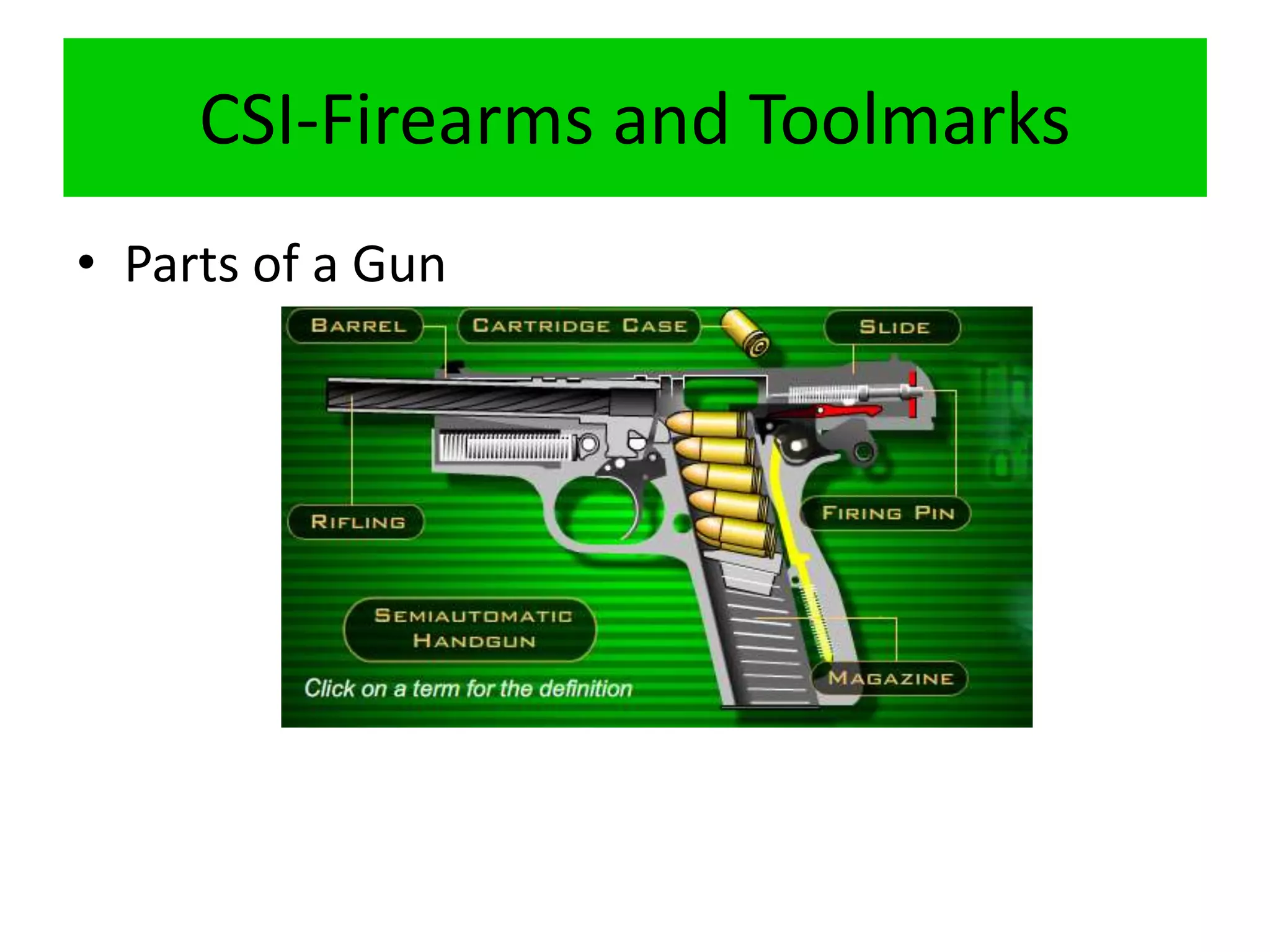
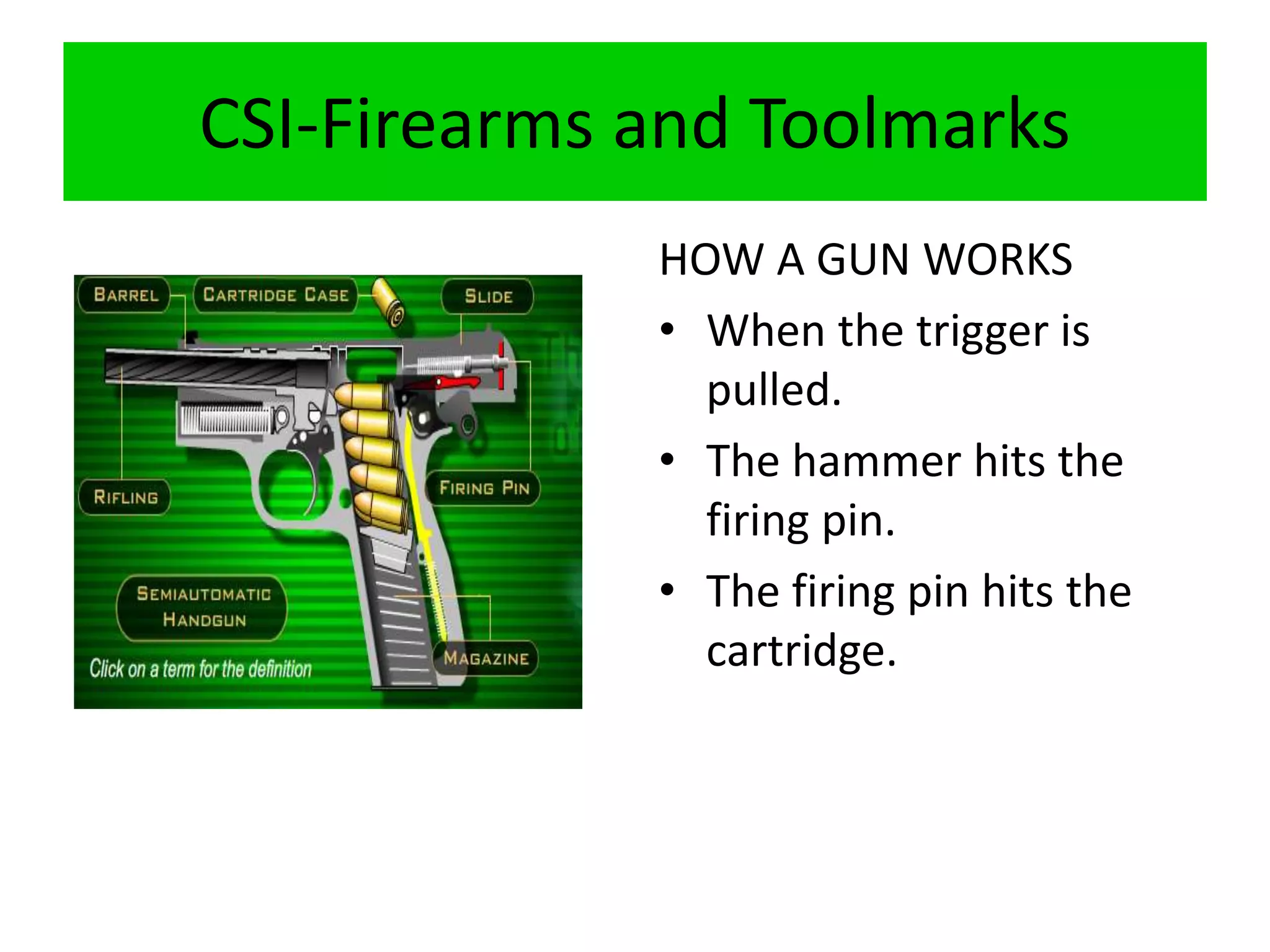
• Parts of a Gun
CSI-Firearms and Toolmarks
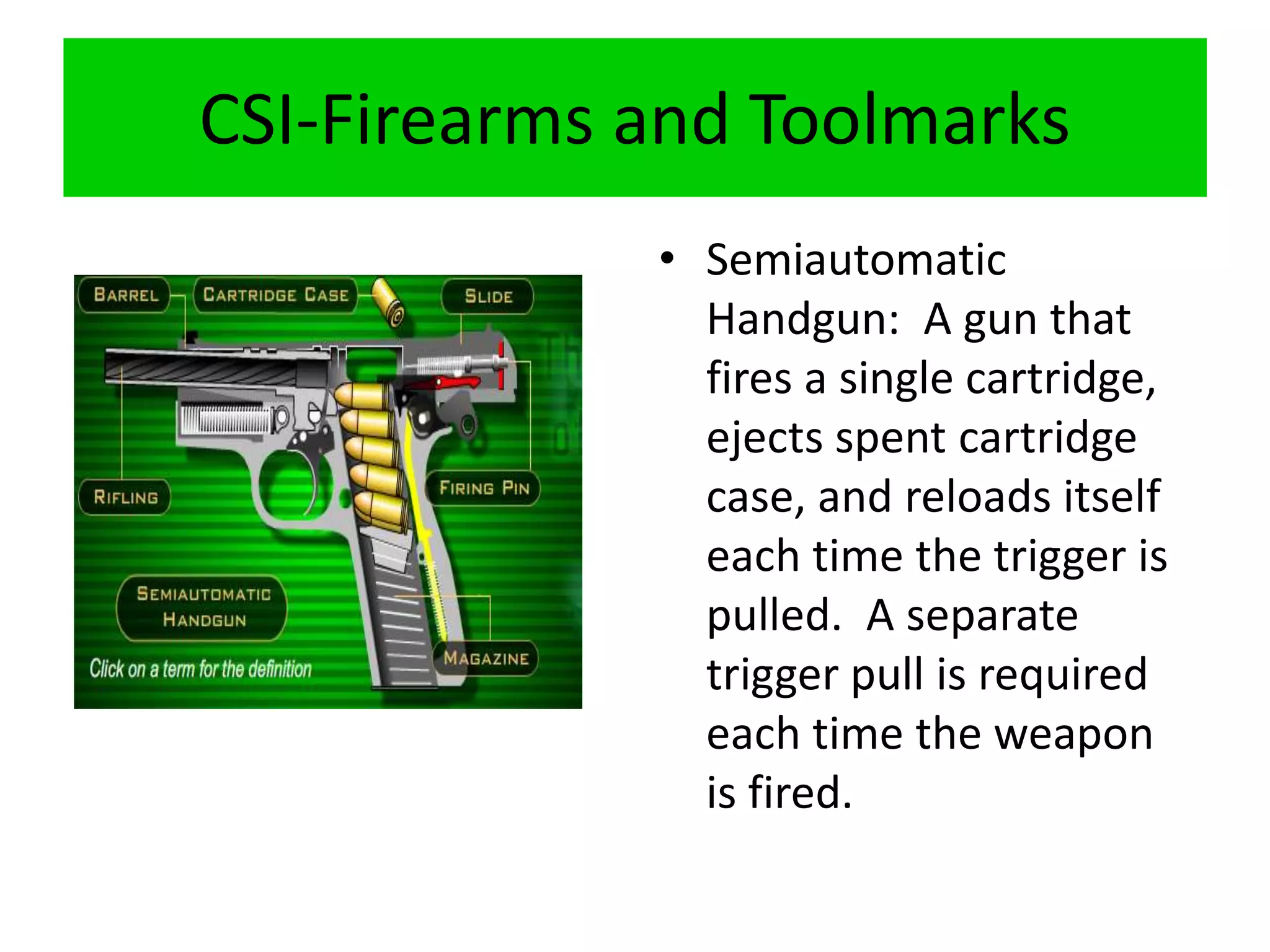
• Semiautomatic
Handgun: A gun that
fires a single cartridge,
ejects spent cartridge
case, and reloads itself
each time the trigger is
pulled. A separate
trigger pull is required
each time the weapon
is fired.
CSI-Firearms and Toolmarks
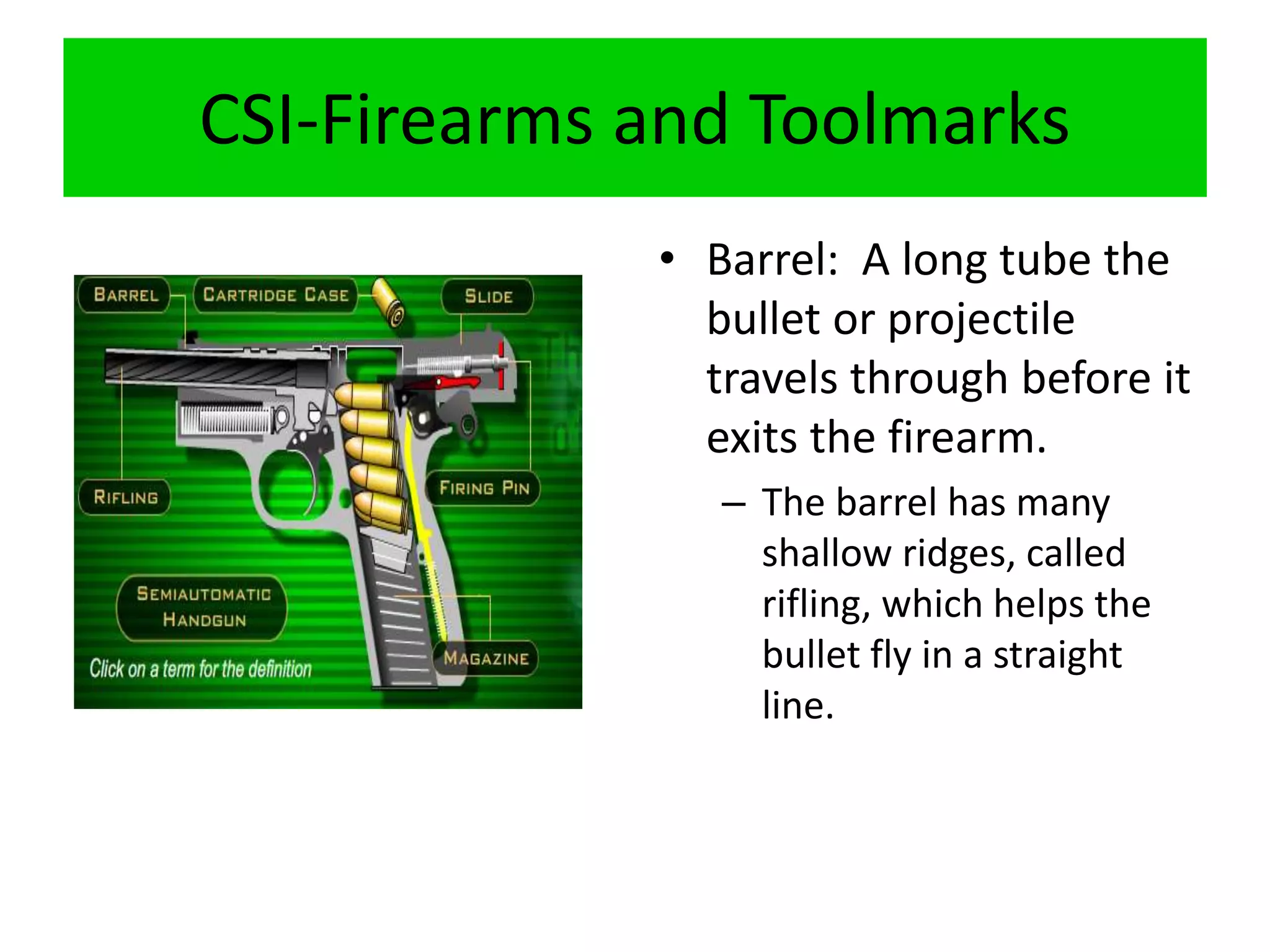
• Barrel: A long tube the
bullet or projectile
travels through before it
exits the firearm.
– The barrel has many
shallow ridges, called
rifling, which helps the
bullet fly in a straight
line.
CSI-Firearms and Toolmarks
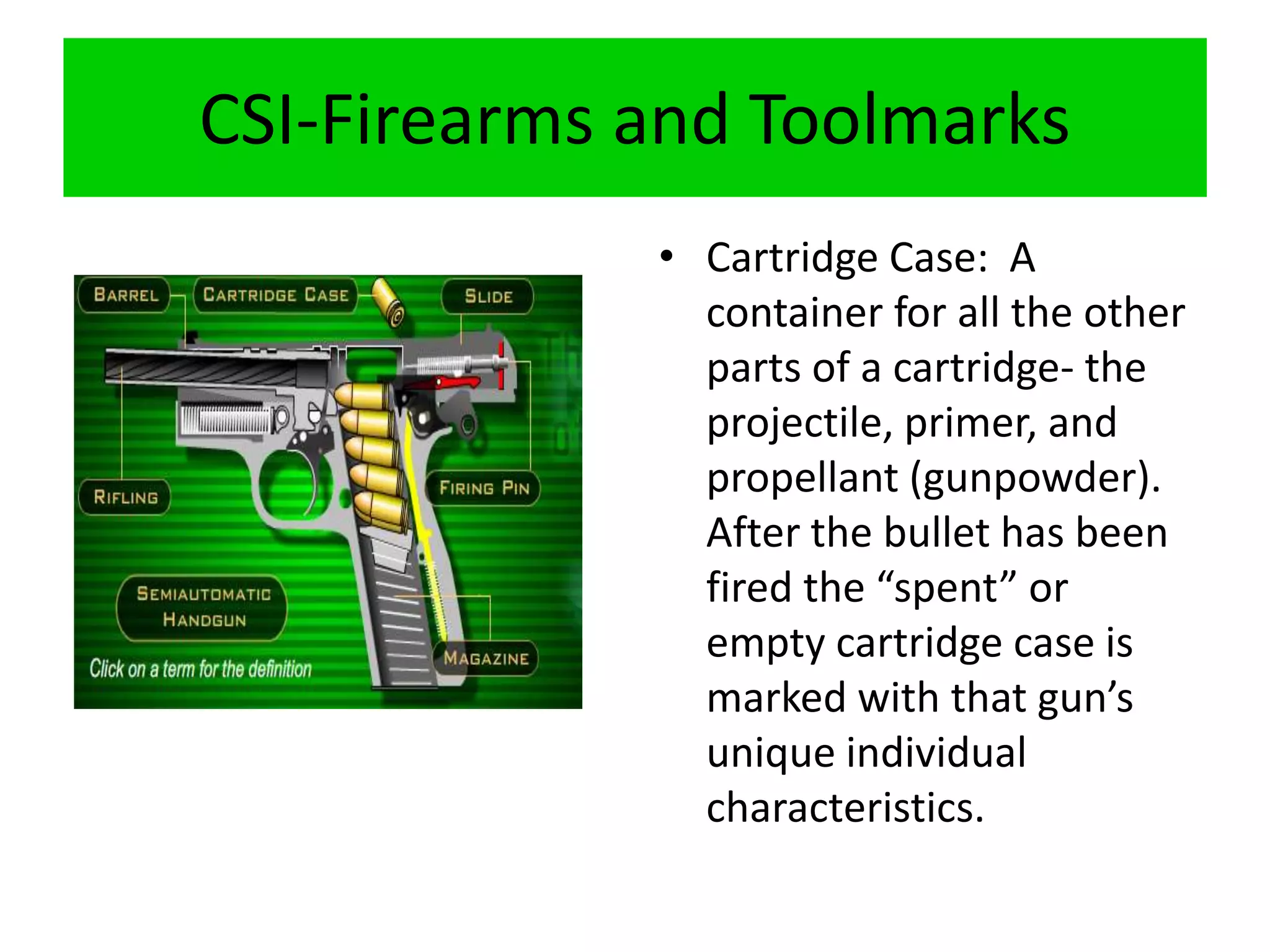
• Cartridge Case: A
container for all the other
parts of a cartridge- the
projectile, primer, and
propellant (gunpowder).
After the bullet has been
fired the “spent” or
empty cartridge case is
marked with that gun’s
unique individual
characteristics.
CSI-Firearms and Toolmarks
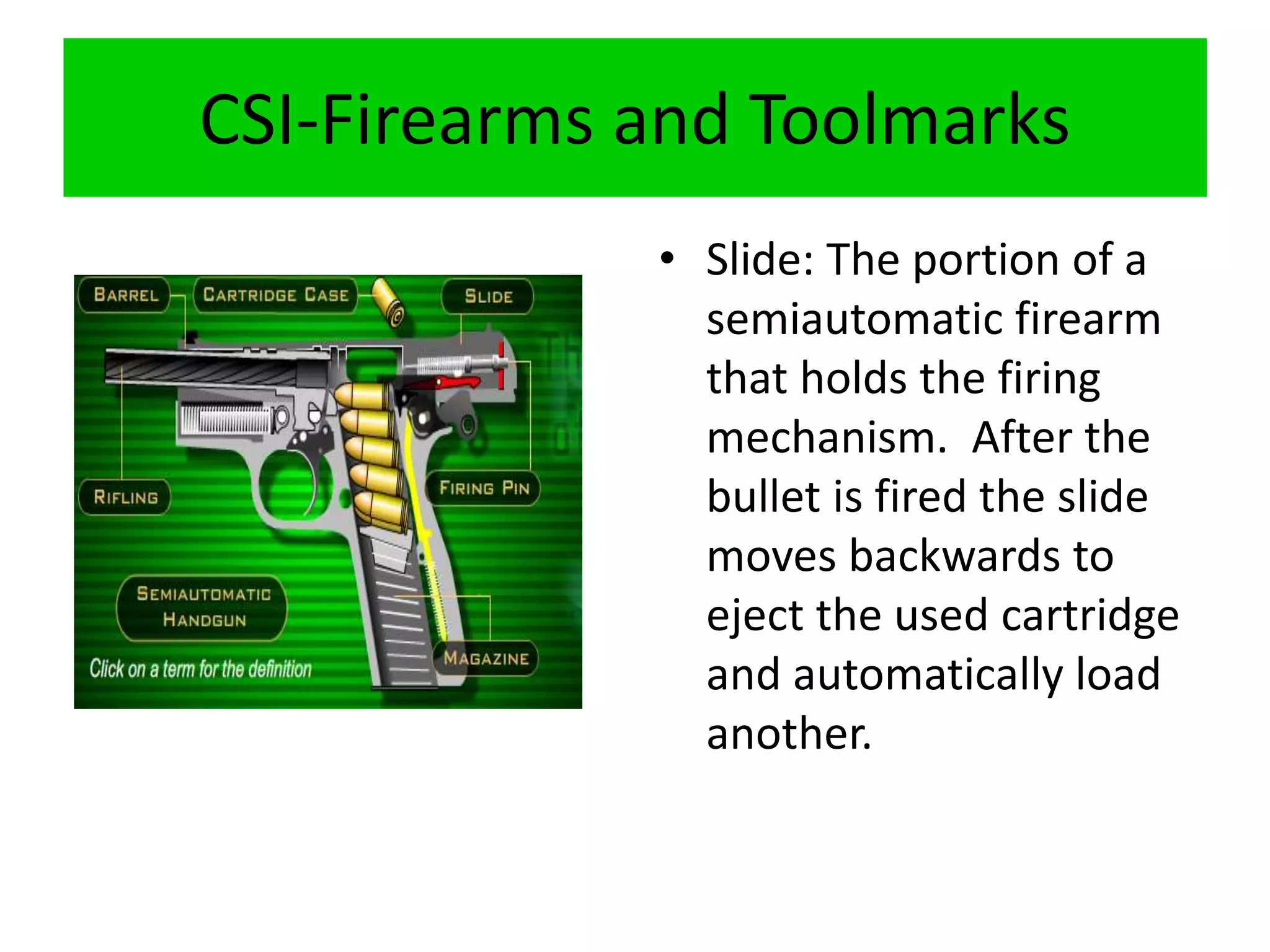
• Slide: The portion of a
semiautomatic firearm
that holds the firing
mechanism. After the
bullet is fired the slide
moves backwards to
eject the used cartridge
and automatically load
another.
CSI-Firearms and Toolmarks
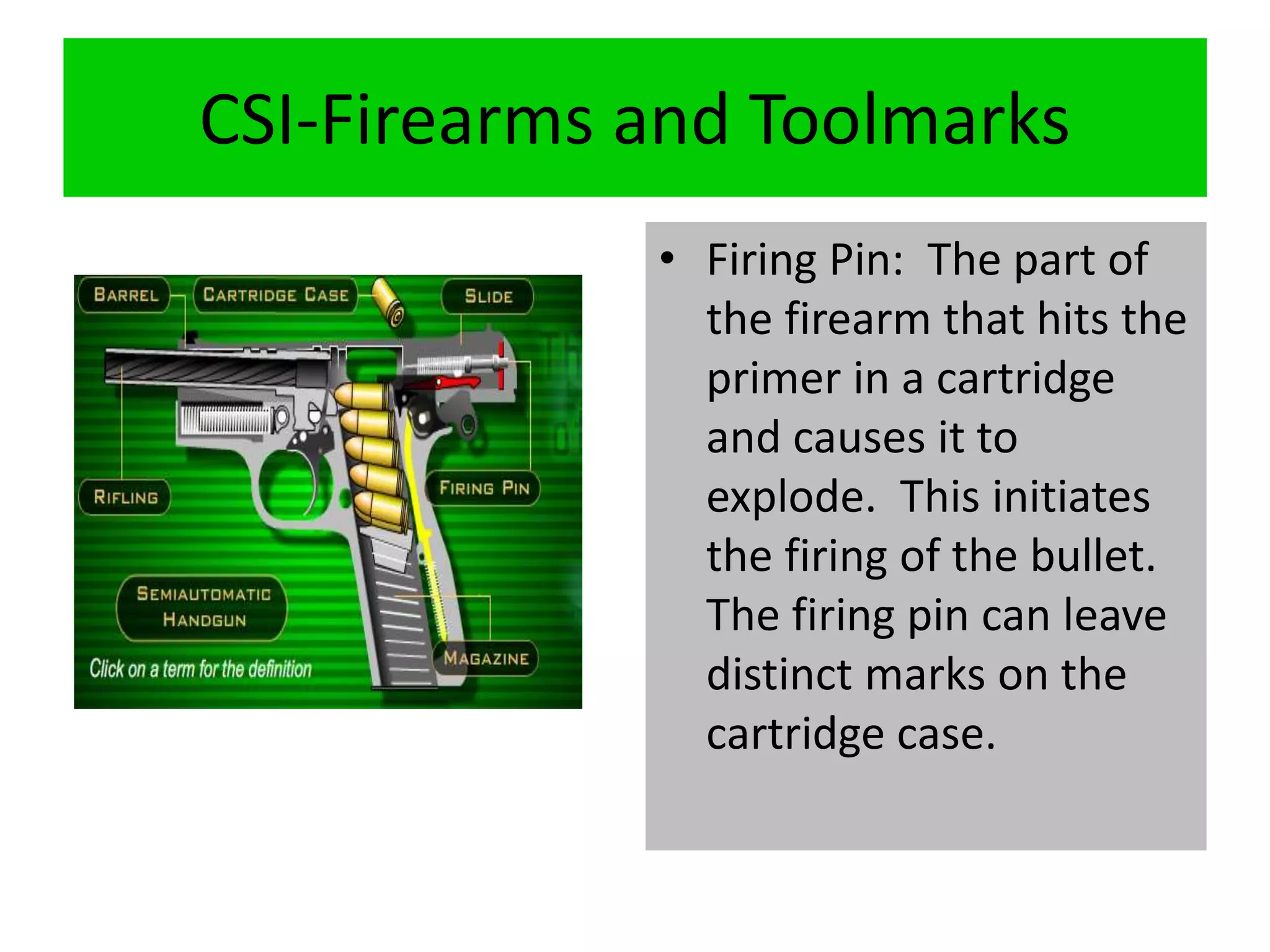
• Firing Pin: The part of
the firearm that hits the
primer in a cartridge
and causes it to
explode. This initiates
the firing of the bullet.
The firing pin can leave
distinct marks on the
cartridge case.
CSI-Firearms and Toolmarks
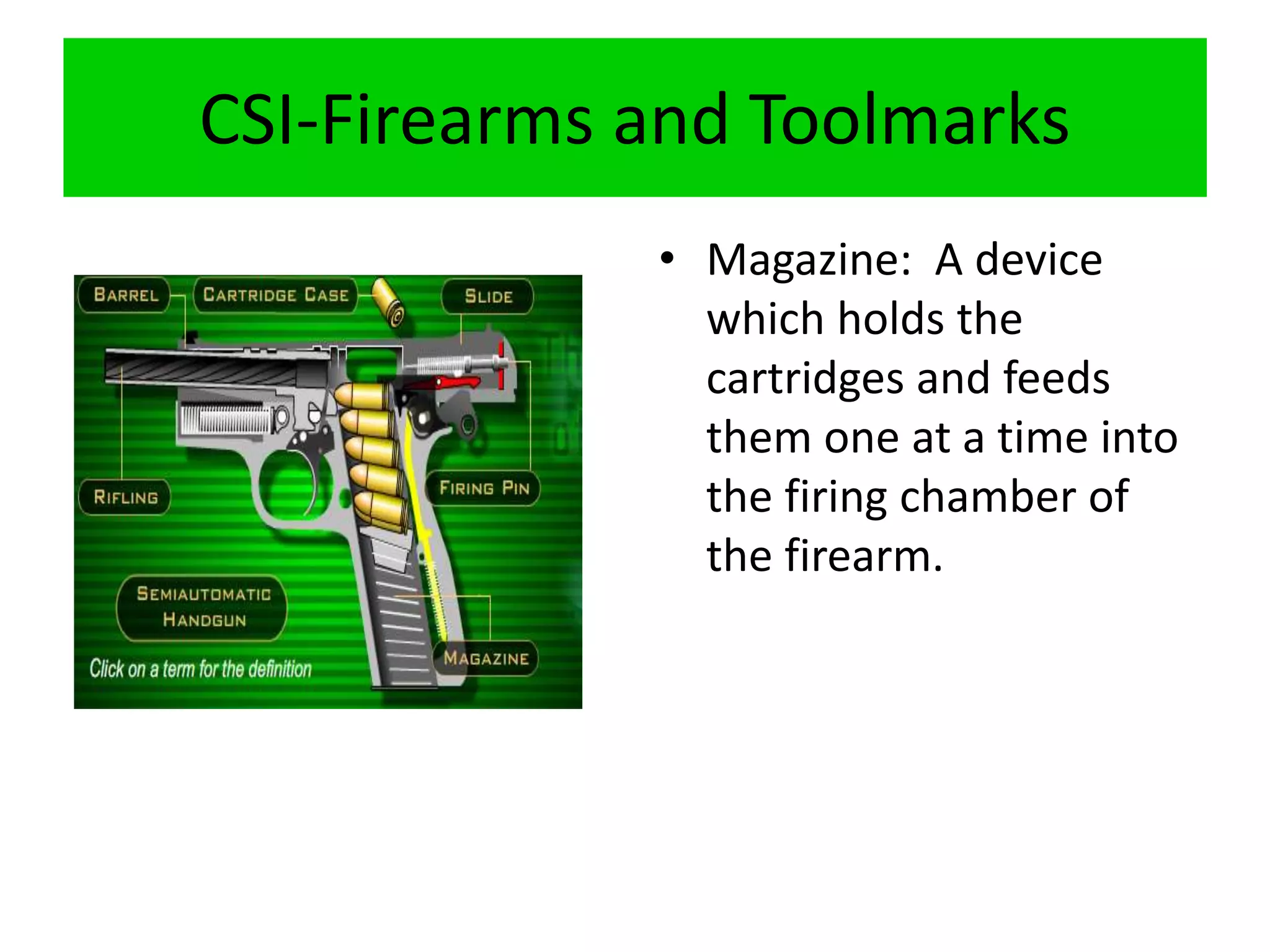
• Magazine: A device
which holds the
cartridges and feeds
them one at a time into
the firing chamber of
the firearm.
CSI-Firearms and Toolmarks
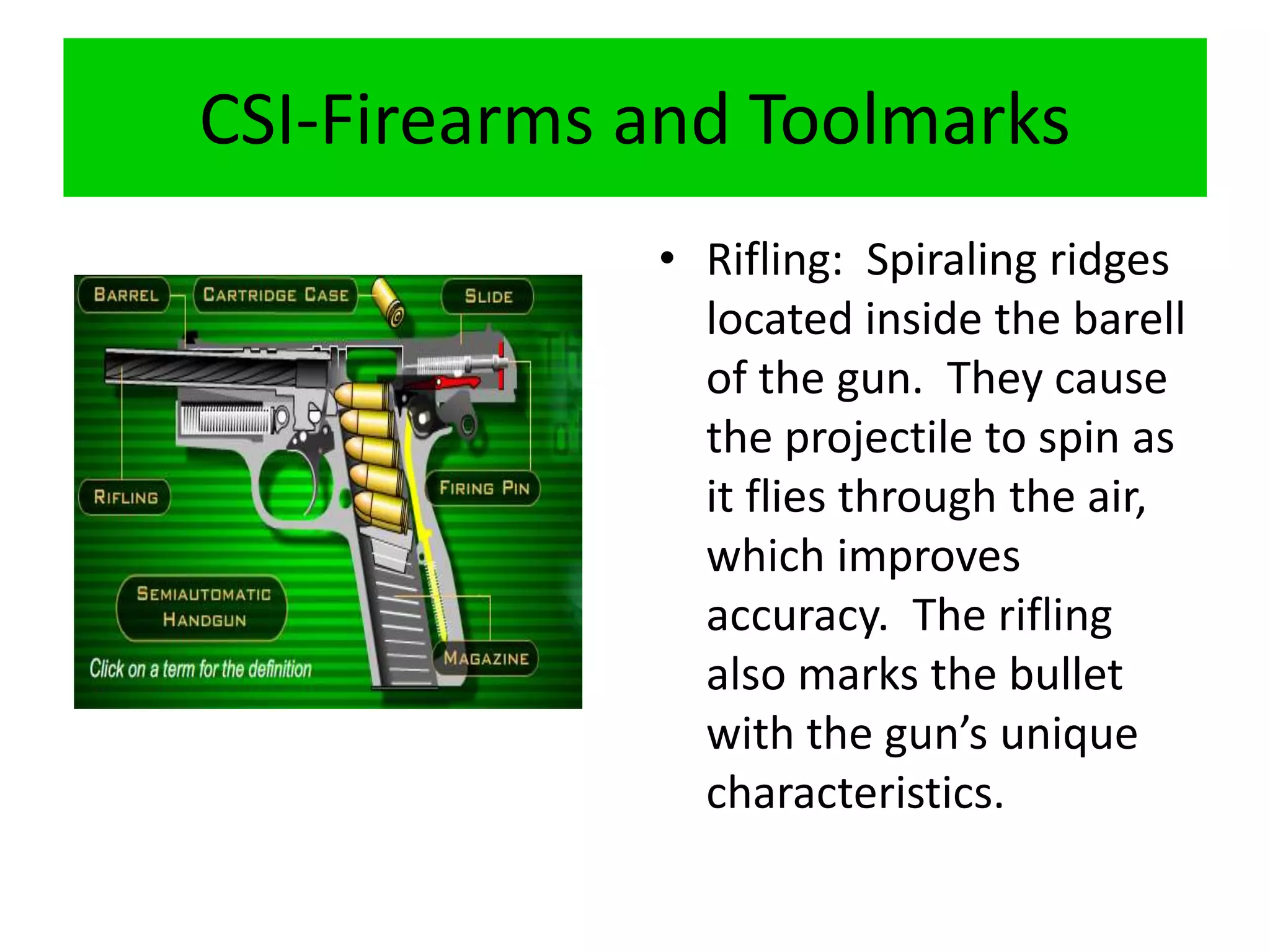
• Rifling: Spiraling ridges
located inside the barell
of the gun. They cause
the projectile to spin as
it flies through the air,
which improves
accuracy. The rifling
also marks the bullet
with the gun’s unique
characteristics.
CSI-Firearms and Toolmarks
HOW A GUN WORKS
• When the trigger is
pulled.
• The hammer hits the
firing pin.
• The firing pin hits the
cartridge.
CSI-Firearms and Toolmarks
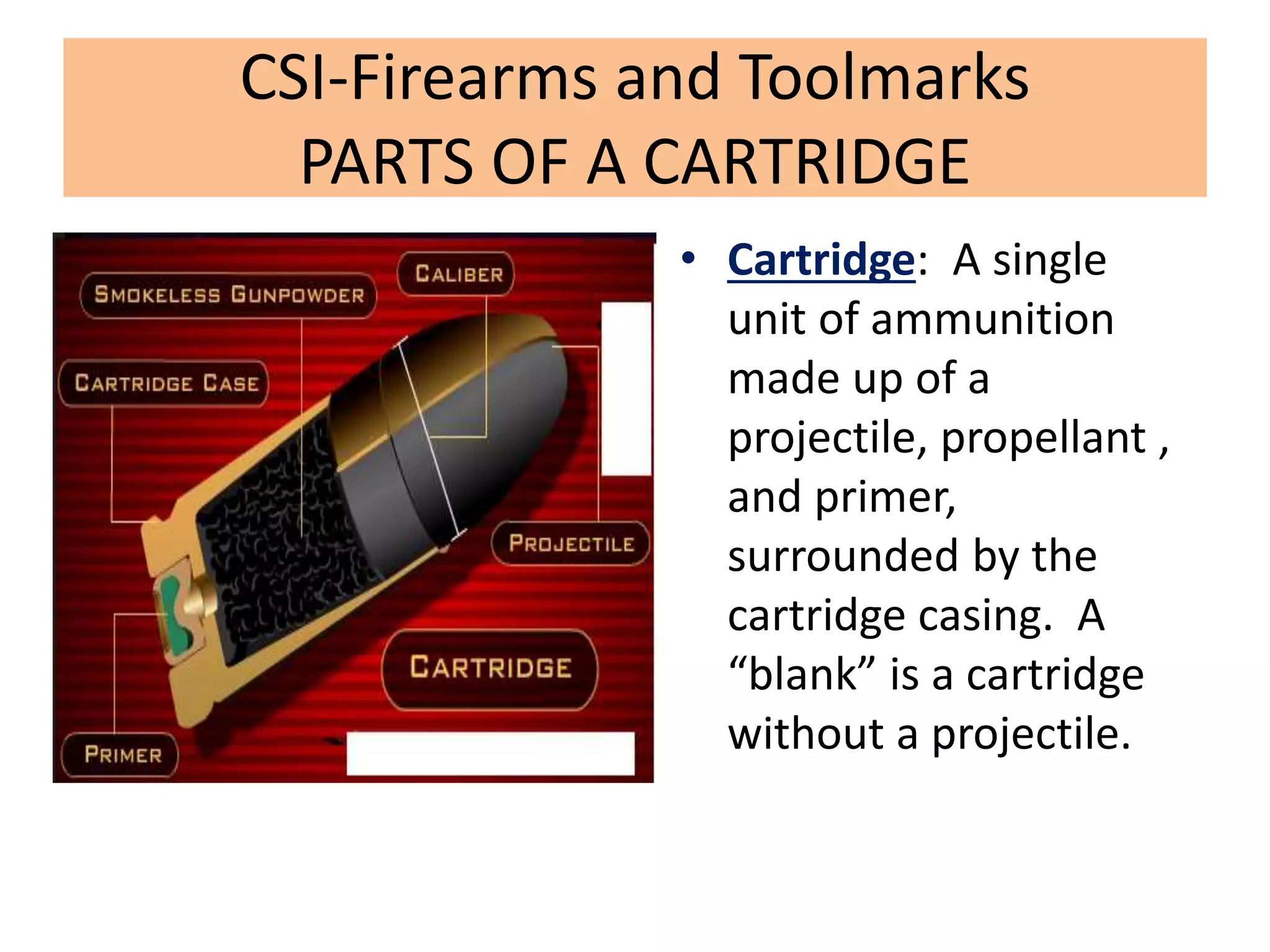
PARTS OF A CARTRIDGE
• Cartridge: A single
unit of ammunition
made up of a
projectile, propellant ,
and primer,
surrounded by the
cartridge casing. A
“blank” is a cartridge
without a projectile.
CSI-Firearms and Toolmarks
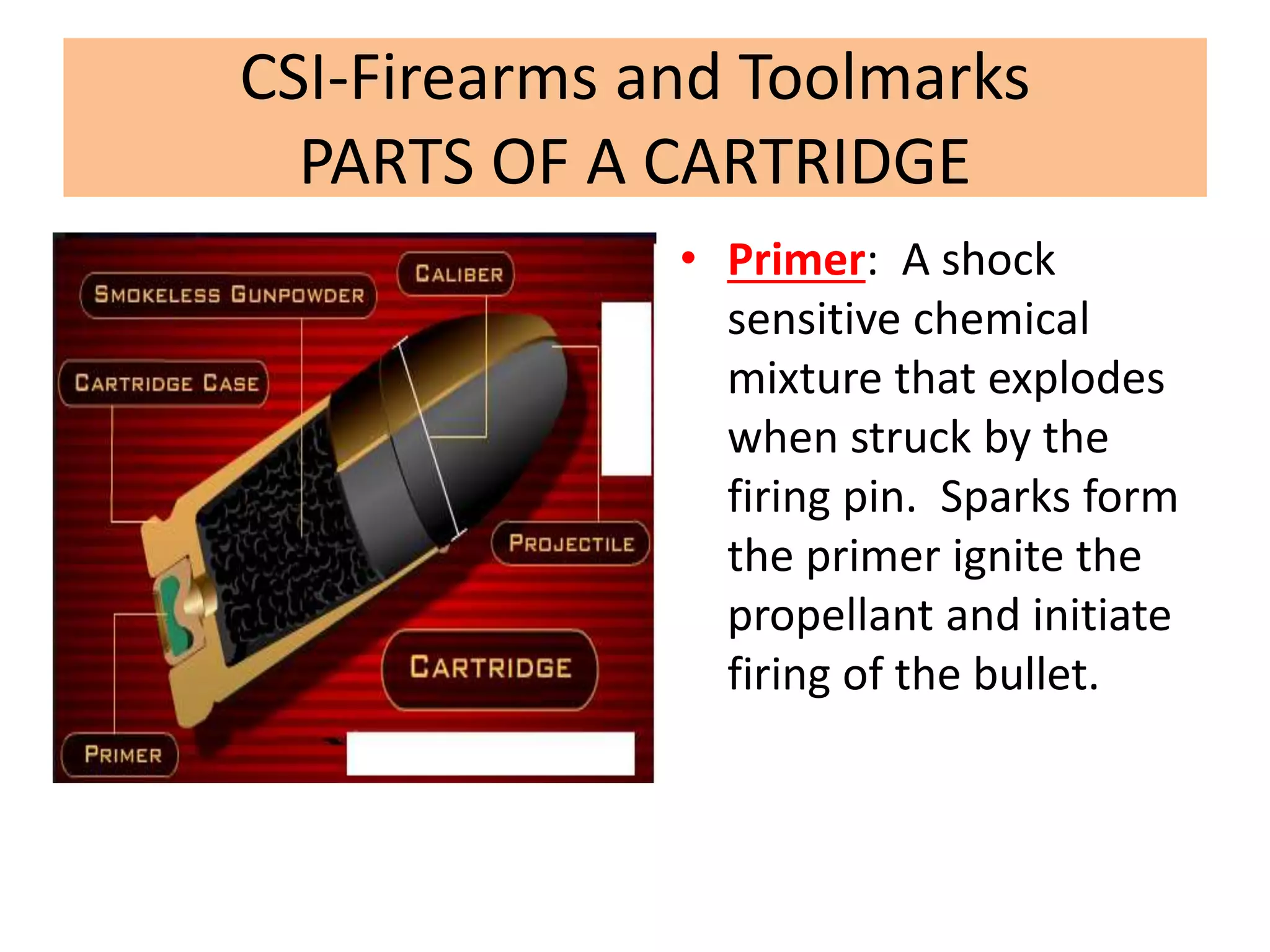
PARTS OF A CARTRIDGE
• Primer: A shock
sensitive chemical
mixture that explodes
when struck by the
firing pin. Sparks form
the primer ignite the
propellant and initiate
firing of the bullet.
CSI-Firearms and Toolmarks
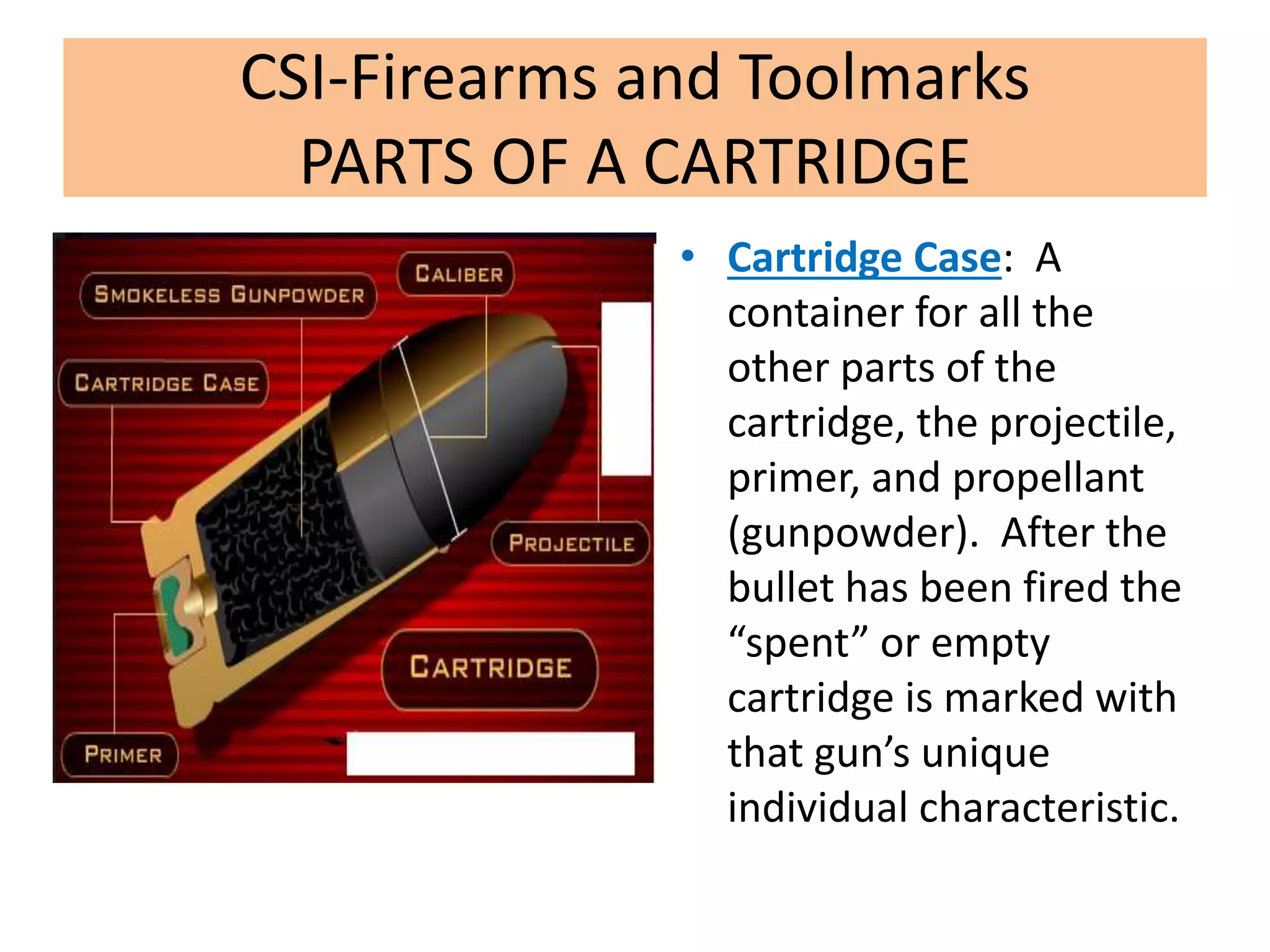
PARTS OF A CARTRIDGE
• Cartridge Case: A
container for all the
other parts of the
cartridge, the projectile,
primer, and propellant
(gunpowder). After the
bullet has been fired the
“spent” or empty
cartridge is marked with
that gun’s unique
individual characteristic.
CSI-Firearms and Toolmarks
PARTS OF A CARTRIDGE
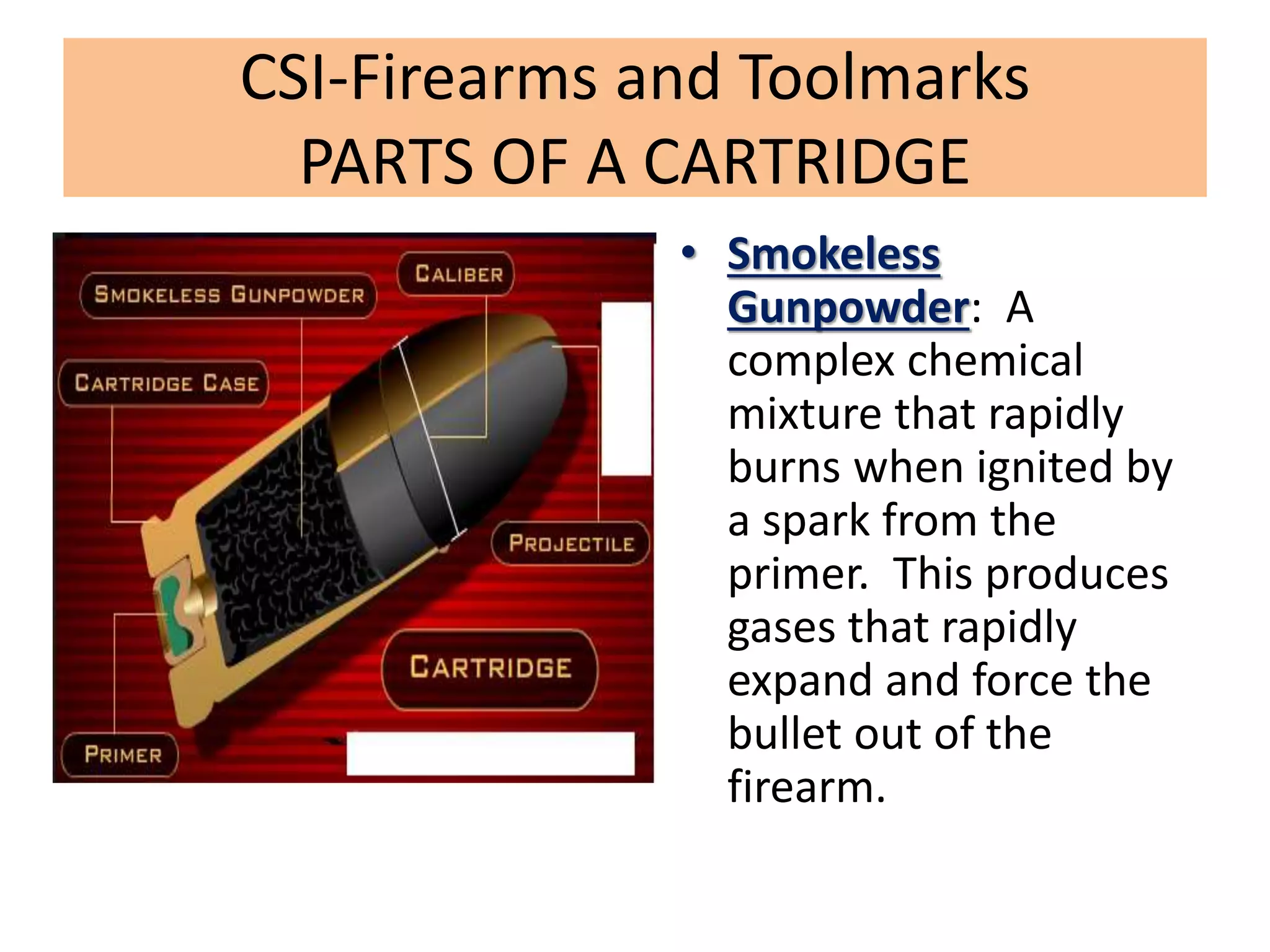
• Smokeless
Gunpowder: A
complex chemical
mixture that rapidly
burns when ignited by
a spark from the
primer. This produces
gases that rapidly
expand and force the
bullet out of the
firearm.
CSI-Firearms and Toolmarks
PARTS OF A CARTRIDGE
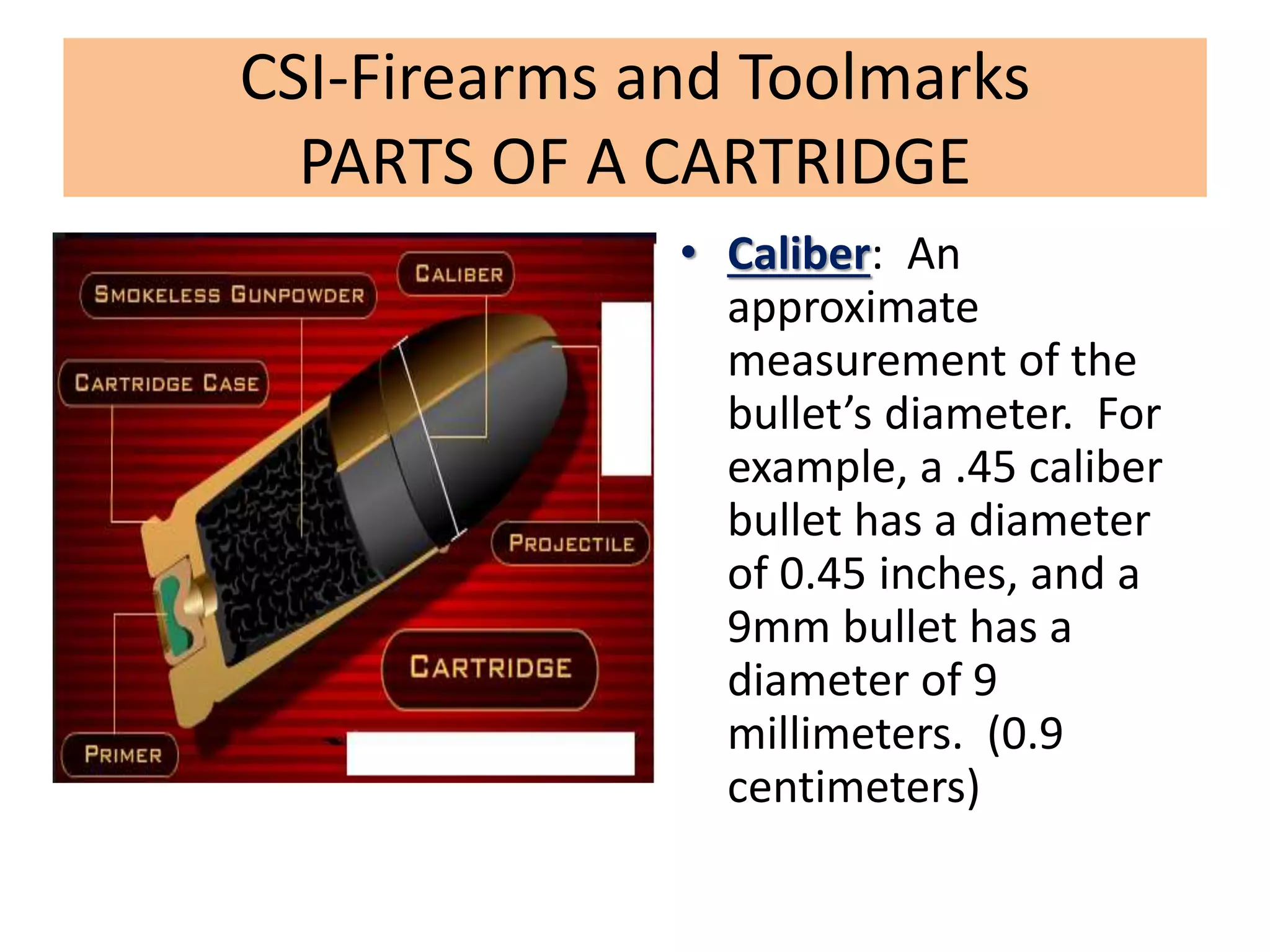
• Caliber: An
approximate
measurement of the
bullet’s diameter. For
example, a .45 caliber
bullet has a diameter
of 0.45 inches, and a
9mm bullet has a
diameter of 9
millimeters. (0.9
centimeters)
CSI-Firearms and Toolmarks
PARTS OF A CARTRIDGE
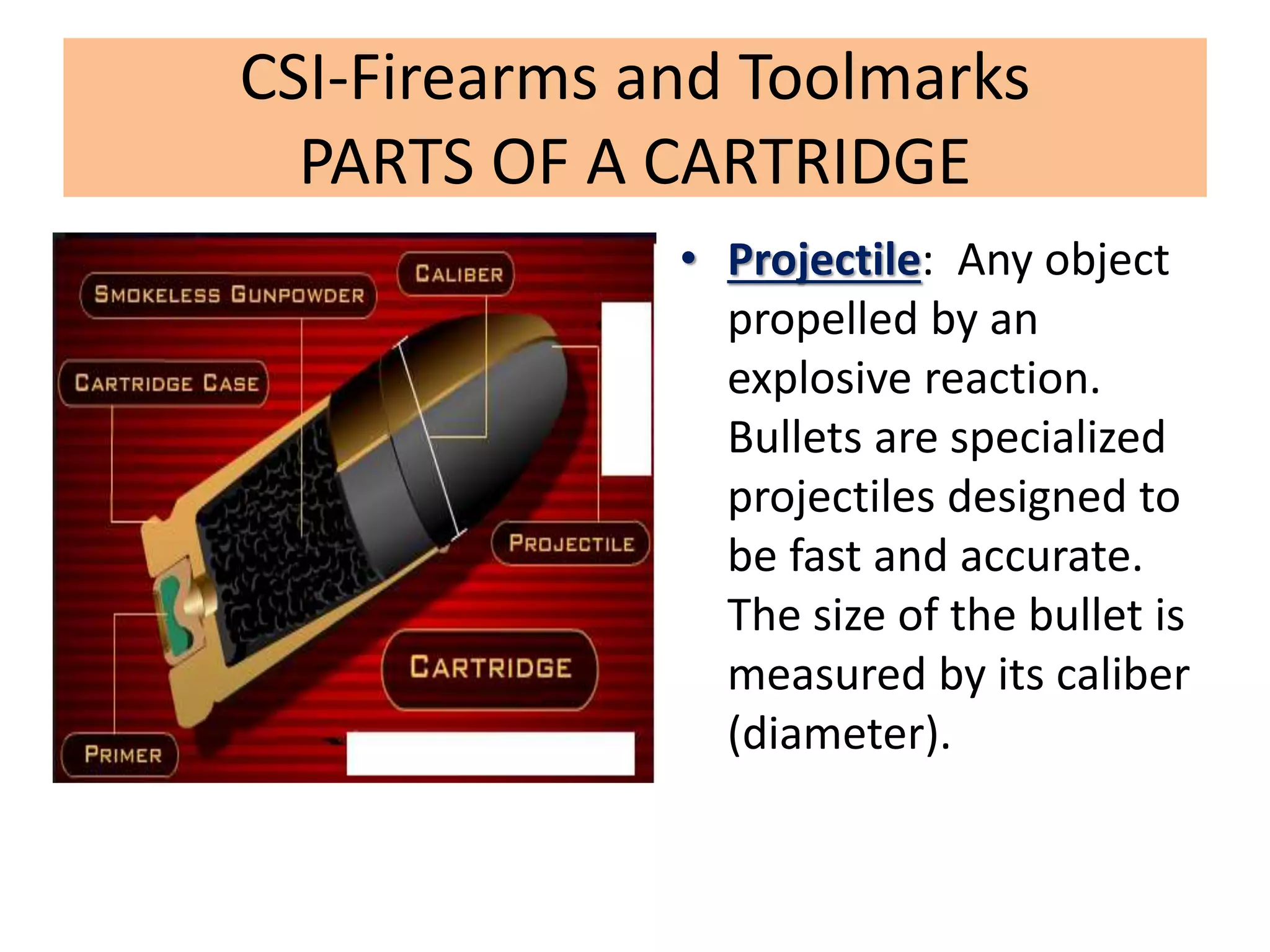
• Projectile: Any object
propelled by an
explosive reaction.
Bullets are specialized
projectiles designed to
be fast and accurate.
The size of the bullet is
measured by its caliber
(diameter).
CSI-Firearms and Toolmarks
Bullet Characteristics
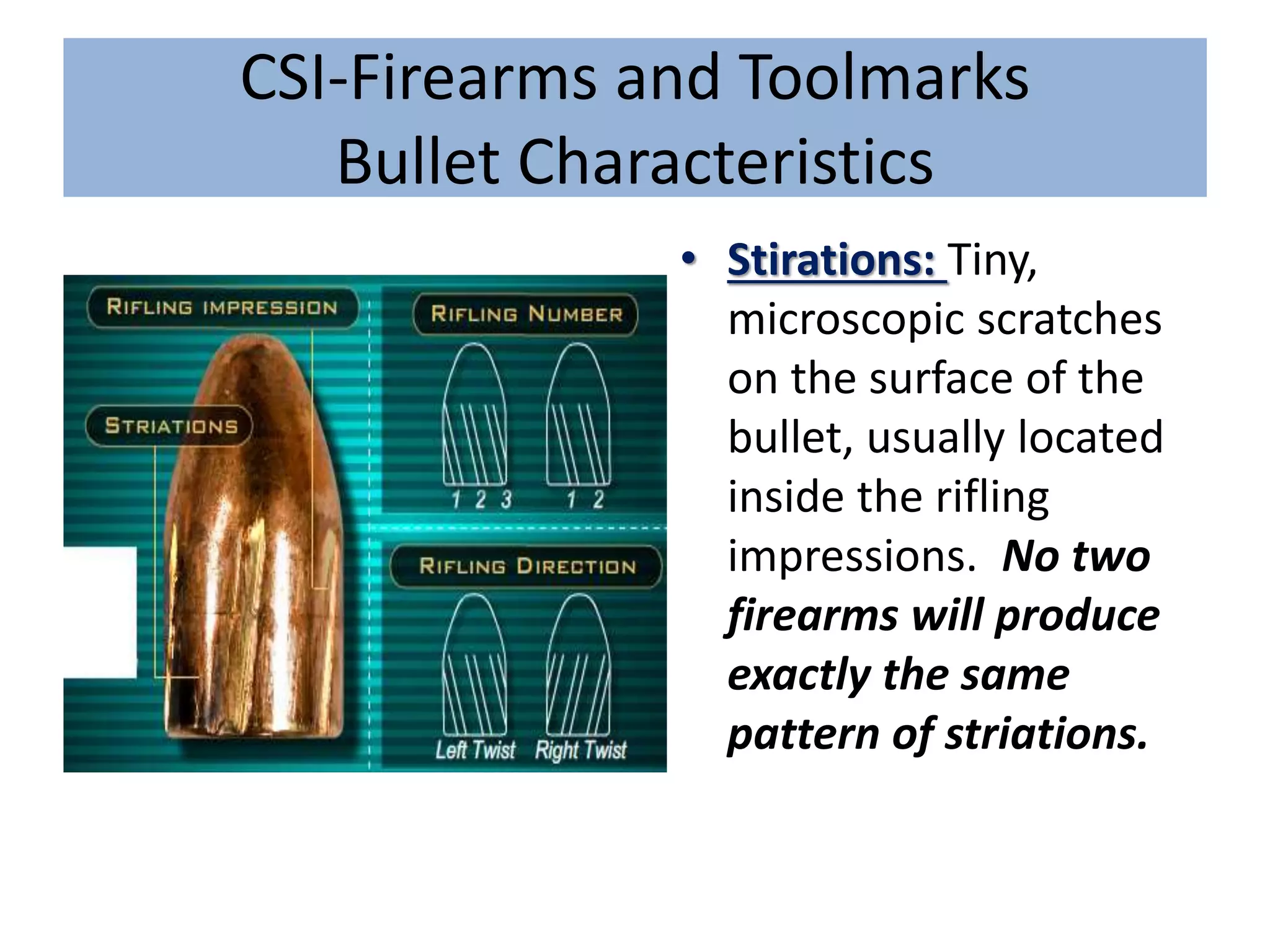
• Stirations: Tiny,
microscopic scratches
on the surface of the
bullet, usually located
inside the rifling
impressions. No two
firearms will produce
exactly the same
pattern of striations.
CSI-Firearms and Toolmarks
Bullet Characteristics
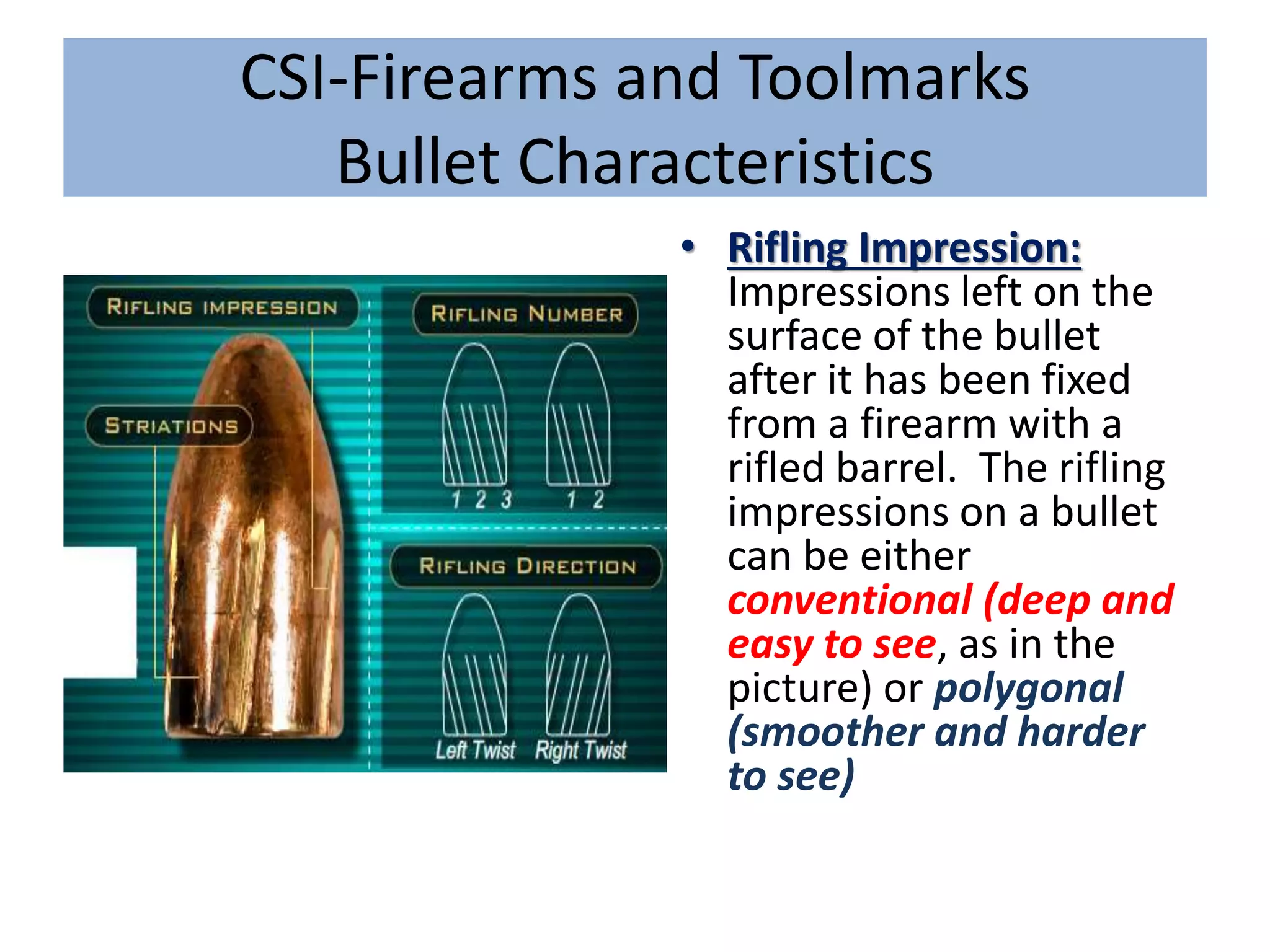
• Rifling Impression:
Impressions left on the
surface of the bullet
after it has been fixed
from a firearm with a
rifled barrel. The rifling
impressions on a bullet
can be either
conventional (deep and
easy to see, as in the
picture) or polygonal
(smoother and harder
to see)
CSI-Firearms and Toolmarks
Bullet Characteristics
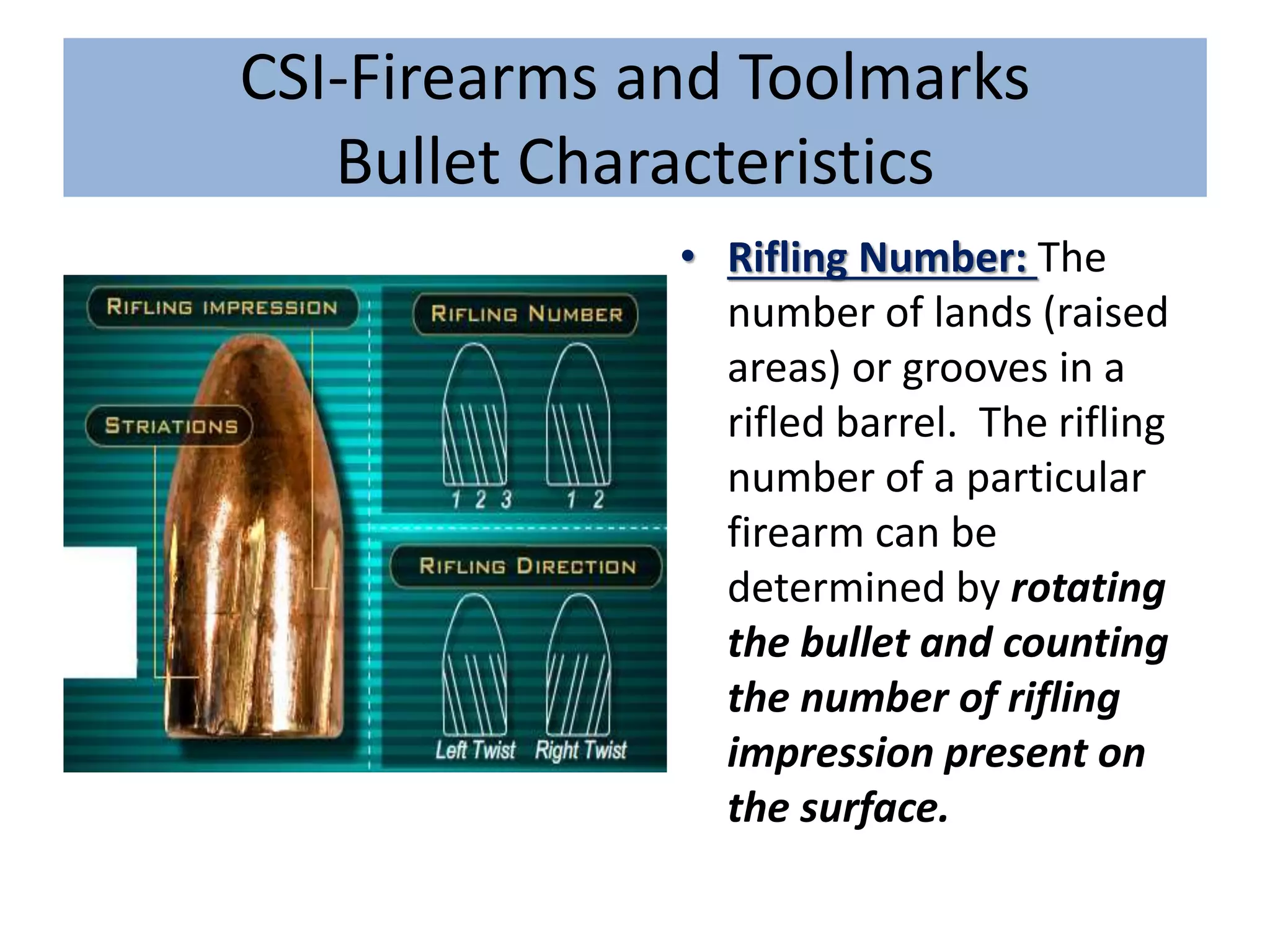
• Rifling Number: The
number of lands (raised
areas) or grooves in a
rifled barrel. The rifling
number of a particular
firearm can be
determined by rotating
the bullet and counting
the number of rifling
impression present on
the surface.
CSI-Firearms and Toolmarks
Bullet Characteristics
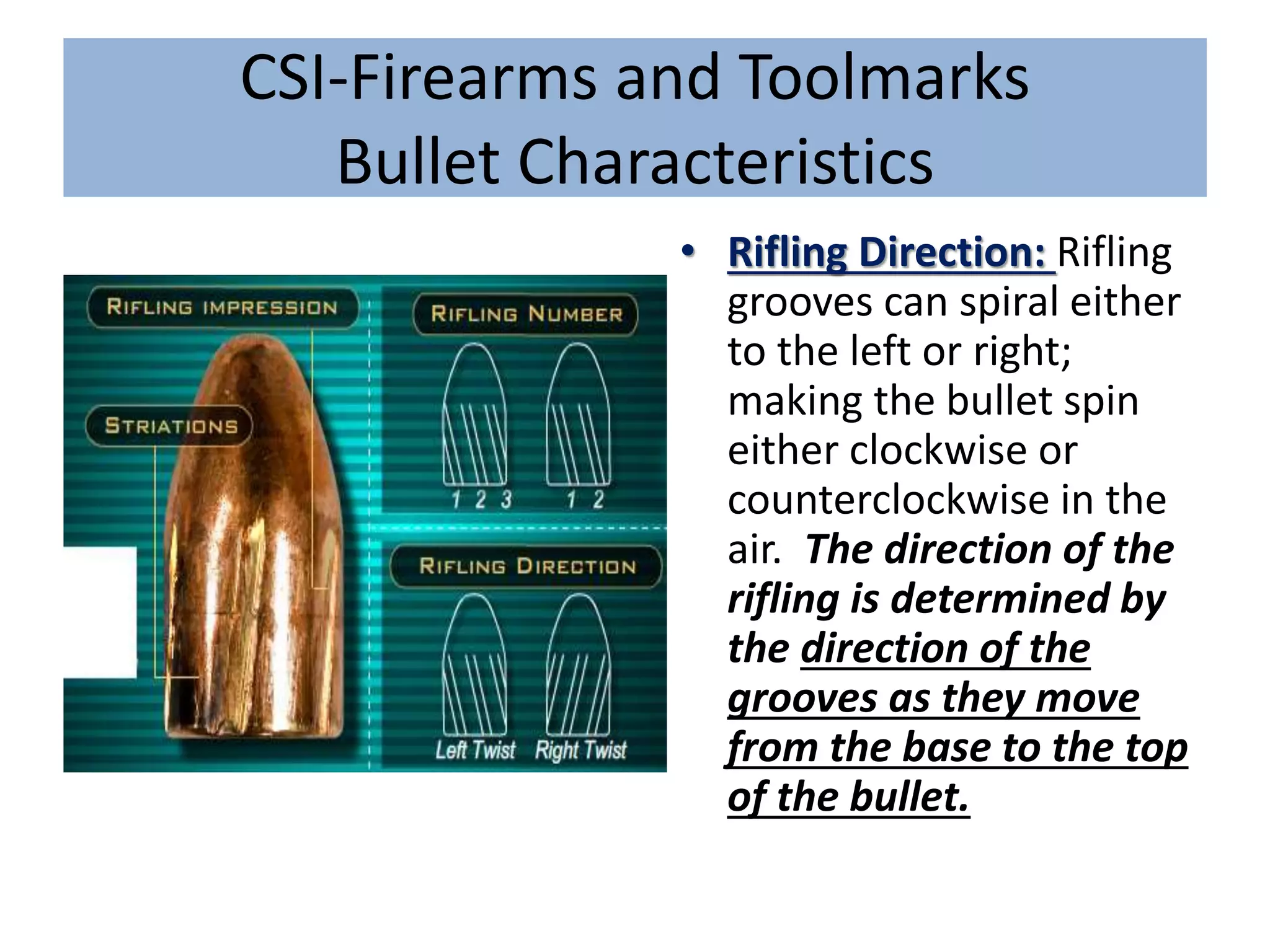
• Rifling Direction: Rifling
grooves can spiral either
to the left or right;
making the bullet spin
either clockwise or
counterclockwise in the
air. The direction of the
rifling is determined by
the direction of the
grooves as they move
from the base to the top
of the bullet.
CSI-Firearms and Toolmarks
Bullet Characteristics
• Firearms Examiners use
two types of bullet
characteristics to
determine if a bullet
could have been fired
by a certain gun:
• What would not be a
class characteristic??
• Striations, caliber,
Rifling Direction, or Rifle
Number
• Class Characterisitcs:
Specific for a certain
brand or type of
firearm.
• Individual
Characteristics: Specific
for an INDIVIDUAL
firearm.
CSI-Firearms and Toolmarks
Class Characterisitics
• Firearms Examiners use
two types of bullet
characteristics to
determine if a bullet
could have been fired
by a certain gun:
• Class Characterisitcs:
Specific for a certain
brand or type of
firearm.
• Individual
Characteristics: Specific
for an INDIVIDUAL
firearm.

CSI Toolmarks etc.

  • 1.
    CSI Training Firearms andToolmarks STEM: CSI Experience Activity Supplemental Notes
  • 2.
  • 3.
    CSI-Firearms and Toolmarks •Semiautomatic Handgun: A gun that fires a single cartridge, ejects spent cartridge case, and reloads itself each time the trigger is pulled. A separate trigger pull is required each time the weapon is fired.
  • 4.
    CSI-Firearms and Toolmarks •Barrel: A long tube the bullet or projectile travels through before it exits the firearm. – The barrel has many shallow ridges, called rifling, which helps the bullet fly in a straight line.
  • 5.
    CSI-Firearms and Toolmarks •Cartridge Case: A container for all the other parts of a cartridge- the projectile, primer, and propellant (gunpowder). After the bullet has been fired the “spent” or empty cartridge case is marked with that gun’s unique individual characteristics.
  • 6.
    CSI-Firearms and Toolmarks •Slide: The portion of a semiautomatic firearm that holds the firing mechanism. After the bullet is fired the slide moves backwards to eject the used cartridge and automatically load another.
  • 7.
    CSI-Firearms and Toolmarks •Firing Pin: The part of the firearm that hits the primer in a cartridge and causes it to explode. This initiates the firing of the bullet. The firing pin can leave distinct marks on the cartridge case.
  • 8.
    CSI-Firearms and Toolmarks •Magazine: A device which holds the cartridges and feeds them one at a time into the firing chamber of the firearm.
  • 9.
    CSI-Firearms and Toolmarks •Rifling: Spiraling ridges located inside the barell of the gun. They cause the projectile to spin as it flies through the air, which improves accuracy. The rifling also marks the bullet with the gun’s unique characteristics.
  • 10.
    CSI-Firearms and Toolmarks HOWA GUN WORKS • When the trigger is pulled. • The hammer hits the firing pin. • The firing pin hits the cartridge.
  • 11.
    CSI-Firearms and Toolmarks PARTSOF A CARTRIDGE • Cartridge: A single unit of ammunition made up of a projectile, propellant , and primer, surrounded by the cartridge casing. A “blank” is a cartridge without a projectile.
  • 12.
    CSI-Firearms and Toolmarks PARTSOF A CARTRIDGE • Primer: A shock sensitive chemical mixture that explodes when struck by the firing pin. Sparks form the primer ignite the propellant and initiate firing of the bullet.
  • 13.
    CSI-Firearms and Toolmarks PARTSOF A CARTRIDGE • Cartridge Case: A container for all the other parts of the cartridge, the projectile, primer, and propellant (gunpowder). After the bullet has been fired the “spent” or empty cartridge is marked with that gun’s unique individual characteristic.
  • 14.
    CSI-Firearms and Toolmarks PARTSOF A CARTRIDGE • Smokeless Gunpowder: A complex chemical mixture that rapidly burns when ignited by a spark from the primer. This produces gases that rapidly expand and force the bullet out of the firearm.
  • 15.
    CSI-Firearms and Toolmarks PARTSOF A CARTRIDGE • Caliber: An approximate measurement of the bullet’s diameter. For example, a .45 caliber bullet has a diameter of 0.45 inches, and a 9mm bullet has a diameter of 9 millimeters. (0.9 centimeters)
  • 16.
    CSI-Firearms and Toolmarks PARTSOF A CARTRIDGE • Projectile: Any object propelled by an explosive reaction. Bullets are specialized projectiles designed to be fast and accurate. The size of the bullet is measured by its caliber (diameter).
  • 17.
    CSI-Firearms and Toolmarks BulletCharacteristics • Stirations: Tiny, microscopic scratches on the surface of the bullet, usually located inside the rifling impressions. No two firearms will produce exactly the same pattern of striations.
  • 18.
    CSI-Firearms and Toolmarks BulletCharacteristics • Rifling Impression: Impressions left on the surface of the bullet after it has been fixed from a firearm with a rifled barrel. The rifling impressions on a bullet can be either conventional (deep and easy to see, as in the picture) or polygonal (smoother and harder to see)
  • 19.
    CSI-Firearms and Toolmarks BulletCharacteristics • Rifling Number: The number of lands (raised areas) or grooves in a rifled barrel. The rifling number of a particular firearm can be determined by rotating the bullet and counting the number of rifling impression present on the surface.
  • 20.
    CSI-Firearms and Toolmarks BulletCharacteristics • Rifling Direction: Rifling grooves can spiral either to the left or right; making the bullet spin either clockwise or counterclockwise in the air. The direction of the rifling is determined by the direction of the grooves as they move from the base to the top of the bullet.
  • 21.
    CSI-Firearms and Toolmarks BulletCharacteristics • Firearms Examiners use two types of bullet characteristics to determine if a bullet could have been fired by a certain gun: • What would not be a class characteristic?? • Striations, caliber, Rifling Direction, or Rifle Number • Class Characterisitcs: Specific for a certain brand or type of firearm. • Individual Characteristics: Specific for an INDIVIDUAL firearm.
  • 22.
    CSI-Firearms and Toolmarks ClassCharacterisitics • Firearms Examiners use two types of bullet characteristics to determine if a bullet could have been fired by a certain gun: • Class Characterisitcs: Specific for a certain brand or type of firearm. • Individual Characteristics: Specific for an INDIVIDUAL firearm.