
Recent Development in Regenerative Medicine
For more info, contact us: xeraya@xeraya.com
Follow us: @xerayacapital
www.xeraya.com
Stem Cell Therapy
July 2022. © Xeraya Capital.
1
Stem Cell Therapy
Content Overview
•  What is Stem Cell Therapy?
•  What are Stem Cells?
•  Sources & Types of Stem Cells
•  Recent Interest in Stem Cells
•  Key Market Figures
•  Potential Applications
•  Recent Stem Cell R&D
July 2022. © Xeraya Capital.
2
What is Stem Cell Therapy?
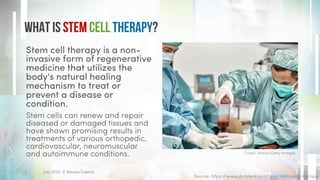
Stem cell therapy is a non-
invasive form of regenerative
medicine that utilizes the
body's natural healing
mechanism to treat or
prevent a disease or
condition.
Stem cells can renew and repair
diseased or damaged tissues and
have shown promising results in
treatments of various orthopedic,
cardiovascular, neuromuscular
and autoimmune conditions.
Source: https://www.dvcstem.com/post/stem-cell-therapy
Credit: Morsa/Getty Images
July 2022. © Xeraya Capital.
3
Recap: What are Stem Cells?
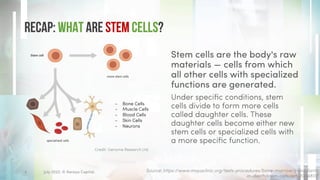
Stem cells are the body's raw
materials — cells from which
all other cells with specialized
functions are generated.
Under specific conditions, stem
cells divide to form more cells
called daughter cells. These
daughter cells become either new
stem cells or specialized cells with
a more specific function.
July 2022. © Xeraya Capital.
4
Credit: Genome Research Ltd.
Source: https://www.mayoclinic.org/tests-procedures/bone-marrow-transplant/
in-depth/stem-cells/art-20048117
-  Bone Cells
-  Muscle Cells
-  Blood Cells
-  Skin Cells
-  Neurons
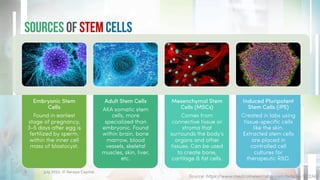
Sources of Stem Cells
July 2022. © Xeraya Capital.
5
Source: https://www.medicalnewstoday.com/articles/323343
Embryonic Stem
Cells
Found in earliest
stage of pregnancy,
3-5 days after egg is
fertilized by sperm,
within the inner cell
mass of blastocyst.
Adult Stem Cells
AKA somatic stem
cells, more
specialized than
embryonic. Found
within brain, bone
marrow, blood
vessels, skeletal
muscles, skin, liver,
etc.
Mesenchymal Stem
Cells (MSCs)
Comes from
connective tissue or
stroma that
surrounds the body’s
organs and other
tissues. Can be used
to create bone,
cartilage & fat cells.
Induced Pluripotent
Stem Cells (iPS)
Created in labs using
tissue-specific cells
like the skin.
Extracted stem cells
are placed in
controlled cell
cultures for
therapeutic R&D.
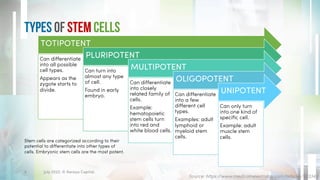
Types of Stem Cells
July 2022. © Xeraya Capital.
6
Source: https://www.medicalnewstoday.com/articles/323343
TOTIPOTENT
Can differentiate
into all possible
cell types.
Appears as the
zygote starts to
divide.
PLURIPOTENT
Can turn into
almost any type
of cell.
Found in early
embryo.
MULTIPOTENT
Can differentiate
into closely
related family of
cells.
Example:
hematopoietic
stem cells turn
into red and
white blood cells.
OLIGOPOTENT
Can differentiate
into a few
different cell
types.
Examples: adult
lymphoid or
myeloid stem
cells.
UNIPOTENT
Can only turn
into one kind of
specific cell.
Example: adult
muscle stem
cells.
Stem cells are categorized according to their
potential to differentiate into other types of
cells. Embryonic stem cells are the most potent.
Interest in Stem Cells
Tapping Into the Potential of Stem Cells
July 2022. © Xeraya Capital.
7
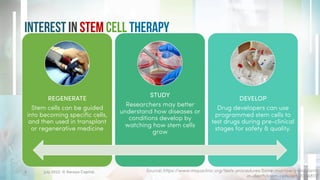
Interest in Stem Cell Therapy
July 2022. © Xeraya Capital.
8 Source: https://www.mayoclinic.org/tests-procedures/bone-marrow-transplant/
in-depth/stem-cells/art-20048117
REGENERATE
Stem cells can be guided
into becoming specific cells,
and then used in transplant
or regenerative medicine
STUDY
Researchers may better
understand how diseases or
conditions develop by
watching how stem cells
grow
DEVELOP
Drug developers can use
programmed stem cells to
test drugs during pre-clinical
stages for safety & quality.
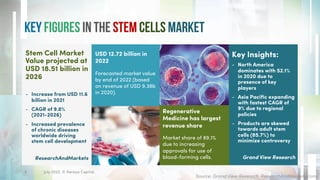
Key Figures in the Stem Cells market
July 2022. © Xeraya Capital.
Stem Cell Market
Value projected at
USD 18.51 billion in
2026
-  Increase from USD 11.6
billion in 2021
-  CAGR of 9.8%
(2021-2026)
-  Increased prevalence
of chronic diseases
worldwide driving
stem cell development
ResearchAndMarkets
USD 12.72 billion in
2022
Forecasted market value
by end of 2022 (based
on revenue of USD 9.38b
in 2020).
Regenerative
Medicine has largest
revenue share
Market share of 89.1%
due to increasing
approvals for use of
blood-forming cells.
Source: Grand View Research, ResearchAndMarkets.com
9
Key Insights:
-  North America
dominates with 52.1%
in 2020 due to
presence of key
players
-  Asia Pacific expanding
with fastest CAGR of
9% due to regional
policies
-  Products are skewed
towards adult stem
cells (85.7%) to
minimize controversy
Grand View Research
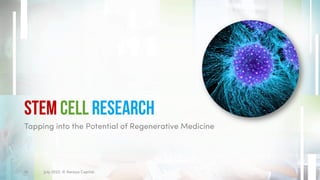
Stem Cell Research
Tapping into the Potential of Regenerative Medicine
July 2022. © Xeraya Capital.
10
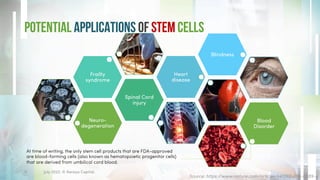
Potential Applications of Stem Cells
July 2022. © Xeraya Capital.
11
Neuro-
degeneration
Spinal Cord
injury
Frailty
syndrome
Heart
disease
Blindness
Blood
Disorder
Source: https://www.nature.com/articles/s41392-019-0089-y
At time of writing, the only stem cell products that are FDA-approved
are blood-forming cells (also known as hematopoietic progenitor cells)
that are derived from umbilical cord blood.
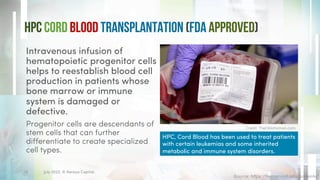
HPC Cord Blood Transplantation (FDA Approved)
Intravenous infusion of
hematopoietic progenitor cells
helps to reestablish blood cell
production in patients whose
bone marrow or immune
system is damaged or
defective.
Progenitor cells are descendants of
stem cells that can further
differentiate to create specialized
cell types.
Source: https://hemacord.info/patients/
Credit: TheOklahoman.com
July 2022. © Xeraya Capital.
12
HPC, Cord Blood has been used to treat patients
with certain leukemias and some inherited
metabolic and immune system disorders.
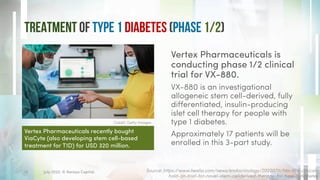
Treatment of Type 1 Diabetes (Phase 1/2)
Vertex Pharmaceuticals is
conducting phase 1/2 clinical
trial for VX-880.
VX-880 is an investigational
allogeneic stem cell-derived, fully
differentiated, insulin-producing
islet cell therapy for people with
type 1 diabetes.
Approximately 17 patients will be
enrolled in this 3-part study.
July 2022. © Xeraya Capital.
13
Credit: Getty Images
Source: https://www.healio.com/news/endocrinology/20220711/fda-lifts-clinical-
hold-on-trial-for-novel-stem-cellderived-therapy-for-type-1-diabetes
Vertex Pharmaceuticals recently bought
ViaCyte (also developing stem cell-based
treatment for T1D) for USD 320 million.
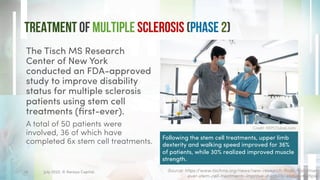
Treatment of Multiple Sclerosis (Phase 2)
The Tisch MS Research
Center of New York
conducted an FDA-approved
study to improve disability
status for multiple sclerosis
patients using stem cell
treatments (first-ever).
A total of 50 patients were
involved, 36 of which have
completed 6x stem cell treatments.
Source: https://www.tischms.org/news/new-research-finds-first-time-
ever-stem-cell-treatments-improve-disability-status-multiple
Credit: REPCDubai.com
July 2022. © Xeraya Capital.
14
Following the stem cell treatments, upper limb
dexterity and walking speed improved for 36%
of patients, while 30% realized improved muscle
strength.
Repair of Traumatic Brain Injury (Research)
Patients who suffer a stroke
or brain injury risk long-term
impairment of crucial motor
or cognitive (language &
memory) functions due to
loss of neurons.
Scientists in Portugal discovered a
novel mechanism by which
neurons and glia collaborate to
drive the process of neural
regeneration.
July 2022. © Xeraya Capital.
15
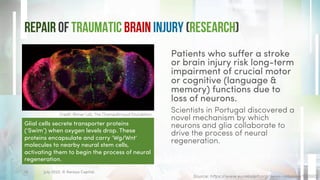
Credit: Rhiner Lab, The Champalimaud Foundation
Source: https://www.eurekalert.org/news-releases/955923
Glial cells secrete transporter proteins
(‘Swim’) when oxygen levels drop. These
proteins encapsulate and carry ‘Wg/Wnt’
molecules to nearby neural stem cells,
activating them to begin the process of neural
regeneration.
•  Researchers have recently shown interest in using stem cells
in the field of regenerative medicine.
•  Stem cell-based therapy has shown promising results in
treating various diseases and conditions.
•  Despite the vast potential of stem cells in regenerative
medicine, only less than a dozen therapies have been
approved by the FDA (even then they are hematopoietic
progenitor cells and not stem cells per se).
•  With the recent advances already made within the past
decade, new regulatory framework and policy support is
needed to further drive the use of stem cells in regenerative
medicine.
Conclusion
July 2022. © Xeraya Capital.
16
By xeraya capital
For more info, contact us: xeraya@xeraya.com
Follow us: @xerayacapital
www.xeraya.com
July 2022. © Xeraya Capital.
17

Recent Development in Regenerative Medicine

  • 1.
    Recent Development inRegenerative Medicine For more info, contact us: xeraya@xeraya.com Follow us: @xerayacapital www.xeraya.com Stem Cell Therapy July 2022. © Xeraya Capital. 1
  • 2.
    Stem Cell Therapy ContentOverview •  What is Stem Cell Therapy? •  What are Stem Cells? •  Sources & Types of Stem Cells •  Recent Interest in Stem Cells •  Key Market Figures •  Potential Applications •  Recent Stem Cell R&D July 2022. © Xeraya Capital. 2
  • 3.
    What is StemCell Therapy? Stem cell therapy is a non- invasive form of regenerative medicine that utilizes the body's natural healing mechanism to treat or prevent a disease or condition. Stem cells can renew and repair diseased or damaged tissues and have shown promising results in treatments of various orthopedic, cardiovascular, neuromuscular and autoimmune conditions. Source: https://www.dvcstem.com/post/stem-cell-therapy Credit: Morsa/Getty Images July 2022. © Xeraya Capital. 3
  • 4.
    Recap: What areStem Cells? Stem cells are the body's raw materials — cells from which all other cells with specialized functions are generated. Under specific conditions, stem cells divide to form more cells called daughter cells. These daughter cells become either new stem cells or specialized cells with a more specific function. July 2022. © Xeraya Capital. 4 Credit: Genome Research Ltd. Source: https://www.mayoclinic.org/tests-procedures/bone-marrow-transplant/ in-depth/stem-cells/art-20048117 -  Bone Cells -  Muscle Cells -  Blood Cells -  Skin Cells -  Neurons
  • 5.
    Sources of StemCells July 2022. © Xeraya Capital. 5 Source: https://www.medicalnewstoday.com/articles/323343 Embryonic Stem Cells Found in earliest stage of pregnancy, 3-5 days after egg is fertilized by sperm, within the inner cell mass of blastocyst. Adult Stem Cells AKA somatic stem cells, more specialized than embryonic. Found within brain, bone marrow, blood vessels, skeletal muscles, skin, liver, etc. Mesenchymal Stem Cells (MSCs) Comes from connective tissue or stroma that surrounds the body’s organs and other tissues. Can be used to create bone, cartilage & fat cells. Induced Pluripotent Stem Cells (iPS) Created in labs using tissue-specific cells like the skin. Extracted stem cells are placed in controlled cell cultures for therapeutic R&D.
  • 6.
    Types of StemCells July 2022. © Xeraya Capital. 6 Source: https://www.medicalnewstoday.com/articles/323343 TOTIPOTENT Can differentiate into all possible cell types. Appears as the zygote starts to divide. PLURIPOTENT Can turn into almost any type of cell. Found in early embryo. MULTIPOTENT Can differentiate into closely related family of cells. Example: hematopoietic stem cells turn into red and white blood cells. OLIGOPOTENT Can differentiate into a few different cell types. Examples: adult lymphoid or myeloid stem cells. UNIPOTENT Can only turn into one kind of specific cell. Example: adult muscle stem cells. Stem cells are categorized according to their potential to differentiate into other types of cells. Embryonic stem cells are the most potent.
  • 7.
    Interest in StemCells Tapping Into the Potential of Stem Cells July 2022. © Xeraya Capital. 7
  • 8.
    Interest in StemCell Therapy July 2022. © Xeraya Capital. 8 Source: https://www.mayoclinic.org/tests-procedures/bone-marrow-transplant/ in-depth/stem-cells/art-20048117 REGENERATE Stem cells can be guided into becoming specific cells, and then used in transplant or regenerative medicine STUDY Researchers may better understand how diseases or conditions develop by watching how stem cells grow DEVELOP Drug developers can use programmed stem cells to test drugs during pre-clinical stages for safety & quality.
  • 9.
    Key Figures inthe Stem Cells market July 2022. © Xeraya Capital. Stem Cell Market Value projected at USD 18.51 billion in 2026 -  Increase from USD 11.6 billion in 2021 -  CAGR of 9.8% (2021-2026) -  Increased prevalence of chronic diseases worldwide driving stem cell development ResearchAndMarkets USD 12.72 billion in 2022 Forecasted market value by end of 2022 (based on revenue of USD 9.38b in 2020). Regenerative Medicine has largest revenue share Market share of 89.1% due to increasing approvals for use of blood-forming cells. Source: Grand View Research, ResearchAndMarkets.com 9 Key Insights: -  North America dominates with 52.1% in 2020 due to presence of key players -  Asia Pacific expanding with fastest CAGR of 9% due to regional policies -  Products are skewed towards adult stem cells (85.7%) to minimize controversy Grand View Research
  • 10.
    Stem Cell Research Tappinginto the Potential of Regenerative Medicine July 2022. © Xeraya Capital. 10
  • 11.
    Potential Applications ofStem Cells July 2022. © Xeraya Capital. 11 Neuro- degeneration Spinal Cord injury Frailty syndrome Heart disease Blindness Blood Disorder Source: https://www.nature.com/articles/s41392-019-0089-y At time of writing, the only stem cell products that are FDA-approved are blood-forming cells (also known as hematopoietic progenitor cells) that are derived from umbilical cord blood.
  • 12.
    HPC Cord BloodTransplantation (FDA Approved) Intravenous infusion of hematopoietic progenitor cells helps to reestablish blood cell production in patients whose bone marrow or immune system is damaged or defective. Progenitor cells are descendants of stem cells that can further differentiate to create specialized cell types. Source: https://hemacord.info/patients/ Credit: TheOklahoman.com July 2022. © Xeraya Capital. 12 HPC, Cord Blood has been used to treat patients with certain leukemias and some inherited metabolic and immune system disorders.
  • 13.
    Treatment of Type1 Diabetes (Phase 1/2) Vertex Pharmaceuticals is conducting phase 1/2 clinical trial for VX-880. VX-880 is an investigational allogeneic stem cell-derived, fully differentiated, insulin-producing islet cell therapy for people with type 1 diabetes. Approximately 17 patients will be enrolled in this 3-part study. July 2022. © Xeraya Capital. 13 Credit: Getty Images Source: https://www.healio.com/news/endocrinology/20220711/fda-lifts-clinical- hold-on-trial-for-novel-stem-cellderived-therapy-for-type-1-diabetes Vertex Pharmaceuticals recently bought ViaCyte (also developing stem cell-based treatment for T1D) for USD 320 million.
  • 14.
    Treatment of MultipleSclerosis (Phase 2) The Tisch MS Research Center of New York conducted an FDA-approved study to improve disability status for multiple sclerosis patients using stem cell treatments (first-ever). A total of 50 patients were involved, 36 of which have completed 6x stem cell treatments. Source: https://www.tischms.org/news/new-research-finds-first-time- ever-stem-cell-treatments-improve-disability-status-multiple Credit: REPCDubai.com July 2022. © Xeraya Capital. 14 Following the stem cell treatments, upper limb dexterity and walking speed improved for 36% of patients, while 30% realized improved muscle strength.
  • 15.
    Repair of TraumaticBrain Injury (Research) Patients who suffer a stroke or brain injury risk long-term impairment of crucial motor or cognitive (language & memory) functions due to loss of neurons. Scientists in Portugal discovered a novel mechanism by which neurons and glia collaborate to drive the process of neural regeneration. July 2022. © Xeraya Capital. 15 Credit: Rhiner Lab, The Champalimaud Foundation Source: https://www.eurekalert.org/news-releases/955923 Glial cells secrete transporter proteins (‘Swim’) when oxygen levels drop. These proteins encapsulate and carry ‘Wg/Wnt’ molecules to nearby neural stem cells, activating them to begin the process of neural regeneration.
  • 16.
    •  Researchers haverecently shown interest in using stem cells in the field of regenerative medicine. •  Stem cell-based therapy has shown promising results in treating various diseases and conditions. •  Despite the vast potential of stem cells in regenerative medicine, only less than a dozen therapies have been approved by the FDA (even then they are hematopoietic progenitor cells and not stem cells per se). •  With the recent advances already made within the past decade, new regulatory framework and policy support is needed to further drive the use of stem cells in regenerative medicine. Conclusion July 2022. © Xeraya Capital. 16
  • 17.
    By xeraya capital Formore info, contact us: xeraya@xeraya.com Follow us: @xerayacapital www.xeraya.com July 2022. © Xeraya Capital. 17