Stem cells, bt426
Presented by: Joumana,
Rokaia, and Mineam
iPSCs
Supervisor Dr. Emad El-zayat Prof. of Molecular Physiology
& Biotechnology
What is iPSCs?
Somatic
cells
Reprogramming
process
Pluripotent
cells (iPSC)
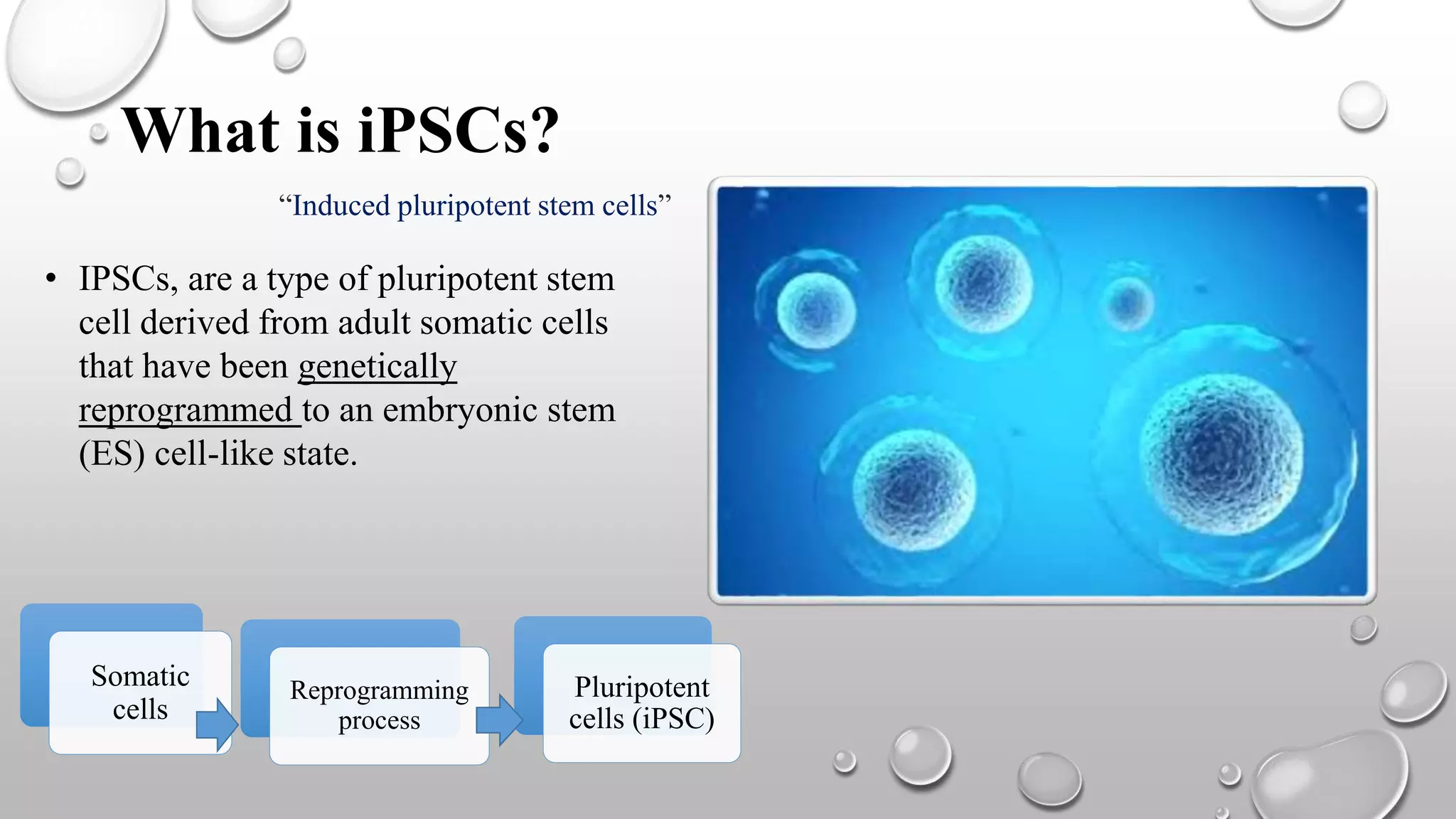
• IPSCs, are a type of pluripotent stem
cell derived from adult somatic cells
that have been genetically
reprogrammed to an embryonic stem
(ES) cell-like state.
“Induced pluripotent stem cells”
Pre-implantation embryo-derived self-renewable cell lines were
developed by Sir Martin John Evans, Matthew H. Kaufman, and Gail R.
Martin
Seminal studies confirmed the existence of reprogramming agents that
might be used to manipulate the pluripotency of any cell.
In 2006
The iPSC technology was pioneered by Shinya Yamanaka and Kazutoshi
Takahashi in Kyoto, Japan, who together showed that the introduction of
four specific genes (named Myc, Oct3/4, Sox2 and Klf4) “Yamanaka
factors” encoding transcription factors could convert somatic cells
into pluripotent stem cells.[1]
DEDIFFERENTIATION
REPROGRAMMING
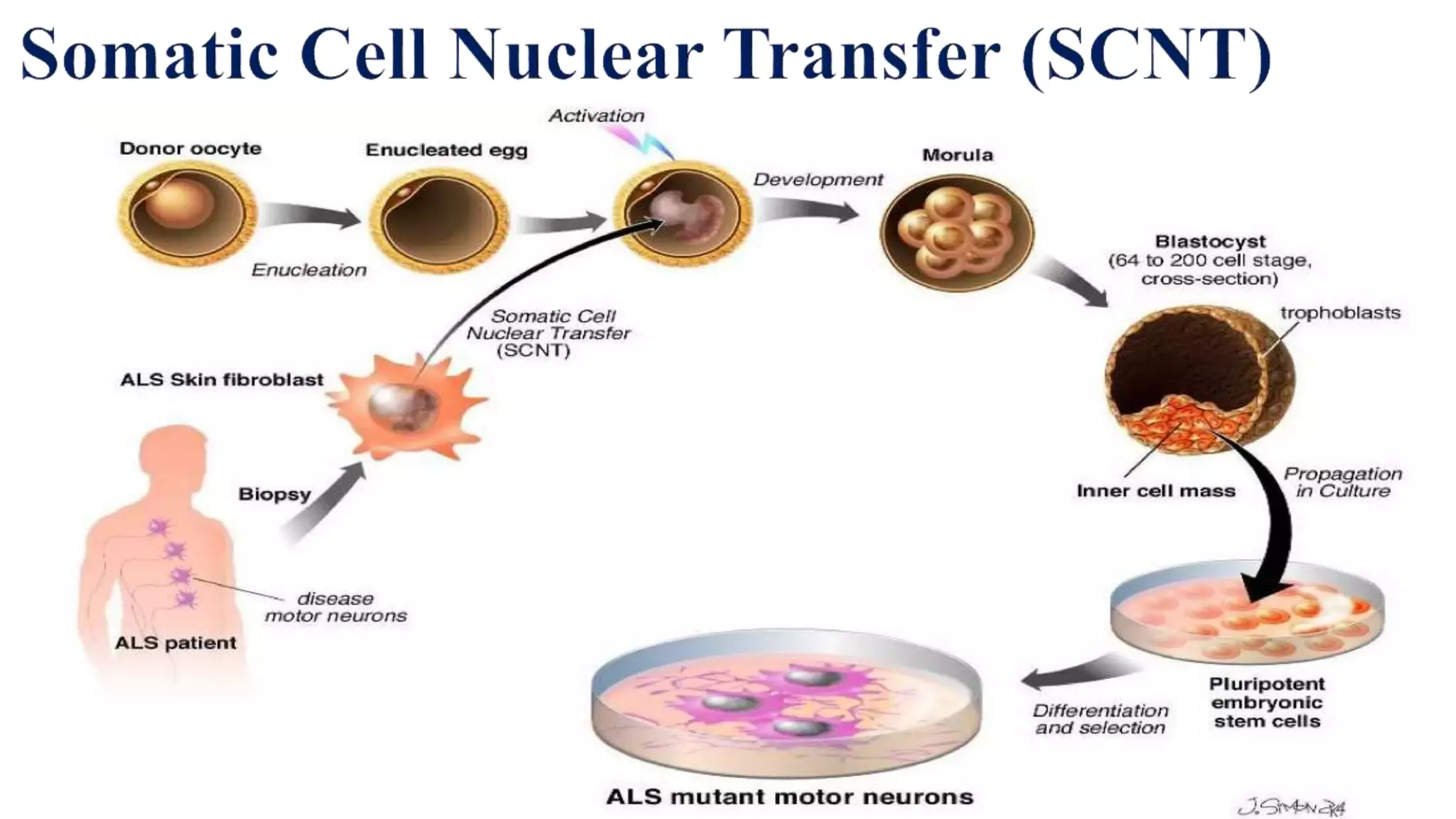
Development of ESCs
•Found in inner cell mass of blastocyte,
pluripotent.
Aim:
 Production of Embryonic-like Stem cells from
multipotent Somatic Cells, that can proliferate
indefinitely and undifferentiatedly in vitro while
still having the ability to develop into a wide range
of somatic cells.
Principle:
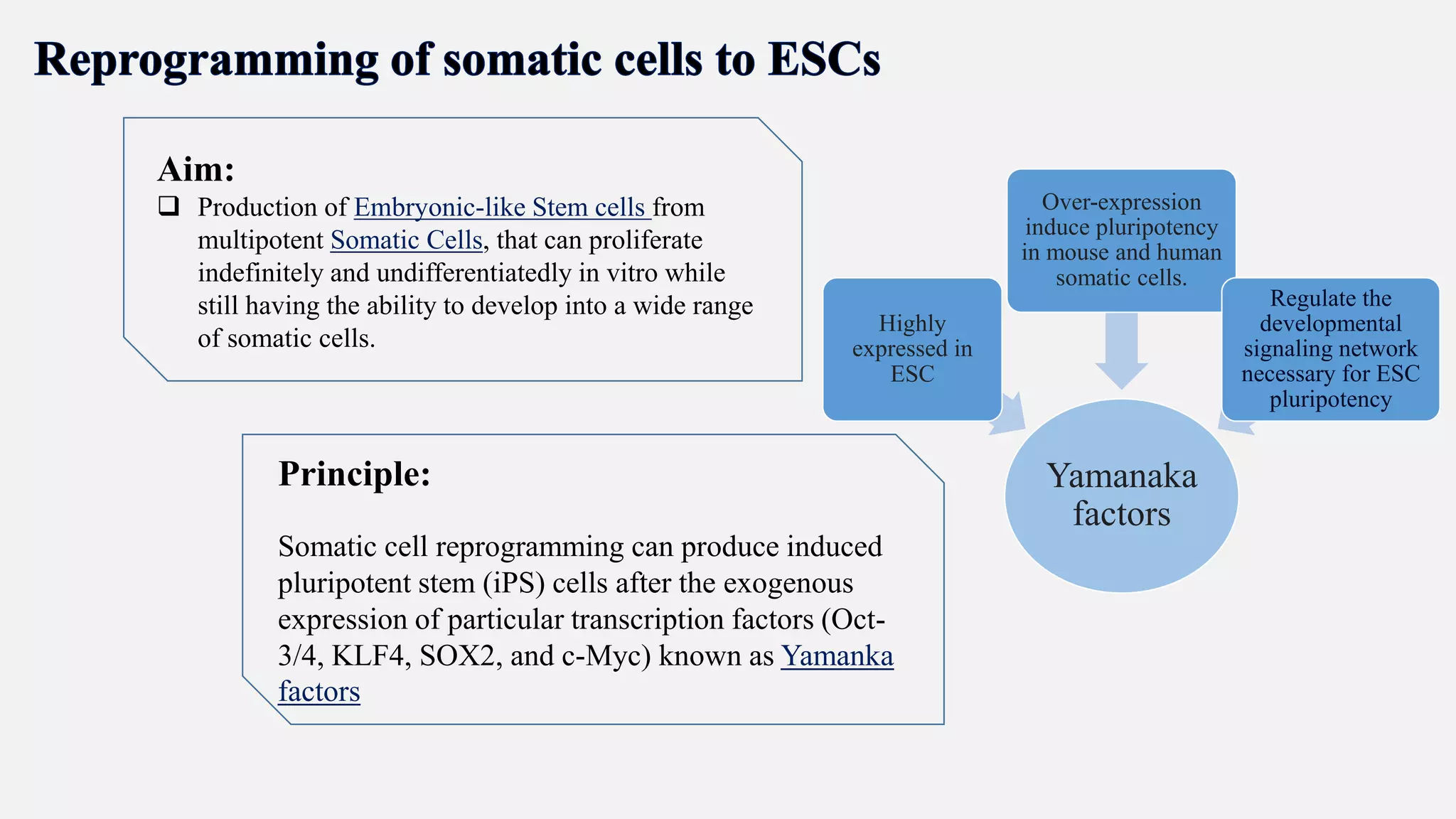
Somatic cell reprogramming can produce induced
pluripotent stem (iPS) cells after the exogenous
expression of particular transcription factors (Oct-
3/4, KLF4, SOX2, and c-Myc) known as Yamanka
factors
Yamanaka
factors
Highly
expressed in
ESC
Over-expression
induce pluripotency
in mouse and human
somatic cells.
Regulate the
developmental
signaling network
necessary for ESC
pluripotency
Delivery methods of reprogramming factors
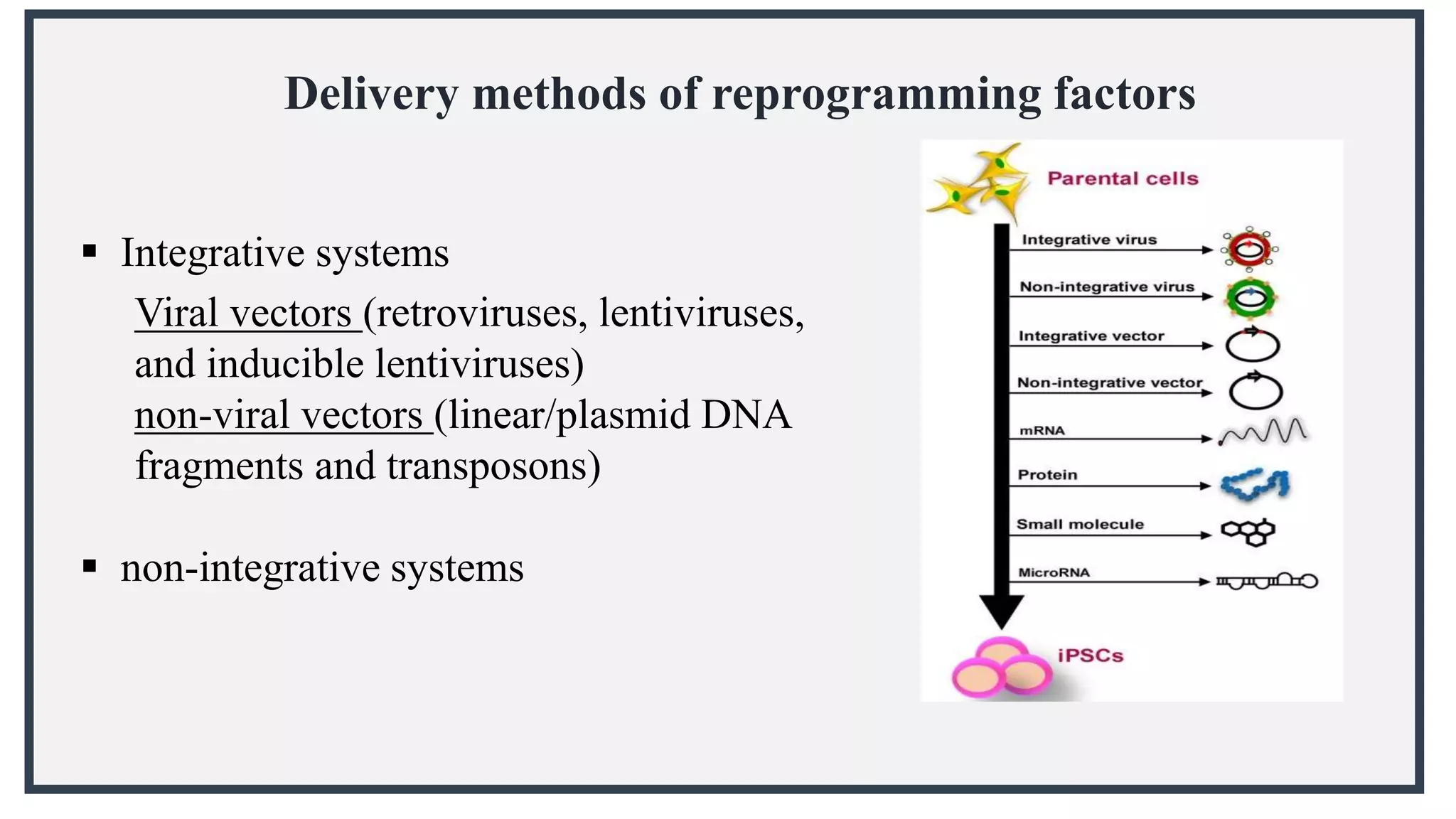
 Integrative systems
Viral vectors (retroviruses, lentiviruses,
and inducible lentiviruses)
non-viral vectors (linear/plasmid DNA
fragments and transposons)
 non-integrative systems
 Morphology: small size, high nuclear/cytoplasm ratios, and presence
of one or more nuclei
 Alkaline phosphatase (AKP), stage-specific embryonic antigens
(SSEA), Tra-1-60, Tra-181, and other molecular labelling techniques
are examples of immunological markers of iPS cells.
 Teratoma formation, embryoid body, and chimaera production are
typical pluripotency tests.
iPSCs Identification
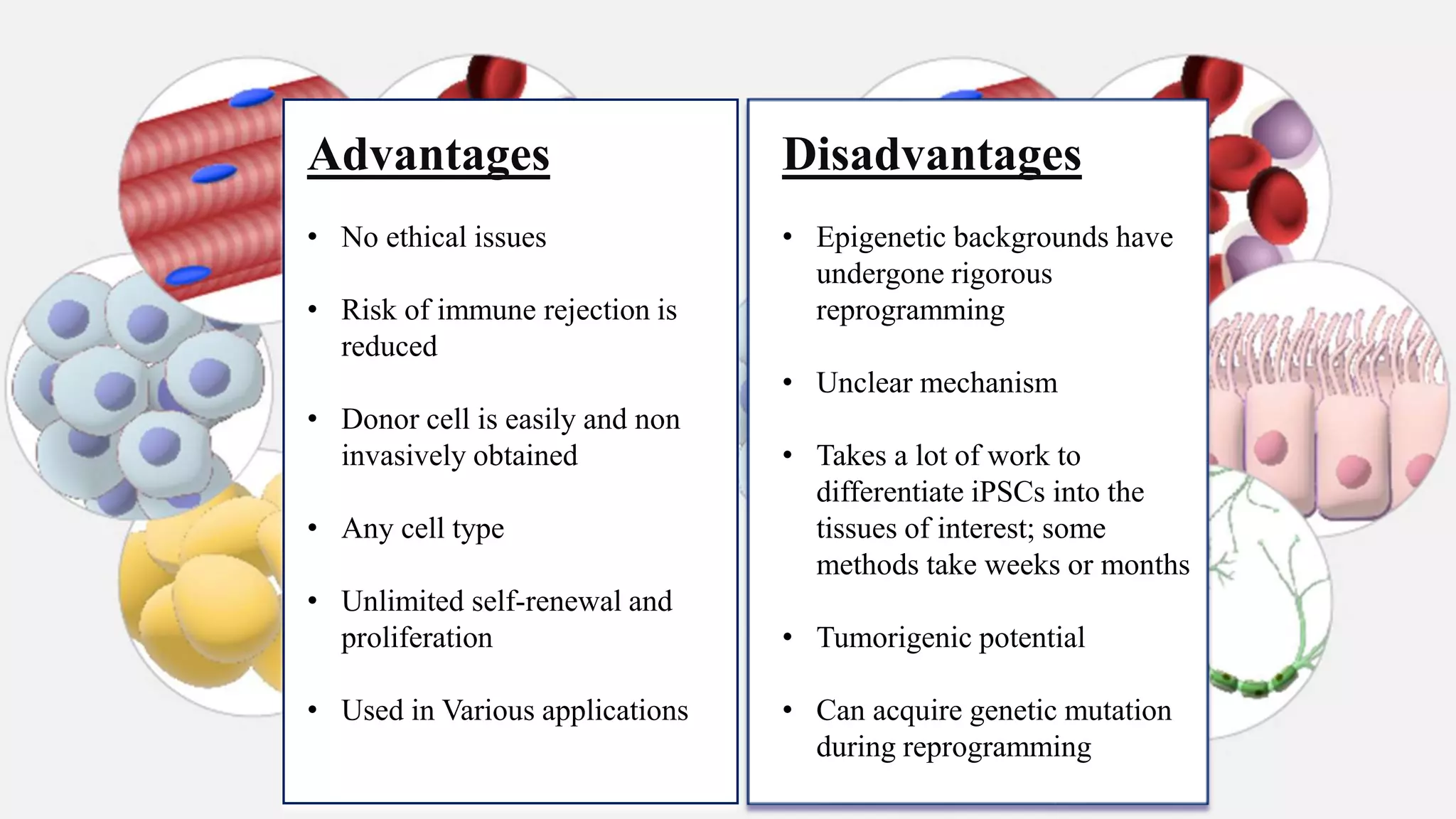
Advantages
• No ethical issues
• Risk of immune rejection is
reduced
• Donor cell is easily and non
invasively obtained
• Any cell type
• Unlimited self-renewal and
proliferation
• Used in Various applications
Disadvantages
• Epigenetic backgrounds have
undergone rigorous
reprogramming
• Unclear mechanism
• Takes a lot of work to
differentiate iPSCs into the
tissues of interest; some
methods take weeks or months
• Tumorigenic potential
• Can acquire genetic mutation
during reprogramming
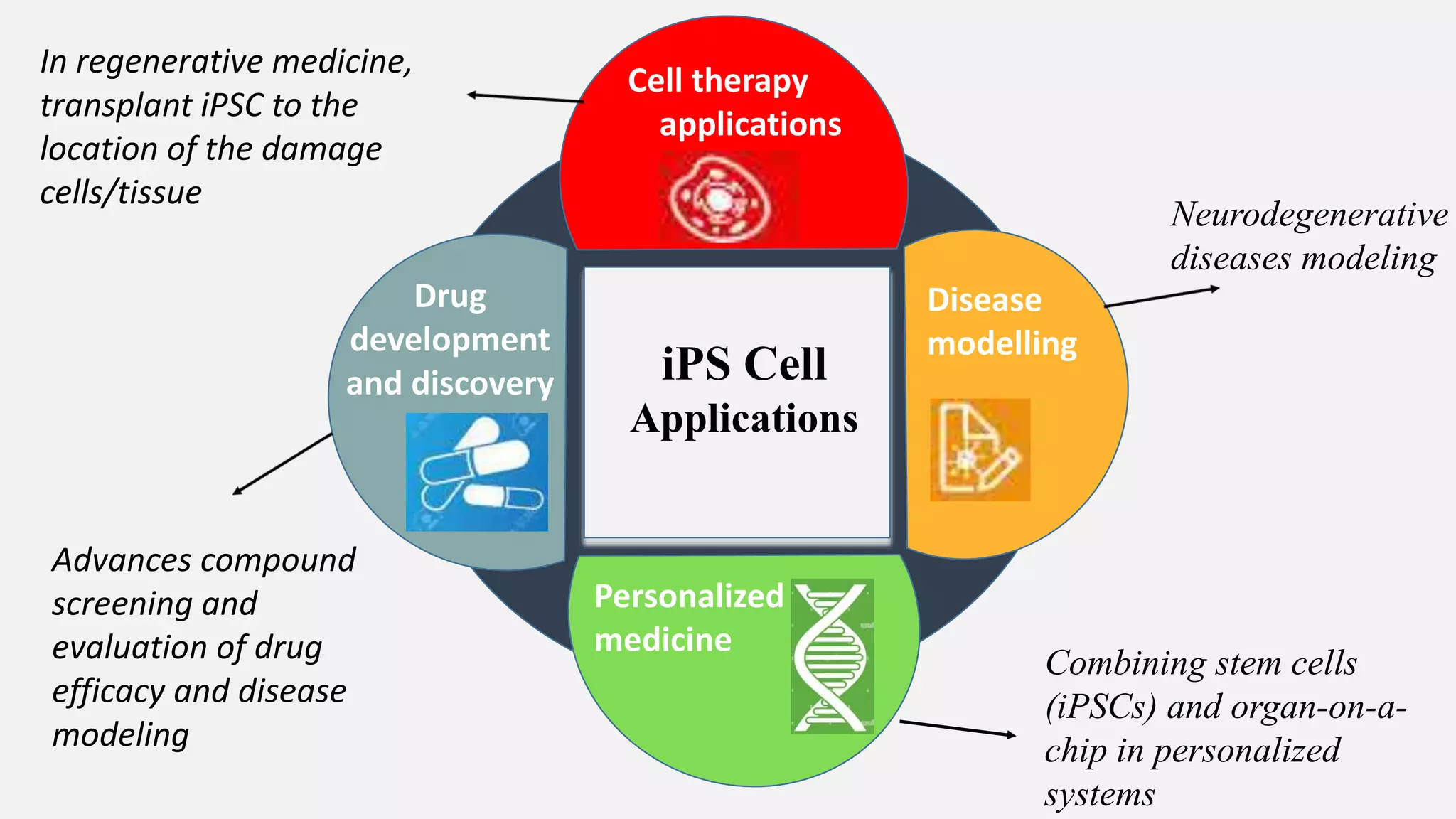
iPS Cell
Applications
Drug
development
and discovery
Cell therapy
applications
Personalized
medicine
Disease
modelling
In regenerative medicine,
transplant iPSC to the
location of the damage
cells/tissue
Neurodegenerative
diseases modeling
Combining stem cells
(iPSCs) and organ-on-a-
chip in personalized
systems
Advances compound
screening and
evaluation of drug
efficacy and disease
modeling
Reference
1. Induced pluripotent stem cells and their use in human models of disease ... (n.d.). Retrieved
March 13, 2023, from
2. Singh, V. K., Kalsan, M., Kumar, N., Saini, A., & Chandra, R. (2015). Induced pluripotent
stem cells: Applications in regenerative medicine, disease modeling, and drug discovery.
Frontiers in Cell and Developmental Biology,
3. Omole, A. E., & Fakoya, A. O. J. (2018). Ten years of progress and promise of induced
pluripotent stem cells: historical origins, characteristics, mechanisms, limitations, and
potential applications. PeerJ, 6, e4370.
4. Ye, L., Swingen, C., & Zhang, J. (2013). Induced pluripotent stem cells and their potential
for basic and clinical sciences. Current cardiology reviews, 9(1), 63–72. Moradi, S.,
5. Mahdizadeh, H., Šarić, T., Kim, J., Harati, J., Shahsavarani, H., ... & Moore, J. B. (2019).
Research and therapy with induced pluripotent stem cells (iPSCs): social, legal, and ethical
considerations. Stem cell research & therapy, 10(1), 1-13.
Thankyou!

Stem Cells iPSCs

  • 1.
    Stem cells, bt426 Presentedby: Joumana, Rokaia, and Mineam iPSCs Supervisor Dr. Emad El-zayat Prof. of Molecular Physiology & Biotechnology
  • 2.
    What is iPSCs? Somatic cells Reprogramming process Pluripotent cells(iPSC) • IPSCs, are a type of pluripotent stem cell derived from adult somatic cells that have been genetically reprogrammed to an embryonic stem (ES) cell-like state. “Induced pluripotent stem cells”
  • 3.
    Pre-implantation embryo-derived self-renewablecell lines were developed by Sir Martin John Evans, Matthew H. Kaufman, and Gail R. Martin Seminal studies confirmed the existence of reprogramming agents that might be used to manipulate the pluripotency of any cell. In 2006 The iPSC technology was pioneered by Shinya Yamanaka and Kazutoshi Takahashi in Kyoto, Japan, who together showed that the introduction of four specific genes (named Myc, Oct3/4, Sox2 and Klf4) “Yamanaka factors” encoding transcription factors could convert somatic cells into pluripotent stem cells.[1]
  • 4.
  • 5.
    Development of ESCs •Foundin inner cell mass of blastocyte, pluripotent.
  • 6.
    Aim:  Production ofEmbryonic-like Stem cells from multipotent Somatic Cells, that can proliferate indefinitely and undifferentiatedly in vitro while still having the ability to develop into a wide range of somatic cells. Principle: Somatic cell reprogramming can produce induced pluripotent stem (iPS) cells after the exogenous expression of particular transcription factors (Oct- 3/4, KLF4, SOX2, and c-Myc) known as Yamanka factors Yamanaka factors Highly expressed in ESC Over-expression induce pluripotency in mouse and human somatic cells. Regulate the developmental signaling network necessary for ESC pluripotency
  • 8.
    Delivery methods ofreprogramming factors  Integrative systems Viral vectors (retroviruses, lentiviruses, and inducible lentiviruses) non-viral vectors (linear/plasmid DNA fragments and transposons)  non-integrative systems
  • 11.
     Morphology: smallsize, high nuclear/cytoplasm ratios, and presence of one or more nuclei  Alkaline phosphatase (AKP), stage-specific embryonic antigens (SSEA), Tra-1-60, Tra-181, and other molecular labelling techniques are examples of immunological markers of iPS cells.  Teratoma formation, embryoid body, and chimaera production are typical pluripotency tests. iPSCs Identification
  • 12.
    Advantages • No ethicalissues • Risk of immune rejection is reduced • Donor cell is easily and non invasively obtained • Any cell type • Unlimited self-renewal and proliferation • Used in Various applications Disadvantages • Epigenetic backgrounds have undergone rigorous reprogramming • Unclear mechanism • Takes a lot of work to differentiate iPSCs into the tissues of interest; some methods take weeks or months • Tumorigenic potential • Can acquire genetic mutation during reprogramming
  • 14.
    iPS Cell Applications Drug development and discovery Celltherapy applications Personalized medicine Disease modelling In regenerative medicine, transplant iPSC to the location of the damage cells/tissue Neurodegenerative diseases modeling Combining stem cells (iPSCs) and organ-on-a- chip in personalized systems Advances compound screening and evaluation of drug efficacy and disease modeling
  • 15.
    Reference 1. Induced pluripotentstem cells and their use in human models of disease ... (n.d.). Retrieved March 13, 2023, from 2. Singh, V. K., Kalsan, M., Kumar, N., Saini, A., & Chandra, R. (2015). Induced pluripotent stem cells: Applications in regenerative medicine, disease modeling, and drug discovery. Frontiers in Cell and Developmental Biology, 3. Omole, A. E., & Fakoya, A. O. J. (2018). Ten years of progress and promise of induced pluripotent stem cells: historical origins, characteristics, mechanisms, limitations, and potential applications. PeerJ, 6, e4370. 4. Ye, L., Swingen, C., & Zhang, J. (2013). Induced pluripotent stem cells and their potential for basic and clinical sciences. Current cardiology reviews, 9(1), 63–72. Moradi, S., 5. Mahdizadeh, H., Šarić, T., Kim, J., Harati, J., Shahsavarani, H., ... & Moore, J. B. (2019). Research and therapy with induced pluripotent stem cells (iPSCs): social, legal, and ethical considerations. Stem cell research & therapy, 10(1), 1-13.
  • 16.