Stem Cell
Technology
Contents
 Defination
 History of stem cell
 Characteristics
 Classification on the level of their potency
 Kinds of Stem cell
 Stem cell Technology
 Application of stem cell Technology
 Ethical issues
 Conclusions and Recommendations
 Refrences
Stem cell definition
• A cell that has the ability to continuously divide and
differentiate into various other kind(s) of cells/tissues is called
stem cell.
• Present in multicellular organisms.
History of stem cells and their research
 In 1868 — The term “stem cell” appears in scientific literature, when German biologist Ernst
Haeckel uses the phrase stem cell to describe the fertilized egg that becomes an organism.
 In 1909, Alexander Maximow introduces the idea of blood stem cells that are multi-potent.
 In 1957 — E. Donnall Thomas, a physician-scientist, attempts the first human bone marrow
transplantation.
 In 1968, the first bone marrow transplant was successfully used in treatment of severe
Combined immunodeficiency.
 Since the 1970s, bone marrow transplants have been used for treatment of immuno
deficiencies and leukemias.
Characteristics
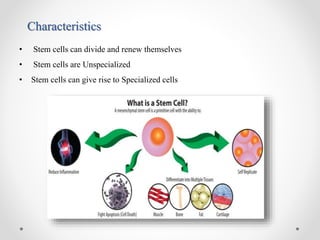
• Stem cells can divide and renew themselves
• Stem cells are Unspecialized
• Stem cells can give rise to Specialized cells
Classification on level of differentiation (potency)
1. Totipotent stem cell
2. Multipotent stem cell
3. Pluripotent stem cell
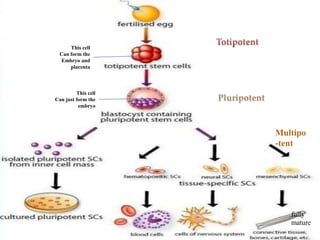
Totipotent stem cells: In this stem cell type, each cell can develop
into a new complete embryo , which forms a new individual.
These can develop into any kind of tissue or cell in the body.
For example; cells from early (1-3 days) embryos.
Multipotent Stem Cells:
Also called as adult stem cells and appear in 14 day old embryo.
These cells have the ability to differentiate into closely related
family of cells. They can give rise to more than one cell type.
• Example: Hematopoietic (adult) stem cells that can become
RBCs, WBCs and platelets.
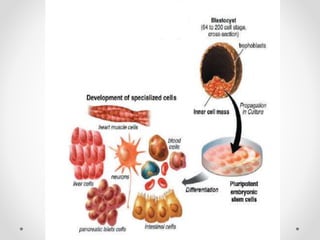
Pluripotent Stem Cells:
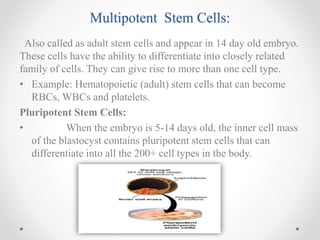
• When the embryo is 5-14 days old, the inner cell mass
of the blastocyst contains pluripotent stem cells that can
differentiate into all the 200+ cell types in the body.
This cell
Can form the
Embryo and
placenta
This cell
Can just form the
embryo
Multipo
-tent
fully
mature
Types of stem cells
On the base of Origin , stem cells can commonly divide into
two basic types:
• Embryonic stem cells
• Adult stem cells
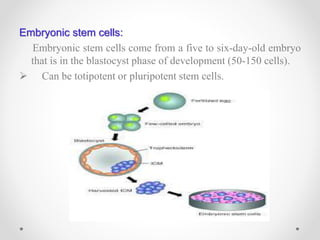
Embryonic stem cells:
Embryonic stem cells come from a five to six-day-old embryo
that is in the blastocyst phase of development (50-150 cells).
 Can be totipotent or pluripotent stem cells.
Adult stem cell:
Adult stem cells are undifferentiated cells found among
specialized or differentiated cells in a tissue or organ after birth
Such as bone marrow cells.
Stem Cell Technology:
Stem cell technology is a rapidly developing field that combines
the efforts of cell biologists, geneticists, and clinicians and
offers hope of effective treatment for a variety of malignant
and non-malignant diseases.
Today living in the 21st century, we still do not have proper
treatments for many diseases like diabetes, Parkinson’s
disease, Alzheimer’s disease etc. Some light of hope for the
treatments of these incurable diseases is – Stem Cell
Technology.
Applications of stem cell technology:
1) Cancer (Leukemia)
• Leukemia is a cancer of blood and bone marrow. It causes
white blood cells (leukocytes) to develop abnormally.
• It is the first disease to have been treated with stem cells –
bone marrow transplant contain blood stem cells.
2. Heart Disease
• Adult bone marrow cells injected into the heart are
believed to cure heart functioning in patients of heart
failure or heart attack
3. Parkinson’s Disease
• The majority of complications in Parkinson’s patients are
related to the failure of dopamine producing neurons.
• Dopamine producing neurons are treated with stem
cells.
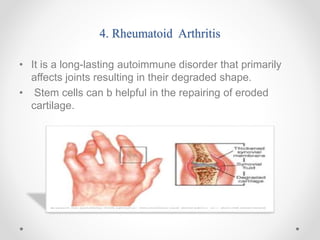
4. Rheumatoid Arthritis
• It is a long-lasting autoimmune disorder that primarily
affects joints resulting in their degraded shape.
• Stem cells can b helpful in the repairing of eroded
cartilage.
Induced Pluripotent stem cells (iPSCs):
 New advancement in SC technology
 Completely embryonic-independent known as “nuclear
reprogramming”
 Ordinary fibroblast cells are converted into embryo like stem
cells by introducing only a few pieces of DNA
 These are iPSCs that function equivalently to hES cells.
Is stem cell technology Ethical?
 Embryonic stem cells- always morally objectionable, because the
human embryo must be destroyed in order to harvest its stem cell.
 Embryonic germ cells- morally objectionable when utilizing fetal
tissue derived from elective abortions, but morally acceptable when
utilizing material from spontaneous abortions (miscarriages)
 Umbilical cord stem cells- morally acceptable, since the umbilical
cord is no longer required once the delivery has been completed
 Placentally -derived stem cells- morally acceptable, since the
afterbirth is no longer required after the delivery has been completed
 Adult stem cells- morally acceptable.
Ethical Debate
In Favor of ESCR:
• Since excess IVF embryos will be discarded anyway, it is
better to use them for human benefits.
• Therapeutic cloning produces cells in petri-dish, not a
pregnancy.
In Opposition of ESCR:
• In ESCR, stem cells are taken from a human blastocyst, which
is then destroyed. This amounts to “murder”.
• ESCR will lead to reproductive cloning.
Conclusions
• Stem cells show great promise for regenerative medicine
• There is enormous potential in human stem cell research, both adult and
embryonic stem cells should be studied
• Much research needed before therapies are realized
• Ethical concerns need to be taken into account
• Proper guidelines are needed to ensure appropriate conduct of the research
Similar to most emerging tools in modern medicines, stem cell
technology should be used within established ethical,
financial, political and scientific perspectives.
References
Beauchamp, T. L. and J. F. Childress. 2008. Principles of biomedical
ethics. NY: Oxford University Press. New York.
Chandross, K. J., E. Mezey., M. P. Mattson and G. V. Zant. 2001.
Plasticity of adult bone marrow stem cells. Greenwich, C.T: JAI Press.
Guido, D. W. and C. Mummery. 2003. Stem and stem cell therapy. J.
Hum. Reprod. 18: pg. 672-682.
Muhammad , A. H., M. S. Wicha, A. B. Hernandez , S. J. Morrison and
M. F. Clarke. 2003. Prospective identification of tumorigenic breast
cancer cells. Proc. Natl. Acad. Sci. U.S.A. 100: pg. 3983–3988.
Any Queries???

Stem cell technology

  • 2.
  • 3.
    Contents  Defination  Historyof stem cell  Characteristics  Classification on the level of their potency  Kinds of Stem cell  Stem cell Technology  Application of stem cell Technology  Ethical issues  Conclusions and Recommendations  Refrences
  • 4.
    Stem cell definition •A cell that has the ability to continuously divide and differentiate into various other kind(s) of cells/tissues is called stem cell. • Present in multicellular organisms.
  • 5.
    History of stemcells and their research  In 1868 — The term “stem cell” appears in scientific literature, when German biologist Ernst Haeckel uses the phrase stem cell to describe the fertilized egg that becomes an organism.  In 1909, Alexander Maximow introduces the idea of blood stem cells that are multi-potent.  In 1957 — E. Donnall Thomas, a physician-scientist, attempts the first human bone marrow transplantation.  In 1968, the first bone marrow transplant was successfully used in treatment of severe Combined immunodeficiency.  Since the 1970s, bone marrow transplants have been used for treatment of immuno deficiencies and leukemias.
  • 6.
    Characteristics • Stem cellscan divide and renew themselves • Stem cells are Unspecialized • Stem cells can give rise to Specialized cells
  • 7.
    Classification on levelof differentiation (potency) 1. Totipotent stem cell 2. Multipotent stem cell 3. Pluripotent stem cell Totipotent stem cells: In this stem cell type, each cell can develop into a new complete embryo , which forms a new individual. These can develop into any kind of tissue or cell in the body. For example; cells from early (1-3 days) embryos.
  • 8.
    Multipotent Stem Cells: Alsocalled as adult stem cells and appear in 14 day old embryo. These cells have the ability to differentiate into closely related family of cells. They can give rise to more than one cell type. • Example: Hematopoietic (adult) stem cells that can become RBCs, WBCs and platelets. Pluripotent Stem Cells: • When the embryo is 5-14 days old, the inner cell mass of the blastocyst contains pluripotent stem cells that can differentiate into all the 200+ cell types in the body.
  • 9.
    This cell Can formthe Embryo and placenta This cell Can just form the embryo Multipo -tent fully mature
  • 10.
    Types of stemcells On the base of Origin , stem cells can commonly divide into two basic types: • Embryonic stem cells • Adult stem cells
  • 11.
    Embryonic stem cells: Embryonicstem cells come from a five to six-day-old embryo that is in the blastocyst phase of development (50-150 cells).  Can be totipotent or pluripotent stem cells.
  • 12.
    Adult stem cell: Adultstem cells are undifferentiated cells found among specialized or differentiated cells in a tissue or organ after birth Such as bone marrow cells.
  • 13.
    Stem Cell Technology: Stemcell technology is a rapidly developing field that combines the efforts of cell biologists, geneticists, and clinicians and offers hope of effective treatment for a variety of malignant and non-malignant diseases. Today living in the 21st century, we still do not have proper treatments for many diseases like diabetes, Parkinson’s disease, Alzheimer’s disease etc. Some light of hope for the treatments of these incurable diseases is – Stem Cell Technology.
  • 15.
    Applications of stemcell technology: 1) Cancer (Leukemia) • Leukemia is a cancer of blood and bone marrow. It causes white blood cells (leukocytes) to develop abnormally. • It is the first disease to have been treated with stem cells – bone marrow transplant contain blood stem cells.
  • 16.
    2. Heart Disease •Adult bone marrow cells injected into the heart are believed to cure heart functioning in patients of heart failure or heart attack
  • 17.
    3. Parkinson’s Disease •The majority of complications in Parkinson’s patients are related to the failure of dopamine producing neurons. • Dopamine producing neurons are treated with stem cells.
  • 18.
    4. Rheumatoid Arthritis •It is a long-lasting autoimmune disorder that primarily affects joints resulting in their degraded shape. • Stem cells can b helpful in the repairing of eroded cartilage.
  • 19.
    Induced Pluripotent stemcells (iPSCs):  New advancement in SC technology  Completely embryonic-independent known as “nuclear reprogramming”  Ordinary fibroblast cells are converted into embryo like stem cells by introducing only a few pieces of DNA  These are iPSCs that function equivalently to hES cells.
  • 20.
    Is stem celltechnology Ethical?  Embryonic stem cells- always morally objectionable, because the human embryo must be destroyed in order to harvest its stem cell.  Embryonic germ cells- morally objectionable when utilizing fetal tissue derived from elective abortions, but morally acceptable when utilizing material from spontaneous abortions (miscarriages)  Umbilical cord stem cells- morally acceptable, since the umbilical cord is no longer required once the delivery has been completed  Placentally -derived stem cells- morally acceptable, since the afterbirth is no longer required after the delivery has been completed  Adult stem cells- morally acceptable.
  • 21.
    Ethical Debate In Favorof ESCR: • Since excess IVF embryos will be discarded anyway, it is better to use them for human benefits. • Therapeutic cloning produces cells in petri-dish, not a pregnancy. In Opposition of ESCR: • In ESCR, stem cells are taken from a human blastocyst, which is then destroyed. This amounts to “murder”. • ESCR will lead to reproductive cloning.
  • 22.
    Conclusions • Stem cellsshow great promise for regenerative medicine • There is enormous potential in human stem cell research, both adult and embryonic stem cells should be studied • Much research needed before therapies are realized • Ethical concerns need to be taken into account • Proper guidelines are needed to ensure appropriate conduct of the research
  • 23.
    Similar to mostemerging tools in modern medicines, stem cell technology should be used within established ethical, financial, political and scientific perspectives.
  • 24.
    References Beauchamp, T. L.and J. F. Childress. 2008. Principles of biomedical ethics. NY: Oxford University Press. New York. Chandross, K. J., E. Mezey., M. P. Mattson and G. V. Zant. 2001. Plasticity of adult bone marrow stem cells. Greenwich, C.T: JAI Press. Guido, D. W. and C. Mummery. 2003. Stem and stem cell therapy. J. Hum. Reprod. 18: pg. 672-682. Muhammad , A. H., M. S. Wicha, A. B. Hernandez , S. J. Morrison and M. F. Clarke. 2003. Prospective identification of tumorigenic breast cancer cells. Proc. Natl. Acad. Sci. U.S.A. 100: pg. 3983–3988.
  • 25.