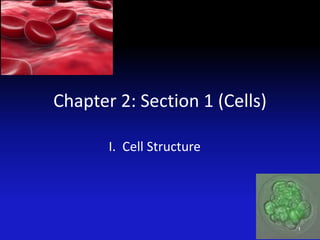
Chapter 2: Section 1 (Cells)
I. Cell Structure
1
2
A. Common Cell Traits
1. Cell: Smallest unit that is capable of performing
life functions.
2. Every cell has a CELL MEMBRANE.
a. In animal cells it is the outer layer.
b. In plant cells it is just inside the CELL WALL.
3. Every cell has cytoplasm.
a. Cytoplasm is a gelatin like material that fills the inside
of the cell.
b. In the cytoplasm of every cell is hereditary material
that controls the life of the cell.
3
B. Comparing Cells
1. Cells come in many sizes.
a. Nerve Cells can be up to a meter long.
b. Human Egg Cell is the size of the dot on the
letter i.
c. Human Red Blood Cell is 1/10th the dot on an i.
d. Bacteria Cell is the smallest known cell.
1. 8,000 will fit inside the dot on an i.
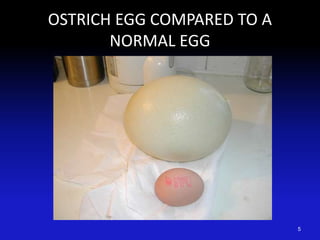
e. Ostrich Egg Yolk is the largest known cell.
f. Plant cells are generally more
square/rectangular shaped.
g. Animal cells are usually more round shaped.
4
OSTRICH EGG COMPARED TO A
NORMAL EGG
5
2. Cells can also vary in shape.
a. Their shape is normally determined by the job it is
doing.
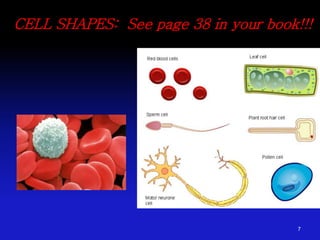
3. Examples of cell shapes:
a. Nerve Cells: have many extensions in order to send
signals faster and over large distances.
b. Muscle Cells: can be long and skinny when relaxed;
can be short and fat when tightened.
c. Red Blood Cells: small and round in order to easily
flow through all the blood vessels TO DELIVER OXYGEN
to all cells.
d. White Blood Cells: can change shape easily because
they eat and devour any harmful object.
6
CELL SHAPES: See page 38 in your book!!!
7
C. Types of Cells
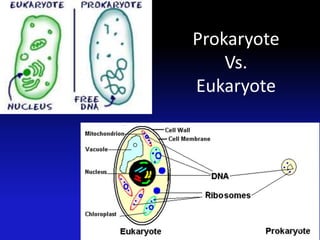
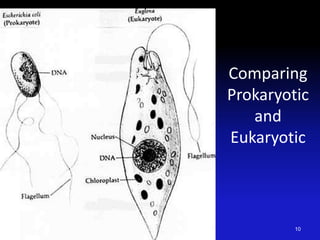
1. Prokaryotic: Cells without a membrane
around the internal cell parts
a. This means they do not have a NUCLEAR
MEMBRANE around the DNA.
b. Example: Bacteria
2. Eukaryotic: Cells with membranes around
their internal cell parts.
a. They have a NUCLEAR MEMBRANE around
their DNA.
b. Examples: Protists, Fungi, Plants, and Animals.
8
Prokaryote
Vs.
Eukaryote
9
Comparing
Prokaryotic
and
Eukaryotic
10
D. What is Cell Organization?
1. Each cell in your body has a specific job.
a. Because of this cells have specific parts that are needed to
perform specific tasks.
2. Organelles are the parts of a cell.
a. Organelles means little organs in Latin.
11
Chapter 2: Section 1
II. Cell Organelles
12
A. Cell Wall: The outer layer of a plants,
bacteria, some protists, and fungi.
1. Description: It is tough and rigid.
2. Function: to protect, give the cell its
shape and allow materials into and
out of the cell.
a. Water, food and oxygen/CO2 need to get into
the cell. (Raw materials for the cell)
b. CO2/ Oxygen and wastes need to get out
of the cell. (Waste products)
13
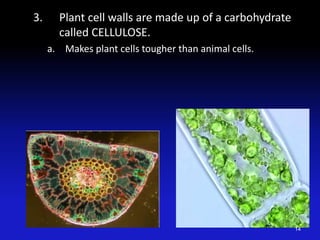
3. Plant cell walls are made up of a carbohydrate
called CELLULOSE.
a. Makes plant cells tougher than animal cells.
14
B. Cell Membrane
1. Outer layer n all animal cells and some protists.
2. 2nd layer inside cell wall in plants.
3. Function: allow materials into and out of the
cell; protection.
a. Water, Oxygen, and Food enter.
b. Wastes and CO2 exit.
4. Cell membranes are less rigid and softer than cell
walls.
15
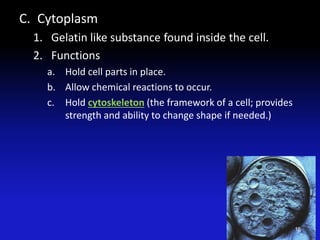
C. Cytoplasm
1. Gelatin like substance found inside the cell.
2. Functions
a. Hold cell parts in place.
b. Allow chemical reactions to occur.
c. Hold cytoskeleton (the framework of a cell; provides
strength and ability to change shape if needed.)
16
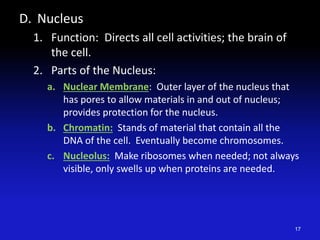
D. Nucleus
1. Function: Directs all cell activities; the brain of
the cell.
2. Parts of the Nucleus:
a. Nuclear Membrane: Outer layer of the nucleus that
has pores to allow materials in and out of nucleus;
provides protection for the nucleus.
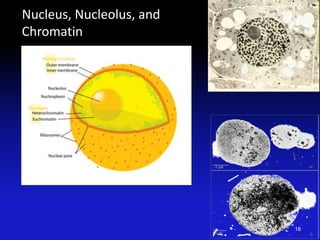
b. Chromatin: Stands of material that contain all the
DNA of the cell. Eventually become chromosomes.
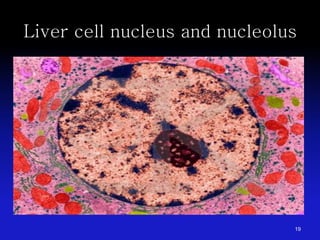
c. Nucleolus: Make ribosomes when needed; not always
visible, only swells up when proteins are needed.
17
Nucleus, Nucleolus, and
Chromatin
18
Liver cell nucleus and nucleolus
19
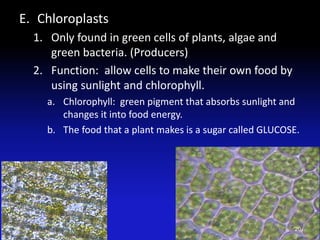
E. Chloroplasts
1. Only found in green cells of plants, algae and
green bacteria. (Producers)
2. Function: allow cells to make their own food by
using sunlight and chlorophyll.
a. Chlorophyll: green pigment that absorbs sunlight and
changes it into food energy.
b. The food that a plant makes is a sugar called GLUCOSE.
20
21
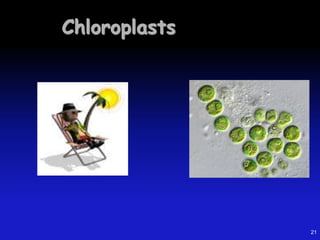
Chloroplasts
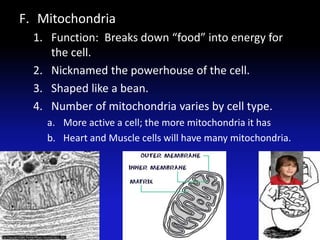
F. Mitochondria
1. Function: Breaks down “food” into energy for
the cell.
2. Nicknamed the powerhouse of the cell.
3. Shaped like a bean.
4. Number of mitochondria varies by cell type.
a. More active a cell; the more mitochondria it has
b. Heart and Muscle cells will have many mitochondria.
22
23
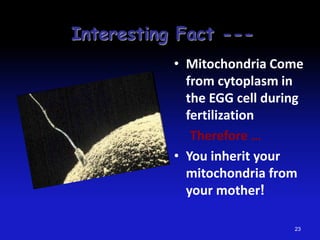
Interesting Fact ---
• Mitochondria Come
from cytoplasm in
the EGG cell during
fertilization
Therefore …
• You inherit your
mitochondria from
your mother!
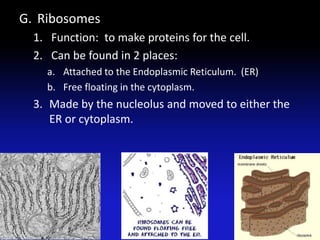
G. Ribosomes
1. Function: to make proteins for the cell.
2. Can be found in 2 places:
a. Attached to the Endoplasmic Reticulum. (ER)
b. Free floating in the cytoplasm.
3. Made by the nucleolus and moved to either the
ER or cytoplasm.
24
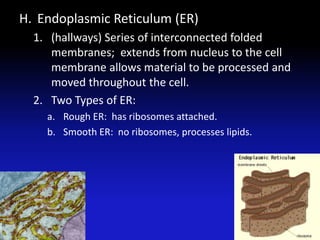
H. Endoplasmic Reticulum (ER)
1. (hallways) Series of interconnected folded
membranes; extends from nucleus to the cell
membrane allows material to be processed and
moved throughout the cell.
2. Two Types of ER:
a. Rough ER: has ribosomes attached.
b. Smooth ER: no ribosomes, processes lipids.
25
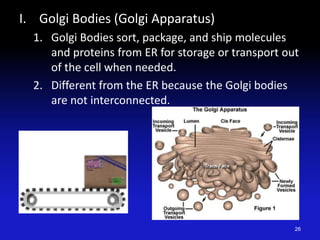
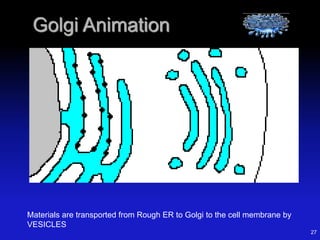
I. Golgi Bodies (Golgi Apparatus)
1. Golgi Bodies sort, package, and ship molecules
and proteins from ER for storage or transport out
of the cell when needed.
2. Different from the ER because the Golgi bodies
are not interconnected.
26
27
Golgi Animation
Materials are transported from Rough ER to Golgi to the cell membrane by
VESICLES
J. Vacuoles (Closets)
1. Temporary storage units for anything .
2. Most will hold water, extra food, waste products
and other cellular material.
3. Vary in size and number between plant and
animal cells.
a. Plant Cells usually have one large vacuole.
b. Animal cells usually have many small vacuoles.
28
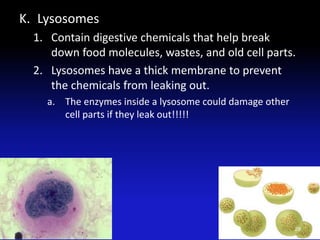
K. Lysosomes
1. Contain digestive chemicals that help break
down food molecules, wastes, and old cell parts.
2. Lysosomes have a thick membrane to prevent
the chemicals from leaking out.
a. The enzymes inside a lysosome could damage other
cell parts if they leak out!!!!!
29
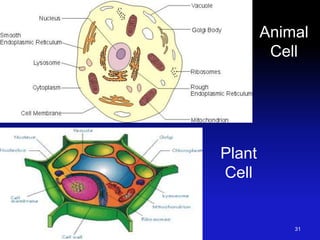
L. Plant vs Animal Cells
1. Plant Cells
a. Have chloroplasts, cell wall, and one large vacuole.
b. More rectangular in shape.
c. Generally have a green color.
2. Animal Cells
a. No cell wall, no chloroplasts, and many small vacuoles.
b. More circular in shape.
c. Color and shape varies on the function of the cell.
30
Plant
Cell
Animal
Cell
31
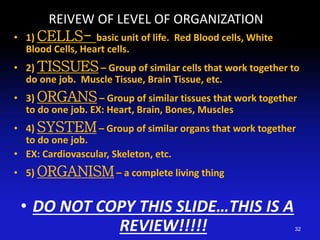
REIVEW OF LEVEL OF ORGANIZATION
• 1) CELLS- basic unit of life. Red Blood cells, White
Blood Cells, Heart cells.
• 2) TISSUES– Group of similar cells that work together to
do one job. Muscle Tissue, Brain Tissue, etc.
• 3) ORGANS– Group of similar tissues that work together
to do one job. EX: Heart, Brain, Bones, Muscles
• 4) SYSTEM– Group of similar organs that work together
to do one job.
• EX: Cardiovascular, Skeleton, etc.
• 5) ORGANISM– a complete living thing
• DO NOT COPY THIS SLIDE…THIS IS A
REVIEW!!!!! 32

Chapter 2 section 1 (2011)

  • 1.
    Chapter 2: Section1 (Cells) I. Cell Structure 1
  • 2.
  • 3.
    A. Common CellTraits 1. Cell: Smallest unit that is capable of performing life functions. 2. Every cell has a CELL MEMBRANE. a. In animal cells it is the outer layer. b. In plant cells it is just inside the CELL WALL. 3. Every cell has cytoplasm. a. Cytoplasm is a gelatin like material that fills the inside of the cell. b. In the cytoplasm of every cell is hereditary material that controls the life of the cell. 3
  • 4.
    B. Comparing Cells 1.Cells come in many sizes. a. Nerve Cells can be up to a meter long. b. Human Egg Cell is the size of the dot on the letter i. c. Human Red Blood Cell is 1/10th the dot on an i. d. Bacteria Cell is the smallest known cell. 1. 8,000 will fit inside the dot on an i. e. Ostrich Egg Yolk is the largest known cell. f. Plant cells are generally more square/rectangular shaped. g. Animal cells are usually more round shaped. 4
  • 5.
    OSTRICH EGG COMPAREDTO A NORMAL EGG 5
  • 6.
    2. Cells canalso vary in shape. a. Their shape is normally determined by the job it is doing. 3. Examples of cell shapes: a. Nerve Cells: have many extensions in order to send signals faster and over large distances. b. Muscle Cells: can be long and skinny when relaxed; can be short and fat when tightened. c. Red Blood Cells: small and round in order to easily flow through all the blood vessels TO DELIVER OXYGEN to all cells. d. White Blood Cells: can change shape easily because they eat and devour any harmful object. 6
  • 7.
    CELL SHAPES: Seepage 38 in your book!!! 7
  • 8.
    C. Types ofCells 1. Prokaryotic: Cells without a membrane around the internal cell parts a. This means they do not have a NUCLEAR MEMBRANE around the DNA. b. Example: Bacteria 2. Eukaryotic: Cells with membranes around their internal cell parts. a. They have a NUCLEAR MEMBRANE around their DNA. b. Examples: Protists, Fungi, Plants, and Animals. 8
  • 9.
  • 10.
  • 11.
    D. What isCell Organization? 1. Each cell in your body has a specific job. a. Because of this cells have specific parts that are needed to perform specific tasks. 2. Organelles are the parts of a cell. a. Organelles means little organs in Latin. 11
  • 12.
    Chapter 2: Section1 II. Cell Organelles 12
  • 13.
    A. Cell Wall:The outer layer of a plants, bacteria, some protists, and fungi. 1. Description: It is tough and rigid. 2. Function: to protect, give the cell its shape and allow materials into and out of the cell. a. Water, food and oxygen/CO2 need to get into the cell. (Raw materials for the cell) b. CO2/ Oxygen and wastes need to get out of the cell. (Waste products) 13
  • 14.
    3. Plant cellwalls are made up of a carbohydrate called CELLULOSE. a. Makes plant cells tougher than animal cells. 14
  • 15.
    B. Cell Membrane 1.Outer layer n all animal cells and some protists. 2. 2nd layer inside cell wall in plants. 3. Function: allow materials into and out of the cell; protection. a. Water, Oxygen, and Food enter. b. Wastes and CO2 exit. 4. Cell membranes are less rigid and softer than cell walls. 15
  • 16.
    C. Cytoplasm 1. Gelatinlike substance found inside the cell. 2. Functions a. Hold cell parts in place. b. Allow chemical reactions to occur. c. Hold cytoskeleton (the framework of a cell; provides strength and ability to change shape if needed.) 16
  • 17.
    D. Nucleus 1. Function:Directs all cell activities; the brain of the cell. 2. Parts of the Nucleus: a. Nuclear Membrane: Outer layer of the nucleus that has pores to allow materials in and out of nucleus; provides protection for the nucleus. b. Chromatin: Stands of material that contain all the DNA of the cell. Eventually become chromosomes. c. Nucleolus: Make ribosomes when needed; not always visible, only swells up when proteins are needed. 17
  • 18.
  • 19.
    Liver cell nucleusand nucleolus 19
  • 20.
    E. Chloroplasts 1. Onlyfound in green cells of plants, algae and green bacteria. (Producers) 2. Function: allow cells to make their own food by using sunlight and chlorophyll. a. Chlorophyll: green pigment that absorbs sunlight and changes it into food energy. b. The food that a plant makes is a sugar called GLUCOSE. 20
  • 21.
  • 22.
    F. Mitochondria 1. Function:Breaks down “food” into energy for the cell. 2. Nicknamed the powerhouse of the cell. 3. Shaped like a bean. 4. Number of mitochondria varies by cell type. a. More active a cell; the more mitochondria it has b. Heart and Muscle cells will have many mitochondria. 22
  • 23.
    23 Interesting Fact --- •Mitochondria Come from cytoplasm in the EGG cell during fertilization Therefore … • You inherit your mitochondria from your mother!
  • 24.
    G. Ribosomes 1. Function:to make proteins for the cell. 2. Can be found in 2 places: a. Attached to the Endoplasmic Reticulum. (ER) b. Free floating in the cytoplasm. 3. Made by the nucleolus and moved to either the ER or cytoplasm. 24
  • 25.
    H. Endoplasmic Reticulum(ER) 1. (hallways) Series of interconnected folded membranes; extends from nucleus to the cell membrane allows material to be processed and moved throughout the cell. 2. Two Types of ER: a. Rough ER: has ribosomes attached. b. Smooth ER: no ribosomes, processes lipids. 25
  • 26.
    I. Golgi Bodies(Golgi Apparatus) 1. Golgi Bodies sort, package, and ship molecules and proteins from ER for storage or transport out of the cell when needed. 2. Different from the ER because the Golgi bodies are not interconnected. 26
  • 27.
    27 Golgi Animation Materials aretransported from Rough ER to Golgi to the cell membrane by VESICLES
  • 28.
    J. Vacuoles (Closets) 1.Temporary storage units for anything . 2. Most will hold water, extra food, waste products and other cellular material. 3. Vary in size and number between plant and animal cells. a. Plant Cells usually have one large vacuole. b. Animal cells usually have many small vacuoles. 28
  • 29.
    K. Lysosomes 1. Containdigestive chemicals that help break down food molecules, wastes, and old cell parts. 2. Lysosomes have a thick membrane to prevent the chemicals from leaking out. a. The enzymes inside a lysosome could damage other cell parts if they leak out!!!!! 29
  • 30.
    L. Plant vsAnimal Cells 1. Plant Cells a. Have chloroplasts, cell wall, and one large vacuole. b. More rectangular in shape. c. Generally have a green color. 2. Animal Cells a. No cell wall, no chloroplasts, and many small vacuoles. b. More circular in shape. c. Color and shape varies on the function of the cell. 30
  • 31.
  • 32.
    REIVEW OF LEVELOF ORGANIZATION • 1) CELLS- basic unit of life. Red Blood cells, White Blood Cells, Heart cells. • 2) TISSUES– Group of similar cells that work together to do one job. Muscle Tissue, Brain Tissue, etc. • 3) ORGANS– Group of similar tissues that work together to do one job. EX: Heart, Brain, Bones, Muscles • 4) SYSTEM– Group of similar organs that work together to do one job. • EX: Cardiovascular, Skeleton, etc. • 5) ORGANISM– a complete living thing • DO NOT COPY THIS SLIDE…THIS IS A REVIEW!!!!! 32