Stem Cell
Prepared by :
Amany Elsayed Abd-elsalam
Under supervisor :
Dr . Moustafa Salah El-Din
We are cells !
The Basic unit of Life ♥
It is The Theory of Every
Thing
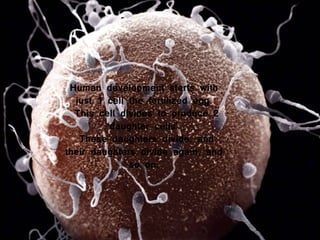
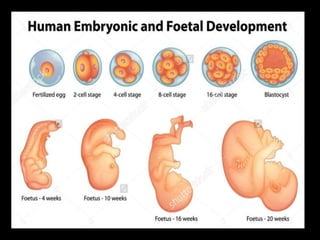
Human development starts with
just 1 cell the fertilized egg.
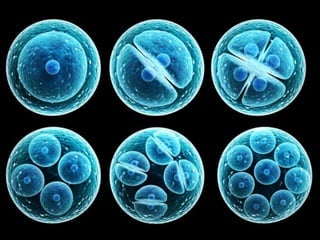
This cell divides to produce 2
‘daughter cells’.
These daughters divide, and
their daughters divide again, and
so on.
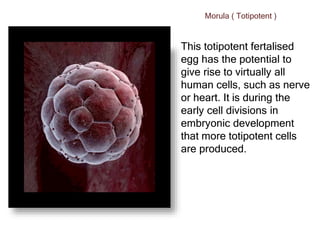
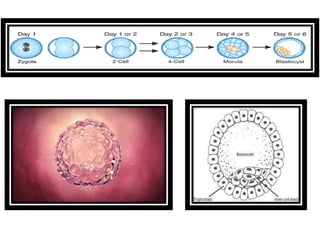
This totipotent fertalised
egg has the potential to
give rise to virtually all
human cells, such as nerve
or heart. It is during the
early cell divisions in
embryonic development
that more totipotent cells
are produced.
Morula ( Totipotent )
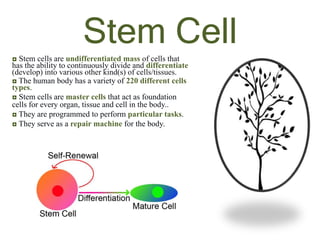
Stem Cell
◘ Stem cells are undifferentiated mass of cells that
has the ability to continuously divide and differentiate
(develop) into various other kind(s) of cells/tissues.
◘ The human body has a variety of 220 different cells
types.
◘ Stem cells are master cells that act as foundation
cells for every organ, tissue and cell in the body..
◘ They are programmed to perform particular tasks.
◘ They serve as a repair machine for the body.
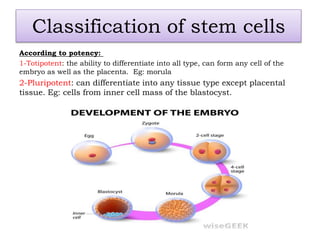
Classification of stem cells
According to potency:
1-Totipotent: the ability to differentiate into all type, can form any cell of the
embryo as well as the placenta. Eg: morula
2-Pluripotent: can differentiate into any tissue type except placental
tissue. Eg: cells from inner cell mass of the blastocyst.
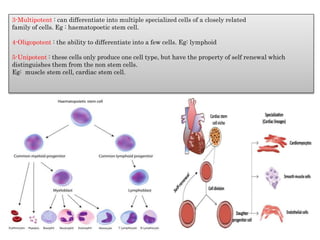
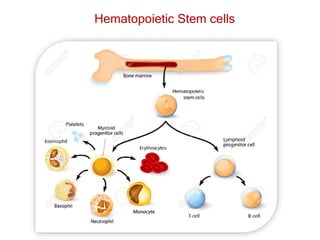
3-Multipotent : can differentiate into multiple specialized cells of a closely related
family of cells. Eg : haematopoetic stem cell.
4-Oligopotent : the ability to differentiate into a few cells. Eg: lymphoid
5-Unipotent : these cells only produce one cell type, but have the property of self renewal which
distinguishes them from the non stem cells.
Eg: muscle stem cell, cardiac stem cell.
According to origin
1- Embryonic stem cells: derived from the cells in the inner cell mass of the
developing blastocyst.
2- Fetal stem cells: obtained from aborted fetal gonadal tissue.
3- Amniotic stem cells : Multipotent stem cells are also found in amniotic fluid.
4- Cord blood stem cells: obtained from the remaining blood in the umbilical cord
after deilvery, these cells contain a big deal of haemopoietic stem cells
5- Adult stem cells: are multi-potent stem cells present in few numbers in many
sites Ex : bone marrow of human body.
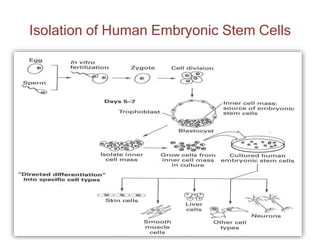
Embryonic stem cells
• come from embryos
- This stage embryo
is called a Blastocyst.
(4-5 days old embryo)
• can self-renew forever.
• are pluripotent – they
can differentiate to become
almost every cell in the
body.
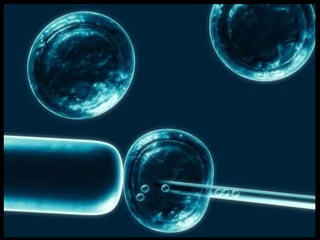
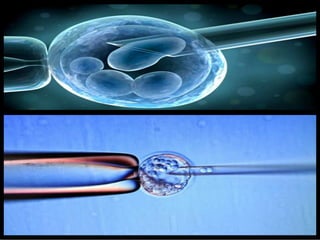
Isolation of Human Embryonic Stem Cells
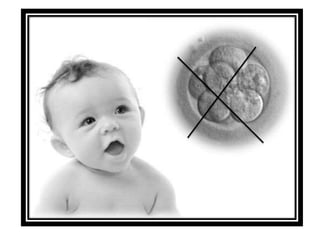
Is Embryonic
Stem cell
research
Ethical !? 
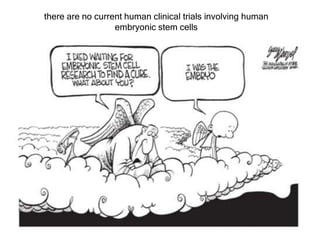
there are no current human clinical trials involving human
embryonic stem cells
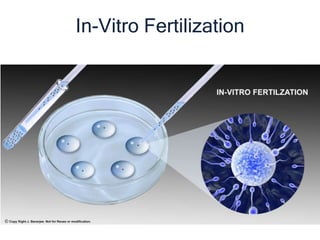
In-Vitro Fertilization
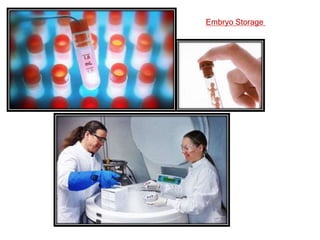
Embryo Storage
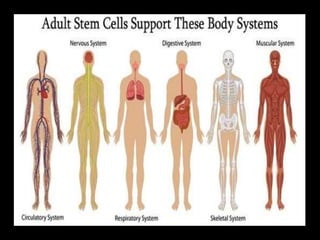
ADULT ( Somatic ) STEM CELLS
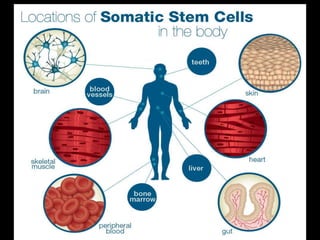
♦ Adult stem cells are found in the human body and in
umbilical cord blood.
- It is Rare 
♦ The most well known source of adult stem cells in the
body is bone marrow but they are also found in many organs
and tissues; even in the blood.
♦ Adult stem cells are more specialized since they are
assigned to a specific cell family such as blood cells, nerve
cells, etc.
♦ Recently, it was discovered that an adult stem cell from
one tissue may act as a stem cell for another tissue, i.e.
blood to neural
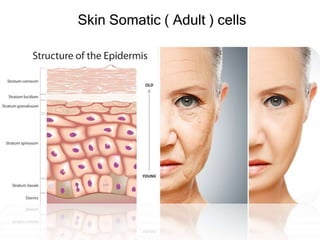
Skin Somatic ( Adult ) cells
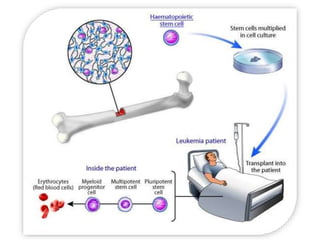
Hematopoietic Stem cells
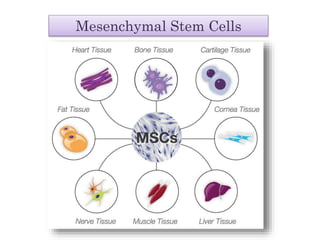
Mesenchymal Stem Cells
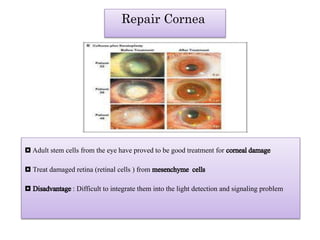
Repair Cornea
◘Adult stem cells from the eye have proved to be good treatment for cornealdamage
◘ Treat damaged retina (retinal cells ) from mesenchyme cells
◘ Disadvantage: Difficult to integrate them into the light detection and signaling problem
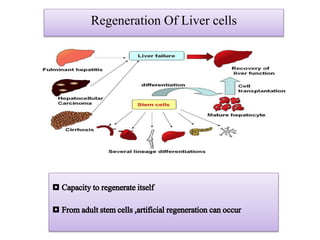
Regeneration Of Liver cells
◘ Capacityto regenerateitself
◘ Fromadultstemcells,artificial regeneration canoccur
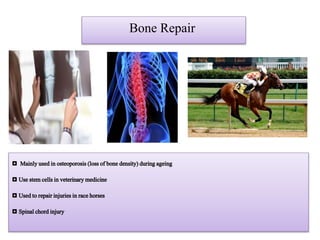
Bone Repair
◘ Mainlyusedinosteoporosis(lossof bonedensity)duringageing
◘ Usestemcellsinveterinarymedicine
◘ Usedtorepairinjuriesinracehorses
◘ Spinalchordinjury
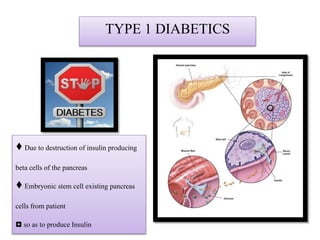
TYPE 1 DIABETICS
♦ Due to destruction of insulin producing
beta cells of the pancreas
♦ Embryonic stem cell existing pancreas
cells from patient
◘ so as to produce Insulin
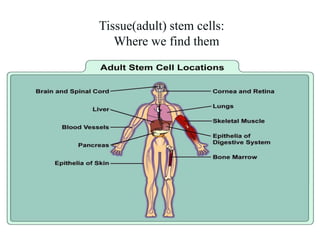
Tissue(adult) stem cells:
Where we find them
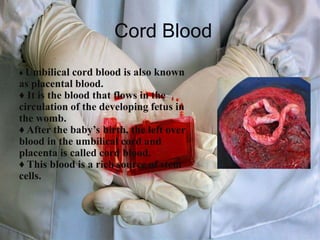
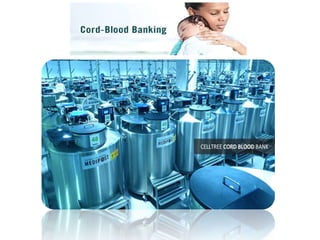
♦ Umbilical cord blood is also known
as placental blood.
♦ It is the blood that flows in the
circulation of the developing fetus in
the womb.
♦ After the baby’s birth, the left over
blood in the umbilical cord and
placenta is called cord blood.
♦ This blood is a rich source of stem
cells.
Cord Blood
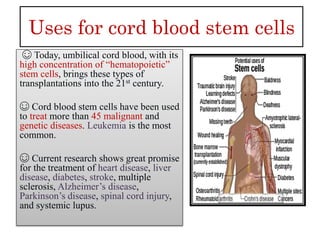
Uses for cord blood stem cells
☺ Today, umbilical cord blood, with its
high concentration of “hematopoietic”
stem cells, brings these types of
transplantations into the 21st century.
☺ Cord blood stem cells have been used
to treat more than 45 malignant and
genetic diseases. Leukemia is the most
common.
☺ Current research shows great promise
for the treatment of heart disease, liver
disease, diabetes, stroke, multiple
sclerosis, Alzheimer’s disease,
Parkinson’s disease, spinal cord injury,
and systemic lupus.
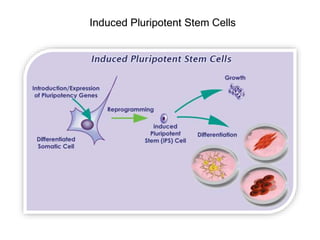
Induced Pluripotent Stem Cells
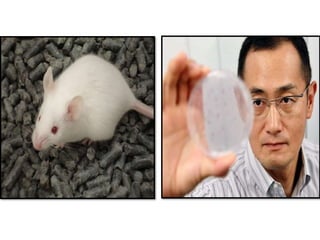
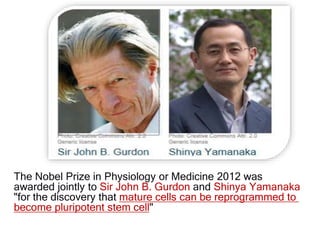
The Nobel Prize in Physiology or Medicine 2012 was
awarded jointly to Sir John B. Gurdon and Shinya Yamanaka
"for the discovery that mature cells can be reprogrammed to
become pluripotent stem cell"
♦ Stem cell research is complicated and
rapidly changing .Today’s medicine generally
tries to support or treat injured tissues and
organs, but stem cells may someday simply
replace them.
♦ Stem cell therapy is considered as like a
soldier with a weapon. Only if the soldier
(experienced doctor),weapon (technology)
and bullets (stem cells) all are in our hand
than the fight will turn in our favor.
Conclusion
Thank you ☺

Stem Cell

  • 1.
    Stem Cell Prepared by: Amany Elsayed Abd-elsalam Under supervisor : Dr . Moustafa Salah El-Din
  • 2.
    We are cells! The Basic unit of Life ♥ It is The Theory of Every Thing
  • 3.
    Human development startswith just 1 cell the fertilized egg. This cell divides to produce 2 ‘daughter cells’. These daughters divide, and their daughters divide again, and so on.
  • 5.
    This totipotent fertalised egghas the potential to give rise to virtually all human cells, such as nerve or heart. It is during the early cell divisions in embryonic development that more totipotent cells are produced. Morula ( Totipotent )
  • 7.
    Stem Cell ◘ Stemcells are undifferentiated mass of cells that has the ability to continuously divide and differentiate (develop) into various other kind(s) of cells/tissues. ◘ The human body has a variety of 220 different cells types. ◘ Stem cells are master cells that act as foundation cells for every organ, tissue and cell in the body.. ◘ They are programmed to perform particular tasks. ◘ They serve as a repair machine for the body.
  • 8.
    Classification of stemcells According to potency: 1-Totipotent: the ability to differentiate into all type, can form any cell of the embryo as well as the placenta. Eg: morula 2-Pluripotent: can differentiate into any tissue type except placental tissue. Eg: cells from inner cell mass of the blastocyst.
  • 10.
    3-Multipotent : candifferentiate into multiple specialized cells of a closely related family of cells. Eg : haematopoetic stem cell. 4-Oligopotent : the ability to differentiate into a few cells. Eg: lymphoid 5-Unipotent : these cells only produce one cell type, but have the property of self renewal which distinguishes them from the non stem cells. Eg: muscle stem cell, cardiac stem cell.
  • 11.
    According to origin 1-Embryonic stem cells: derived from the cells in the inner cell mass of the developing blastocyst. 2- Fetal stem cells: obtained from aborted fetal gonadal tissue. 3- Amniotic stem cells : Multipotent stem cells are also found in amniotic fluid. 4- Cord blood stem cells: obtained from the remaining blood in the umbilical cord after deilvery, these cells contain a big deal of haemopoietic stem cells 5- Adult stem cells: are multi-potent stem cells present in few numbers in many sites Ex : bone marrow of human body.
  • 12.
    Embryonic stem cells •come from embryos - This stage embryo is called a Blastocyst. (4-5 days old embryo) • can self-renew forever. • are pluripotent – they can differentiate to become almost every cell in the body.
  • 14.
    Isolation of HumanEmbryonic Stem Cells
  • 15.
  • 19.
    there are nocurrent human clinical trials involving human embryonic stem cells
  • 20.
  • 21.
  • 22.
    ADULT ( Somatic) STEM CELLS ♦ Adult stem cells are found in the human body and in umbilical cord blood. - It is Rare  ♦ The most well known source of adult stem cells in the body is bone marrow but they are also found in many organs and tissues; even in the blood. ♦ Adult stem cells are more specialized since they are assigned to a specific cell family such as blood cells, nerve cells, etc. ♦ Recently, it was discovered that an adult stem cell from one tissue may act as a stem cell for another tissue, i.e. blood to neural
  • 25.
    Skin Somatic (Adult ) cells
  • 28.
  • 30.
  • 31.
    Repair Cornea ◘Adult stemcells from the eye have proved to be good treatment for cornealdamage ◘ Treat damaged retina (retinal cells ) from mesenchyme cells ◘ Disadvantage: Difficult to integrate them into the light detection and signaling problem
  • 32.
    Regeneration Of Livercells ◘ Capacityto regenerateitself ◘ Fromadultstemcells,artificial regeneration canoccur
  • 33.
    Bone Repair ◘ Mainlyusedinosteoporosis(lossofbonedensity)duringageing ◘ Usestemcellsinveterinarymedicine ◘ Usedtorepairinjuriesinracehorses ◘ Spinalchordinjury
  • 34.
    TYPE 1 DIABETICS ♦Due to destruction of insulin producing beta cells of the pancreas ♦ Embryonic stem cell existing pancreas cells from patient ◘ so as to produce Insulin
  • 35.
  • 36.
    ♦ Umbilical cordblood is also known as placental blood. ♦ It is the blood that flows in the circulation of the developing fetus in the womb. ♦ After the baby’s birth, the left over blood in the umbilical cord and placenta is called cord blood. ♦ This blood is a rich source of stem cells. Cord Blood
  • 37.
    Uses for cordblood stem cells ☺ Today, umbilical cord blood, with its high concentration of “hematopoietic” stem cells, brings these types of transplantations into the 21st century. ☺ Cord blood stem cells have been used to treat more than 45 malignant and genetic diseases. Leukemia is the most common. ☺ Current research shows great promise for the treatment of heart disease, liver disease, diabetes, stroke, multiple sclerosis, Alzheimer’s disease, Parkinson’s disease, spinal cord injury, and systemic lupus.
  • 40.
  • 42.
    The Nobel Prizein Physiology or Medicine 2012 was awarded jointly to Sir John B. Gurdon and Shinya Yamanaka "for the discovery that mature cells can be reprogrammed to become pluripotent stem cell"
  • 43.
    ♦ Stem cellresearch is complicated and rapidly changing .Today’s medicine generally tries to support or treat injured tissues and organs, but stem cells may someday simply replace them. ♦ Stem cell therapy is considered as like a soldier with a weapon. Only if the soldier (experienced doctor),weapon (technology) and bullets (stem cells) all are in our hand than the fight will turn in our favor. Conclusion
  • 44.