STEM CELLS
PRESENTED BY-UTKARSH NAGPAL 15BBT0070
What are stem cells?
• the body is made up of about 200 different kinds of
specialised cells such as muscle cells, nerve cells, fat cells and
skin cells
• all cells in the body come from stem cells
• a stem cell is a cell that is not yet specialised
• the process of specialisation is called differentiation
• once the differentiation pathway of a stem cell has been
decided, it can no longer become another type of cell on its
own
Fluorescent imaging of embryonic
stem cell colonies
Signals to Stem Cells
Other Cells
Matrix Molecules
Self-Renewal
Soluble Factors
Differentiation
Little, et al. Chemical Reviews (2008).
All cells in a person share the same genotype
Yet eye cells differ from nose cells
Central dogma of biology
Genetic
engineerin
g
Tissue
therapy
How do cells know what to
become?
Embryonic stem cells
 Totipotent:
toti = total
potent = capacity
 The state of the cells
after the first few
divisions of the
fertilised egg.
 Have the capacity to
become all cell types
plus placenta.
Embryonic stem cells
 Pluripotent:
pluri = many
potent = capacity
 At blastocyst stage cells
become pluripotent.
 Have the capacity to
become all cell types
but not placenta.
 Cells of most interest to
research scientists.
Adult stem cells
 Multipotent
 Can develop into cells
that are closely related.
 Limited number of several
cell types.
 Make all cell types from
the tissue they come
from.
 Found in many parts of
the body.
 Can self-renew over a
lifetime.
Stem cells in the adult brain:
Are they still working for us now?
Tissue stem cells
• often known as adult stem cells
• also includes stem cells isolated from fetal and cord blood
• reside in most tissues of the body where they are involved
in repair and replacement
• generally very difficult to isolate
• already used to treat patients (haematological malignancies,
diseases of the immune system)
Bone marrow Kidney Lung
8-cell blastocystfertilised
egg
2-cellegg
Day 0 Day 1 Day 2 Day 3 Day 6
• Donated excess IVF embryos
Images from www.advancedfertility.com
Where do embryonic stem cells
come from?
Inner cell mass
Embryonic stem cells
 derived from donated IVF
embryos
 can be grown indefinitely in
the laboratory in an
unspecialised state
 retain ability to specialise into
many different tissue types –
know as pluripotent
 can restore function in animal
models following
transplantation
Human embryonic stem cells can become any
cell in the body including these beating heart
cells
human embryonic stem cells
Induced pluripotent stem
cells
 derived from adult cells in
2007 - very recent discovery!
 can be grown indefinitely in
culture in an undifferentiated
state
 similar properties to
embryonic stem cells as can
differentiate into many
different tissue types –
pluripotent
 can create stem cells directly
from a patient for research
Induced change in
gene expression
pluripotent
stem cells
Starting cells from
donor tissue
iPS Cells
Pros and Cons to iPS cell
technology
 Pros:
 Cells would be genetically identical to patient or donor of skin cells (no
immune rejection!)
 Do not need to use an embryo
 Cons:
 Cells would still have genetic defects
 One of the pluripotency genes is a cancer gene
 Viruses might insert genes in places we don’t want them (causing
mutations)
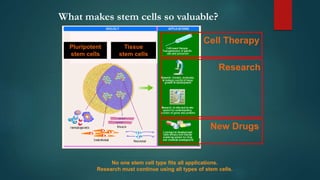
What makes stem cells so valuable?
Cell Therapy
Research
New Drugs
Pluripotent
stem cells
Tissue
stem cells
No one stem cell type fits all applications.
Research must continue using all types of stem cells.
Bone marrow transplant:
Example of adult stem cell-based therapy
Science is discovering the unknown
 Stem cell field is still in its infancy
 Human embryonic stem cell research is a decade
old, adult stem cell research has 30-year head start
 Holds hope for curing or improving treatments for
70+ diseases
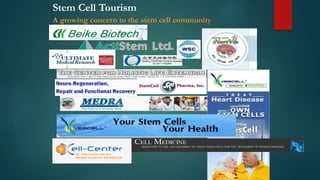
Stem Cell Tourism
A growing concern to the stem cell community

Stem cells ppt

  • 1.
  • 2.
    What are stemcells? • the body is made up of about 200 different kinds of specialised cells such as muscle cells, nerve cells, fat cells and skin cells • all cells in the body come from stem cells • a stem cell is a cell that is not yet specialised • the process of specialisation is called differentiation • once the differentiation pathway of a stem cell has been decided, it can no longer become another type of cell on its own
  • 3.
    Fluorescent imaging ofembryonic stem cell colonies
  • 4.
    Signals to StemCells Other Cells Matrix Molecules Self-Renewal Soluble Factors Differentiation Little, et al. Chemical Reviews (2008).
  • 5.
    All cells ina person share the same genotype Yet eye cells differ from nose cells Central dogma of biology Genetic engineerin g Tissue therapy How do cells know what to become?
  • 6.
    Embryonic stem cells Totipotent: toti = total potent = capacity  The state of the cells after the first few divisions of the fertilised egg.  Have the capacity to become all cell types plus placenta.
  • 7.
    Embryonic stem cells Pluripotent: pluri = many potent = capacity  At blastocyst stage cells become pluripotent.  Have the capacity to become all cell types but not placenta.  Cells of most interest to research scientists.
  • 8.
    Adult stem cells Multipotent  Can develop into cells that are closely related.  Limited number of several cell types.  Make all cell types from the tissue they come from.  Found in many parts of the body.  Can self-renew over a lifetime.
  • 9.
    Stem cells inthe adult brain: Are they still working for us now?
  • 10.
    Tissue stem cells •often known as adult stem cells • also includes stem cells isolated from fetal and cord blood • reside in most tissues of the body where they are involved in repair and replacement • generally very difficult to isolate • already used to treat patients (haematological malignancies, diseases of the immune system) Bone marrow Kidney Lung
  • 11.
    8-cell blastocystfertilised egg 2-cellegg Day 0Day 1 Day 2 Day 3 Day 6 • Donated excess IVF embryos Images from www.advancedfertility.com Where do embryonic stem cells come from? Inner cell mass
  • 12.
    Embryonic stem cells derived from donated IVF embryos  can be grown indefinitely in the laboratory in an unspecialised state  retain ability to specialise into many different tissue types – know as pluripotent  can restore function in animal models following transplantation Human embryonic stem cells can become any cell in the body including these beating heart cells human embryonic stem cells
  • 13.
    Induced pluripotent stem cells derived from adult cells in 2007 - very recent discovery!  can be grown indefinitely in culture in an undifferentiated state  similar properties to embryonic stem cells as can differentiate into many different tissue types – pluripotent  can create stem cells directly from a patient for research Induced change in gene expression pluripotent stem cells Starting cells from donor tissue iPS Cells
  • 14.
    Pros and Consto iPS cell technology  Pros:  Cells would be genetically identical to patient or donor of skin cells (no immune rejection!)  Do not need to use an embryo  Cons:  Cells would still have genetic defects  One of the pluripotency genes is a cancer gene  Viruses might insert genes in places we don’t want them (causing mutations)
  • 15.
    What makes stemcells so valuable? Cell Therapy Research New Drugs Pluripotent stem cells Tissue stem cells No one stem cell type fits all applications. Research must continue using all types of stem cells.
  • 16.
    Bone marrow transplant: Exampleof adult stem cell-based therapy
  • 17.
    Science is discoveringthe unknown  Stem cell field is still in its infancy  Human embryonic stem cell research is a decade old, adult stem cell research has 30-year head start  Holds hope for curing or improving treatments for 70+ diseases
  • 18.
    Stem Cell Tourism Agrowing concern to the stem cell community