INDIAN REGIONAL NAVIGATION
SATELLITE SYSTEM (IRNSS) – INDIA’S
OWN GPS!
Introduction
• ISRO is developing a satellite based navigation system, called
Indian Regional Navigation Satellite System (IRNSS), with a
constellation of 7 satellites and complementary ground
infrastructure. Four spare satellites are also planned.
• The IRNSS system is planned to be made operational by end of
2014. Government has approved the IRNSS project at a total cost
of Rs. 1420.00 crores in May 2006 for both space and ground
infrastructure.
Type Satellite navigation system
Country India
Accuracy Less than 20 m over
the Indian Ocean region
Less than 10 m accuracy
over mainland India
Coverage 1,500–2,000 kilometers
(930–1,240 mi) around
Indian landmass
Operational by 2015–16
Project Cost 16 billion (US$260 million)
Coverage
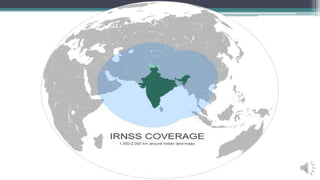
• The IRNSS is expected to provide positional accuracies similar to the
Global Positioning System (10 m over Indian landmass and 20 m over
the Indian Ocean) in a region centered around the country with a
coverage extending up to 1,500 km from India between longitude 40° E
to 140° E and between latitude ± 40°.
• Besides accurate real time position, the system is designed to
provide Navigation and Time (PNT) services to users on a variety of
platforms with 24x7 service availability under all weather conditions.
• As in the case of GPS, IRNSS will provide a more accurate restricted
service for special authorized users.
Features
• Highly accurate position, velocity and time information in real
time for authorized users on a variety of vehicles
• Data with good accuracy for a single frequency user with the help
of Ionospheric corrections
• All weather operation on a 24 hour basis.
Architecture
• The INRSS will consist of three segments: space, ground and user.
• The space segment consists of a constellation of seven satellites: three
(Geostationary Orbit) GEOs located at 34° E, 83° E and 131.5° E and
four (Gyosynchronous Orbit) GSOs at an inclination angle of
29° placed two each at with equator crossing at 55° and 111° East.
• IRNSS ground segment consists ground stations for generation and
transmission of navigation parameters, satellite control, satellite
ranging and monitoring. A total of 20 stations are planned, most of
them located at airports along with GAGAN ground elements.
• IRNSS will have the two Master Control Stations (MCS), which may be
co-located with GAGAN INMCC.
Satellites
• Each IRNSS satellite will weigh about 1,380 kg and their solar
panels generate 1,400 Watt of power. The satellites will be
configured with an optimized I-1K bus (compatible for launch
onboard PSLV) with a power handling capability of around
1600W
• The satellite is designed for a nominal life of 7 years. Its payload
will consist of electronic equipment to generate navigation signals
and extremely accurate on-board atomic clocks.
Progress
• The full constellation of 7 satellites is planned to be realized by
2015-16.
• Two satellites - IRNSS-1A and IRNSS-1B - have been already
launched. IRNSS-1C, IRNSS-1D, IRNSS-1E are scheduled to be
launched during FY 2014-15 on board PSLVs. By the middle of
2015, the IRNSS would be able to provide GPS services to Indian
users.
References
• http://www.thehindu.com/multimedia/archive/01499/Inside_IR
NSS_1499475a.jpg
• http://archives.deccanchronicle.com/sites/default/files/styles/art
icle_node_view/public/irnss-1a_0_0.jpg
• http://isp.justthe80.com/space-applications/indian-regional-
navigation-satellite-system-irnss
• http://en.wikipedia.org/wiki/Indian_Regional_Navigation_Satel
lite_System
THANK YOU

Irnss

  • 1.
    INDIAN REGIONAL NAVIGATION SATELLITESYSTEM (IRNSS) – INDIA’S OWN GPS!
  • 3.
    Introduction • ISRO isdeveloping a satellite based navigation system, called Indian Regional Navigation Satellite System (IRNSS), with a constellation of 7 satellites and complementary ground infrastructure. Four spare satellites are also planned. • The IRNSS system is planned to be made operational by end of 2014. Government has approved the IRNSS project at a total cost of Rs. 1420.00 crores in May 2006 for both space and ground infrastructure.
  • 5.
    Type Satellite navigationsystem Country India Accuracy Less than 20 m over the Indian Ocean region Less than 10 m accuracy over mainland India Coverage 1,500–2,000 kilometers (930–1,240 mi) around Indian landmass Operational by 2015–16 Project Cost 16 billion (US$260 million)
  • 7.
    Coverage • The IRNSSis expected to provide positional accuracies similar to the Global Positioning System (10 m over Indian landmass and 20 m over the Indian Ocean) in a region centered around the country with a coverage extending up to 1,500 km from India between longitude 40° E to 140° E and between latitude ± 40°. • Besides accurate real time position, the system is designed to provide Navigation and Time (PNT) services to users on a variety of platforms with 24x7 service availability under all weather conditions. • As in the case of GPS, IRNSS will provide a more accurate restricted service for special authorized users.
  • 9.
    Features • Highly accurateposition, velocity and time information in real time for authorized users on a variety of vehicles • Data with good accuracy for a single frequency user with the help of Ionospheric corrections • All weather operation on a 24 hour basis.
  • 11.
    Architecture • The INRSSwill consist of three segments: space, ground and user. • The space segment consists of a constellation of seven satellites: three (Geostationary Orbit) GEOs located at 34° E, 83° E and 131.5° E and four (Gyosynchronous Orbit) GSOs at an inclination angle of 29° placed two each at with equator crossing at 55° and 111° East. • IRNSS ground segment consists ground stations for generation and transmission of navigation parameters, satellite control, satellite ranging and monitoring. A total of 20 stations are planned, most of them located at airports along with GAGAN ground elements. • IRNSS will have the two Master Control Stations (MCS), which may be co-located with GAGAN INMCC.
  • 13.
    Satellites • Each IRNSSsatellite will weigh about 1,380 kg and their solar panels generate 1,400 Watt of power. The satellites will be configured with an optimized I-1K bus (compatible for launch onboard PSLV) with a power handling capability of around 1600W • The satellite is designed for a nominal life of 7 years. Its payload will consist of electronic equipment to generate navigation signals and extremely accurate on-board atomic clocks.
  • 15.
    Progress • The fullconstellation of 7 satellites is planned to be realized by 2015-16. • Two satellites - IRNSS-1A and IRNSS-1B - have been already launched. IRNSS-1C, IRNSS-1D, IRNSS-1E are scheduled to be launched during FY 2014-15 on board PSLVs. By the middle of 2015, the IRNSS would be able to provide GPS services to Indian users.
  • 16.
    References • http://www.thehindu.com/multimedia/archive/01499/Inside_IR NSS_1499475a.jpg • http://archives.deccanchronicle.com/sites/default/files/styles/art icle_node_view/public/irnss-1a_0_0.jpg •http://isp.justthe80.com/space-applications/indian-regional- navigation-satellite-system-irnss • http://en.wikipedia.org/wiki/Indian_Regional_Navigation_Satel lite_System
  • 18.