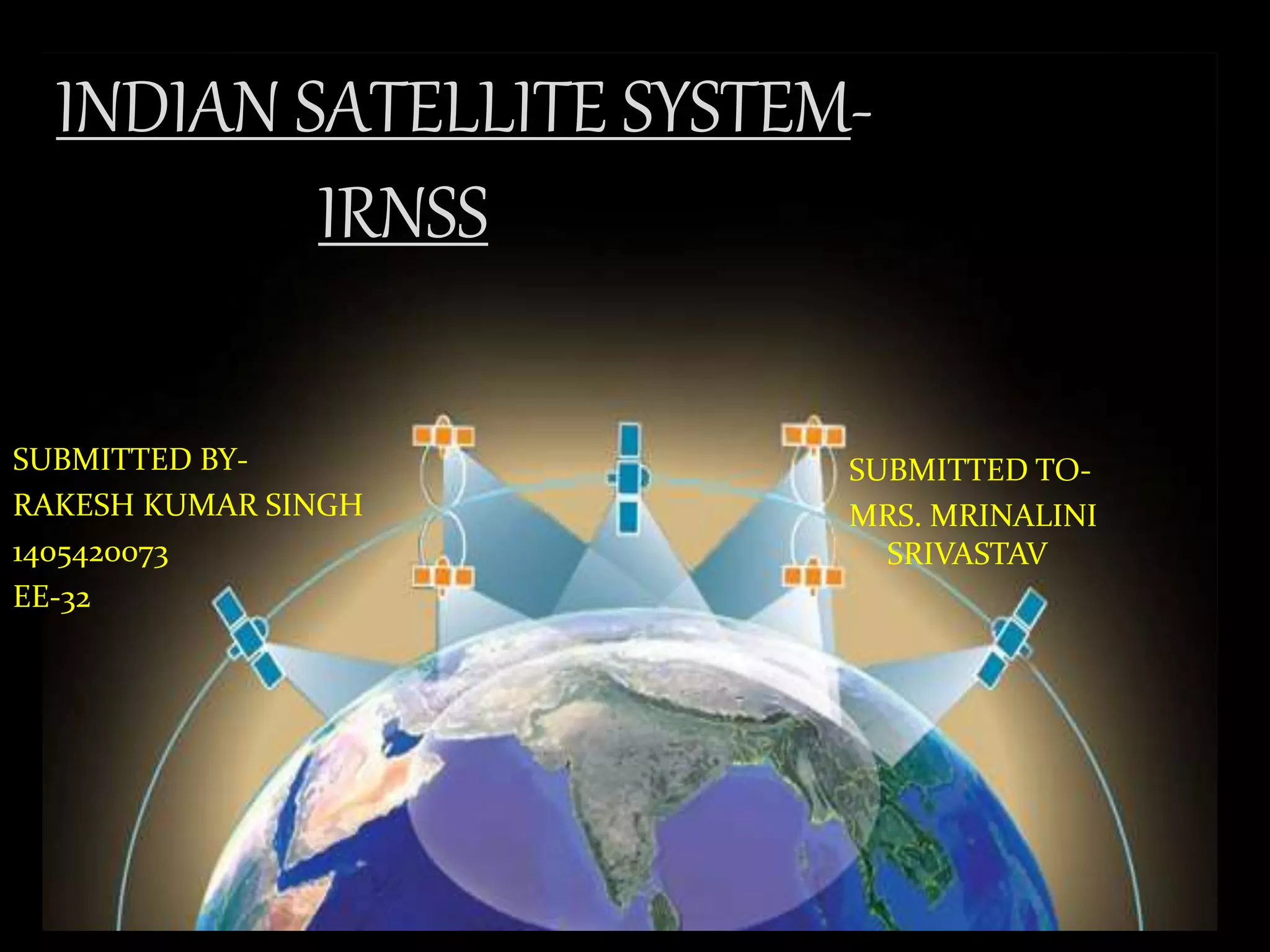
INDIAN SATELLITE SYSTEM-
IRNSS
SUBMITTED BY-
RAKESH KUMAR SINGH
1405420073
EE-32
SUBMITTED TO-
MRS. MRINALINI
SRIVASTAV
History of Satellites :
 First satellite that was used
for communication
purpose in INDIA was
-ARYABHATTA (19 April
1975)
 The first geostationary
communication satellite
-SYNCOM 3(19 Aug 1963).
 Father of geostationary
communication satellite is
-HAROLD ROSEN
(Aircraft engineer)
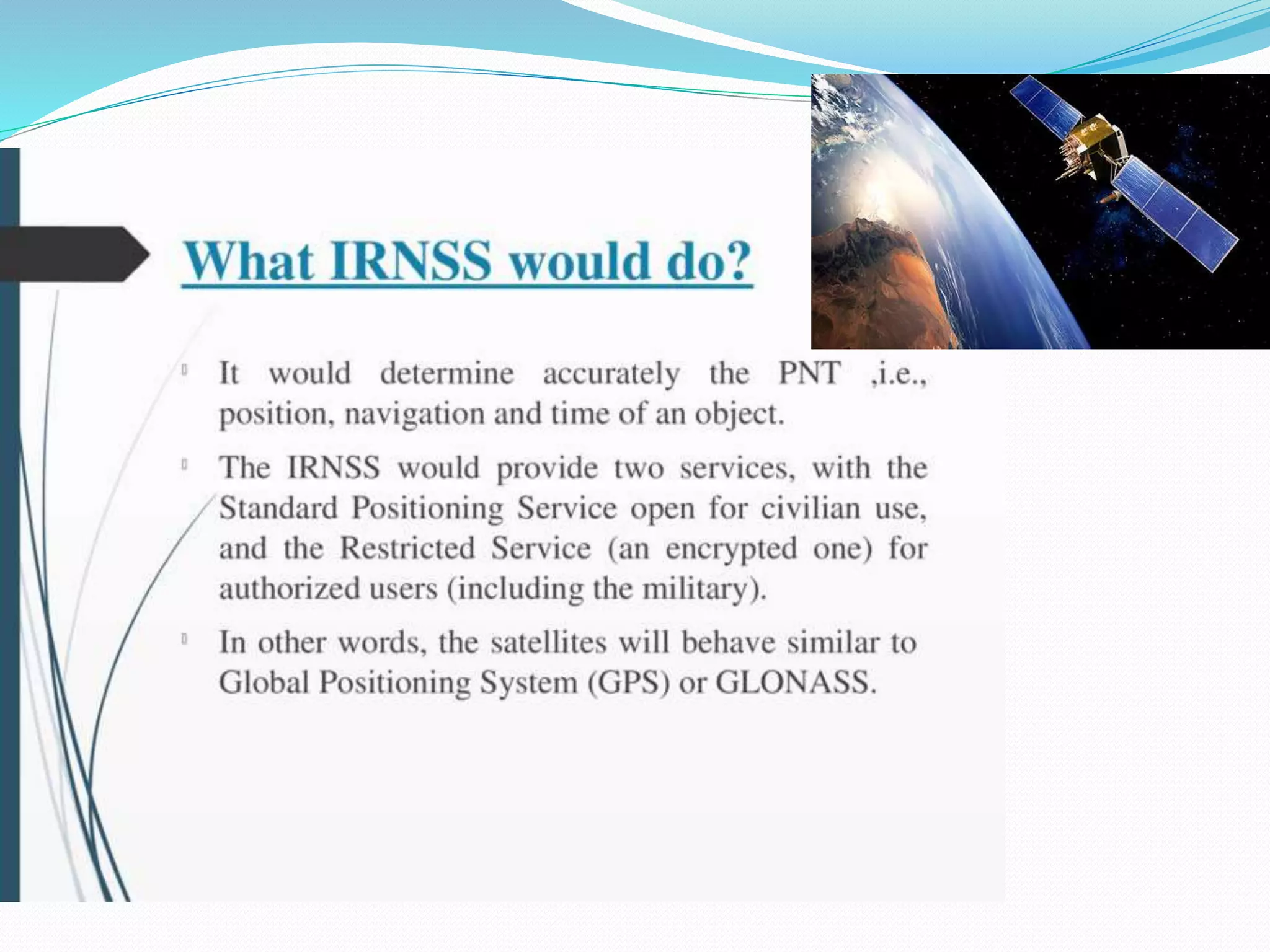
The world's first artificial satellite is the Sputnik 1
was launched in 1957
RANGE COVERAGE •Range coverage-
1500-2000 km
from border
•Orbital hight-
36000km
COMPONENTS OF SATELLITE
COUNTRIES WHOHAVE THEIROWN GPS
IRNSS CONFIGURATION
How Satellites Work :
I. A Earth Station
sends message in
GHz range (Uplink).
II. Satellite Receive and
retransmit signals
back. (Downlink)
III. Difference between
Downlink and
Uplink frequency is
2 GHz.
TYPES OF ORBITS
Low-Earth-Orbit (LEOs)
Medium-Earth-Orbit (MEOs)
Geostationary (GEOs)
Low-Earth-Orbit (LEO)
Altitude (600-1000 KM)
 satellite gives it a better
signal strength
Advantages:
Reduces transmission
delay
Disadvantages:
Smaller coverage area.
Shorter life span (5-8
yrs.)
Middle-Earth-Orbiting (MEO)
MEOs orbits between the
altitudes of 8,000 - 20,000 km
above the earth.
MEO satellites have a larger
coverage.
These orbits are primarily
reserved for communications
satellites that cover the North and
South Pole.
 MEOs are placed in an elliptical (oval-shaped)
orbit.
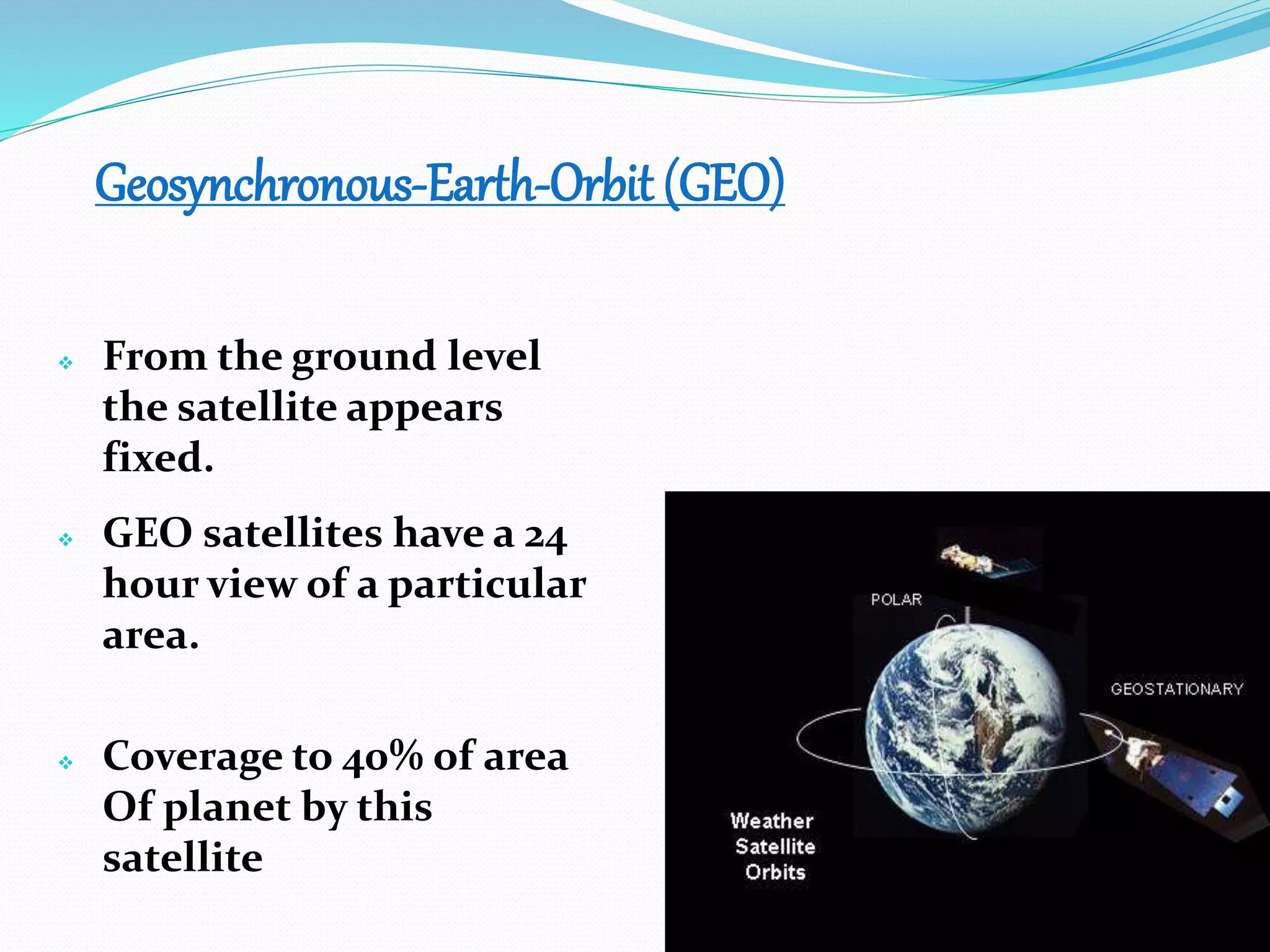
Geosynchronous-Earth-Orbit (GEO)
 From the ground level
the satellite appears
fixed.
 GEO satellites have a 24
hour view of a particular
area.
 Coverage to 40% of area
Of planet by this
satellite
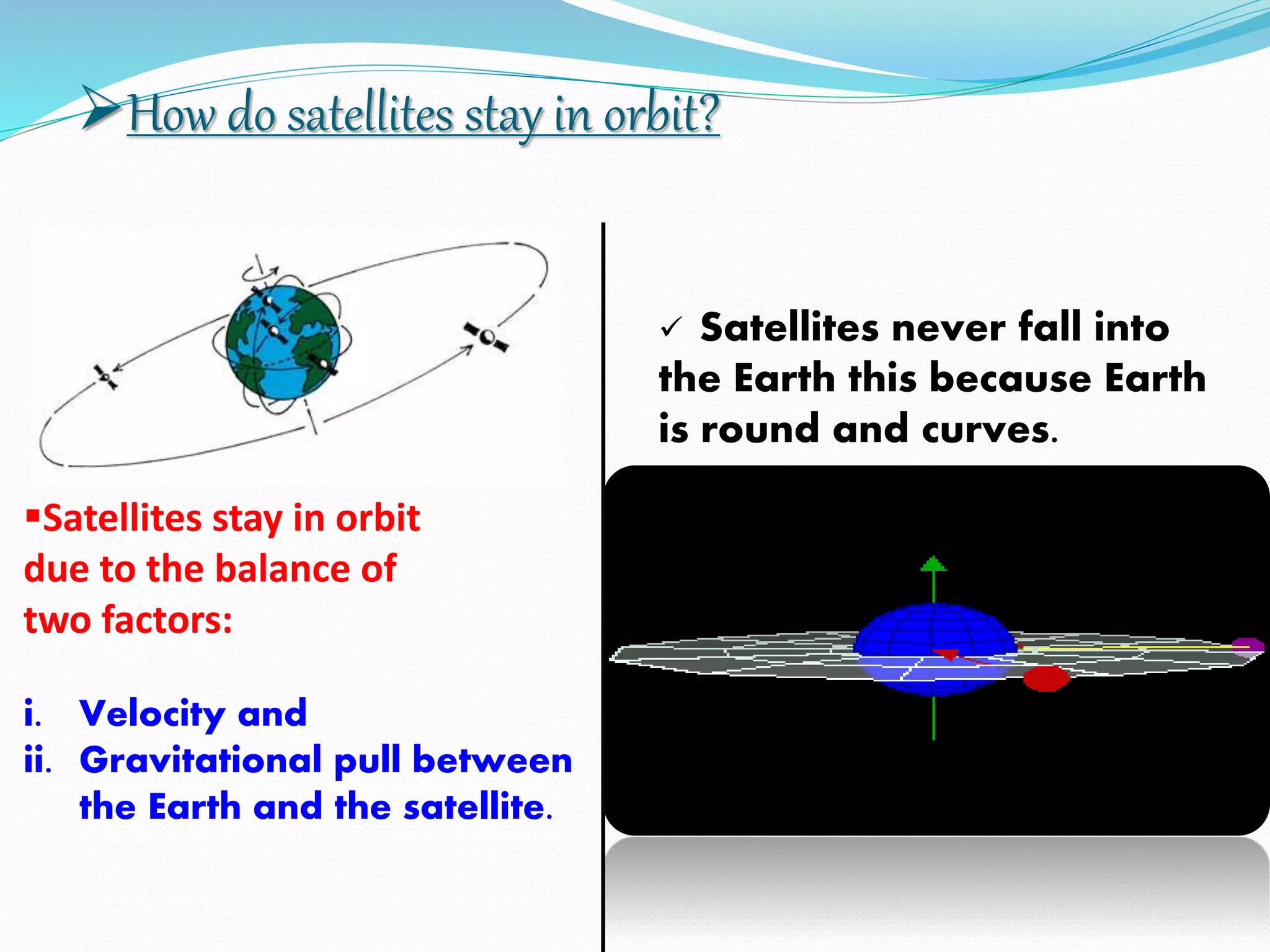
How do satellites stay in orbit?
Satellites stay in orbit
due to the balance of
two factors:
i. Velocity and
ii. Gravitational pull between
the Earth and the satellite.
 Satellites never fall into
the Earth this because Earth
is round and curves.
Applications of IRNSS:
- Terrestrial, Aerial and
Marine Navigation.
- Disaster Management
- Vehicle tracking and
fleet management.
 Integration with
mobile phones.
Precise Timing
-Mapping and Geodetic
data capture
-Visual and voice
navigation for drivers
CONCLUCION
Satellites remain the best utilization used
for COMMUNICATION AND OTHER
SECTOR due to their speed and other
advantages mentioned in this
presentation.
THANK YOU

Irnss ppt.

  • 1.
    INDIAN SATELLITE SYSTEM- IRNSS SUBMITTEDBY- RAKESH KUMAR SINGH 1405420073 EE-32 SUBMITTED TO- MRS. MRINALINI SRIVASTAV
  • 2.
    History of Satellites:  First satellite that was used for communication purpose in INDIA was -ARYABHATTA (19 April 1975)  The first geostationary communication satellite -SYNCOM 3(19 Aug 1963).  Father of geostationary communication satellite is -HAROLD ROSEN (Aircraft engineer) The world's first artificial satellite is the Sputnik 1 was launched in 1957
  • 8.
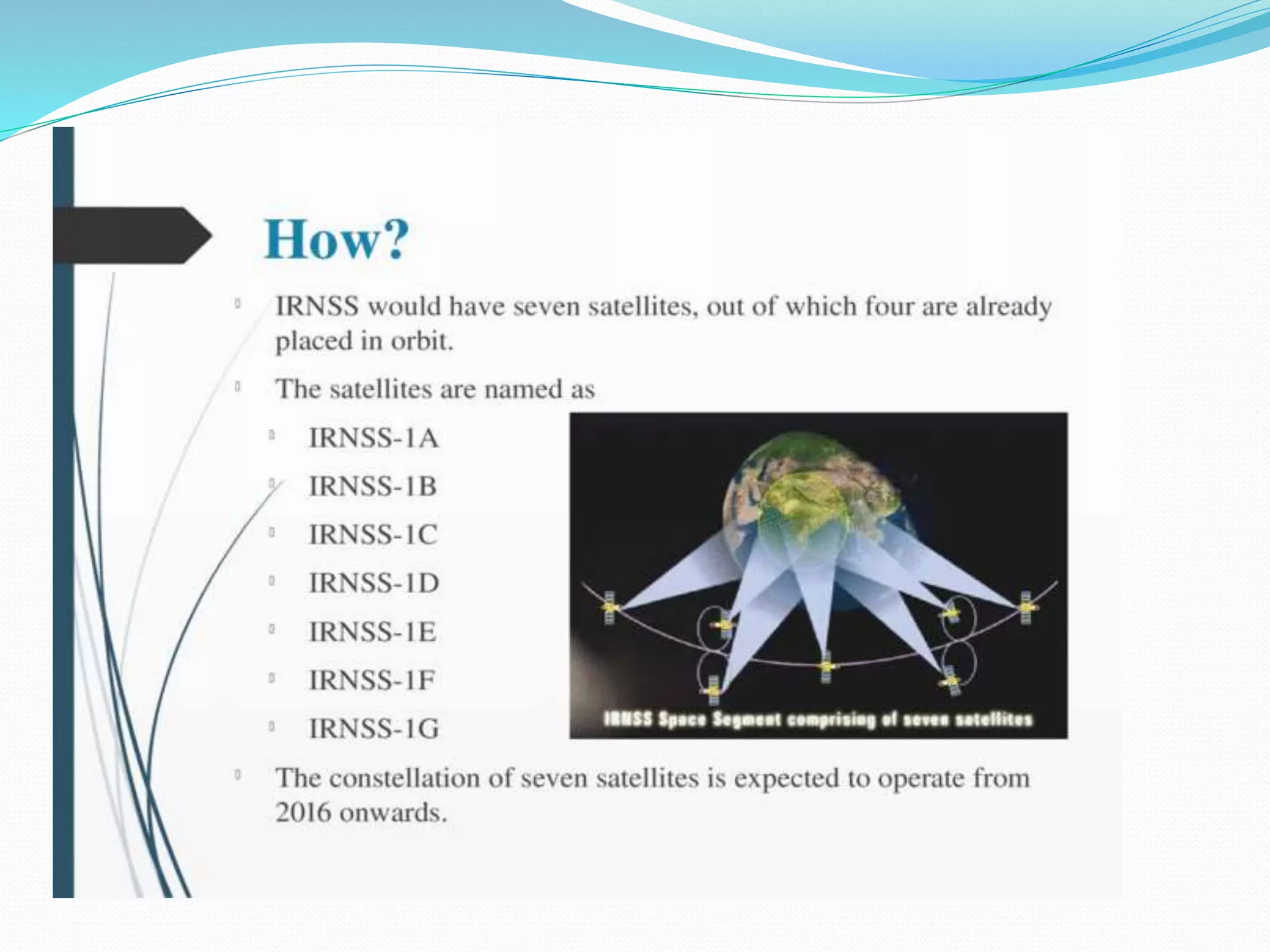
    RANGE COVERAGE •Rangecoverage- 1500-2000 km from border •Orbital hight- 36000km
  • 9.
  • 10.
  • 11.
  • 12.
    How Satellites Work: I. A Earth Station sends message in GHz range (Uplink). II. Satellite Receive and retransmit signals back. (Downlink) III. Difference between Downlink and Uplink frequency is 2 GHz.
  • 13.
    TYPES OF ORBITS Low-Earth-Orbit(LEOs) Medium-Earth-Orbit (MEOs) Geostationary (GEOs)
  • 14.
    Low-Earth-Orbit (LEO) Altitude (600-1000KM)  satellite gives it a better signal strength Advantages: Reduces transmission delay Disadvantages: Smaller coverage area. Shorter life span (5-8 yrs.)
  • 15.
    Middle-Earth-Orbiting (MEO) MEOs orbitsbetween the altitudes of 8,000 - 20,000 km above the earth. MEO satellites have a larger coverage. These orbits are primarily reserved for communications satellites that cover the North and South Pole.  MEOs are placed in an elliptical (oval-shaped) orbit.
  • 16.
    Geosynchronous-Earth-Orbit (GEO)  Fromthe ground level the satellite appears fixed.  GEO satellites have a 24 hour view of a particular area.  Coverage to 40% of area Of planet by this satellite
  • 17.
    How do satellitesstay in orbit? Satellites stay in orbit due to the balance of two factors: i. Velocity and ii. Gravitational pull between the Earth and the satellite.  Satellites never fall into the Earth this because Earth is round and curves.
  • 18.
    Applications of IRNSS: -Terrestrial, Aerial and Marine Navigation. - Disaster Management - Vehicle tracking and fleet management.
  • 19.
     Integration with mobilephones. Precise Timing -Mapping and Geodetic data capture -Visual and voice navigation for drivers
  • 20.
    CONCLUCION Satellites remain thebest utilization used for COMMUNICATION AND OTHER SECTOR due to their speed and other advantages mentioned in this presentation.
  • 21.