Technology Strategy and OrganisationGroup Presentation Global Positioning System (GPS) 11th March 2011R. Craig, S. G****, R. V****, C. A****, S. D****
OutlineBackgroundChronological GPS EvolutionTechnology S CurveMultiple S CurvesProduct Process CycleDominant Design ModelDiffusion Curve
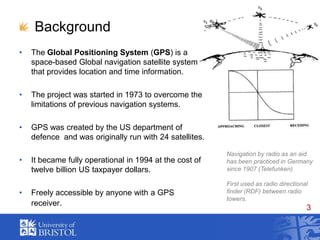
BackgroundThe Global Positioning System (GPS) is a space-based Global navigation satellite system that provides location and time information.The project was started in 1973 to overcome the limitations of previous navigation systems. GPS was created by the US department of defence  and was originally run with 24 satellites.It became fully operational in 1994 at the cost of twelve billion US taxpayer dollars.Freely accessible by anyone with a GPS receiver.Navigation by radio as an aid has been practiced in Germany since 1907 (Telefunken)First used as radio directional finder (RDF) between radio towers.
GPS TimelineIn 1972, the US Air Force developmental flight tests of two prototype GPS receivers In 1978 the first experimental Block-I GPS satellite was launched. In 1983, civilian airliner strayed into restricted Soviet airspace due to navigational errors  and shot , GPS made available for civilian use.February 14, 1989, the first modern Block-II satellite was launched.  December 1993 the GPS achieved initial operational capability[51] January 17, 1994 a complete constellation of 24 satellites was in orbit. Full Operational Capability was declared by NAVSTAR in April 1995. In 1996, US declaring GPS to be a dual-use system (national asset). In 1998, two new civilian signals for enhanced user accuracy and reliability, particularly with respect to aviation safety. On May 2, 2000 "Selective Availability" was discontinued In 2004, US and European Community establishing cooperation related to Garmin GPSand Europe's planned Galileo system. November 2004, successful tests of Assisted-GPS for mobile phones.In 2005, the first modernized GPS satellite was launched and began transmitting a second civilian signal for enhanced user performance.
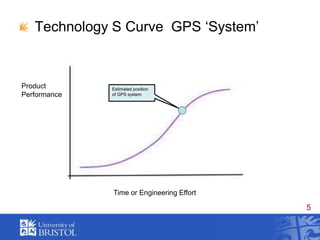
Technology S Curve  GPS ‘System’Product PerformanceEstimated position of GPS systemTime or Engineering Effort
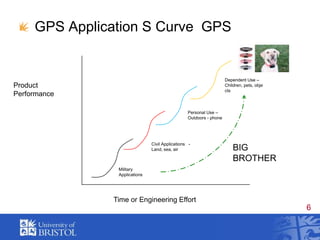
GPS Application S Curve  GPSDependent Use – Children, pets, objectsProduct PerformancePersonal Use – Outdoors - phoneCivil Applications   - Land, sea, airBIG BROTHERMilitary ApplicationsTime or Engineering Effort
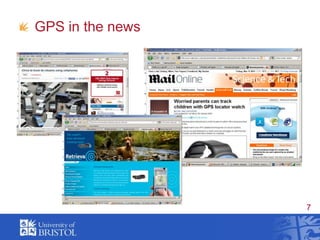
GPS in the news
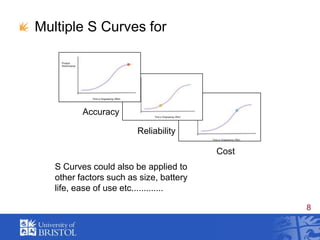
Multiple S Curves for AccuracyReliabilityCostS Curves could also be applied to other factors such as size, battery life, ease of use etc.............
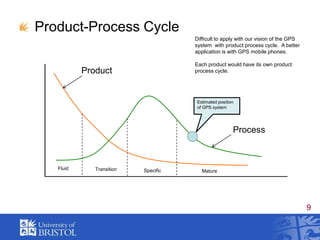
Product-Process CycleDifficult to apply with our vision of the GPS system  with product process cycle.  A better application is with GPS mobile phones.Each product would have its own product process cycle.ProductEstimated position of GPS systemProcessFluidTransitionSpecificMature
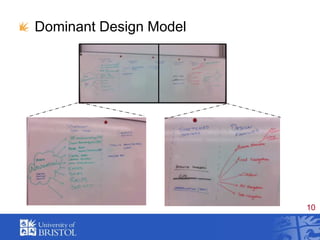
Dominant Design Model
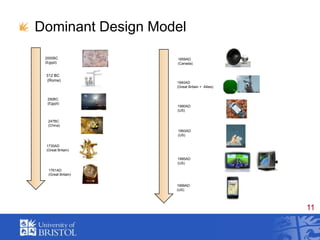
Dominant Design Model2000BC (Egypt)1859AD (Canada)312 BC (Rome)1940AD (Great Britain +  Allies)290BC (Egypt)1990AD (US)247BC (China)1993AD (US)1730AD (Great Britain)1995AD (US)1761AD (Great Britain)1999AD (US)
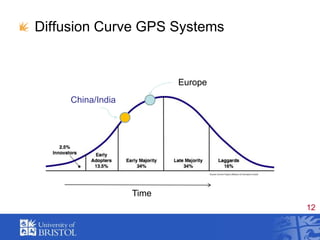
Diffusion Curve GPS SystemsEuropeChina/IndiaTime
Implications of this analysis for technology strategy for these organisations and potential entrants.Works well for a physical product evolution, but has difficulty contextually complex systems. System was too big to handle within the set time scale,  the team boundaries were too big to manage.   Boundaries would need to be rationalized (reduced, simplified).Market evolution not product specificMore questions than answers, systems understanding expanded.In application of the dominant design model highlighted how complex the system is
Conclusions (Models)Presentation Critique for ease of use and their utility for decision making in technology strategyS-CurveHelps to indicate when to invest in new tech/productsDominant Systems ModelModels too basic for multi dimensional technology convergenceDiffusion ModelPromotes understanding of current technology trajectoryProduct-Process CycleProduct specific, different applicationsAbstract level, N-dimensions
Conclusions (Reflections) Presentation Critique for ease of use and their utility for decision making in technology strategyModels used for indication only (creates discussion)All models are wrong but some are usefulEnables visibility of technological paradigmsEpistemological evolutionNot a panacea Group had no tacit knowledge for successful application
ReferencesBauer, A. “Some historical and technical aspects of radio navigation, in Germany, over the period 1907 to 1945”, 2004 http://www.xs4all.nl/~aobauer/Navigati.pdf

Global Positioning System (GPS)

  • 1.
    Technology Strategy andOrganisationGroup Presentation Global Positioning System (GPS) 11th March 2011R. Craig, S. G****, R. V****, C. A****, S. D****
  • 2.
    OutlineBackgroundChronological GPS EvolutionTechnologyS CurveMultiple S CurvesProduct Process CycleDominant Design ModelDiffusion Curve
  • 3.
    BackgroundThe Global PositioningSystem (GPS) is a space-based Global navigation satellite system that provides location and time information.The project was started in 1973 to overcome the limitations of previous navigation systems. GPS was created by the US department of defence and was originally run with 24 satellites.It became fully operational in 1994 at the cost of twelve billion US taxpayer dollars.Freely accessible by anyone with a GPS receiver.Navigation by radio as an aid has been practiced in Germany since 1907 (Telefunken)First used as radio directional finder (RDF) between radio towers.
  • 4.
    GPS TimelineIn 1972,the US Air Force developmental flight tests of two prototype GPS receivers In 1978 the first experimental Block-I GPS satellite was launched. In 1983, civilian airliner strayed into restricted Soviet airspace due to navigational errors and shot , GPS made available for civilian use.February 14, 1989, the first modern Block-II satellite was launched. December 1993 the GPS achieved initial operational capability[51] January 17, 1994 a complete constellation of 24 satellites was in orbit. Full Operational Capability was declared by NAVSTAR in April 1995. In 1996, US declaring GPS to be a dual-use system (national asset). In 1998, two new civilian signals for enhanced user accuracy and reliability, particularly with respect to aviation safety. On May 2, 2000 "Selective Availability" was discontinued In 2004, US and European Community establishing cooperation related to Garmin GPSand Europe's planned Galileo system. November 2004, successful tests of Assisted-GPS for mobile phones.In 2005, the first modernized GPS satellite was launched and began transmitting a second civilian signal for enhanced user performance.
  • 5.
    Technology S Curve GPS ‘System’Product PerformanceEstimated position of GPS systemTime or Engineering Effort
  • 6.
    GPS Application SCurve GPSDependent Use – Children, pets, objectsProduct PerformancePersonal Use – Outdoors - phoneCivil Applications - Land, sea, airBIG BROTHERMilitary ApplicationsTime or Engineering Effort
  • 7.
  • 8.
    Multiple S Curvesfor AccuracyReliabilityCostS Curves could also be applied to other factors such as size, battery life, ease of use etc.............
  • 9.
    Product-Process CycleDifficult toapply with our vision of the GPS system with product process cycle. A better application is with GPS mobile phones.Each product would have its own product process cycle.ProductEstimated position of GPS systemProcessFluidTransitionSpecificMature
  • 10.
  • 11.
    Dominant Design Model2000BC(Egypt)1859AD (Canada)312 BC (Rome)1940AD (Great Britain + Allies)290BC (Egypt)1990AD (US)247BC (China)1993AD (US)1730AD (Great Britain)1995AD (US)1761AD (Great Britain)1999AD (US)
  • 12.
    Diffusion Curve GPSSystemsEuropeChina/IndiaTime
  • 13.
    Implications of thisanalysis for technology strategy for these organisations and potential entrants.Works well for a physical product evolution, but has difficulty contextually complex systems. System was too big to handle within the set time scale, the team boundaries were too big to manage. Boundaries would need to be rationalized (reduced, simplified).Market evolution not product specificMore questions than answers, systems understanding expanded.In application of the dominant design model highlighted how complex the system is
  • 14.
    Conclusions (Models)Presentation Critiquefor ease of use and their utility for decision making in technology strategyS-CurveHelps to indicate when to invest in new tech/productsDominant Systems ModelModels too basic for multi dimensional technology convergenceDiffusion ModelPromotes understanding of current technology trajectoryProduct-Process CycleProduct specific, different applicationsAbstract level, N-dimensions
  • 15.
    Conclusions (Reflections) PresentationCritique for ease of use and their utility for decision making in technology strategyModels used for indication only (creates discussion)All models are wrong but some are usefulEnables visibility of technological paradigmsEpistemological evolutionNot a panacea Group had no tacit knowledge for successful application
  • 16.
    ReferencesBauer, A. “Somehistorical and technical aspects of radio navigation, in Germany, over the period 1907 to 1945”, 2004 http://www.xs4all.nl/~aobauer/Navigati.pdf