DGPS
PRINCIPLE AND WORKING
Presentation by:
Baljinder Kaur
GPS
 Stands for Global Positioning System.
 GPS is used to get an exact location on or above the surface of the
earth (1cm to 100m accuracy).
 Developed by U.S. Department of Defense in 1980 and made available
to public in 1983.
 GPS is a very important data input source.
 GPS is one of two (soon to be more) GNSS – Global Navigation
Satellite System
NAVSTAR – U.S. Department of Defense. (“GPS”)
GLONASS – Russian system
Galileo – European system (online in 2019?)
Compass/BeiDou-2 – Chinese system in development (operational with
10 satellites as of December, 2011; 35 planned)

GPS and GLONASS are free to use!
GNSS
• GLONASS
• 24 satellites (100% deployed)
• 3 orbital planes
• GPS
• 31 satellites (>100% deployed)
• 6 orbital planes
GNSS comparison
GPS
 GPS is worldwide Radio-Navigation System formed from
24-30 satellites and their ground stations.
 Satellites orbit earth every 12 hours at approximately
20,200 km.
 GPS uses satellites in space as reference points for
locations here on earth.

GPS Uses
 Agriculture
 Surveying
 Navigation (air, sea, land)
 Engineering
 Military operations
 Unmanned vehicle guidance
 Mapping
What's a GPS signal?
 There are two frequencies of low power radio signals that GPS
satellites transmit.
 These are called L1 and L2.
 The L1 frequency at 1575.42 MHz in the UHF band is what comes
into play for civilian applications. Wavelength about 19 cm.
 The L2 frequency at 1227.60 Mhz is used for deference purpose.
Wavelength about 24 cm.
 GPS satellites circle the earth twice a day in a very precise orbit
and transmit signal information to earth.
 GPS receivers take this information and use to calculate the user's
exact location.
 The receiver can determine the user's position and display it on
the unit's electronic map.
How Global Positioning System works?
• This method assumes we can find exact distance from our GPS receiver to
a satellite. HOW???
• Simple answer: See how long it takes for a radio signal to get from the
satellite to the receiver.
•
• We know speed of light, but we also need to know:

Distance = Velocity * Time
1) When the signal left the satellite
2)When the signal arrived at the receiver
 To do this requires comparing lag in pseudo-random code, one
from satellite and one generated at the same time by the receiver.
 This code has to be extremely complex (hence almost random), so
that patterns are not linked up at the wrong place on the code.
 Sent by satellite at time t0

Received from
satellite at time t1
• Assumption: The code also has to be generated from each source
at exactly the same time. (1/1000th
sec means 200 miles of error!)
• So, the satellites have expensive atomic clocks that keep nearly
perfect time—that takes care of their end.
•
Distance measurements from
two satellites limits our location
to the intersection of two
spheres, which is a circle.
SATELLITE TRIANGULATION
A third measurement
narrows our location
to just two points.
A fourth measurement
determines which point is
our true location
It is the stationary
receiver situated at
suitable location of
site.
It is the receiver to
which we move to take
readings at different
places of site.
Base
Rover
DGPS
Working Principle
 The stationary receiver must be located on a known control point
 The stationary unit works backwards—instead of using timing to calculate
position, it uses its position to calculate timing.
 Can do this because precise location of stationary receiver is known, and
hence, so is location of satellite
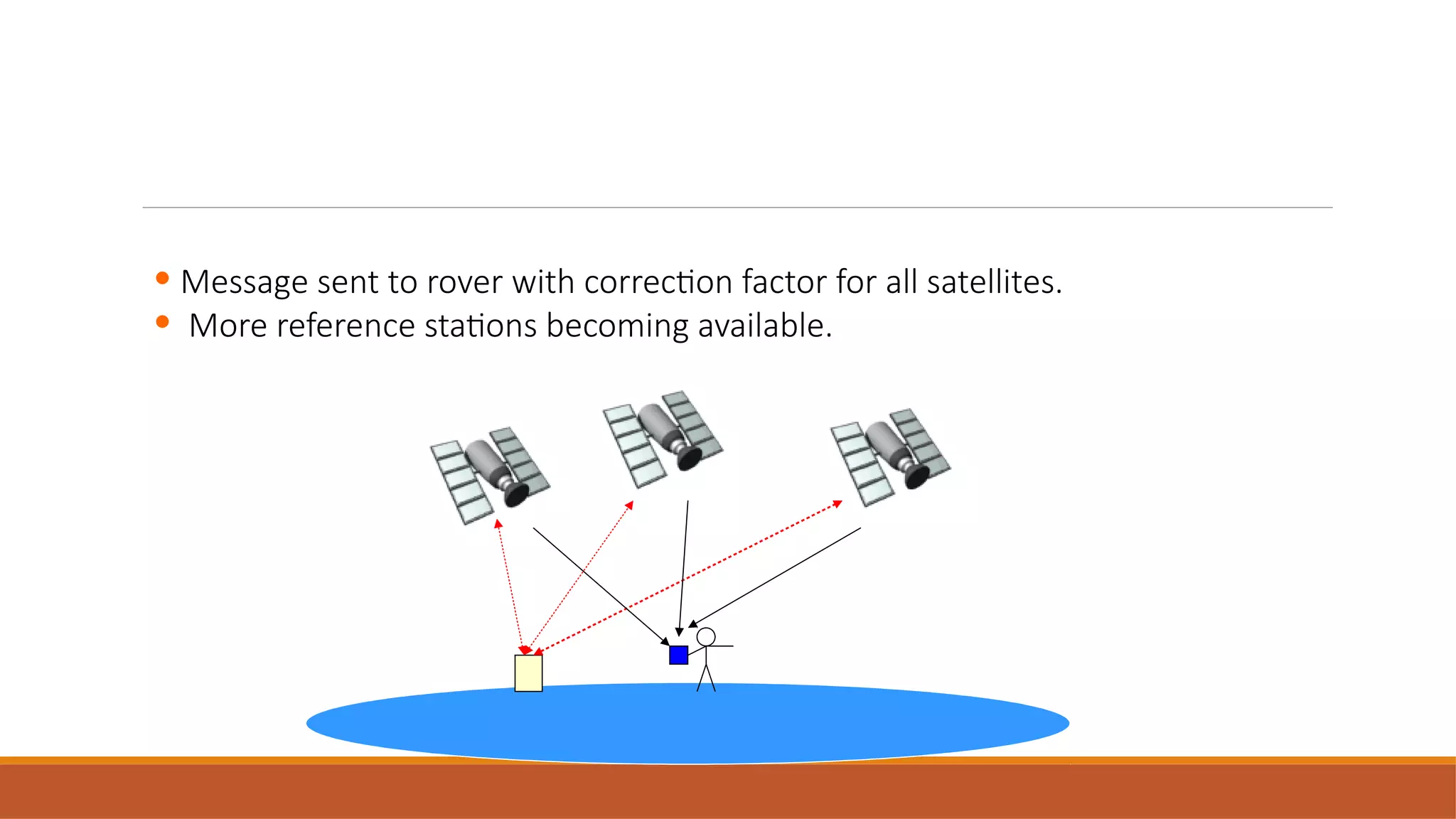
 Once it knows error, it determines a correction factor and sends it to the
other receiver.


How does DGPS work?
 Message sent to rover with correction factor for all satellites.
 More reference stations becoming available.
GPS Error Sources
•Wave path errors
•Satellite orbit errors
•Multipath
•Satellite Geometry (PDOP)
•Satellite Constellation changes
Atmospheric Errors
Constellation Changes
Satellite Orbit Errors
Atmospheric Errors
Multipath
Dilution of Precision
Differential Correction
•Base Station generates corrections for all satellites in view
•Roving GPS receiver uses corrections to reduce errors
•Differential correction can be performed in either real-time or post-processed
mode
Corrected Results
Possible Corrections
Possible
• Wave path
• Satellite orbit errors
• Satellite constellation changes
Exceptions
• Multipath
• Satellite Geometry
Base Station
Site Requirements
• Clear view to satellites
• Known coordinates
• Clear of transmitters (TV, radar)
• Line of site to rover is not necessary
Elevation Mask (problem)
Elevation Mask (solution)
Sources of Base Data (for Post Processing)
•
•Community Base Stations (CBS)
– government, commercial or public
• Internet Access
• Set up your own
– GPS Base Station
– Rover units used as a base
Signal Noise 0-30 meters All Removed
Clock Drift 0-1.5 meters All Removed
Multipath 0-1 meters All Removed
Ephemeris Data 1-5 meters All Removed
Troposphere 0-30 meters All Removed
Ionosphere 0-30 meters Mostly Removed
Errors Removed by DGPS
Some GPS Devices
GPS Maps Smart Phones TOMTOM
(CARS)
Smart Watches TABLETS
Types of Maps
Two Dimensional Three Dimensional
Dgps

Dgps

  • 1.
  • 2.
    GPS  Stands forGlobal Positioning System.  GPS is used to get an exact location on or above the surface of the earth (1cm to 100m accuracy).  Developed by U.S. Department of Defense in 1980 and made available to public in 1983.  GPS is a very important data input source.  GPS is one of two (soon to be more) GNSS – Global Navigation Satellite System
  • 3.
    NAVSTAR – U.S.Department of Defense. (“GPS”) GLONASS – Russian system Galileo – European system (online in 2019?) Compass/BeiDou-2 – Chinese system in development (operational with 10 satellites as of December, 2011; 35 planned)  GPS and GLONASS are free to use! GNSS
  • 4.
    • GLONASS • 24satellites (100% deployed) • 3 orbital planes • GPS • 31 satellites (>100% deployed) • 6 orbital planes GNSS comparison
  • 5.
    GPS  GPS isworldwide Radio-Navigation System formed from 24-30 satellites and their ground stations.  Satellites orbit earth every 12 hours at approximately 20,200 km.  GPS uses satellites in space as reference points for locations here on earth.
  • 6.
     GPS Uses  Agriculture Surveying  Navigation (air, sea, land)  Engineering  Military operations  Unmanned vehicle guidance  Mapping
  • 7.
    What's a GPSsignal?  There are two frequencies of low power radio signals that GPS satellites transmit.  These are called L1 and L2.  The L1 frequency at 1575.42 MHz in the UHF band is what comes into play for civilian applications. Wavelength about 19 cm.  The L2 frequency at 1227.60 Mhz is used for deference purpose. Wavelength about 24 cm.
  • 8.
     GPS satellitescircle the earth twice a day in a very precise orbit and transmit signal information to earth.  GPS receivers take this information and use to calculate the user's exact location.  The receiver can determine the user's position and display it on the unit's electronic map. How Global Positioning System works?
  • 9.
    • This methodassumes we can find exact distance from our GPS receiver to a satellite. HOW??? • Simple answer: See how long it takes for a radio signal to get from the satellite to the receiver. • • We know speed of light, but we also need to know:  Distance = Velocity * Time 1) When the signal left the satellite 2)When the signal arrived at the receiver
  • 10.
     To dothis requires comparing lag in pseudo-random code, one from satellite and one generated at the same time by the receiver.  This code has to be extremely complex (hence almost random), so that patterns are not linked up at the wrong place on the code.  Sent by satellite at time t0  Received from satellite at time t1
  • 11.
    • Assumption: Thecode also has to be generated from each source at exactly the same time. (1/1000th sec means 200 miles of error!) • So, the satellites have expensive atomic clocks that keep nearly perfect time—that takes care of their end. •
  • 12.
    Distance measurements from twosatellites limits our location to the intersection of two spheres, which is a circle. SATELLITE TRIANGULATION
  • 13.
    A third measurement narrowsour location to just two points.
  • 14.
    A fourth measurement determineswhich point is our true location
  • 15.
    It is thestationary receiver situated at suitable location of site. It is the receiver to which we move to take readings at different places of site. Base Rover DGPS
  • 16.
  • 17.
     The stationaryreceiver must be located on a known control point  The stationary unit works backwards—instead of using timing to calculate position, it uses its position to calculate timing.  Can do this because precise location of stationary receiver is known, and hence, so is location of satellite  Once it knows error, it determines a correction factor and sends it to the other receiver.   How does DGPS work?
  • 18.
     Message sentto rover with correction factor for all satellites.  More reference stations becoming available.
  • 19.
    GPS Error Sources •Wavepath errors •Satellite orbit errors •Multipath •Satellite Geometry (PDOP) •Satellite Constellation changes
  • 20.
  • 21.
  • 22.
  • 23.
  • 24.
  • 25.
  • 26.
  • 27.
    Differential Correction •Base Stationgenerates corrections for all satellites in view •Roving GPS receiver uses corrections to reduce errors •Differential correction can be performed in either real-time or post-processed mode
  • 28.
  • 29.
    Possible Corrections Possible • Wavepath • Satellite orbit errors • Satellite constellation changes Exceptions • Multipath • Satellite Geometry
  • 30.
    Base Station Site Requirements •Clear view to satellites • Known coordinates • Clear of transmitters (TV, radar) • Line of site to rover is not necessary
  • 31.
  • 32.
  • 33.
    Sources of BaseData (for Post Processing) • •Community Base Stations (CBS) – government, commercial or public • Internet Access • Set up your own – GPS Base Station – Rover units used as a base
  • 34.
    Signal Noise 0-30meters All Removed Clock Drift 0-1.5 meters All Removed Multipath 0-1 meters All Removed Ephemeris Data 1-5 meters All Removed Troposphere 0-30 meters All Removed Ionosphere 0-30 meters Mostly Removed Errors Removed by DGPS
  • 35.
    Some GPS Devices GPSMaps Smart Phones TOMTOM (CARS)
  • 36.
  • 37.
    Types of Maps TwoDimensional Three Dimensional