PRANANATH AUTONOMOUS COLLEGE
DEPARTMENT OF PHYSICS
TOPIC OFTHE PROJECT:-INDIAN REGIONAL NAVIGATION SATELLITE SYSTEM
PRESENTED BY:-SAMIR RANJANTADA
BSc. FINALYEAR(PHHYSICS)
ROLL NO. :-5703U20039
SESSION:-2022-2023
GUIDE:-DR. PRADEEPTA KUMAR MOHAPATRA
(LECTURER IN PHYSICS)
(Indian regional navigation satellite system)
Contents: -
1.Introduction of IRNSS
2.Need for indigenous positioning system
3. History of IRNSS
4. Basic concepts of IRNSS
5.Trilateration
6.Elements of GPS
7.Applications of IRNSS
8.Comparision between GPS and IRNSS
9.Advantages
10.Disadvantages
11.Conclusion
Introduction
India have two regional GPS:
 GAGAN: GPS Aided Geoaugmented
Navigation Satellite system.
 IRNSS : Indian Regional Navigation
Satellite System.
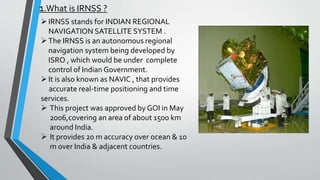
IRNSS stands for INDIAN REGIONAL
NAVIGATION SATELLITE SYSTEM .
The IRNSS is an autonomous regional
navigation system being developed by
ISRO , which would be under complete
control of Indian Government.
It is also known as NAVIC , that provides
accurate real-time positioning and time
services.
 This project was approved by GOI in May
2006,covering an area of about 1500 km
around India.
 It provides 20 m accuracy over ocean & 10
m over India & adjacent countries.
1.What is IRNSS ?
2.Need for indigenous positioning system
During the Kargil war in 1999,when Pakistani troops took the
position in high mountains, one of the first things Indian
military was trying to get their hands on was GPS data of the
region.
GPS could’ve provided vital information, but the United States
denied access to India.
The experience at Kargil mode the nation realize the
importance of indigenous navigation system and hence the idea
of IRNSS began to take shape.
With the help of IRNSS, India will become self-reliant to keep a
close watch on its boundaries and much more.
3. History of IRNSS
The world’s first artificial satellite is the
Sputnik 1 was launched in 1957.
First satellite that was used for
communication purpose in INDIA was –
ARYABHATA(19 April 1975).
The first geostationary communication
satellite –SYNCOM3(19 Aug 1963).
Father of geostationary communication
satellite is-HAROLD ROSEN(Aircraft
engineer).
4.Basic concepts of IRNSS
It consists of 7 satellites(Launches -9),these are
IRNSS-1A,1B,1C,1D,1E,1F & 1 G were
successfully launched on July 2,2013,Apr 4,
2014,Oct 16,2014,Mar 28, 2015,Jan 20,2016 & Apr
28,2016 respectively.
4 satellites in geosynchronous orbit-in pairs,
move in two inclined orbits-appear from ground
to travel, assist in accurate position
determination.
3 satellites in geostationary orbit-appear from
ground to be at fixed positions in the sky.
It’s orbit present at a altitude of 36,000 km from
the surface of earth.
It covers India and up to 15000km beyond its
borders.
4.Difference between Geostationary and Geosynchronous orbit
5.Trilateration:-
 Trilateration is determining a position by knowing your distance from at
least 3 known points.
 A GPS receiver, like the one in your smartphone, pinpoints its location on
Earth’s surface by analysing its distance to three GPS satellites; a fourth
satellite synchronizes clocks in the receiver and satellites.
6. Elements of GPS :
There are 3 segments of GPS.
i. Space segment – Satellites
ii. Control segment – Ground Stations
iii. User segment – Receivers Control segment
Control segment User segment
i. Space Segment :
 Their orbits are designed in a way such that 6
satellites are always within a line of sight from any
location on the Earth.
 Satellites act like stars in the constellations whose
locations are known as they send out signals.
 The space segment of GPS comprises the satellites
that orbit the Earth at an altitude of 20000 km
above the Earth’s surface for a period of 12 hours.
 Some key features of satellites are
ii. Control Segment :
 The control segment of GPS comprises the ground
station which further divided to three sub-
components.
. Master control system
. Monitor station
. Ground antenna
 The key functions of control segments are
 Checking the movement & proper functioning of
the satellites .
 Using RADAR to make sure of the position of the
satellite
iii. User Segment :
 The user segment comprises the GPS receiver . GPS
receivers are present in smartphones , tablets , PCs
etc. which receives GPS signals and determine their
location from the satellites .
 Some key features are
 Estimating the distance of satellites .
 Exactly determines the receiver location .
7.Applications of IRNSS:-
a.Terrestrial and Marine Navigation:
IRNSS is a regional tracking system that allows
users to find their position on the map as well
as act as a directional mechanism for
transportation.
b. Disaster Management:
This system will be able to track and
provide information during natural
disasters.
c.Vehicle tracking & fleet management:
The tracking device obtains the vehicle
location, through the GNSS receiver, sends it
through wireless communication.
d. Military Precision-guided mountains:
IRNSS helps in finding the accuracy positions of
enemies and also helps in launching drones.
e. Mapping and Geodetic data
capture:-
f.Terrestrial navigation aid for hikers and
travellers:-
8.Is NaVIC as good as GPS?
IN some respects ,better GPS can take you within 20 meters of your
target, While NaVIC is more precise—it will take you within 5 meters of
the target.This may not be a big deal for individual users, but for military
stuff, like guided missiles, it is very important. On the other hand, while
GPS is global-you can use it anywhere in the world-NaVIC regional and
can be used in India and up to 1500 km from India's borders.
However, India desires to make NaVIC global, Which will happen if more
satellites, say around 30, are sent up for this purpose. For now NaVIC is
regional.
Why do we need NaVIC when Google Maps is there for free?
Google Maps runs on GPS, which is American. Depending upon
another country is never good, for they can easily switch off
service at any time. In 1999, during the Kargil War, India
requested the US to give data about enemy locations, which the
US refused.That made India realize the critically of an India-
owned navigation system.
9.Advantages of IRNSS:-
There are various advantages if using IRNSS navigation
system instead of other:-
 The location tracked by IRNSS will be accurate. It will
provide accurate Position,Velocity, andTime(PVT)
information to users in India as well as the region
extending up to 1500 km from its boundary.
 Services will provide by IRNSS not only in India but also on
another neighbouring country of India such as Nepal,
Bhutan, etc.
 Now we are independent of the navigation system of
other countries at Wartime, Disaster time, earthquake,
flood, etc.
 IRNSS navigation system will be of less cost in comparison
of the GPS navigation system.
9.Disadvantages of IRNSS:-
It’s coverage area is limited if you take global presence
into account.
Signals might take relatively more time considering
satellites are in Geostationary orbit(approximately
36000km).
It has only 7 satellites as compared to GPS.
You can use IRNSS in your mobile phone, only if your
mobile phone receiver is capable of receiving IRNSS
signals. So it is determined by mobile manufacturer.
10.Conclusion:-
Satellites remain the best utilization used for
COMMUNICATION AND OTHER SECTOR due to their
speed and other advantages mentioned in this
presentation.
IRNSS.pptx

IRNSS.pptx

  • 1.
    PRANANATH AUTONOMOUS COLLEGE DEPARTMENTOF PHYSICS TOPIC OFTHE PROJECT:-INDIAN REGIONAL NAVIGATION SATELLITE SYSTEM PRESENTED BY:-SAMIR RANJANTADA BSc. FINALYEAR(PHHYSICS) ROLL NO. :-5703U20039 SESSION:-2022-2023 GUIDE:-DR. PRADEEPTA KUMAR MOHAPATRA (LECTURER IN PHYSICS)
  • 2.
    (Indian regional navigationsatellite system)
  • 3.
    Contents: - 1.Introduction ofIRNSS 2.Need for indigenous positioning system 3. History of IRNSS 4. Basic concepts of IRNSS 5.Trilateration 6.Elements of GPS 7.Applications of IRNSS 8.Comparision between GPS and IRNSS 9.Advantages 10.Disadvantages 11.Conclusion
  • 4.
    Introduction India have tworegional GPS:  GAGAN: GPS Aided Geoaugmented Navigation Satellite system.  IRNSS : Indian Regional Navigation Satellite System.
  • 5.
    IRNSS stands forINDIAN REGIONAL NAVIGATION SATELLITE SYSTEM . The IRNSS is an autonomous regional navigation system being developed by ISRO , which would be under complete control of Indian Government. It is also known as NAVIC , that provides accurate real-time positioning and time services.  This project was approved by GOI in May 2006,covering an area of about 1500 km around India.  It provides 20 m accuracy over ocean & 10 m over India & adjacent countries. 1.What is IRNSS ?
  • 6.
    2.Need for indigenouspositioning system During the Kargil war in 1999,when Pakistani troops took the position in high mountains, one of the first things Indian military was trying to get their hands on was GPS data of the region. GPS could’ve provided vital information, but the United States denied access to India. The experience at Kargil mode the nation realize the importance of indigenous navigation system and hence the idea of IRNSS began to take shape. With the help of IRNSS, India will become self-reliant to keep a close watch on its boundaries and much more.
  • 7.
    3. History ofIRNSS The world’s first artificial satellite is the Sputnik 1 was launched in 1957. First satellite that was used for communication purpose in INDIA was – ARYABHATA(19 April 1975). The first geostationary communication satellite –SYNCOM3(19 Aug 1963). Father of geostationary communication satellite is-HAROLD ROSEN(Aircraft engineer).
  • 8.
    4.Basic concepts ofIRNSS It consists of 7 satellites(Launches -9),these are IRNSS-1A,1B,1C,1D,1E,1F & 1 G were successfully launched on July 2,2013,Apr 4, 2014,Oct 16,2014,Mar 28, 2015,Jan 20,2016 & Apr 28,2016 respectively. 4 satellites in geosynchronous orbit-in pairs, move in two inclined orbits-appear from ground to travel, assist in accurate position determination. 3 satellites in geostationary orbit-appear from ground to be at fixed positions in the sky. It’s orbit present at a altitude of 36,000 km from the surface of earth. It covers India and up to 15000km beyond its borders.
  • 9.
    4.Difference between Geostationaryand Geosynchronous orbit
  • 10.
    5.Trilateration:-  Trilateration isdetermining a position by knowing your distance from at least 3 known points.  A GPS receiver, like the one in your smartphone, pinpoints its location on Earth’s surface by analysing its distance to three GPS satellites; a fourth satellite synchronizes clocks in the receiver and satellites.
  • 11.
    6. Elements ofGPS : There are 3 segments of GPS. i. Space segment – Satellites ii. Control segment – Ground Stations iii. User segment – Receivers Control segment Control segment User segment
  • 12.
    i. Space Segment:  Their orbits are designed in a way such that 6 satellites are always within a line of sight from any location on the Earth.  Satellites act like stars in the constellations whose locations are known as they send out signals.  The space segment of GPS comprises the satellites that orbit the Earth at an altitude of 20000 km above the Earth’s surface for a period of 12 hours.  Some key features of satellites are
  • 13.
    ii. Control Segment:  The control segment of GPS comprises the ground station which further divided to three sub- components. . Master control system . Monitor station . Ground antenna  The key functions of control segments are  Checking the movement & proper functioning of the satellites .  Using RADAR to make sure of the position of the satellite
  • 14.
    iii. User Segment:  The user segment comprises the GPS receiver . GPS receivers are present in smartphones , tablets , PCs etc. which receives GPS signals and determine their location from the satellites .  Some key features are  Estimating the distance of satellites .  Exactly determines the receiver location .
  • 15.
    7.Applications of IRNSS:- a.Terrestrialand Marine Navigation: IRNSS is a regional tracking system that allows users to find their position on the map as well as act as a directional mechanism for transportation. b. Disaster Management: This system will be able to track and provide information during natural disasters.
  • 16.
    c.Vehicle tracking &fleet management: The tracking device obtains the vehicle location, through the GNSS receiver, sends it through wireless communication. d. Military Precision-guided mountains: IRNSS helps in finding the accuracy positions of enemies and also helps in launching drones.
  • 17.
    e. Mapping andGeodetic data capture:- f.Terrestrial navigation aid for hikers and travellers:-
  • 18.
    8.Is NaVIC asgood as GPS? IN some respects ,better GPS can take you within 20 meters of your target, While NaVIC is more precise—it will take you within 5 meters of the target.This may not be a big deal for individual users, but for military stuff, like guided missiles, it is very important. On the other hand, while GPS is global-you can use it anywhere in the world-NaVIC regional and can be used in India and up to 1500 km from India's borders. However, India desires to make NaVIC global, Which will happen if more satellites, say around 30, are sent up for this purpose. For now NaVIC is regional.
  • 19.
    Why do weneed NaVIC when Google Maps is there for free? Google Maps runs on GPS, which is American. Depending upon another country is never good, for they can easily switch off service at any time. In 1999, during the Kargil War, India requested the US to give data about enemy locations, which the US refused.That made India realize the critically of an India- owned navigation system.
  • 20.
    9.Advantages of IRNSS:- Thereare various advantages if using IRNSS navigation system instead of other:-  The location tracked by IRNSS will be accurate. It will provide accurate Position,Velocity, andTime(PVT) information to users in India as well as the region extending up to 1500 km from its boundary.  Services will provide by IRNSS not only in India but also on another neighbouring country of India such as Nepal, Bhutan, etc.  Now we are independent of the navigation system of other countries at Wartime, Disaster time, earthquake, flood, etc.  IRNSS navigation system will be of less cost in comparison of the GPS navigation system.
  • 21.
    9.Disadvantages of IRNSS:- It’scoverage area is limited if you take global presence into account. Signals might take relatively more time considering satellites are in Geostationary orbit(approximately 36000km). It has only 7 satellites as compared to GPS. You can use IRNSS in your mobile phone, only if your mobile phone receiver is capable of receiving IRNSS signals. So it is determined by mobile manufacturer.
  • 22.
    10.Conclusion:- Satellites remain thebest utilization used for COMMUNICATION AND OTHER SECTOR due to their speed and other advantages mentioned in this presentation.