By Subhodip Mukherjee 
1313MNG 
Geoinformatics (1st semester) 
TERI University
 Is a sun-synchronous satellite, built and launched by 
ISRO ( Indian Space Research Organisation) on 5th May, 
2005 
 Covers the entire globe in 1867 orbits on a 126 day cycle. 
 The National Remote Sensing Centre is responsible for 
acquisition, processing of data relayed by the Cartosat-1
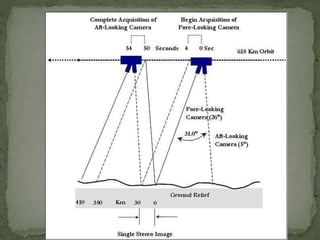
 Spatial Resolution : 2.5 m (PAN fore) [+26 degrees] 
2.5 m (PAN aft) [-5 degrees] 
 Radiometric Resolution: 10 bit 
 Temporal Resolution: 5 days 
 Swath : 30 km (PAN fore) 
27 km (PAN aft) 
 Altitude: 618 km 
 Wavelength: 0.50-0.85 μm 
 Possible field of application: 
1. Stereo viewing for large scale mapping and terrain 
modeling. 
2. Also generates accurate 3d maps.
 Is an Earth observation satellite in a sun-synchronous 
orbit and the second of the Cartosat series of satellites. 
 The satellite was built, launched and maintained by 
the Indian Space Research Organisation. 
 It was launched on 10th January,2007.
 Spatial Resolution : 0.81 m (PAN) 
 Radiometric Resolution : 10 bits per pixel 
 Temporal Resolution: 4 days 
 Altitude: 630 km 
 wavelength : 0.5 μm - 0.85 μm 
 Swath width: about 9.6 km 
 Possible fields of application : 
1. Topographic mapping up to 1:5000 
2. Agriculture fields assessing 
3. Inventory and monitoring transport 
4. Land and water resources management 
5. Cadastral level application
 Cartosat 2A : built by ISRO and launched in April 28, 
2008, is a Ministry of Defence satellite for the Govt. of 
India. 
 Cartosat 2B: built and launched by ISRO on 12 July 2010, 
carries a PAN camera capable of capturing B&W images in 
the visible EM spectrum. 
 Cartosat 3: built by ISRO, will have a resolution of 25 cm 
(10"). Is planned to be launched on 2014 and will have 
weather mapping, cartography, and strategic applications. 
* Source: wikipedia.com and 
http://www.gim.be/ewcm/ewcm.nsf/_/447D6D87AA82798BC12575F40079CF40?OpenD 
ocument (20.9.13)
Cartosat

Cartosat

  • 1.
    By Subhodip Mukherjee 1313MNG Geoinformatics (1st semester) TERI University
  • 2.
     Is asun-synchronous satellite, built and launched by ISRO ( Indian Space Research Organisation) on 5th May, 2005  Covers the entire globe in 1867 orbits on a 126 day cycle.  The National Remote Sensing Centre is responsible for acquisition, processing of data relayed by the Cartosat-1
  • 3.
     Spatial Resolution: 2.5 m (PAN fore) [+26 degrees] 2.5 m (PAN aft) [-5 degrees]  Radiometric Resolution: 10 bit  Temporal Resolution: 5 days  Swath : 30 km (PAN fore) 27 km (PAN aft)  Altitude: 618 km  Wavelength: 0.50-0.85 μm  Possible field of application: 1. Stereo viewing for large scale mapping and terrain modeling. 2. Also generates accurate 3d maps.
  • 6.
     Is anEarth observation satellite in a sun-synchronous orbit and the second of the Cartosat series of satellites.  The satellite was built, launched and maintained by the Indian Space Research Organisation.  It was launched on 10th January,2007.
  • 7.
     Spatial Resolution: 0.81 m (PAN)  Radiometric Resolution : 10 bits per pixel  Temporal Resolution: 4 days  Altitude: 630 km  wavelength : 0.5 μm - 0.85 μm  Swath width: about 9.6 km  Possible fields of application : 1. Topographic mapping up to 1:5000 2. Agriculture fields assessing 3. Inventory and monitoring transport 4. Land and water resources management 5. Cadastral level application
  • 9.
     Cartosat 2A: built by ISRO and launched in April 28, 2008, is a Ministry of Defence satellite for the Govt. of India.  Cartosat 2B: built and launched by ISRO on 12 July 2010, carries a PAN camera capable of capturing B&W images in the visible EM spectrum.  Cartosat 3: built by ISRO, will have a resolution of 25 cm (10"). Is planned to be launched on 2014 and will have weather mapping, cartography, and strategic applications. * Source: wikipedia.com and http://www.gim.be/ewcm/ewcm.nsf/_/447D6D87AA82798BC12575F40079CF40?OpenD ocument (20.9.13)