HISTORY OF TELEPHONE
INTRODUCTION
• This history of the telephone chronicles the development of the
electrical telephone.
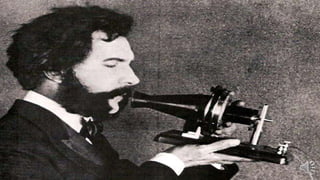
• In the 1870s, two inventors Elisha Gray and Alexander Graham Bell
both independently designed devices that could transmit speech
electrically
• Both men rushed their respective designs to the patent office within
hours of each other, Alexander Graham Bell patented his telephone
first.
• Elisha Gray and Alexander Graham Bell entered into a famous legal
battle over the invention of the telephone, which Bell won.
INVENTION OF THE TELEPHONE
• Credit for the invention of the electric telephone is frequently
disputed, and new controversies over the issue have arisen from time-
to-time.
• Charles Bourseul, Antonio Meucci, Johann Philipp Reis, Alexander
Graham Bell, and Elisha Gray, amongst others, have all been credited
with the telephone's invention.
• The Bell and Edison patents, however, were commercially decisive,
because they dominated telephone technology and were upheld by
court decisions in the United States.
EVOLUTION OF THE TELEGRAPH INTO THE
TELEPHONE
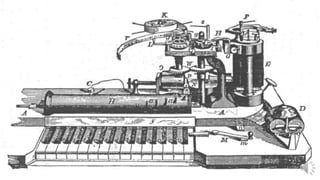
• The telegraph and telephone are both wire-based electrical systems.
• Alexander Graham Bell's success with the telephone came as a direct
result of his attempts to improve the telegraph.
• When Bell began experimenting with electrical signals, the telegraph
had been an established means of communication for some 30 years.
• Although a highly successful system, the telegraph, with its dot-and-
dash Morse code, was basically limited to receiving and sending one
message at a time.
• His "harmonic telegraph" was based on the principle that several
notes could be sent simultaneously along the same wire if the notes or
signals differed in pitch.
20TH CENTURY DEVELOPMENTS
• By 1904 over three million phones in the U.S
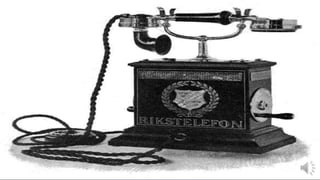
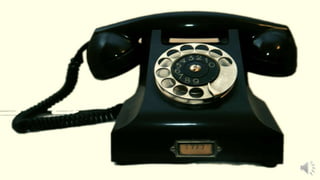
• What turned out to be the most popular and longest lasting physical style of
telephone was introduced in the early 20th century, including Bell's model 102
telephone.
• The circuit diagram of the model 102 shows the direct connection of the receiver to
the line, while the transmitter was induction coupled, with energy supplied by a
local battery.
• The rotary dial in the base interrupted the line current by repeatedly but very
briefly disconnecting the line 1 to 10 times for each digit, and the hook switch
permanently disconnected the line and the transmitter battery while the handset
was on the cradle.
21ST CENTURY DEVELOPMENTS
• Internet Protocol (IP) telephony, also known as Internet telephony or
Voice over Internet Protocol (VoIP), is a disruptive technology that is
rapidly gaining ground against traditional telephone network
technologies.
• In Japan and South Korea up to 10% of subscribers switched to this
type of telephone service as of January 2005.
• IP telephony uses a broadband Internet service to transmit
conversations as data packets.
• VoIP is also used on private wireless networks which may or may not
have a connection to the outside telephone network.
REFERENCES
• http://en.wikipedia.org/wiki/History_of_the_telephone
• https://www.google.co.in/search?q=History+of+the+telephone&oq=History+of+the+te
lephone&aqs=chrome..69i57j69i60.655j0j7&sourceid=chrome&es_sm=122&ie=UTF-
8
• http://www.nationalitpa.com/history-of-the-telephone.html
• http://inventors.about.com/od/bstartinventors/a/telephone.htm
THANK YOU

History of Telephone

  • 1.
  • 2.
    INTRODUCTION • This historyof the telephone chronicles the development of the electrical telephone. • In the 1870s, two inventors Elisha Gray and Alexander Graham Bell both independently designed devices that could transmit speech electrically • Both men rushed their respective designs to the patent office within hours of each other, Alexander Graham Bell patented his telephone first. • Elisha Gray and Alexander Graham Bell entered into a famous legal battle over the invention of the telephone, which Bell won.
  • 4.
    INVENTION OF THETELEPHONE • Credit for the invention of the electric telephone is frequently disputed, and new controversies over the issue have arisen from time- to-time. • Charles Bourseul, Antonio Meucci, Johann Philipp Reis, Alexander Graham Bell, and Elisha Gray, amongst others, have all been credited with the telephone's invention. • The Bell and Edison patents, however, were commercially decisive, because they dominated telephone technology and were upheld by court decisions in the United States.
  • 6.
    EVOLUTION OF THETELEGRAPH INTO THE TELEPHONE • The telegraph and telephone are both wire-based electrical systems. • Alexander Graham Bell's success with the telephone came as a direct result of his attempts to improve the telegraph. • When Bell began experimenting with electrical signals, the telegraph had been an established means of communication for some 30 years. • Although a highly successful system, the telegraph, with its dot-and- dash Morse code, was basically limited to receiving and sending one message at a time. • His "harmonic telegraph" was based on the principle that several notes could be sent simultaneously along the same wire if the notes or signals differed in pitch.
  • 8.
    20TH CENTURY DEVELOPMENTS •By 1904 over three million phones in the U.S • What turned out to be the most popular and longest lasting physical style of telephone was introduced in the early 20th century, including Bell's model 102 telephone. • The circuit diagram of the model 102 shows the direct connection of the receiver to the line, while the transmitter was induction coupled, with energy supplied by a local battery. • The rotary dial in the base interrupted the line current by repeatedly but very briefly disconnecting the line 1 to 10 times for each digit, and the hook switch permanently disconnected the line and the transmitter battery while the handset was on the cradle.
  • 10.
    21ST CENTURY DEVELOPMENTS •Internet Protocol (IP) telephony, also known as Internet telephony or Voice over Internet Protocol (VoIP), is a disruptive technology that is rapidly gaining ground against traditional telephone network technologies. • In Japan and South Korea up to 10% of subscribers switched to this type of telephone service as of January 2005. • IP telephony uses a broadband Internet service to transmit conversations as data packets. • VoIP is also used on private wireless networks which may or may not have a connection to the outside telephone network.
  • 12.
  • 13.