Indian
Regional Navigation Satellite
System (IRNSS)
Presentation By :
Tarang Gupta
1315001
MMU , Mullana
What is IRNSS?..(NAVIC)
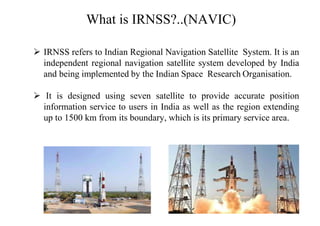
 IRNSS refers to Indian Regional Navigation Satellite System. It is an
independent regional navigation satellite system developed by India
and being implemented by the Indian Space Research Organisation.
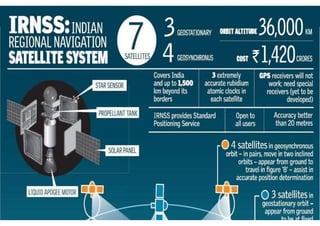
 It is designed using seven satellite to provide accurate position
information service to users in India as well as the region extending
up to 1500 km from its boundary, which is its primary service area.
Satelittes
 IRNSS-1A
 IRNSS-1A was the first out of seven navigational satellite in the Indian
Regional Navigation Satellite System (IRNSS) series of satellites to be
placed in geosynchronous orbit. It was built at ISRO Satellite Centre,
Bangalore, costing ₹125 crore (US$19 million). It has a lift-off mass of
1380 kg.
 IRNSS-1B
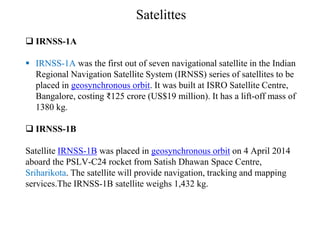
Satellite IRNSS-1B was placed in geosynchronous orbit on 4 April 2014
aboard the PSLV-C24 rocket from Satish Dhawan Space Centre,
Sriharikota. The satellite will provide navigation, tracking and mapping
services.The IRNSS-1B satellite weighs 1,432 kg.
Satelittes
 IRNSS-1C
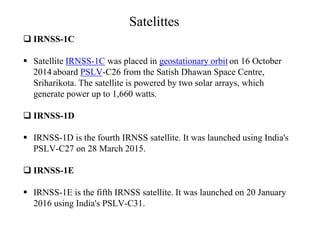
 Satellite IRNSS-1C was placed in geostationary orbit on 16 October
2014 aboard PSLV-C26 from the Satish Dhawan Space Centre,
Sriharikota. The satellite is powered by two solar arrays, which
generate power up to 1,660 watts.
 IRNSS-1D
 IRNSS-1D is the fourth IRNSS satellite. It was launched using India's
PSLV-C27 on 28 March 2015.
 IRNSS-1E
 IRNSS-1E is the fifth IRNSS satellite. It was launched on 20 January
2016 using India's PSLV-C31.
Satelittes
 IRNSS-1F
 IRNSS-1F is the sixth IRNSS satellite. It was launched on 10 March 2016
using India's PSLV-C32.
 IRNSS-1G
 IRNSS-1G is the seventh IRNSS satellite. It was launched on 28 April 2016
using India's PSLV-C33, which concludes the setting up of the Indian
Regional Navigation Satellite System.
IRNSS Elements
 Space Segment
 Ground Segment
 User Segment
Space Segment
■ Space Segment consists of Seven satellites.
■ 3 Satellites in Geo-Stationary orbit at 34°, 83° and 132°
East.
■ 4 Satellites in GEO Synchronous orbit placed at
inclination of 29° with Longitude crossing at 55° and 111°
East.
■ The Satellites are specially configured for the Navigation.
■ IRNSS Satellites are to be launched by the Indian launcher
PSLV.
Space Segment
Ground Segment
■ Spacecraft Control Centre (SCC)
■ Manage and maintain the Satellite Constellation
■ IRNSS Telemetry and Command stations
■ Receiving telemetry from the IRNSS constellation.
■ Telecommand the IRNSS constellation.
■ Uplinking Navigation updates
■ CDMA Ranging Stations
■ Facilitate accurate ranging of IRNSS Satellite and send the data to
the Navigation Control Centre.
USER Segment
■ The user segment consists of a specially designed dual frequency receiver.
■ Several types of receivers are planned with single and dual frequency
reception. Single frequency receivers may be provided with capability to
receive ionospheric corrections.
■ The user receiver may receive other constellations in addition to IRNSS.
tracked by the user■ All the seven IRNSS satellites will be continuously
receiver.
■ The user receiver will have minimum G/T of -27 dB/K similar to GPS user
receiver.
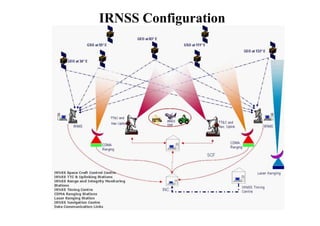
IRNSS Configuration
IRNSS Coverage and Position
Accuracy
 The intended service area for IRNSS is primarily
the Indian Land Mass. The service area for IRNSS is
in general specified as between longitude 40 deg
East to 140 deg east and between latitude ± 40 deg.
 IRNSS system provides the Dual frequency user
with a targeted position accuracy less than 20
meters in the coverage area.
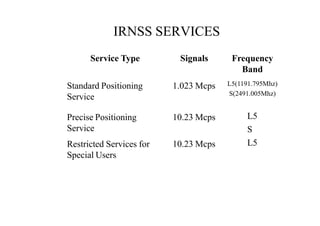
IRNSS SERVICES
10.23 Mcps
L5
S
L5
10.23 McpsPrecise Positioning
Service
Restricted Services for
Special Users
1.023 McpsStandard Positioning
Service
Frequency
Band
L5(1191.795Mhz)
S(2491.005Mhz)
Service Type Signals
S BaLnBdanfdreFqreuqeunenccyy::112491.75 MHz
IRNSS Applications
• Terrestrial, Aerial and Marine Navigation.
• Disaster Management.
• Vehicle tracking and fleet management.
• Integration with mobile phones.
• Precise Timing.
• Aid for hikers and travellers.
• Visual and voice navigation for drivers.
CLOCK GENERATION &
DISTRIBUTION UNIT (M)
3400-3425 MHz
C
O
D
E
&
D
A
T
A
R
O
U
T
I
N
G
U
N
I
T
S Band BPSK
Modulator (M)
S Band BPSK
Modulator (R)
L5 BOC
Modulator (M)
L5 BOC
Modulator (R)
S
W
S Band U/C
(M)S
W
S Band U/C
(R)
S Band DRIVER
TWTA120W
S Band DRIVER
TWTA120W
S
W
S
W
L5 Band U/C
(M)
L5 Band U/C
(R)
L5 BPSK
Modulator (M)
L5 BPSK
Modulator (R)
S
W
L5 Band U/C
(M)
L5 Band U/C
(R)
H
Y
B
H
Y
B
BPF
CLOCK GENERATION &
DISTRIBUTION UNIT (R)
CLOCK SOURCE-1
(M)
CLOCK SOURCE-2
(M)
CLOCK SOURCE-3
(R)
L5 BPSK
Modulator (M)
L5 BPSK
Modulator (R)
S
W
L5 Band U/C
(M)
L5 Band U/C
(R)
H
Y
B
L5 Band
SSPA (M)
L5 Band
SSPA (R)
L5 Band
SSPA (M)
L5 Band
SSPA (M)
L5 Band
SSPA (R)
40W SSPA
C
O
M
B
I
N
E
R
RECEIVER(M)
RECEIVER(R)
PSF
6700-6725 MHz
S
W
5W SSPA
5W SSPA
BPF
3400-3425 MHZ
C-BAND
Tx GLOBAL HORN ANTENNA
C-BAND
Rx GLOBAL HORN ANTENNA
FREQUENCY GENERATION UNIT
(M)
NAV DATA
UPLOADED
THROUGHTTC
NSGU (R)
NSGU (M)
Upload Data Memory Frame Formatter
Spreading Code Generator ErrorCorrectionCode
Control Signal Generator TimingData Generator
EncryptionUnit
AutoNAV DataGenerator
10.23 MHz
L &S-BAND
GLOBAL
COVERAGE
ANTENNA
TO
SUBSYSTEMS
FREQUENCY GENERATION UNIT
(R)
NAVIGATION PAYLOAD
RANGING PAYLOAD
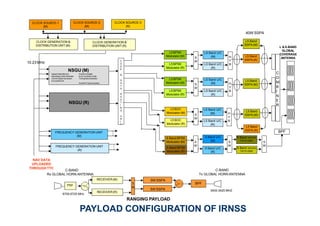
PAYLOAD CONFIGURATION OF IRNSS
Bibliography
 http://gpsworld.com/irnss-signal-in-space-icd-released/
 https://en.wikipedia.org/wiki/Indian_Regional_Navigatio
n_Satellite_System
 http://www.isro.gov.in/irnss-programme
 http://www.navipedia.net/index.php/NAVIC
THANK YOU

IRNSS

  • 1.
    Indian Regional Navigation Satellite System(IRNSS) Presentation By : Tarang Gupta 1315001 MMU , Mullana
  • 2.
    What is IRNSS?..(NAVIC) IRNSS refers to Indian Regional Navigation Satellite System. It is an independent regional navigation satellite system developed by India and being implemented by the Indian Space Research Organisation.  It is designed using seven satellite to provide accurate position information service to users in India as well as the region extending up to 1500 km from its boundary, which is its primary service area.
  • 3.
    Satelittes  IRNSS-1A  IRNSS-1Awas the first out of seven navigational satellite in the Indian Regional Navigation Satellite System (IRNSS) series of satellites to be placed in geosynchronous orbit. It was built at ISRO Satellite Centre, Bangalore, costing ₹125 crore (US$19 million). It has a lift-off mass of 1380 kg.  IRNSS-1B Satellite IRNSS-1B was placed in geosynchronous orbit on 4 April 2014 aboard the PSLV-C24 rocket from Satish Dhawan Space Centre, Sriharikota. The satellite will provide navigation, tracking and mapping services.The IRNSS-1B satellite weighs 1,432 kg.
  • 4.
    Satelittes  IRNSS-1C  SatelliteIRNSS-1C was placed in geostationary orbit on 16 October 2014 aboard PSLV-C26 from the Satish Dhawan Space Centre, Sriharikota. The satellite is powered by two solar arrays, which generate power up to 1,660 watts.  IRNSS-1D  IRNSS-1D is the fourth IRNSS satellite. It was launched using India's PSLV-C27 on 28 March 2015.  IRNSS-1E  IRNSS-1E is the fifth IRNSS satellite. It was launched on 20 January 2016 using India's PSLV-C31.
  • 5.
    Satelittes  IRNSS-1F  IRNSS-1Fis the sixth IRNSS satellite. It was launched on 10 March 2016 using India's PSLV-C32.  IRNSS-1G  IRNSS-1G is the seventh IRNSS satellite. It was launched on 28 April 2016 using India's PSLV-C33, which concludes the setting up of the Indian Regional Navigation Satellite System.
  • 6.
    IRNSS Elements  SpaceSegment  Ground Segment  User Segment
  • 7.
    Space Segment ■ SpaceSegment consists of Seven satellites. ■ 3 Satellites in Geo-Stationary orbit at 34°, 83° and 132° East. ■ 4 Satellites in GEO Synchronous orbit placed at inclination of 29° with Longitude crossing at 55° and 111° East. ■ The Satellites are specially configured for the Navigation. ■ IRNSS Satellites are to be launched by the Indian launcher PSLV.
  • 8.
  • 9.
    Ground Segment ■ SpacecraftControl Centre (SCC) ■ Manage and maintain the Satellite Constellation ■ IRNSS Telemetry and Command stations ■ Receiving telemetry from the IRNSS constellation. ■ Telecommand the IRNSS constellation. ■ Uplinking Navigation updates ■ CDMA Ranging Stations ■ Facilitate accurate ranging of IRNSS Satellite and send the data to the Navigation Control Centre.
  • 10.
    USER Segment ■ Theuser segment consists of a specially designed dual frequency receiver. ■ Several types of receivers are planned with single and dual frequency reception. Single frequency receivers may be provided with capability to receive ionospheric corrections. ■ The user receiver may receive other constellations in addition to IRNSS. tracked by the user■ All the seven IRNSS satellites will be continuously receiver. ■ The user receiver will have minimum G/T of -27 dB/K similar to GPS user receiver.
  • 11.
  • 12.
    IRNSS Coverage andPosition Accuracy  The intended service area for IRNSS is primarily the Indian Land Mass. The service area for IRNSS is in general specified as between longitude 40 deg East to 140 deg east and between latitude ± 40 deg.  IRNSS system provides the Dual frequency user with a targeted position accuracy less than 20 meters in the coverage area.
  • 13.
    IRNSS SERVICES 10.23 Mcps L5 S L5 10.23McpsPrecise Positioning Service Restricted Services for Special Users 1.023 McpsStandard Positioning Service Frequency Band L5(1191.795Mhz) S(2491.005Mhz) Service Type Signals S BaLnBdanfdreFqreuqeunenccyy::112491.75 MHz
  • 14.
    IRNSS Applications • Terrestrial,Aerial and Marine Navigation. • Disaster Management. • Vehicle tracking and fleet management. • Integration with mobile phones. • Precise Timing. • Aid for hikers and travellers. • Visual and voice navigation for drivers.
  • 15.
    CLOCK GENERATION & DISTRIBUTIONUNIT (M) 3400-3425 MHz C O D E & D A T A R O U T I N G U N I T S Band BPSK Modulator (M) S Band BPSK Modulator (R) L5 BOC Modulator (M) L5 BOC Modulator (R) S W S Band U/C (M)S W S Band U/C (R) S Band DRIVER TWTA120W S Band DRIVER TWTA120W S W S W L5 Band U/C (M) L5 Band U/C (R) L5 BPSK Modulator (M) L5 BPSK Modulator (R) S W L5 Band U/C (M) L5 Band U/C (R) H Y B H Y B BPF CLOCK GENERATION & DISTRIBUTION UNIT (R) CLOCK SOURCE-1 (M) CLOCK SOURCE-2 (M) CLOCK SOURCE-3 (R) L5 BPSK Modulator (M) L5 BPSK Modulator (R) S W L5 Band U/C (M) L5 Band U/C (R) H Y B L5 Band SSPA (M) L5 Band SSPA (R) L5 Band SSPA (M) L5 Band SSPA (M) L5 Band SSPA (R) 40W SSPA C O M B I N E R RECEIVER(M) RECEIVER(R) PSF 6700-6725 MHz S W 5W SSPA 5W SSPA BPF 3400-3425 MHZ C-BAND Tx GLOBAL HORN ANTENNA C-BAND Rx GLOBAL HORN ANTENNA FREQUENCY GENERATION UNIT (M) NAV DATA UPLOADED THROUGHTTC NSGU (R) NSGU (M) Upload Data Memory Frame Formatter Spreading Code Generator ErrorCorrectionCode Control Signal Generator TimingData Generator EncryptionUnit AutoNAV DataGenerator 10.23 MHz L &S-BAND GLOBAL COVERAGE ANTENNA TO SUBSYSTEMS FREQUENCY GENERATION UNIT (R) NAVIGATION PAYLOAD RANGING PAYLOAD PAYLOAD CONFIGURATION OF IRNSS
  • 17.
  • 18.