BIOLOGY TISSUES
www.topperlearning.com 2
Tissues
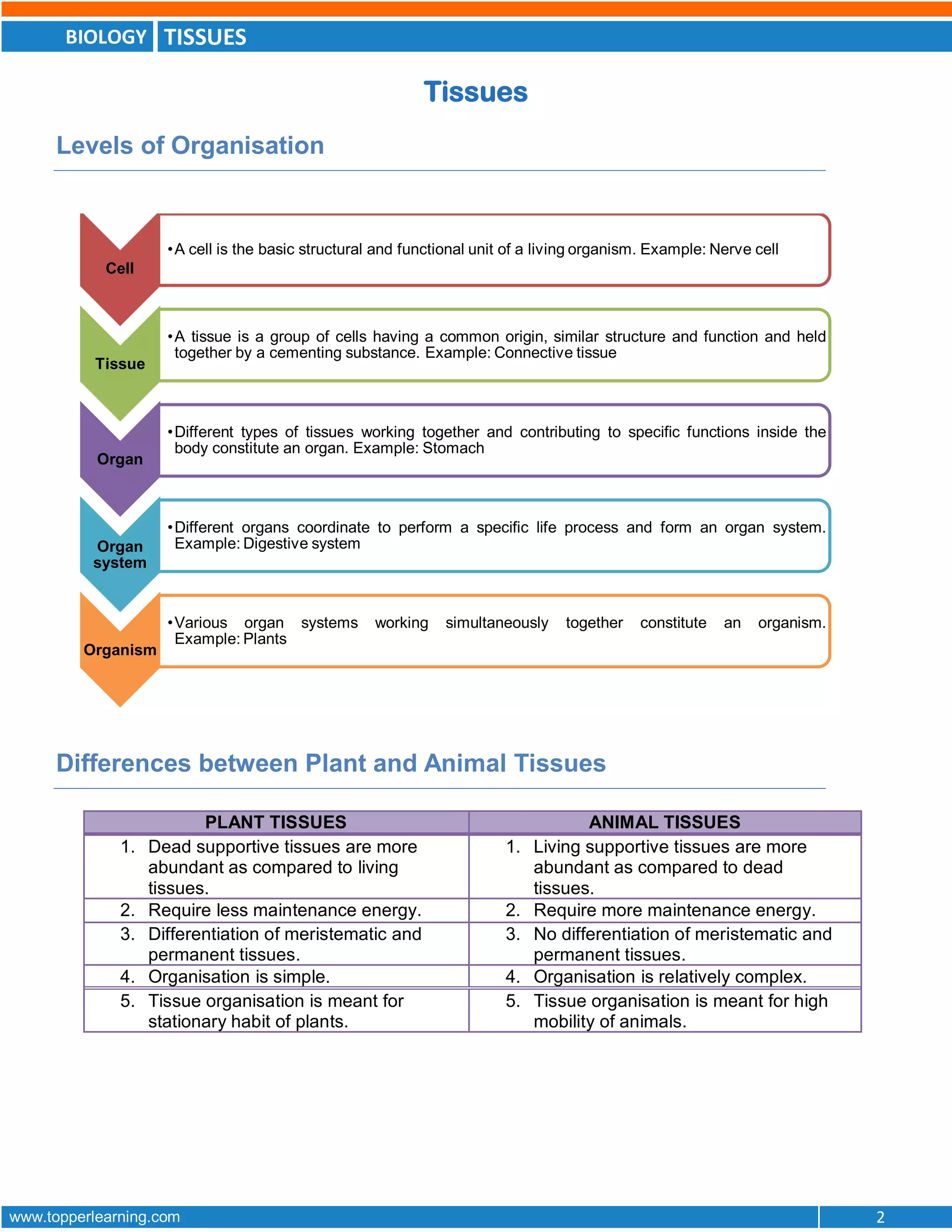
Levels of Organisation
Differences between Plant and Animal Tissues
PLANT TISSUES ANIMAL TISSUES
1. Dead supportive tissues are more
abundant as compared to living
tissues.
1. Living supportive tissues are more
abundant as compared to dead
tissues.
2. Require less maintenance energy. 2. Require more maintenance energy.
3. Differentiation of meristematic and
permanent tissues.
3. No differentiation of meristematic and
permanent tissues.
4. Organisation is simple. 4. Organisation is relatively complex.
5. Tissue organisation is meant for
stationary habit of plants.
5. Tissue organisation is meant for high
mobility of animals.
Cell
•A cell is the basic structural and functional unit of a living organism. Example: Nerve cell
Tissue
•A tissue is a group of cells having a common origin, similar structure and function and held
together by a cementing substance. Example: Connective tissue
Organ
•Different types of tissues working together and contributing to specific functions inside the
body constitute an organ. Example: Stomach
Organ
system
•Different organs coordinate to perform a specific life process and form an organ system.
Example: Digestive system
Organism
•Various organ systems working simultaneously together constitute an organism.
Example: Plants
BIOLOGY TISSUES
www.topperlearning.com 3
Classification of Plant Tissues
Meristematic Tissue
Types of Meristematic Tissues
Type Location Function
Apical meristem Located at the growing points of the stem,
roots, branches and in growing young leaves
near the tips of stems and axillary buds
Enables the root and stem to
grow by increasing the length of
plants
Intercalary
meristem
Located at the internodes or stem regions
between the places at which the leaves attach
and at leaf bases
The cells are active and they
continuously form several new
cells
Lateral
meristem/
Cambium
Present laterally (on the sides) on the roots and
stem and is situated parallel to the longitudinal
axis below the bark
The girth and
width/diameter/thickness of the
stem or root increases because of
the lateral meristem
Characteristics
•Cells are thin-walled
and composed of
cellulose.
Location
•Located at the tips of
the roots and stems,
and the base of the
node, internode or
leaf.
Function
•The cells of
meristematic tissue
divide actively, which
results in growth
(increase in thickness
and length) of plants.
BIOLOGY TISSUES
www.topperlearning.com 4
Permanent Tissues
 Permanent tissues are formed by the division of the meristematic tissue cells which have lost their
ability to multiply.
Types of Permanent Tissues
Protective Tissue
 It is found on the surface of the roots, stems and leaves.
 It consists of cells with thick walls.
 It provides protection against mechanical injury or invasion by parasitic fungi.
Types of Protective Tissues
Type Characteristics Location Function
Epidermis Cells are elongated and
flattened with no intercellular
spaces between them.
Present in the outermost
layer of leaves, flowers,
stem and roots.
Protects the plant from
desiccation and
infection.
Cork Cells are rectangular with
vacuolated protoplasts.
It is the outermost layer
formed after the epidermis
undergoes certain changes.
Prevents desiccation,
infection and mechanical
injury.
Supporting Tissue
 It provides support to the plant.
Types of Supporting Tissues
Type Characteristics Location Function
Parenchyma Consists of relatively non-
specialised large, thin-walled
living cells
Mainly present in the soft
parts of the plant and outer
cortical region of roots and
stems
Provides temporary
support and maintains
the shape of the plant
body
Collenchyma Cells are living and elongated
with cell walls irregularly
thickened at the corners
Located in non-woody
plants, leaf stalks and
below the epidermis of the
stems and veins of leaves
Provides mechanical
support and elasticity to
young dicotyledonous
plants
Sclerenchyma Consists of elongated, narrow
and fibre-like cells.
Cells are dead, pointed at
both ends and thickened
Located in the stems
around the vascular bundle,
veins of leaves and hard
covering of seeds and nuts
Provides strength and
toughness to plant parts
BIOLOGY TISSUES
www.topperlearning.com 5
Conducting Tissue (Vascular Tissue)
 It is present in stems, roots and leaves.
 It provides a passage for water and dissolved materials to move up and down in the plant body.
Types of Conducting Tissues
Type Characteristics Location Function
Xylem Complex permanent tissue
with thick-walled cells; most of
the cells are dead
Present in the stem, roots
and leaves
Provides upward
movement of water and
dissolved materials
Components of Xylem
Tracheids Made of elongated cells with
flat and tapering ends
- Provide a network of
hollow and connected
cells for the transport of
water
Xylem vessels Tubular structures which
consist of dead cells
- Allow free flow of water
and minerals from the
roots to the leaves
Xylem
parenchyma
Consists of living parenchyma
cells associated with xylem
- Stores food in the plant
body
Xylem fibres Separated by thin cross walls - Mainly support the plant
Types of Conducting Tissues
Type Characteristics Location Function
Phloem Complex permanent tissue Lies just beneath the bark
of the tree
Provides a passage for
the downward movement
of food
Components of Phloem
Sieve tubes Tubular cells with perforated
walls and arranged end to end
- Translocation of organic
substances
Companion
cells
Cells are living and keep their
nuclei and other organelles
throughout their life
- Help to control the
activity of sieve tube
elements
Phloem fibres Elongated, tapering and dead
cells with thickened cell walls
Found particularly in the
stem
Provide mechanical
strength to plants
Phloem
parenchyma
Cells are alive and filled with
cytoplasm
- Transports food from the
leaves to the other non-
green parts of the plants
BIOLOGY TISSUES
www.topperlearning.com 6
Differences between Meristematic and Permanent Tissues
MERISTEMATIC TISSUE PERMANENT TISSUE
1. Simple tissue 1. Simple, complex or specialised tissue
2. Component cells are small,
spherical or polygonal and
undifferentiated
2. Component cells are large,
differentiated with different shapes
3. Intercellular spaces are absent 3. Intercellular spaces are present
4. Cells grow and divide regularly 4. Cells do not divide
5. Metabolically active 5. Metabolic rate is slow
6. Provides growth to the plant 6. Provides protection, support,
conduction, photosynthesis, storage
Classification of Animal Tissues
Epithelial Tissue
Characteristics
•Flat, cuboidal or
columnar cells
Location
•Covers the whole body
surface
Function
•Protection, absorption,
secretion, sensory
perception
BIOLOGY TISSUES
www.topperlearning.com 7
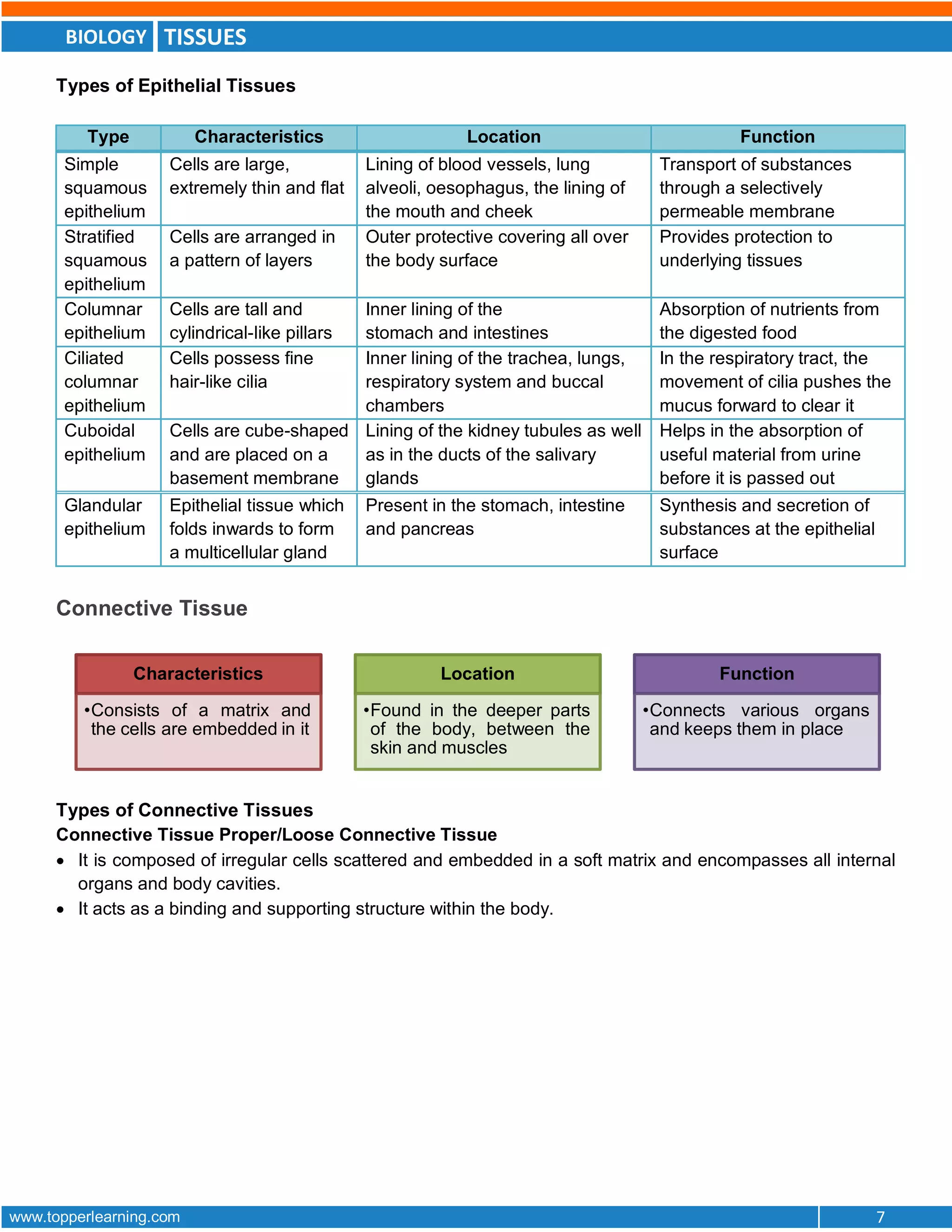
Types of Epithelial Tissues
Type Characteristics Location Function
Simple
squamous
epithelium
Cells are large,
extremely thin and flat
Lining of blood vessels, lung
alveoli, oesophagus, the lining of
the mouth and cheek
Transport of substances
through a selectively
permeable membrane
Stratified
squamous
epithelium
Cells are arranged in
a pattern of layers
Outer protective covering all over
the body surface
Provides protection to
underlying tissues
Columnar
epithelium
Cells are tall and
cylindrical-like pillars
Inner lining of the
stomach and intestines
Absorption of nutrients from
the digested food
Ciliated
columnar
epithelium
Cells possess fine
hair-like cilia
Inner lining of the trachea, lungs,
respiratory system and buccal
chambers
In the respiratory tract, the
movement of cilia pushes the
mucus forward to clear it
Cuboidal
epithelium
Cells are cube-shaped
and are placed on a
basement membrane
Lining of the kidney tubules as well
as in the ducts of the salivary
glands
Helps in the absorption of
useful material from urine
before it is passed out
Glandular
epithelium
Epithelial tissue which
folds inwards to form
a multicellular gland
Present in the stomach, intestine
and pancreas
Synthesis and secretion of
substances at the epithelial
surface
Connective Tissue
Types of Connective Tissues
Connective Tissue Proper/Loose Connective Tissue
 It is composed of irregular cells scattered and embedded in a soft matrix and encompasses all internal
organs and body cavities.
 It acts as a binding and supporting structure within the body.
Characteristics
•Consists of a matrix and
the cells are embedded in it
Location
•Found in the deeper parts
of the body, between the
skin and muscles
Function
•Connects various organs
and keeps them in place
BIOLOGY TISSUES
www.topperlearning.com 8
Types of Connective Tissues Proper
Type Characteristics Location Function
Areolar
tissue
Made of gelatinous matrix
containing cells and
irregularly arranged fibres
Found between the skin and
muscles, around the blood
vessels, nerves and in the bone
marrow
Supports and strengthens the
internal organs
Adipose
tissue
Cells are filled with fat
globules
Found beneath the skin, around
the kidneys and other internal
organs such as intestines
Insulates the body and
prevents the loss of heat
Fibrous
tissue
Mainly formed of fibre-
forming cells, which form
the tendons and
ligaments
Found in the spaces between the
bones and muscles
Tendons help to attach
muscles to the bones.
Ligaments serve to hold the
structures together and keep
them strong and stable
Supportive Connective Tissue/Dense Connective Tissue
 It is composed of fibres as its main matrix element and is found in bones and cartilages.
 It connects different tissues.
Types of Supportive Connective Tissues
Type Characteristics Location Function
Cartilage Non-porous, semi-
transparent and elastic
tissue
Present in the nose, external ear,
trachea, larynx, ends of the long
bones and between the vertebrae
Smoothens the bone surface
at joints, allowing smooth
movement of these joints
Bone Hard, strong and non-
flexible porous tissue
which consists of living
cells
Forms a rigid part of the skeletal
system
Forms the supporting
framework of the body
Gives shape and rigidity to
the body
Fluid Connective Tissue
 It consists of liquid as the ground substance and is present throughout the body.
 It provides nutrition, helps in transport of nutrients and gets rid of waste matter.
Types of Fluid Connective Tissues
Type Characteristics Location Function
Blood Red-coloured fluid matrix which
consists of plasma and cells such
as RBCs, WBCs and platelets
Present throughout the
body
Connects different parts of
the body and establishes
continuity within the body
Lymph Fluid surrounding the body cells
which contains WBCs
Present throughout the
body
Transports nutrients and
provides protection against
diseases
BIOLOGY TISSUES
www.topperlearning.com 9
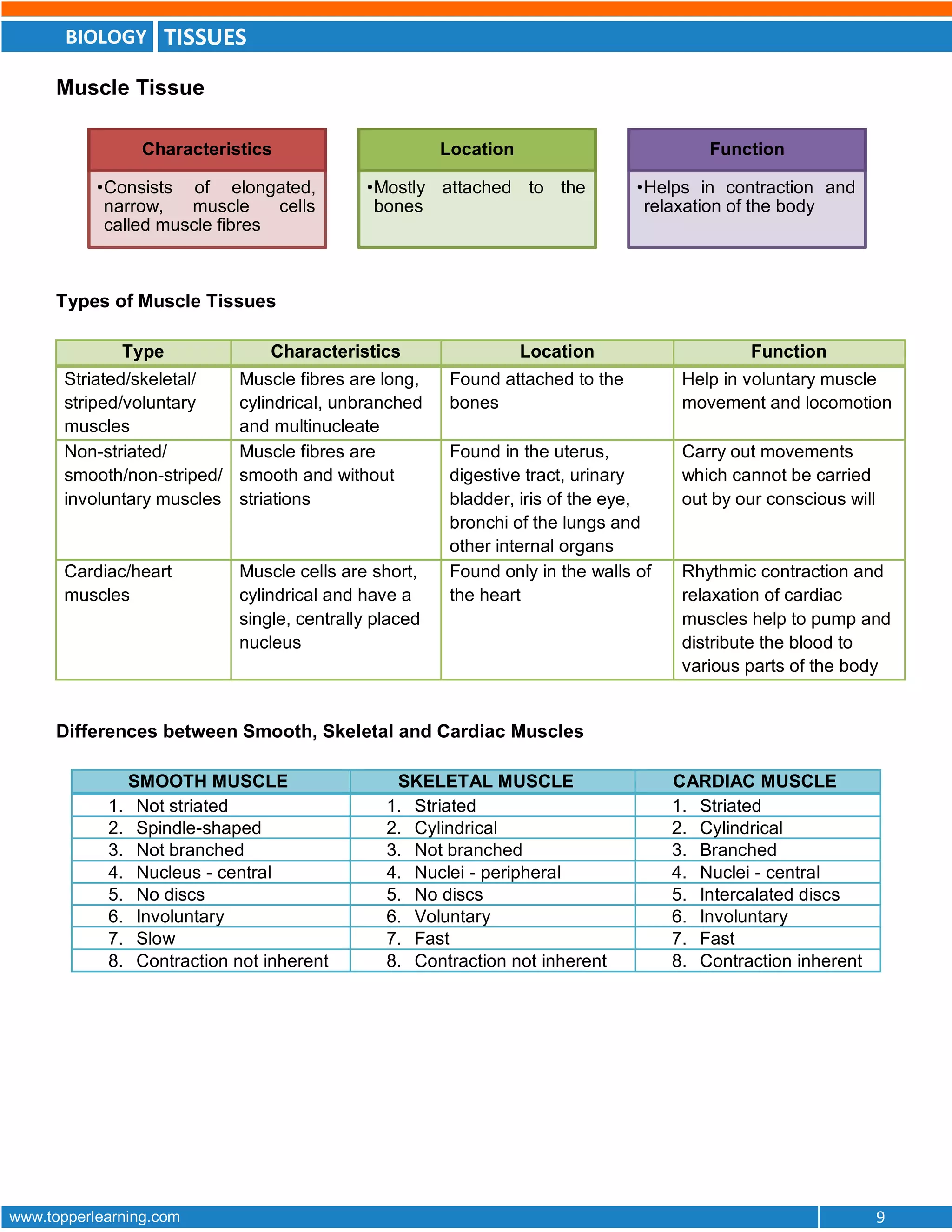
Muscle Tissue
Types of Muscle Tissues
Type Characteristics Location Function
Striated/skeletal/
striped/voluntary
muscles
Muscle fibres are long,
cylindrical, unbranched
and multinucleate
Found attached to the
bones
Help in voluntary muscle
movement and locomotion
Non-striated/
smooth/non-striped/
involuntary muscles
Muscle fibres are
smooth and without
striations
Found in the uterus,
digestive tract, urinary
bladder, iris of the eye,
bronchi of the lungs and
other internal organs
Carry out movements
which cannot be carried
out by our conscious will
Cardiac/heart
muscles
Muscle cells are short,
cylindrical and have a
single, centrally placed
nucleus
Found only in the walls of
the heart
Rhythmic contraction and
relaxation of cardiac
muscles help to pump and
distribute the blood to
various parts of the body
Differences between Smooth, Skeletal and Cardiac Muscles
SMOOTH MUSCLE SKELETAL MUSCLE CARDIAC MUSCLE
1. Not striated 1. Striated 1. Striated
2. Spindle-shaped 2. Cylindrical 2. Cylindrical
3. Not branched 3. Not branched 3. Branched
4. Nucleus - central 4. Nuclei - peripheral 4. Nuclei - central
5. No discs 5. No discs 5. Intercalated discs
6. Involuntary 6. Voluntary 6. Involuntary
7. Slow 7. Fast 7. Fast
8. Contraction not inherent 8. Contraction not inherent 8. Contraction inherent
Characteristics
•Consists of elongated,
narrow, muscle cells
called muscle fibres
Location
•Mostly attached to the
bones
Function
•Helps in contraction and
relaxation of the body
BIOLOGY TISSUES
www.topperlearning.com 10
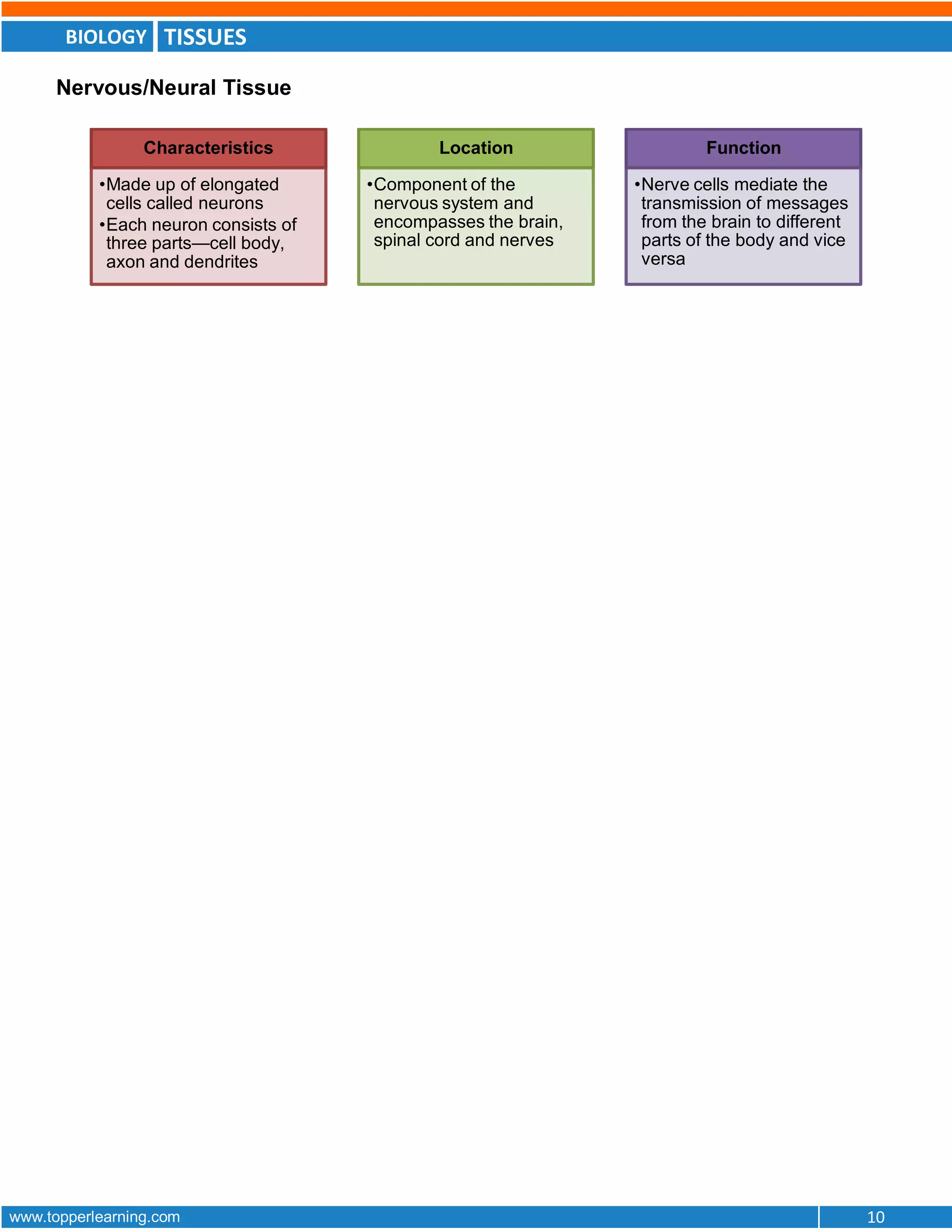
Nervous/Neural Tissue
Characteristics
•Made up of elongated
cells called neurons
•Each neuron consists of
three parts—cell body,
axon and dendrites
Location
•Component of the
nervous system and
encompasses the brain,
spinal cord and nerves
Function
•Nerve cells mediate the
transmission of messages
from the brain to different
parts of the body and vice
versa

tissues (class- 9th notes)

  • 2.
    BIOLOGY TISSUES www.topperlearning.com 2 Tissues Levelsof Organisation Differences between Plant and Animal Tissues PLANT TISSUES ANIMAL TISSUES 1. Dead supportive tissues are more abundant as compared to living tissues. 1. Living supportive tissues are more abundant as compared to dead tissues. 2. Require less maintenance energy. 2. Require more maintenance energy. 3. Differentiation of meristematic and permanent tissues. 3. No differentiation of meristematic and permanent tissues. 4. Organisation is simple. 4. Organisation is relatively complex. 5. Tissue organisation is meant for stationary habit of plants. 5. Tissue organisation is meant for high mobility of animals. Cell •A cell is the basic structural and functional unit of a living organism. Example: Nerve cell Tissue •A tissue is a group of cells having a common origin, similar structure and function and held together by a cementing substance. Example: Connective tissue Organ •Different types of tissues working together and contributing to specific functions inside the body constitute an organ. Example: Stomach Organ system •Different organs coordinate to perform a specific life process and form an organ system. Example: Digestive system Organism •Various organ systems working simultaneously together constitute an organism. Example: Plants
  • 3.
    BIOLOGY TISSUES www.topperlearning.com 3 Classificationof Plant Tissues Meristematic Tissue Types of Meristematic Tissues Type Location Function Apical meristem Located at the growing points of the stem, roots, branches and in growing young leaves near the tips of stems and axillary buds Enables the root and stem to grow by increasing the length of plants Intercalary meristem Located at the internodes or stem regions between the places at which the leaves attach and at leaf bases The cells are active and they continuously form several new cells Lateral meristem/ Cambium Present laterally (on the sides) on the roots and stem and is situated parallel to the longitudinal axis below the bark The girth and width/diameter/thickness of the stem or root increases because of the lateral meristem Characteristics •Cells are thin-walled and composed of cellulose. Location •Located at the tips of the roots and stems, and the base of the node, internode or leaf. Function •The cells of meristematic tissue divide actively, which results in growth (increase in thickness and length) of plants.
  • 4.
    BIOLOGY TISSUES www.topperlearning.com 4 PermanentTissues  Permanent tissues are formed by the division of the meristematic tissue cells which have lost their ability to multiply. Types of Permanent Tissues Protective Tissue  It is found on the surface of the roots, stems and leaves.  It consists of cells with thick walls.  It provides protection against mechanical injury or invasion by parasitic fungi. Types of Protective Tissues Type Characteristics Location Function Epidermis Cells are elongated and flattened with no intercellular spaces between them. Present in the outermost layer of leaves, flowers, stem and roots. Protects the plant from desiccation and infection. Cork Cells are rectangular with vacuolated protoplasts. It is the outermost layer formed after the epidermis undergoes certain changes. Prevents desiccation, infection and mechanical injury. Supporting Tissue  It provides support to the plant. Types of Supporting Tissues Type Characteristics Location Function Parenchyma Consists of relatively non- specialised large, thin-walled living cells Mainly present in the soft parts of the plant and outer cortical region of roots and stems Provides temporary support and maintains the shape of the plant body Collenchyma Cells are living and elongated with cell walls irregularly thickened at the corners Located in non-woody plants, leaf stalks and below the epidermis of the stems and veins of leaves Provides mechanical support and elasticity to young dicotyledonous plants Sclerenchyma Consists of elongated, narrow and fibre-like cells. Cells are dead, pointed at both ends and thickened Located in the stems around the vascular bundle, veins of leaves and hard covering of seeds and nuts Provides strength and toughness to plant parts
  • 5.
    BIOLOGY TISSUES www.topperlearning.com 5 ConductingTissue (Vascular Tissue)  It is present in stems, roots and leaves.  It provides a passage for water and dissolved materials to move up and down in the plant body. Types of Conducting Tissues Type Characteristics Location Function Xylem Complex permanent tissue with thick-walled cells; most of the cells are dead Present in the stem, roots and leaves Provides upward movement of water and dissolved materials Components of Xylem Tracheids Made of elongated cells with flat and tapering ends - Provide a network of hollow and connected cells for the transport of water Xylem vessels Tubular structures which consist of dead cells - Allow free flow of water and minerals from the roots to the leaves Xylem parenchyma Consists of living parenchyma cells associated with xylem - Stores food in the plant body Xylem fibres Separated by thin cross walls - Mainly support the plant Types of Conducting Tissues Type Characteristics Location Function Phloem Complex permanent tissue Lies just beneath the bark of the tree Provides a passage for the downward movement of food Components of Phloem Sieve tubes Tubular cells with perforated walls and arranged end to end - Translocation of organic substances Companion cells Cells are living and keep their nuclei and other organelles throughout their life - Help to control the activity of sieve tube elements Phloem fibres Elongated, tapering and dead cells with thickened cell walls Found particularly in the stem Provide mechanical strength to plants Phloem parenchyma Cells are alive and filled with cytoplasm - Transports food from the leaves to the other non- green parts of the plants
  • 6.
    BIOLOGY TISSUES www.topperlearning.com 6 Differencesbetween Meristematic and Permanent Tissues MERISTEMATIC TISSUE PERMANENT TISSUE 1. Simple tissue 1. Simple, complex or specialised tissue 2. Component cells are small, spherical or polygonal and undifferentiated 2. Component cells are large, differentiated with different shapes 3. Intercellular spaces are absent 3. Intercellular spaces are present 4. Cells grow and divide regularly 4. Cells do not divide 5. Metabolically active 5. Metabolic rate is slow 6. Provides growth to the plant 6. Provides protection, support, conduction, photosynthesis, storage Classification of Animal Tissues Epithelial Tissue Characteristics •Flat, cuboidal or columnar cells Location •Covers the whole body surface Function •Protection, absorption, secretion, sensory perception
  • 7.
    BIOLOGY TISSUES www.topperlearning.com 7 Typesof Epithelial Tissues Type Characteristics Location Function Simple squamous epithelium Cells are large, extremely thin and flat Lining of blood vessels, lung alveoli, oesophagus, the lining of the mouth and cheek Transport of substances through a selectively permeable membrane Stratified squamous epithelium Cells are arranged in a pattern of layers Outer protective covering all over the body surface Provides protection to underlying tissues Columnar epithelium Cells are tall and cylindrical-like pillars Inner lining of the stomach and intestines Absorption of nutrients from the digested food Ciliated columnar epithelium Cells possess fine hair-like cilia Inner lining of the trachea, lungs, respiratory system and buccal chambers In the respiratory tract, the movement of cilia pushes the mucus forward to clear it Cuboidal epithelium Cells are cube-shaped and are placed on a basement membrane Lining of the kidney tubules as well as in the ducts of the salivary glands Helps in the absorption of useful material from urine before it is passed out Glandular epithelium Epithelial tissue which folds inwards to form a multicellular gland Present in the stomach, intestine and pancreas Synthesis and secretion of substances at the epithelial surface Connective Tissue Types of Connective Tissues Connective Tissue Proper/Loose Connective Tissue  It is composed of irregular cells scattered and embedded in a soft matrix and encompasses all internal organs and body cavities.  It acts as a binding and supporting structure within the body. Characteristics •Consists of a matrix and the cells are embedded in it Location •Found in the deeper parts of the body, between the skin and muscles Function •Connects various organs and keeps them in place
  • 8.
    BIOLOGY TISSUES www.topperlearning.com 8 Typesof Connective Tissues Proper Type Characteristics Location Function Areolar tissue Made of gelatinous matrix containing cells and irregularly arranged fibres Found between the skin and muscles, around the blood vessels, nerves and in the bone marrow Supports and strengthens the internal organs Adipose tissue Cells are filled with fat globules Found beneath the skin, around the kidneys and other internal organs such as intestines Insulates the body and prevents the loss of heat Fibrous tissue Mainly formed of fibre- forming cells, which form the tendons and ligaments Found in the spaces between the bones and muscles Tendons help to attach muscles to the bones. Ligaments serve to hold the structures together and keep them strong and stable Supportive Connective Tissue/Dense Connective Tissue  It is composed of fibres as its main matrix element and is found in bones and cartilages.  It connects different tissues. Types of Supportive Connective Tissues Type Characteristics Location Function Cartilage Non-porous, semi- transparent and elastic tissue Present in the nose, external ear, trachea, larynx, ends of the long bones and between the vertebrae Smoothens the bone surface at joints, allowing smooth movement of these joints Bone Hard, strong and non- flexible porous tissue which consists of living cells Forms a rigid part of the skeletal system Forms the supporting framework of the body Gives shape and rigidity to the body Fluid Connective Tissue  It consists of liquid as the ground substance and is present throughout the body.  It provides nutrition, helps in transport of nutrients and gets rid of waste matter. Types of Fluid Connective Tissues Type Characteristics Location Function Blood Red-coloured fluid matrix which consists of plasma and cells such as RBCs, WBCs and platelets Present throughout the body Connects different parts of the body and establishes continuity within the body Lymph Fluid surrounding the body cells which contains WBCs Present throughout the body Transports nutrients and provides protection against diseases
  • 9.
    BIOLOGY TISSUES www.topperlearning.com 9 MuscleTissue Types of Muscle Tissues Type Characteristics Location Function Striated/skeletal/ striped/voluntary muscles Muscle fibres are long, cylindrical, unbranched and multinucleate Found attached to the bones Help in voluntary muscle movement and locomotion Non-striated/ smooth/non-striped/ involuntary muscles Muscle fibres are smooth and without striations Found in the uterus, digestive tract, urinary bladder, iris of the eye, bronchi of the lungs and other internal organs Carry out movements which cannot be carried out by our conscious will Cardiac/heart muscles Muscle cells are short, cylindrical and have a single, centrally placed nucleus Found only in the walls of the heart Rhythmic contraction and relaxation of cardiac muscles help to pump and distribute the blood to various parts of the body Differences between Smooth, Skeletal and Cardiac Muscles SMOOTH MUSCLE SKELETAL MUSCLE CARDIAC MUSCLE 1. Not striated 1. Striated 1. Striated 2. Spindle-shaped 2. Cylindrical 2. Cylindrical 3. Not branched 3. Not branched 3. Branched 4. Nucleus - central 4. Nuclei - peripheral 4. Nuclei - central 5. No discs 5. No discs 5. Intercalated discs 6. Involuntary 6. Voluntary 6. Involuntary 7. Slow 7. Fast 7. Fast 8. Contraction not inherent 8. Contraction not inherent 8. Contraction inherent Characteristics •Consists of elongated, narrow, muscle cells called muscle fibres Location •Mostly attached to the bones Function •Helps in contraction and relaxation of the body
  • 10.
    BIOLOGY TISSUES www.topperlearning.com 10 Nervous/NeuralTissue Characteristics •Made up of elongated cells called neurons •Each neuron consists of three parts—cell body, axon and dendrites Location •Component of the nervous system and encompasses the brain, spinal cord and nerves Function •Nerve cells mediate the transmission of messages from the brain to different parts of the body and vice versa