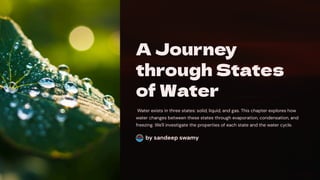
A Journey
through States
of Water
Water exists in three states: solid, liquid, and gas. This chapter explores how
water changes between these states through evaporation, condensation, and
freezing. We'll investigate the properties of each state and the water cycle.
by sandeep swamy
The Three States of Water
Solid (Ice)
Ice has a fixed shape. It does not flow
or spread.
Liquid (Water)
Water flows and takes the shape of its
container. It spreads but keeps a
constant volume.
Gas (Water Vapor)
Water vapor spreads to fill available
space. It has no fixed shape or volume.
Changing States:
Melting and Freezing
1 Solid Ice
Ice starts as a solid with a fixed shape.
2 Melting
Heat causes ice to melt into liquid water.
3 Liquid Water
Water takes the shape of its container.
4 Freezing
Cooling causes water to freeze back into ice.
Evaporation: Water to
Vapor
1 Definition
Evaporation is the process of liquid water changing into water vapor.
2 Energy
Heat energy causes water molecules to break free from the liquid
surface.
3 Examples
Drying clothes, puddles disappearing, and sweat evaporating from skin.
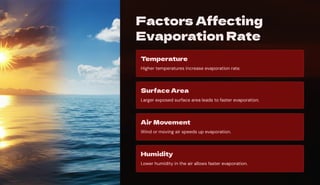
Factors Affecting
Evaporation Rate
Temperature
Higher temperatures increase evaporation rate.
Surface Area
Larger exposed surface area leads to faster evaporation.
Air Movement
Wind or moving air speeds up evaporation.
Humidity
Lower humidity in the air allows faster evaporation.
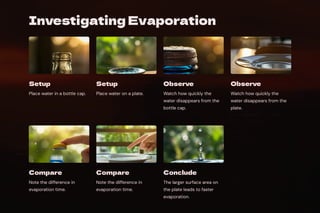
Investigating Evaporation
Setup
Place water in a bottle cap.
Setup
Place water on a plate.
Observe
Watch how quickly the
water disappears from the
bottle cap.
Observe
Watch how quickly the
water disappears from the
plate.
Compare
Note the difference in
evaporation time.
Compare
Note the difference in
evaporation time.
Conclude
The larger surface area on
the plate leads to faster
evaporation.
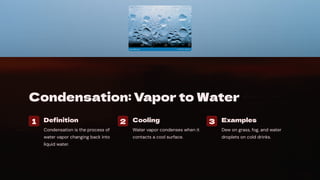
Condensation: Vapor to Water
1 Definition
Condensation is the process of
water vapor changing back into
liquid water.
2 Cooling
Water vapor condenses when it
contacts a cool surface.
3 Examples
Dew on grass, fog, and water
droplets on cold drinks.
Observing Condensation
Setup
Fill a glass with cold water and ice cubes.
Observe
Notice water droplets forming on the outside of the glass.
Leave the glass undisturbed for a few minutes. Water vapor in the air condenses on the cold surface.
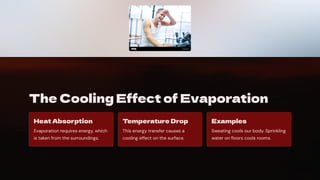
The Cooling Effect of Evaporation
Heat Absorption
Evaporation requires energy, which
is taken from the surroundings.
Temperature Drop
This energy transfer causes a
cooling effect on the surface.
Examples
Sweating cools our body. Sprinkling
water on floors cools rooms.
Pot-in-Pot Cooler
Setup
Place a small pot inside a larger
one, fill the gap with wet sand.
Evaporation
Water evaporates from the sand,
cooling the inner pot.
Cooling
The inner pot stays cool,
preserving food without electricity.
Cloud Formation
1
Evaporation
Water evaporates from Earth's surface, rising as
vapor.
2 Cooling
As vapor rises, it cools in the atmosphere.
3
Condensation
Cooled vapor condenses around dust particles,
forming tiny droplets.
4 Cloud Formation
Many droplets cluster together, creating visible
clouds.
Precipitation: Rain, Snow, and Hail
Rain
Water droplets in clouds grow and
fall as rain.
Snow
Water freezes in clouds and falls as
snowflakes.
Hail
Droplets freeze, thaw, and refreeze
while falling, forming hailstones.
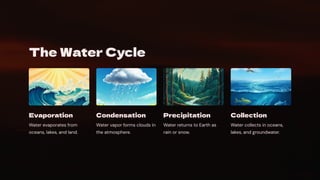
The Water Cycle
Evaporation
Water evaporates from
oceans, lakes, and land.
Condensation
Water vapor forms clouds in
the atmosphere.
Precipitation
Water returns to Earth as
rain or snow.
Collection
Water collects in oceans,
lakes, and groundwater.
Water Conservation
1 Limited Resource
Only a small portion of Earth's
water is usable by humans.
2 Growing Demand
Population growth increases
water usage and potential
shortages.
3 Conservation
We must use water wisely and
prevent pollution.
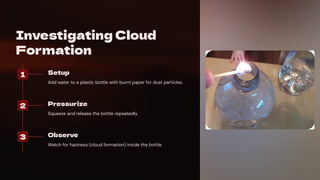
Investigating Cloud
Formation
1 Setup
Add water to a plastic bottle with burnt paper for dust particles.
2 Pressurize
Squeeze and release the bottle repeatedly.
3 Observe
Watch for haziness (cloud formation) inside the bottle.
Everyday Examples of State
Changes
Solid to Liquid
Ice cubes melting in a drink. Butter
melting in a pan.
Liquid to Gas
Boiling water in a kettle. Drying nail
polish.
Gas to Liquid
Foggy bathroom mirror. Dew on grass
in the morning.
The Importance of
Dust in Cloud
Formation
1 Nucleation
Dust particles act as nuclei for water droplets to form.
2 Condensation
Water vapor condenses more easily around these particles.
3 Cloud Formation
Without dust, cloud formation would be much more difficult.
Water's Unique
Properties
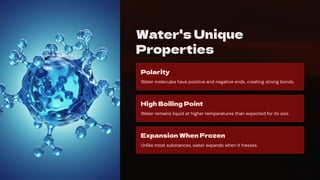
Polarity
Water molecules have positive and negative ends, creating strong bonds.
High Boiling Point
Water remains liquid at higher temperatures than expected for its size.
Expansion When Frozen
Unlike most substances, water expands when it freezes.
The Role of Water in
Climate
1
Heat Transfer
Oceans absorb and distribute heat around the planet.
2
Weather Patterns
The water cycle drives global weather systems.
3
Climate Regulation
Water vapor acts as a greenhouse gas, affecting Earth's
temperature.
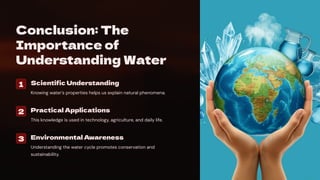
Conclusion: The
Importance of
Understanding Water
1 Scientific Understanding
Knowing water's properties helps us explain natural phenomena.
2 Practical Applications
This knowledge is used in technology, agriculture, and daily life.
3 Environmental Awareness
Understanding the water cycle promotes conservation and
sustainability.