TISSUES
INTRODUCTION
By
Dr Savita Deshmukh
Asst. Teacher (CBZ)
KPS, Nandagudi. Tq-Hoskote
Bangalore Rural Dist
Introduction
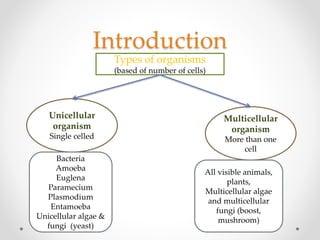
Types of organisms
(based of number of cells)
Unicellular
organism
Single celled
Multicellular
organism
More than one
cell
Bacteria
Amoeba
Euglena
Paramecium
Plasmodium
Entamoeba
Unicellular algae &
fungi (yeast)
All visible animals,
plants,
Multicellular algae
and multicellular
fungi (boost,
mushroom)
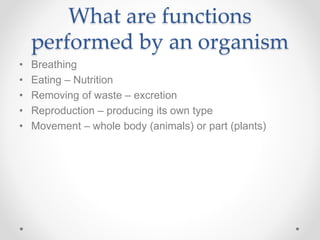
What are functions
performed by an organism
• Breathing
• Eating – Nutrition
• Removing of waste – excretion
• Reproduction – producing its own type
• Movement – whole body (animals) or part (plants)
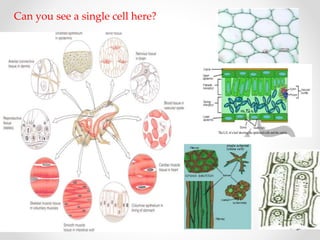
Can you see a single cell here?
INTRODUCTION
All living organisms are made up of Cells
In a unicellular organisms all the basic functions like
movement, intake of food, respiration, excretion of food
are all carried out by – a single cell.
What happens in Multicellular organisms?
Each function is carried out by a group of cells called –
Tissues
Group of such different tissues performing same
function form – Organs
And organs having different tissues but perform same
function are called – Organ system.
Video click here
INTRODUCTION
In organisms we can find the following systems
namely
 Circulatory system
 Digestive system
 Excretory system
 Respiratory system
 Nervous System – includes nerves, brain and spinal
cord
 Skeletal System – bones
 Muscular System – having muscles, blood vessels
tendons & nerves
 Reproductive system – Male and Female separate
 Integumentary system – skin, hair, feaathers, hooves,
Experiment no 1
Aim: To study the growing tissues in onion root tip
Apparatus required:
Procedure:
1.
2.
3.
4.
Observation:
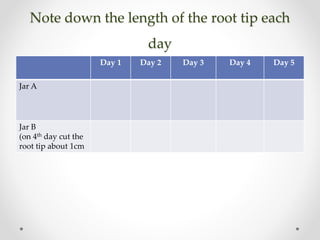
Note down the length of the root tip each
day
Day 1 Day 2 Day 3 Day 4 Day 5
Jar A
Jar B
(on 4th day cut the
root tip about 1cm
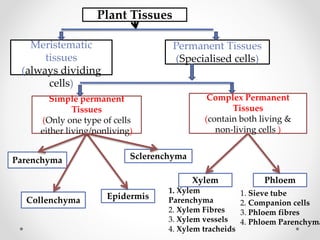
Plant Tissues
Meristematic
tissues
(always dividing
cells)
Permanent Tissues
(Specialised cells)
Simple permanent
Tissues
(Only one type of cells
either living/nonliving)
Complex Permanent
Tissues
(contain both living &
non-living cells )
Parenchyma
Collenchyma
Sclerenchyma
Epidermis
Xylem Phloem
1. Xylem
Parenchyma
2. Xylem Fibres
3. Xylem vessels
4. Xylem tracheids
1. Sieve tube
2. Companion cells
3. Phloem fibres
4. Phloem Parenchyma
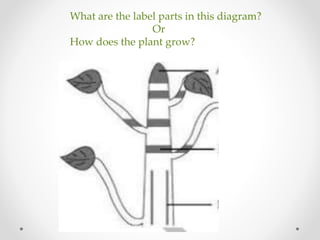
What are the label parts in this diagram?
Or
How does the plant grow?
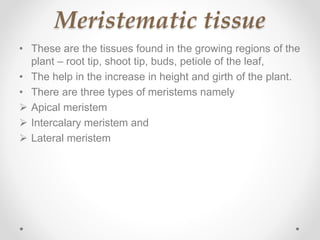
Meristematic tissue
• These are the tissues found in the growing regions of the
plant – root tip, shoot tip, buds, petiole of the leaf,
• The help in the increase in height and girth of the plant.
• There are three types of meristems namely
 Apical meristem
 Intercalary meristem and
 Lateral meristem
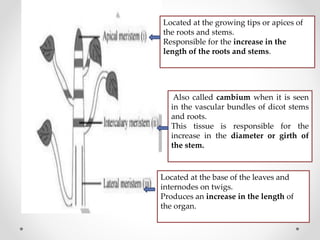
Located at the growing tips or apices of
the roots and stems.
Responsible for the increase in the
length of the roots and stems.
Also called cambium when it is seen
in the vascular bundles of dicot stems
and roots.
This tissue is responsible for the
increase in the diameter or girth of
the stem.
Located at the base of the leaves and
internodes on twigs.
Produces an increase in the length of
the organ.
What are the functions
performed in the plant body?
 Preparation of food and storage of food.
Intake of water and its storage and supply
Mechanical strength for support.
So plants need tissues to
 store food/water
Give mechanical strength
Protect inner tissues
Supply food and water within the plant body.
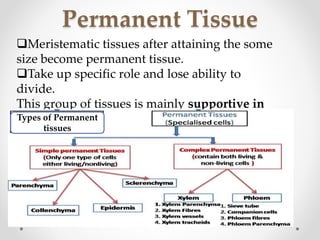
Permanent Tissue
Meristematic tissues after attaining the some
size become permanent tissue.
Take up specific role and lose ability to
divide.
This group of tissues is mainly supportive in
function, yet they also perform other functions.Types of Permanent
tissues
i). Simple Permanent
Tissue
Contain only one type of cells
either living cells or non-living
cells. Occur in few layers and
forms basic packing tissue.
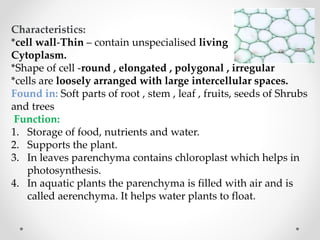
Characteristics:
*cell wall-Thin – contain unspecialised living
Cytoplasm.
*Shape of cell -round , elongated , polygonal , irregular
*cells are loosely arranged with large intercellular spaces.
Found in: Soft parts of root , stem , leaf , fruits, seeds of Shrubs
and trees
Function:
1. Storage of food, nutrients and water.
2. Supports the plant.
3. In leaves parenchyma contains chloroplast which helps in
photosynthesis.
4. In aquatic plants the parenchyma is filled with air and is
called aerenchyma. It helps water plants to float.
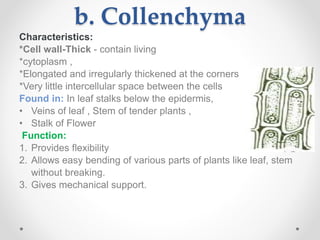
b. Collenchyma
Characteristics:
*Cell wall-Thick - contain living
*cytoplasm ,
*Elongated and irregularly thickened at the corners
*Very little intercellular space between the cells
Found in: In leaf stalks below the epidermis,
• Veins of leaf , Stem of tender plants ,
• Stalk of Flower
Function:
1. Provides flexibility
2. Allows easy bending of various parts of plants like leaf, stem
without breaking.
3. Gives mechanical support.
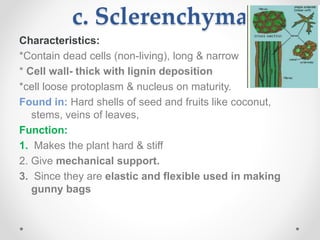
c. Sclerenchyma
Characteristics:
*Contain dead cells (non-living), long & narrow
* Cell wall- thick with lignin deposition
*cell loose protoplasm & nucleus on maturity.
Found in: Hard shells of seed and fruits like coconut,
stems, veins of leaves,
Function:
1. Makes the plant hard & stiff
2. Give mechanical support.
3. Since they are elastic and flexible used in making
gunny bags
d. Epidermal Tissue
Characteristics:
*Made up of single layer of cells, thicker in plants of dry
habitats.
• Cells flat and form continuous layer without intercellular
spaces.
Found in: Found in the entire surface of the plant body.
Function:
1. Protects the inner tissues of the plants.
2. In roots it forms root hairs & absorbs water and
nutrients from the soil.
3. In leaves it has stomata which help in the passage of
gases & control the transpiration.
4. It prevents the plant from drying out.
ii). Complex Permanent
Tissue
*consists of more than one type of cells
which work together as a unit.
* Also known as conducting tissue or
vascular tissue as their main function is
to
transport water, mineral salts and food
materials.
The two types of complex permanent
tissue are: 1. Xylem or wood
2. Phloem or bast.
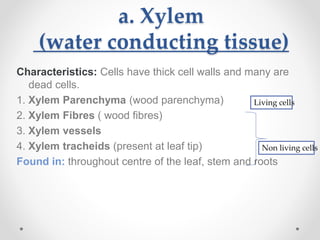
a. Xylem
(water conducting tissue)
Characteristics: Cells have thick cell walls and many are
dead cells.
1. Xylem Parenchyma (wood parenchyma)
2. Xylem Fibres ( wood fibres)
3. Xylem vessels
4. Xylem tracheids (present at leaf tip)
Found in: throughout centre of the leaf, stem and roots
Non living cells
Living cells
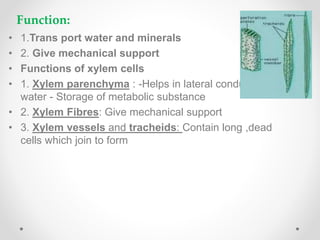
• 1.Trans port water and minerals
• 2. Give mechanical support
• Functions of xylem cells
• 1. Xylem parenchyma : -Helps in lateral conduction of
water - Storage of metabolic substance
• 2. Xylem Fibres: Give mechanical support
• 3. Xylem vessels and tracheids: Contain long ,dead
cells which join to form
Function:
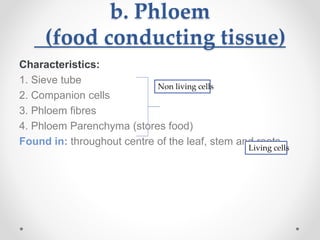
b. Phloem
(food conducting tissue)
Characteristics:
1. Sieve tube
2. Companion cells
3. Phloem fibres
4. Phloem Parenchyma (stores food)
Found in: throughout centre of the leaf, stem and roots
Non living cells
Living cells
Function:
1.Transport food from leaves to all parts of plant Body
Functions of Phloem cells
1.Sieve tube: Conduct food
2.Companion cell : Control the passage of food through
the phloem
3.Phloem fibres : Provide tensile strength
4. Phloem parenchyma : Store food and water.
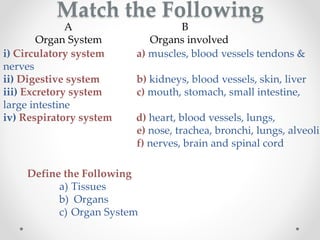
Match the Following
i) Circulatory system a) muscles, blood vessels tendons &
nerves
ii) Digestive system b) kidneys, blood vessels, skin, liver
iii) Excretory system c) mouth, stomach, small intestine,
large intestine
iv) Respiratory system d) heart, blood vessels, lungs,
e) nose, trachea, bronchi, lungs, alveoli
f) nerves, brain and spinal cord
A
Organ System
B
Organs involved
Define the Following
a) Tissues
b) Organs
c) Organ System
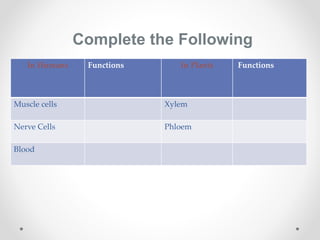
Complete the Following
In Humans Functions In Plants Functions
Muscle cells Xylem
Nerve Cells Phloem
Blood
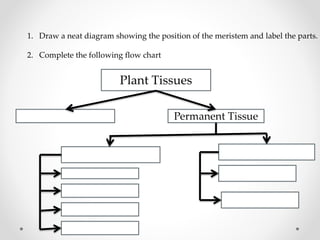
Plant Tissues
1. Draw a neat diagram showing the position of the meristem and label the parts.
2. Complete the following flow chart
Permanent Tissue
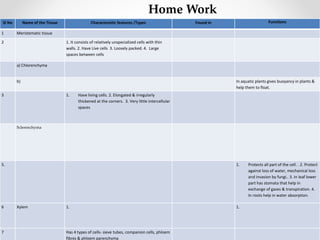
Sl No Name of the Tissue Characteristic features /Types Found in Functions
1 Meristematic tissue
2 1. It consists of relatively unspecialized cells with thin
walls. 2. Have Live cells 3. Loosely packed. 4. Large
spaces between cells
a) Chlorenchyma
b) In aquatic plants gives buoyancy in plants &
help them to float.
3 1. Have living cells. 2. Elongated & irregularly
thickened at the corners. 3. Very little intercellular
spaces
Sclerenchyma
5. 1. Protects all part of the cell. . 2. Protect
against loss of water, mechanical loss
and invasion by fungi.. 3. In leaf lower
part has stomata that help in
exchange of gases & transpiration. 4.
In roots help in water absorption.
6 Xylem 1. 1.
7 Has 4 types of cells- sieve tubes, companion cells, phloem
fibres & phloem parenchyma
Home Work

Plant tissues interactive mode

  • 1.
    TISSUES INTRODUCTION By Dr Savita Deshmukh Asst.Teacher (CBZ) KPS, Nandagudi. Tq-Hoskote Bangalore Rural Dist
  • 2.
    Introduction Types of organisms (basedof number of cells) Unicellular organism Single celled Multicellular organism More than one cell Bacteria Amoeba Euglena Paramecium Plasmodium Entamoeba Unicellular algae & fungi (yeast) All visible animals, plants, Multicellular algae and multicellular fungi (boost, mushroom)
  • 3.
    What are functions performedby an organism • Breathing • Eating – Nutrition • Removing of waste – excretion • Reproduction – producing its own type • Movement – whole body (animals) or part (plants)
  • 4.
    Can you seea single cell here?
  • 5.
    INTRODUCTION All living organismsare made up of Cells In a unicellular organisms all the basic functions like movement, intake of food, respiration, excretion of food are all carried out by – a single cell. What happens in Multicellular organisms? Each function is carried out by a group of cells called – Tissues Group of such different tissues performing same function form – Organs And organs having different tissues but perform same function are called – Organ system. Video click here
  • 6.
    INTRODUCTION In organisms wecan find the following systems namely  Circulatory system  Digestive system  Excretory system  Respiratory system  Nervous System – includes nerves, brain and spinal cord  Skeletal System – bones  Muscular System – having muscles, blood vessels tendons & nerves  Reproductive system – Male and Female separate  Integumentary system – skin, hair, feaathers, hooves,
  • 7.
    Experiment no 1 Aim:To study the growing tissues in onion root tip Apparatus required: Procedure: 1. 2. 3. 4. Observation:
  • 8.
    Note down thelength of the root tip each day Day 1 Day 2 Day 3 Day 4 Day 5 Jar A Jar B (on 4th day cut the root tip about 1cm
  • 9.
    Plant Tissues Meristematic tissues (always dividing cells) PermanentTissues (Specialised cells) Simple permanent Tissues (Only one type of cells either living/nonliving) Complex Permanent Tissues (contain both living & non-living cells ) Parenchyma Collenchyma Sclerenchyma Epidermis Xylem Phloem 1. Xylem Parenchyma 2. Xylem Fibres 3. Xylem vessels 4. Xylem tracheids 1. Sieve tube 2. Companion cells 3. Phloem fibres 4. Phloem Parenchyma
  • 10.
    What are thelabel parts in this diagram? Or How does the plant grow?
  • 11.
    Meristematic tissue • Theseare the tissues found in the growing regions of the plant – root tip, shoot tip, buds, petiole of the leaf, • The help in the increase in height and girth of the plant. • There are three types of meristems namely  Apical meristem  Intercalary meristem and  Lateral meristem
  • 12.
    Located at thegrowing tips or apices of the roots and stems. Responsible for the increase in the length of the roots and stems. Also called cambium when it is seen in the vascular bundles of dicot stems and roots. This tissue is responsible for the increase in the diameter or girth of the stem. Located at the base of the leaves and internodes on twigs. Produces an increase in the length of the organ.
  • 13.
    What are thefunctions performed in the plant body?  Preparation of food and storage of food. Intake of water and its storage and supply Mechanical strength for support. So plants need tissues to  store food/water Give mechanical strength Protect inner tissues Supply food and water within the plant body.
  • 14.
    Permanent Tissue Meristematic tissuesafter attaining the some size become permanent tissue. Take up specific role and lose ability to divide. This group of tissues is mainly supportive in function, yet they also perform other functions.Types of Permanent tissues
  • 15.
    i). Simple Permanent Tissue Containonly one type of cells either living cells or non-living cells. Occur in few layers and forms basic packing tissue.
  • 16.
    Characteristics: *cell wall-Thin –contain unspecialised living Cytoplasm. *Shape of cell -round , elongated , polygonal , irregular *cells are loosely arranged with large intercellular spaces. Found in: Soft parts of root , stem , leaf , fruits, seeds of Shrubs and trees Function: 1. Storage of food, nutrients and water. 2. Supports the plant. 3. In leaves parenchyma contains chloroplast which helps in photosynthesis. 4. In aquatic plants the parenchyma is filled with air and is called aerenchyma. It helps water plants to float.
  • 17.
    b. Collenchyma Characteristics: *Cell wall-Thick- contain living *cytoplasm , *Elongated and irregularly thickened at the corners *Very little intercellular space between the cells Found in: In leaf stalks below the epidermis, • Veins of leaf , Stem of tender plants , • Stalk of Flower Function: 1. Provides flexibility 2. Allows easy bending of various parts of plants like leaf, stem without breaking. 3. Gives mechanical support.
  • 18.
    c. Sclerenchyma Characteristics: *Contain deadcells (non-living), long & narrow * Cell wall- thick with lignin deposition *cell loose protoplasm & nucleus on maturity. Found in: Hard shells of seed and fruits like coconut, stems, veins of leaves, Function: 1. Makes the plant hard & stiff 2. Give mechanical support. 3. Since they are elastic and flexible used in making gunny bags
  • 19.
    d. Epidermal Tissue Characteristics: *Madeup of single layer of cells, thicker in plants of dry habitats. • Cells flat and form continuous layer without intercellular spaces. Found in: Found in the entire surface of the plant body. Function: 1. Protects the inner tissues of the plants. 2. In roots it forms root hairs & absorbs water and nutrients from the soil. 3. In leaves it has stomata which help in the passage of gases & control the transpiration. 4. It prevents the plant from drying out.
  • 20.
    ii). Complex Permanent Tissue *consistsof more than one type of cells which work together as a unit. * Also known as conducting tissue or vascular tissue as their main function is to transport water, mineral salts and food materials. The two types of complex permanent tissue are: 1. Xylem or wood 2. Phloem or bast.
  • 21.
    a. Xylem (water conductingtissue) Characteristics: Cells have thick cell walls and many are dead cells. 1. Xylem Parenchyma (wood parenchyma) 2. Xylem Fibres ( wood fibres) 3. Xylem vessels 4. Xylem tracheids (present at leaf tip) Found in: throughout centre of the leaf, stem and roots Non living cells Living cells
  • 22.
    • 1.Trans portwater and minerals • 2. Give mechanical support • Functions of xylem cells • 1. Xylem parenchyma : -Helps in lateral conduction of water - Storage of metabolic substance • 2. Xylem Fibres: Give mechanical support • 3. Xylem vessels and tracheids: Contain long ,dead cells which join to form Function:
  • 23.
    b. Phloem (food conductingtissue) Characteristics: 1. Sieve tube 2. Companion cells 3. Phloem fibres 4. Phloem Parenchyma (stores food) Found in: throughout centre of the leaf, stem and roots Non living cells Living cells
  • 24.
    Function: 1.Transport food fromleaves to all parts of plant Body Functions of Phloem cells 1.Sieve tube: Conduct food 2.Companion cell : Control the passage of food through the phloem 3.Phloem fibres : Provide tensile strength 4. Phloem parenchyma : Store food and water.
  • 25.
    Match the Following i)Circulatory system a) muscles, blood vessels tendons & nerves ii) Digestive system b) kidneys, blood vessels, skin, liver iii) Excretory system c) mouth, stomach, small intestine, large intestine iv) Respiratory system d) heart, blood vessels, lungs, e) nose, trachea, bronchi, lungs, alveoli f) nerves, brain and spinal cord A Organ System B Organs involved Define the Following a) Tissues b) Organs c) Organ System
  • 26.
    Complete the Following InHumans Functions In Plants Functions Muscle cells Xylem Nerve Cells Phloem Blood
  • 27.
    Plant Tissues 1. Drawa neat diagram showing the position of the meristem and label the parts. 2. Complete the following flow chart Permanent Tissue
  • 28.
    Sl No Nameof the Tissue Characteristic features /Types Found in Functions 1 Meristematic tissue 2 1. It consists of relatively unspecialized cells with thin walls. 2. Have Live cells 3. Loosely packed. 4. Large spaces between cells a) Chlorenchyma b) In aquatic plants gives buoyancy in plants & help them to float. 3 1. Have living cells. 2. Elongated & irregularly thickened at the corners. 3. Very little intercellular spaces Sclerenchyma 5. 1. Protects all part of the cell. . 2. Protect against loss of water, mechanical loss and invasion by fungi.. 3. In leaf lower part has stomata that help in exchange of gases & transpiration. 4. In roots help in water absorption. 6 Xylem 1. 1. 7 Has 4 types of cells- sieve tubes, companion cells, phloem fibres & phloem parenchyma Home Work